I decided to write a piece today because I have a high conviction view.
While it’s a holiday in the US, the FX market only takes two days off a year, and this isn’t one of them.

I decided to write a piece today because I have a high conviction view.
While it’s a holiday in the US, the FX market only takes two days off a year, and this isn’t one of them.

Stop loss 1.1374
Take profit 1.1839
Stop loss 159.29
Take profit 165.99
Stop loss 1.4884
Take profit 1.5684
September 5, 2022
It’s Labor/Labour Day but I was motivated to sit down and write a piece on Cable as it feels like a high EV setup where you can risk 1 to make 3 with around a 50% chance of success. Here’s why:
We also remain fully committed to the independence of the Bank of England and the important job they have in the months ahead to bring down inflation. We believe co-ordination across monetary policy and fiscal policy is crucial.
The guys at Macrodesiac point out that Team Truss opted to post this editorial in the FT, not (say) the Telegraph. That seems like a strategic message to financial markets: We are not going rogue here. The market sold GBP and sold gilts into Truss, and I said specifically in “am/FX: A Matter of Truss” that I don’t think the short GBP trade will work once she’s in. Whether the market is pricing Truss or just the energy crisis, there is a narrow window of opportunity here for a GBP sentiment shift.
Given the severity of the crisis we face, there will need to be some fiscal loosening to help people through the winter. That is absolutely the right thing to do in these exceptionally difficult times.
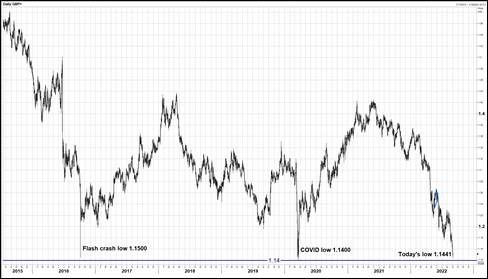
If we zoom in on that GBPUSD chart you see a dragonfly doji (bullish):
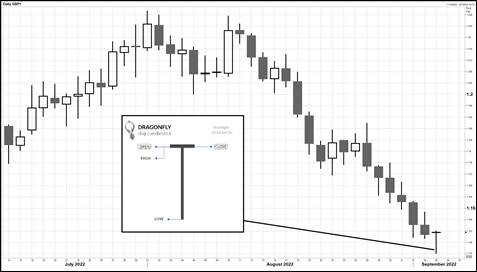
As regular am/FX readers know, I do not do a trade because of a chart. But, when the chart offers an easy risk management setup against the backdrop of what looks like a decent behavioral and macro catalyst, that makes life so much easier. This trade is easy to risk manage because if GBP decisively breaks 1.1400—it’s wrong. But if we hold, GBPUSD could rally to 1.18 for no good reason other than a candle of hope flickered in the UK darkness. In other words, with clear risk management parameters, it looks like a positive EV bet to buy pounds.
I still don’t love the idea of short USD here, so I’m looking at a variety of charts and I decided to go long a basket of GBPUSD, GBPJPY, and GBPCAD. For the sake of tracking, I will assign each trade 50% of normal capital so this GBP basket is 1.5X normal single trade risk (3 X 0.5). Doing the basket removes some of the USD and SPX risk, which I want to do because I’m not bearish USD and I’m not bullish SPX.
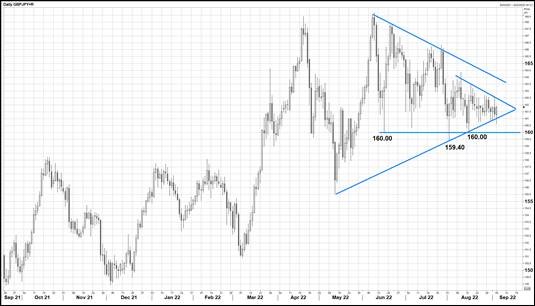
Here’s the GBPJPY chart… It is “a looker” as Sal would say. Tightening triangular consolidation.
When I was in university, Citibank brought a very sophisticated FX trading simulation game to my school. It was called “The Bourse Game” and it involved a full weekend of simulated trading. They had dedicated phone boards, simulated headlines, and streaming prices on glowing green computer screens like the one below. It was awesome and confirmed to me at the time:
When I grow up, I want to be a trader.
At the start of the game, you were given some basic information about four countries and four currencies. There was a very strong economy called “Kikwanaland” and a very weak one called “Fazoola”. And two in the middle. And you received a packet which outlined the recent economic data and a bunch of recent realistic-sounding headlines from Kikwanaland and Fazoola.
You were also provided a chart of the Kikwanaland rupee which had done well and a chart of the Fazoola pound which had not. Naturally, because we had no trading experience and we were 20 years old, most students wanted to buy the rupee because the narrative was so good, and they wanted to sell the Fazoolian pound. But it was a trick. The rupee was not the currency to buy because all the good news was priced in and so in fact, to have the best odds of winning the game you needed to go short the rupee and long Fazoolian pounds at the outset.
My teammate and I sensed the Kikwanaland story was too good to be true and so right on the open we went nuts buying Fazoola and selling Kikwanaland. Most of the other students were confused. “Wait!” they said to each other. “Why are they going short Kikwanaland?! Their economy is all that and a bag of chips![1]”
Needless to say, we crushed it P&L-wise. But sadly, we finished second because “you kept losing track of our position” and “your P&L tracking was not accurate”. We were docked points for bad accounting! Geez. I was very disappointed. Fortunately, I ended up with one of the hot trading jobs at Citibank and my buddy scored a highly-coveted job trading natgas at Enron. I am not kidding.
Anyway… Let’s play the bourse game again. The country is called “United Kingdom” and their currency is called “the Great Britain pound”. Here are five recent headlines from “United Kingdom.”
Gotta be short those Fazoolan United Kingdom pounds, right? Or… Maybe it’s a trick.
I am the first person to say that being contrarian just for the sake of being contrarian is a terrible strategy. Trends are a real thing. But the series of breathless headlines in the past few days and the change of leadership as a possible catalyst in the UK flashed me back to that study room in London, Ontario in 1995. The trick then was to plug your nose and just do the crazy thing. Buy Fazoolan pounds!? What do you mean? There’s a huge crisis there! Are you crazy?
Maybe.
The purpose of the bourse game story was not to say: GBP is a layup here. It’s not. It was more a friendly reminder to readers that highs are made on good news and lows are made on bad news. And at this particular price point, risk management of long GBP is simple. You can do the trade in spot or options, and you’ll know within a week or two whether it’s right or wrong. If GBPUSD trades much onto a 1.13 handle, you move on and chalk it up to good decision / bad outcome.
Specific details of the three trades are in the sidebar.
[1] That was a real expression people used in the 1990s, I swear.
Long-time readers will recognize the bourse game analogy from a piece I wrote about the US economy in October 2018. In that piece, USA was Kikwanaland, and the headlines looked like this:
The US economy turned south, and US 2-year yields peaked a few weeks later.
Thanks for reading.
This piece was partially inspired by the Macrodesiac piece linked on page one and partially inspired by Phil Valori turning bullish GBP. Phil is Spectra’s UK expert and he flipped bullish today after being correctly bearish for eons. Also, Gittins tells me that the UK feels cheap for the first time in ages.
Have a laborious day.


This piece is mostly for people who are interested in backtesting