Analyzing the add/delete setup for AMZN and WAB.
It looks to me like the USD is ready to rock higher again.

Analyzing the add/delete setup for AMZN and WAB.
It looks to me like the USD is ready to rock higher again.

In Buddhism, there are Eight Hot Hells and Eight Cold Hells.
Avīci is the lowest of the hot hells. The term is in reference to what is perceived as the lowest level of the Naraka or “hell” realm, with the most suffering, into which the dead who have committed grave misdeeds may be reborn. It is said to be a cube 20,000 yojanas (240,000 to 300,000 kilometers) on each side, buried deep underneath the divine (nonvisible) earth.
Long USDJPY @ 149.10
Stop loss was 148.14 now 149.14
Take profit 151.15/25
February 22, 2024
Amazon has been added to the Dow Jones Industrial Average just at the moment that Jeff Bezos is hitting the bid in size. Interesting.
While the DJIA is an anachronistic index, a relic from ye olden days, and not all that much money is indexed to it anymore, there still appears to be some signal when stocks are added or deleted from the venerable group of 30.
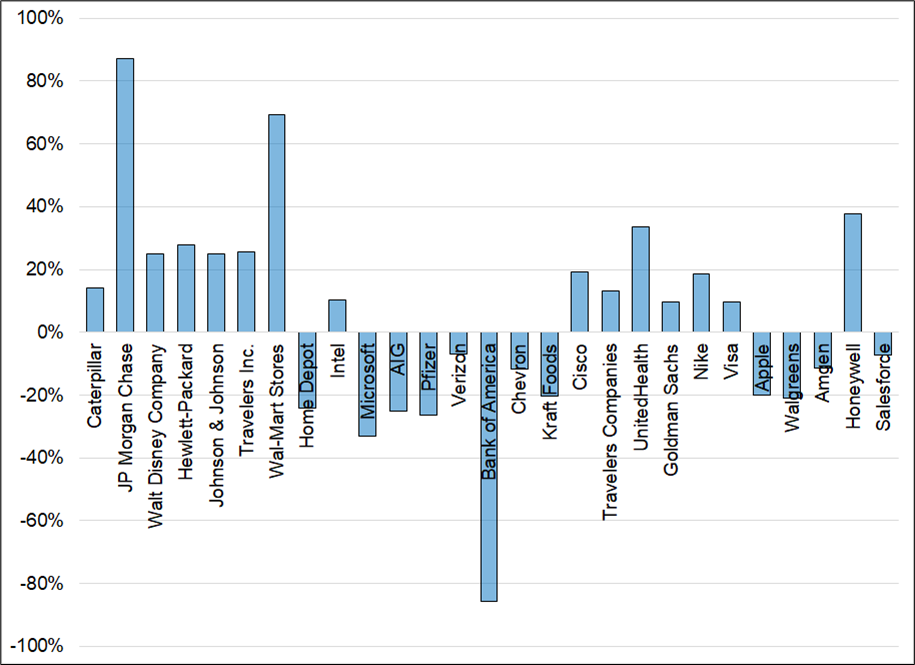
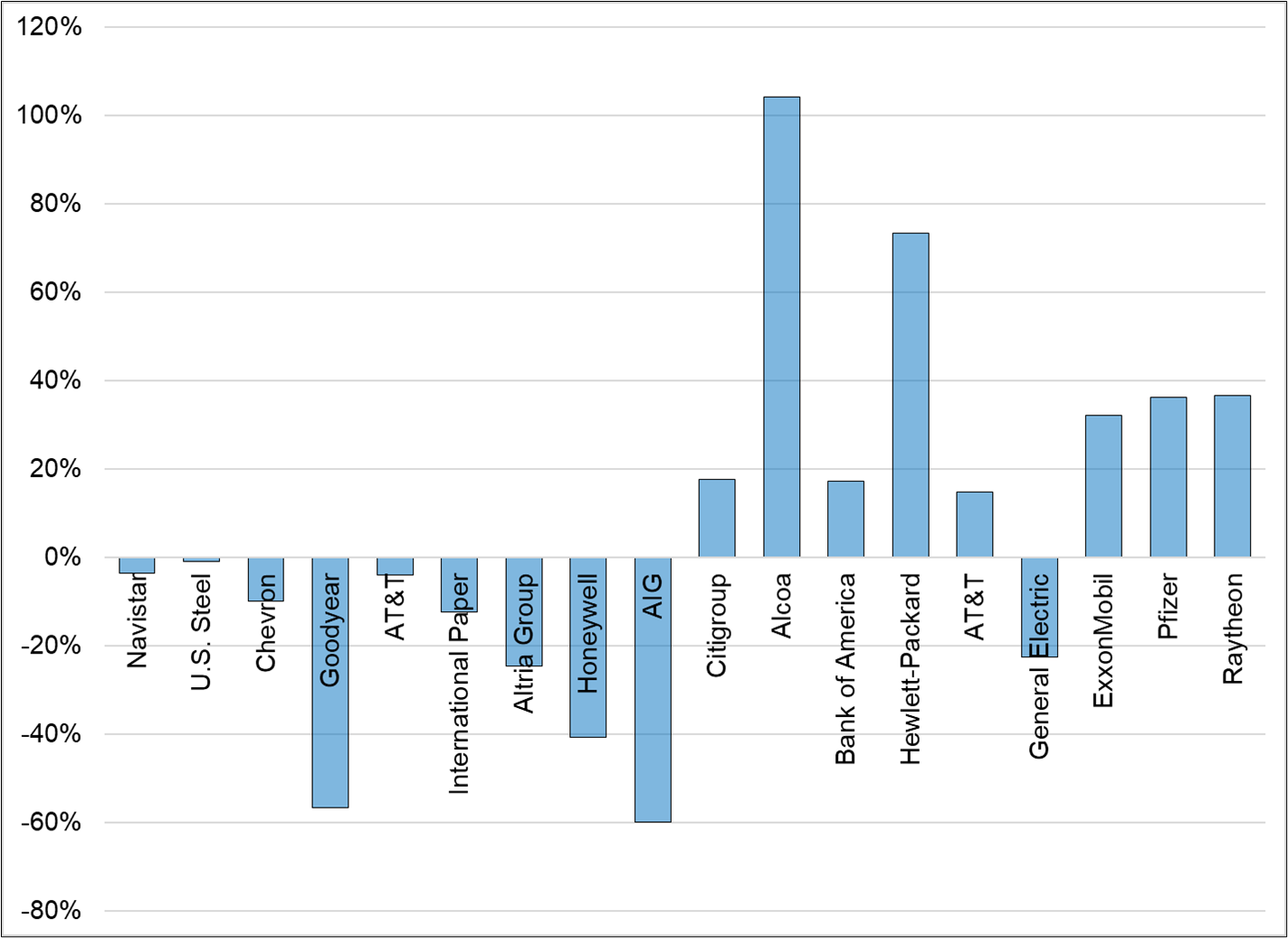
First of all, some stats. The adds and the deletes both outperform on most time horizons. One year later, both the adds and deletes underperform the S&P by 5%. This makes sense to me because the adds are fully valued and are obviously around peak popularity by definition when they get added, while the deletes are decaying, obsolete businesses that the index folks believe are in structural decline and no longer worthy of DJIA membership. Here are the 1-year changes for all the stocks added. The names are shown chronologically from 1990 (left) to 2020.
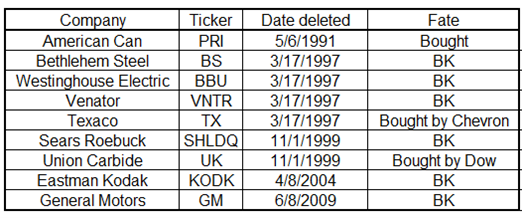
There are also some deletes that went bankrupt or got bought out, so this study is not perfect. These are the deletes that I am not showing because I don’t have stock price data. BK means bankrupt.
The averages of the 1-year moves don’t tell the full story. Take a look at those charts on page 1 again and you will see that there seems to be a regime shift after 1999 or so where adds do poorly and deletes do well. Given the rise of passive indexing, this is the opposite of what I would have guessed. If all the money now just stampedes blindly into indexes and there is no longer any skill in stock selection, you would expect the opposite result. In fact, shorting the adds and going long the deletes worked pretty well starting around 1999.
Things get more interesting when you zoom in. The general pattern for index adds is that they runup into the add date and sell off after. This is a known pattern that relates to flows and has been well-documented for S&P add/deletes. That is what happens with DJIA add/deletes too. Here’s a chart of the five days into the add (blue) and the five and ten days after (orange and red).
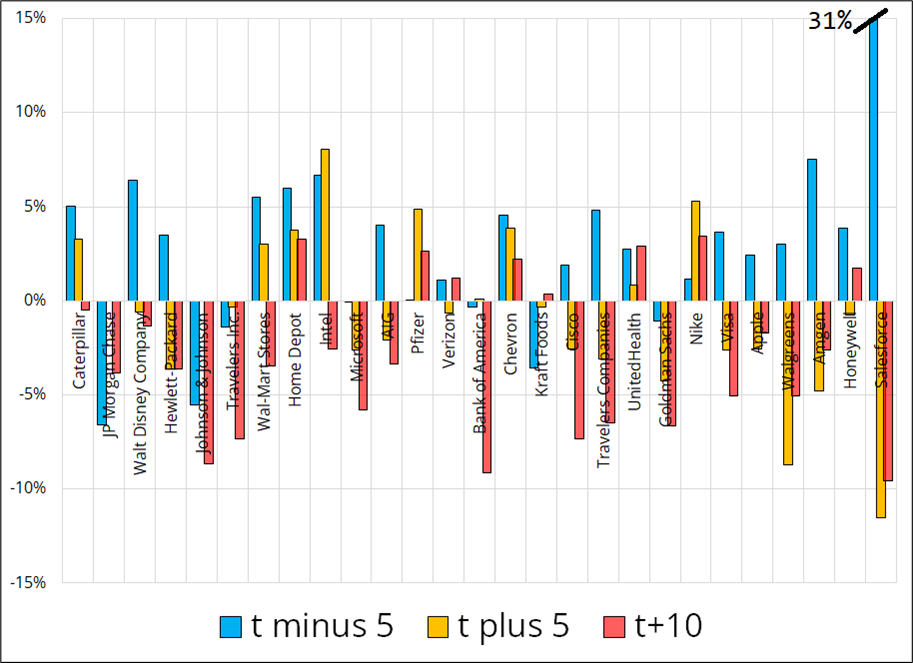
The pattern is pretty clear. They rally in and selloff after. Average t-5 performance is plus 3% and then t+10 average is minus 3%. So there’s 6% of non-random, flow-driven action. Up, then down. OK, so what about the deletes. A one-word summary would be: Yuck.
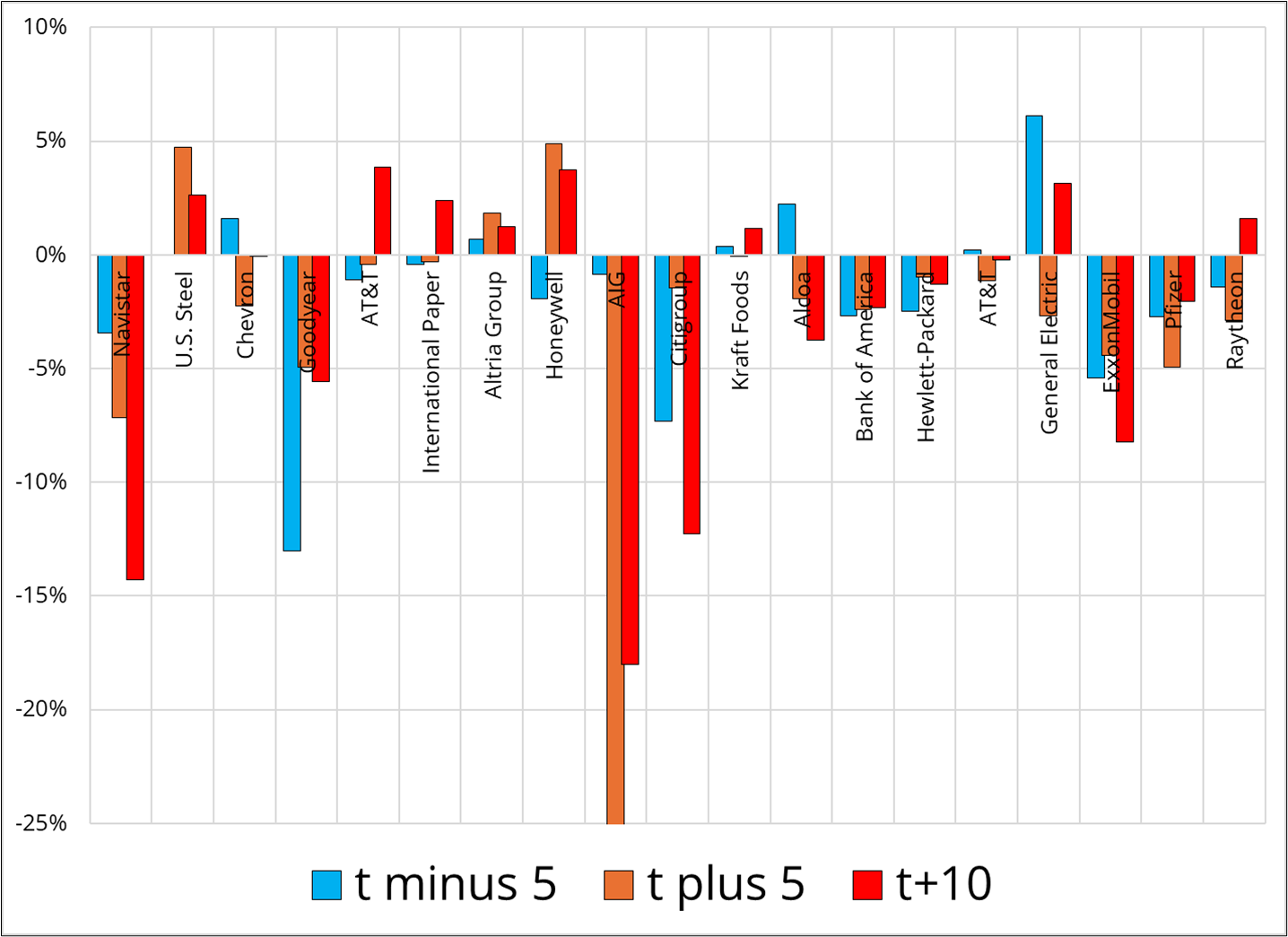
Average move into the delete is -3% over five days and another -3% in the 10 days after. So the simple strategy is:
For adds: Buy five days before, flip short and hold for 10 days.
For deletes: Sell five days before and hold until 10 days after.
Here are the P&Ls for every add and delete using that strategy.
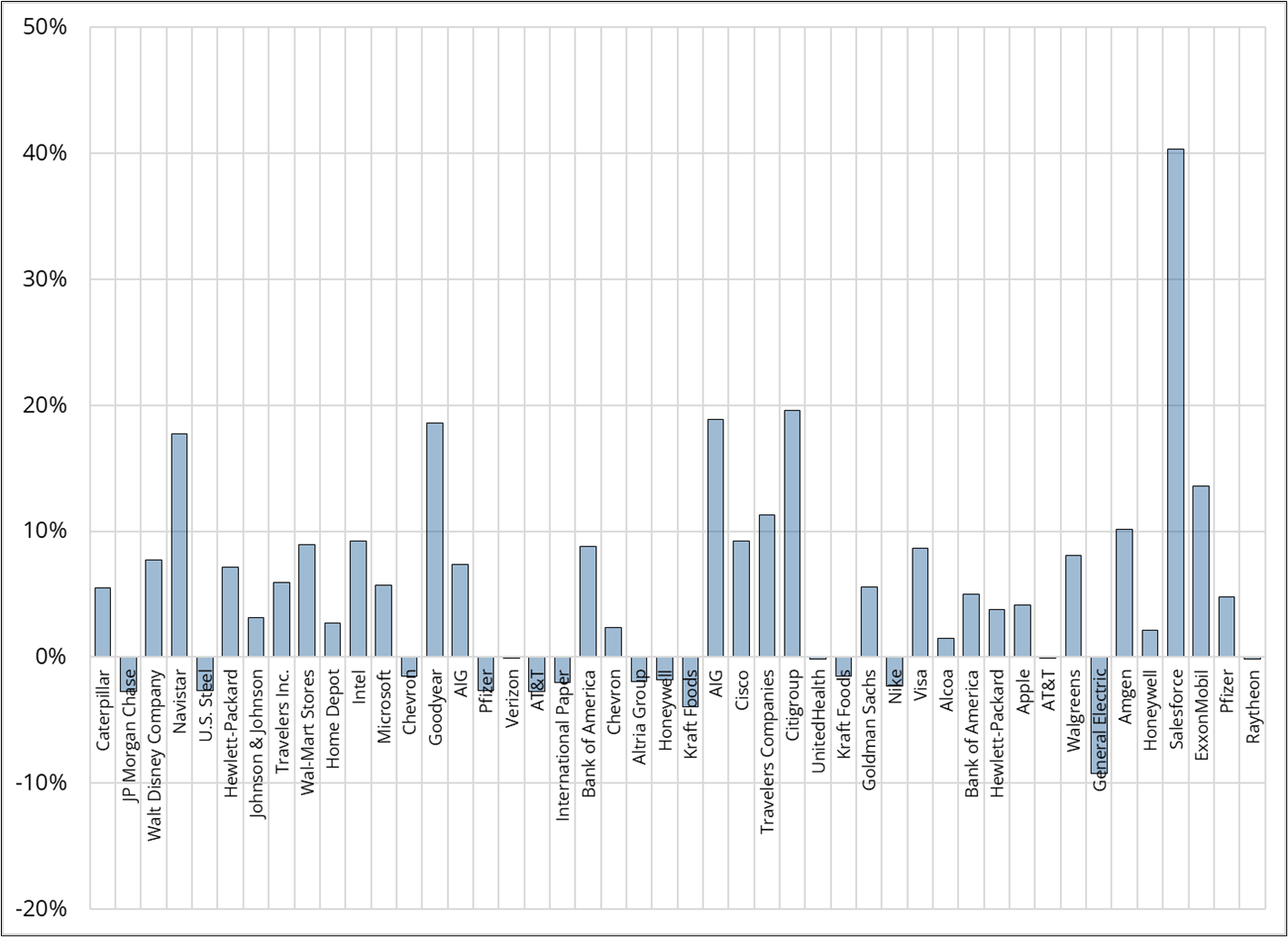
Amazon’s add is just two trading days from now, and it’s gapping higher again today so this writeup comes too late to properly benefit from the long side of the trade. The short side (sell AMZN on 26FEB and hold for 10 days) makes sense, I think, especially if you do it as an RV trade against equal weight S&P or something like that. Bezos dumping stock is a little bit of a kicker, though his sales have been pretty steady and not particularly directional. Unlike the DJIA indexers, who buy high and sell low, Bezos does like to sell high, at least!
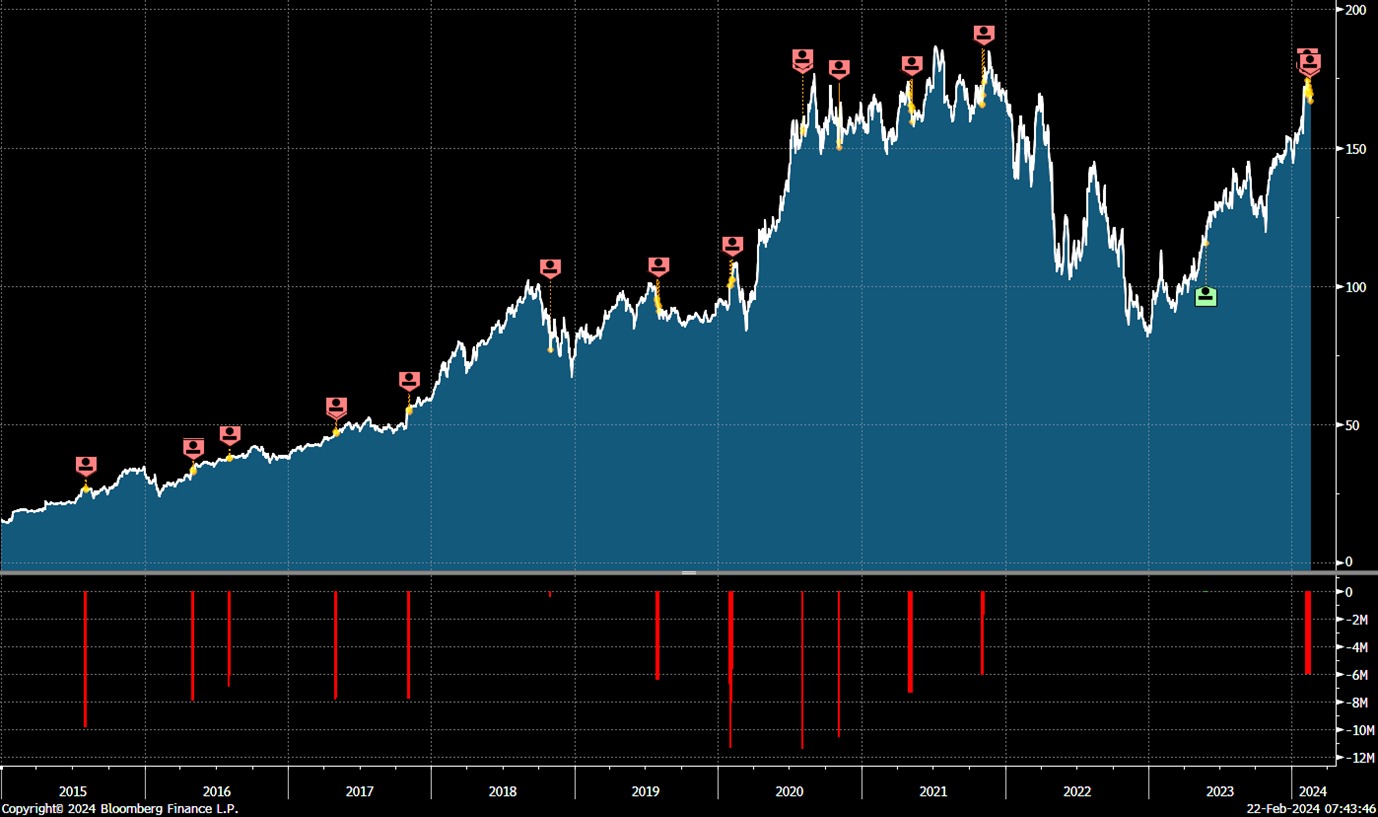
And the other side of the trade is short Walgreen’s (WBA). Based on historical performance of deleted stocks, it should underperform dramatically between now and March 11. That is 10 trading days after the stock is deleted on February 26. Correctly sizing the position relative to vol is important. Surprisingly, recent WBA vol is higher than AMZN. WBA and AMZN should also both underperform on a 1-year time horizon. You can short them both vs. equal weight S&P and wait a year. None of this is investment advice, just a bunch of ideas based on historical data that might not repeat out of sample. That said, the logic of why this happens is sound.
There are a bunch of ways to structure this trade, and I think the underlying mechanics are interesting and could be applicable to other situations in the future. Thanks to Justin Ross for collecting and slicing and dicing copious unstructured data to help me create the charts in today’s am/FX.
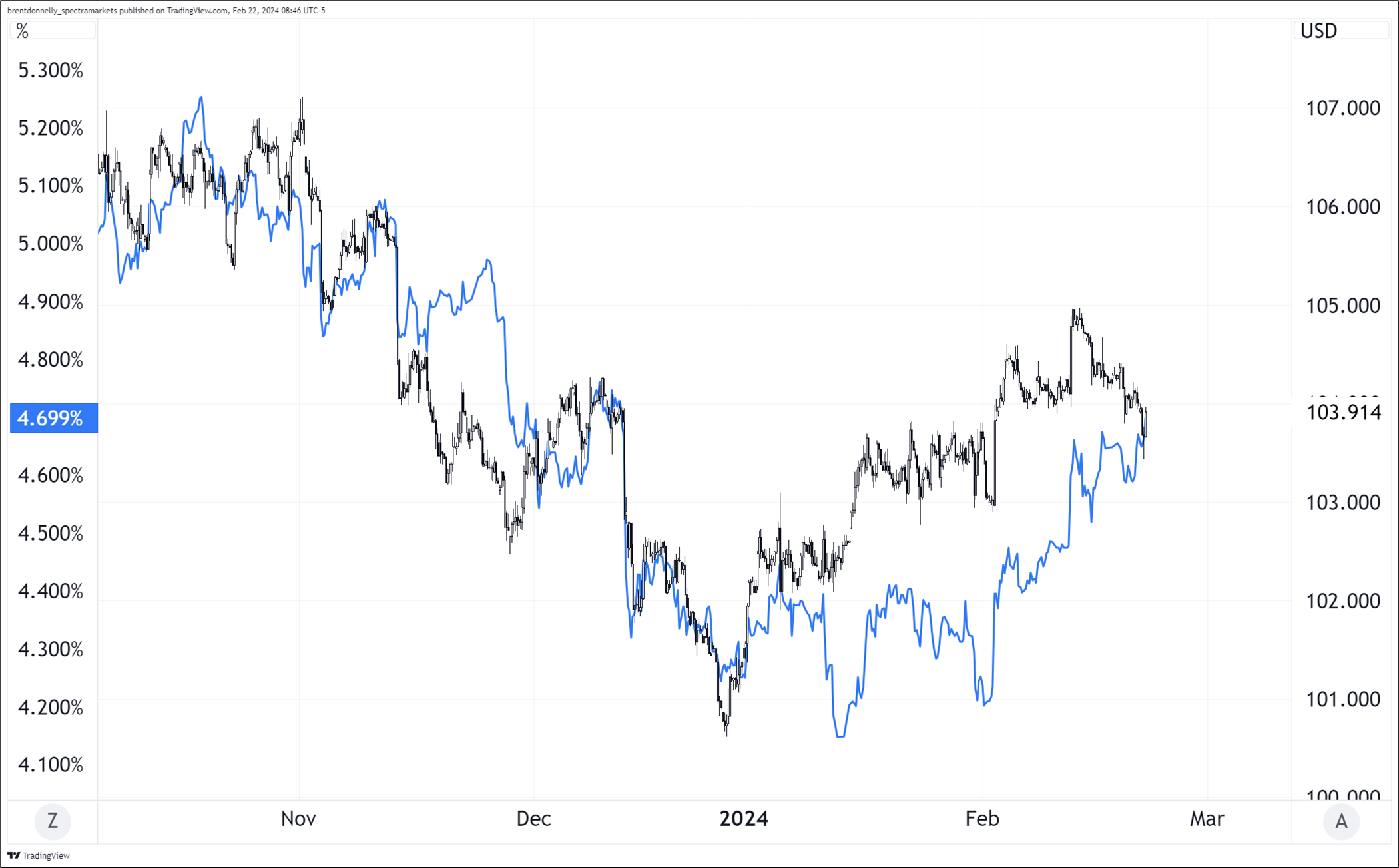
While it doesn’t feel like it recently because yields have been going up and the USD has been falling, the general ebbs and flows of the DXY are still mostly following US yields if you zoom out a bit. We have had a squeeze as the market got way too short euros around the time I was in Brazil, but that has mostly been rinsed now and I think EUR positioning is now pretty clean. Here’s the DXY vs. US 2-year yields.
The love affair with Japan continues as the Nikkei has finally taken out the 1989 highs. Buffett was so early on this trade, it’s absolutely remarkable. What a stud. The buoyancy in Japanese equities kept USDJPY bid overnight, even as the USD traded lower elsewhere and this has led to a huge round of stop outs in cross/JPY. Short CHFJPY is the new short JGBs (aka, the widowmaker). It makes so much sense and yet is so incredibly frustrating.
False break in GBP. Zippy rejection of 7.18 in USDCNH. AUD trades like a pig again. EUR shorts have capitulated. Time to find some good dollar longs and get on board.
Finally, do you ever feel like product review websites seem fake, are extremely cut and paste, and obviously lack credibility? Even the ones hosted by brands you thought you could trust like Popular Science? That’s because many of those brands have been bought by private equity and turned into super lame content and clickbait farms.
Full explanation here:
https://housefresh.com/david-vs-digital-goliaths/¹

Have a bromantic day.
—
¹ I acknowledge the authors of this article are biased but a quick 20 minutes of fact checking supports their claims.
Avicii, the music producer, got his name from the Buddhist hell but added an “i” to the end because there was already a DJ named Avici.
If you’re into house music, Tim: The Official Biography of Avicii by Mans Mosesson is excellent.
It’s authorized, well written, and well researched. It’s a book about the evolution of EDM, out of the clubs and onto the radio. It’s about creative genius, anxiety, mental health, the opioid crisis, and how even after finding oneself at the highest levels of “success”—a human being can still feel tragically lost.
Tim Bergling just wanted to make music, but he got sucked into a huge touring and performance machine and struggled to get out. His true self (the creative, introverted, and fragile kid from Stockholm, Tim Bergling) succumbed to derealization, morphing into a global touring DJ celebrity phenom/ego/icon called Avicii. It’s a sad but compelling book. Many paralells to Kurt Cobain.