Talking about NVDA, tech bubbles, EURGBP and the dollar.

Japanese salaryman eraser

Talking about NVDA, tech bubbles, EURGBP and the dollar.

Japanese salaryman eraser
Short EURGBP @ 0.8634
Stop loss was 0.8756, now 0.8681
Take profit 0.8444
June 5, 2023
Equity markets are capturing most of the attention in capital markets over the last week or so as the megacap AI bubblette reaches a new apex. The Russell 2000 is down 4% in the last three months, while the NASDAQ is up 16%.
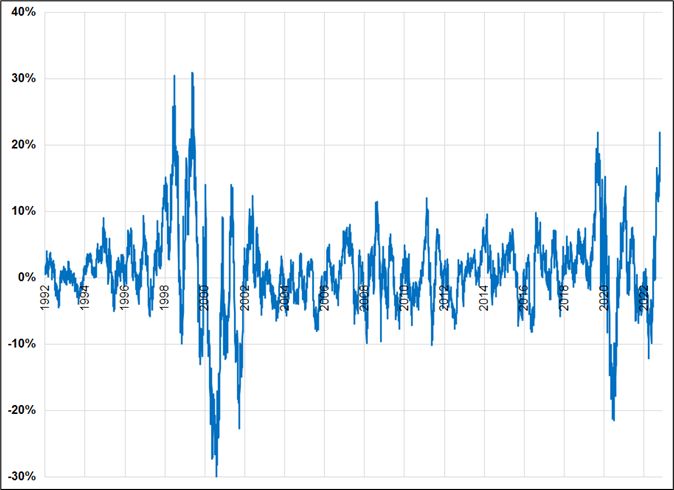
Obviously if you zoom in on the Magnificent Seven¹, you see an even more extreme story. This bubble is unique, but also much like the ones we saw in 1999 and 2021. As with all bubbles, it’s extremely difficult to know what you are supposed to do. It’s hard to make money shorting bubbles and a cynical long is often the better strategy. Then again, the speed of these cycles is accelerating year after year and I would not touch any of these stocks at current levels—I would rather be flat, underweight, or short megacap tech, even though I understand how difficult this view is to risk manage.
—
Footnote:
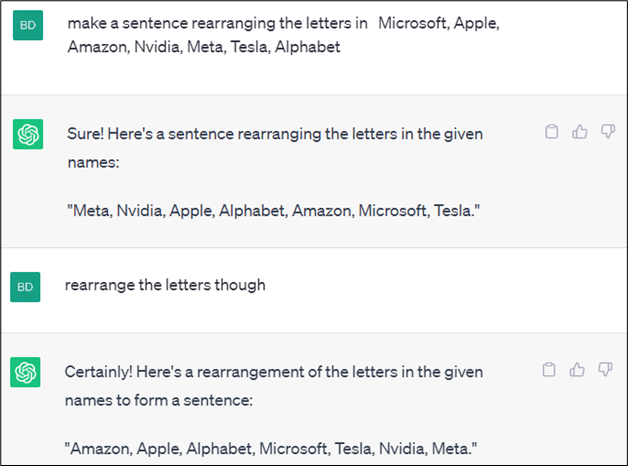
¹ Microsoft, Apple, Amazon, Nvidia, Meta, Tesla, Alphabet.
—
Hard to manage or not, I would rather miss out on gains and dabble short than get sucked into another capital-destroying tech stock hype cycle. It’s OK to step out of the way and let the bubble play out. There is no rule that says you have to play. Sometimes the only winning move is not to play.
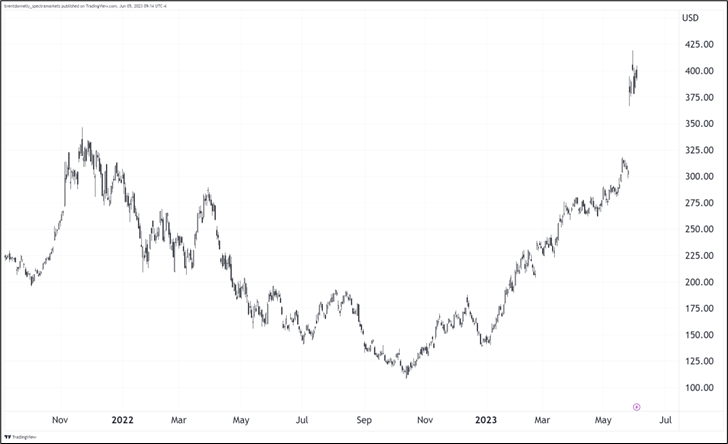
If that irritating GPT interaction in the footnote gives you an uncontrollable desire to short NVDA… The only way I have ever made money shorting bubbles is to pick a location, go short, and stop without hesitation at a given price.
For example, right now, noting that NVDA was unchanged last week despite huge gains elsewhere, you could short here and stop out at new highs. That is, above $425 the bull trend resumes, and you don’t want to be involved from the short side. Here, you could make an argument for exhaustion as the huge island is a clear consolidation zone 375/425.
If you need a fundamental rationale to tell your boss, this writeup from my friend and old boss Liran Blum makes sense to me. I hung out with Liran at Epsilon Connect in Nashville last week and I will send a full writeup about the conference later this week. I just need a bit of time to pull it all together. Here’s what Liran is thinking (this is an email he sent me, which I’m reproducing with his permission).
Why buying the Magnificent Seven is probably the wrong way to invest in AI.
When thinking about the investment implication of what may be a transformative new technology, I find it useful to breakdown the investment process to 3 steps
Step 1 – Is the technology actually transformative? – Since I am far from an innovation specialist, that is always the hardest part for me, but here I try to focus on reading the research and listening to the most enthusiastic people about this new innovation. My goal in this stage is to actually give the benefit of the doubt and try and see how it could be rather than find reasons why it would not be transformative.
Step 2 – If it is transformative will the economic gain accrue mainly to producers or to users? – This is an important question that is often overlooked. A lot of transformative innovations do not generate meaningful and sustainable economic benefits to the inventors and early investors but rather most of the economic benefits accrue to the users of these technologies (an example is one of the most important innovations ever – indoor plumbing).
Step 3 – If it is transformative and the likelihood of economic benefit accruing to creators is high – will the current leaders be the future winners? – If we look at the two latest transformative technologies (Internet and mobile) it is interesting to see that in both cases our view at the time on the best way to invest in this new transformative technology ended up being wrong. In 1999, we viewed the infrastructure builders as the future winners (CSCO, Telcos, optical networking, etc.) and if you looked at the biggest companies in the mobile business in 2006-07 you would have seen Blackberry and Nokia as the market leaders. CSCO was touted as the “picks and shovels” investment winner, just as NVDA is today.
If you take into account the combination of these three steps, it is hard for me to see how investing in the Magnificent Seven (AAPL, GOOG, META, MSFT, TSLA, AMZN, NVDA) as a play on AI will end up working out. I think the probability of AI being a moat destroyer for these guys (as the leaked Google memo suggests) is high and history tells me that even in cases where transformative innovation leads to massive profits for corporations, it tends to deliver those to new rather than incumbent leaders.
Obviously, you need to both be right on the thesis, and correct on the timing. In bubbles, the thesis is pretty easy: Valuation and excessive FOMO, greed, and optimism. The timing is the hard part. I think the best way to deal with the timing issue is to simply take shots at opportune moments and never, ever just sit there bearish week after week.
You could do worse than taking a shot here with equity seasonality turning negative, NVDA in a clear range, and TGA refill, tighter Fed, and continuing QT likely to matter at some point soonish. Blue chip crypto trades very poorly, too, though that has been true for a few weeks. Still, it’s another sign of narrow tech leadership. And don’t forget Time Magazine, often an excellent reverse indicator, featured AI last week. If am/FX was a stock trading newsletter, I would put short NVDA with a stop at 436 in the sidebar simply because the timing and tactics are as good right now as they will ever be and thus, I think that trade is positive EV. Not investment advice.
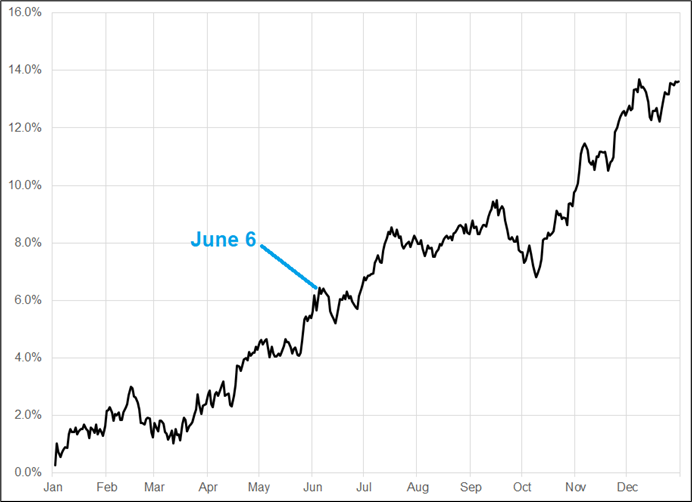
The seasonals are not raging bearish here, but at least they’re not bullish.
Last week before I left, I put out a short EURGBP idea based primarily on my expectation that German CPI would come in worse than expected. I thought the data miss would allow EURGBP to escape the 0.8720/0.8920 range that has dominated all year and head toward 0.8450.
The trade worked well, at first, as German CPI was weak and the chart break looked real. Now, we are bouncing and while I think the trade still works, I am bringing the stop loss way down as we really should not go back above 0.8650/60 at this point. Chart below. See sidebar (top of page) for new details.
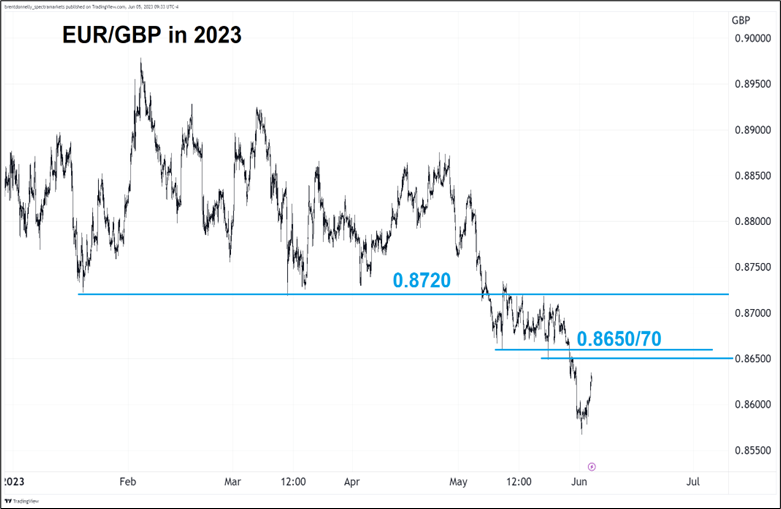
If we get back above 0.8650/70, I think the idea is dead.
With regard to the dollar, I feel we are pretty close to equilibrium here and I don’t see an obvious path of least resistance from here. While yields pointed to lower EURUSD for a while, the overlay now looks like this. You can see the breakdown in the yield differential in early May was an excellent trend change indicator in FX but there is no divergence anymore. In fact, this is the area where the yield spread bottomed in January and March 2023.
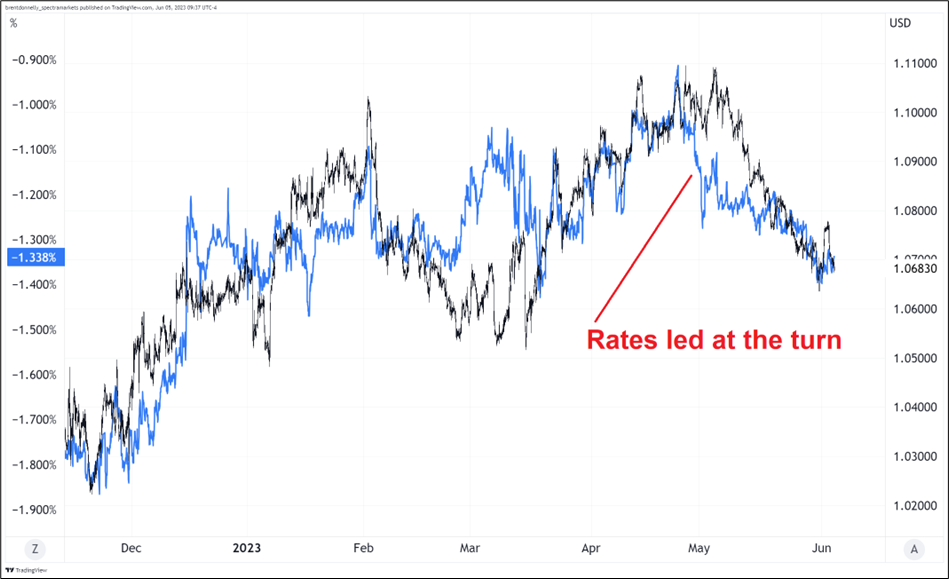
Other cross-market indicators for the USD look mixed with copper trading well in the last few weeks, gold heavy, and oil somewhere in between. This is a good time to be neutral on the dollar, especially with US yields getting back to resistance at 3.85%/3.90% in US 10-year yields and the 2023 high of 4.64% in 2’s.
Finally, RBA looks a bit underpriced for a hike tonight as the minimum wage news and the last RBA meeting make it seem like perhaps the dovish RBA post-review was a one-off early this year and they are now more prepared to move away from deeply negative real rates. I would not be short AUD into the meeting.
Nice piece from Scott Galloway.
Happy birthday, Dad! Thanks for teaching me what is important and what is not.
Have a drole week, everyone.


This piece is mostly for people who are interested in backtesting

This could be a consolidation week as crosswinds now blow in FX and equities