France!
The price action this week is telling. EURUSD ignores U.S. data and forward guidance from Williams. Pieces from JPM and GS showing Hormuz flows back to normal are followed by higher oil prices. EURUSD tracks France spreads tick for tick. EURCHF decouples (a bit) from USDCHF. This chart shows how the market tried to take the USD lower after weaker-than-expected Core PCE yesterday, but the Europe story blocked the upside move.
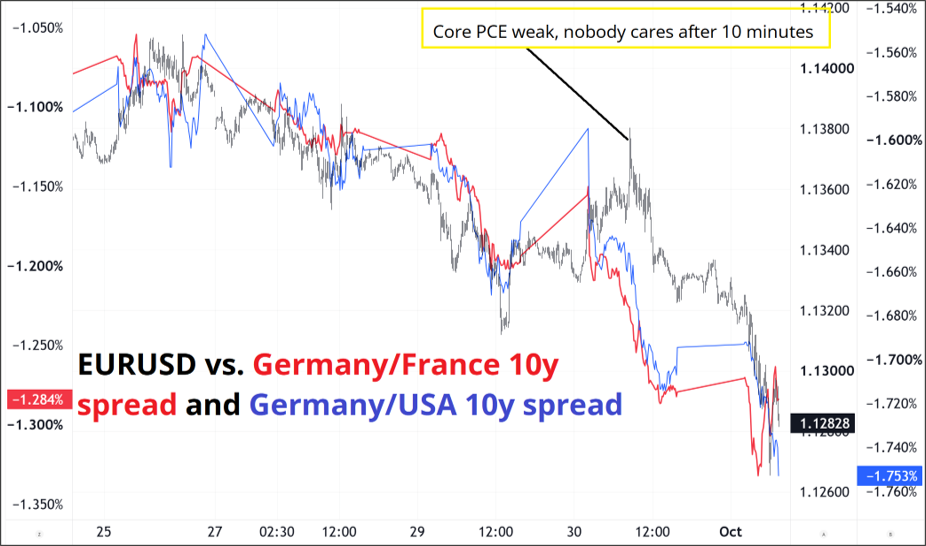
The catalyst for that move lower and snap higher today was the release of the French budget. While not as bad as the worst-case scenario, it wasn’t great, either. And it featured the kind of wishful thinking often seen at Fed meetings. Instead of the old: We’ll get inflation to 2% in two years, you get:
*LESCURE: FRENCH BUDGET DEFICIT OF 3% IN 2029 STILL POSSIBLE
It’s been a few years since we’ve had a sovereign debt panic in Europe, and the instruments the ECB has at its disposal are in constant flux. The current weapon of choice for fighting fragmentation and disorderly bond market moves is called the TPI and because I am far more familiar with OMT and PEPP than I am with TPI, I decided to do an explainer today.
This sort of monetary policy / central bank intervention minutiae can be a tad boring, but it’s useful and necessary, even if you’re a short-term trader. I need to know the background so that when talk of TPI intervention picks up, I know what to look for and which headlines matter and which don’t. So pardon the wonky material today. Sometimes you have to plug your nose and study the boring stuff.
TPI
Everyone remembers OMT and PEPP, but TPI is a new instrument that is unused to this point. TPI stands for Transmission Protection Instrument. It was invented in 2022, when the ECB had a problem: it wanted to hike rates without blowing up Italy. If one country’s bond yields start to fly and the ECB decides the move is not justified by fundamentals, it can step in and buy the bonds.
There is no ex-ante limit on TPI purchases. The ECB designed TPI so markets cannot simply calculate how many euros of ammunition are available and then test the number. Purchases are sized according to the severity of the threat to monetary-policy transmission. With France now coming under serious bond-market pressure, TPI has entered the global macro chat.
The ECB has been inventing acronyms for sovereign spread blowouts since the euro crisis. OMT was the Draghi-era nuclear option: unlimited purchases, but only if the country submitted to an ESM program and all the associated conditionality. It was mostly about redenomination risk and keeping the euro together. PEPP came along during COVID. That was different. It was QE with broad discretion over where the ECB bought bonds. If Italy was getting smoked, the ECB could overweight Italy instead of blindly following the capital key.
TPI is different again. It is not stimulus and it is not really a crisis bailout facility. It is there so the ECB can set one monetary policy without French, Italian, or Spanish spreads turning that into several different monetary policies. The problem was, by 2022 inflation was ripping higher and the ECB needed to raise rates. But raising rates created an obvious risk: German yields might go up 50bps while Italian yields went up 150bps. Suddenly the ECB would not have one monetary policy. It would have a dozen different ones. So, on 21 July 2022, the day the ECB delivered its first rate hike in more than ten years, it also unveiled TPI.
They wanted to tighten monetary policy without accidentally triggering another sovereign-debt crisis. People tend to lump PEPP and TPI together because both involve the ECB buying government bonds. But their purposes are different. PEPP was monetary stimulus plus emergency market stabilization. It was created specifically because of COVID. TPI is an anti-fragmentation instrument. It is permanent, not pandemic-specific, and its purpose is not to lower interest rates for everyone. Its purpose is to prevent an unjustified blowout in one part of the euro area from breaking monetary-policy transmission.
PEPP purchases stopped in March 2022. Reinvestments continued for a while, but the ECB fully stopped PEPP reinvestments at the end of 2024. There is now no active pile of PEPP reinvestment cash that the ECB can quietly redirect toward France. So when can the ECB actually use TPI? There is no spread trigger. The program is discretionary and open-ended by design. To trigger TPI, the story has to satisfy three conditions:
Condition 1: Is this a France problem or a Europe problem?
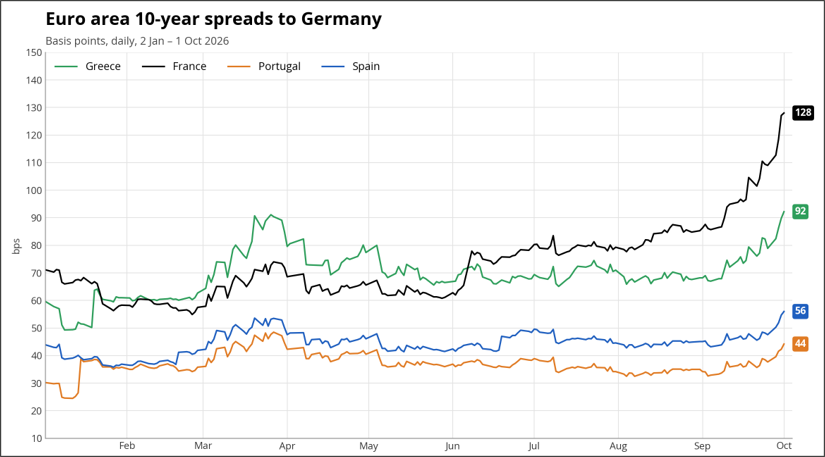
This is important for France. TPI is designed to counter unwarranted and disorderly market dynamics. OAT/Bund at 127bp does not magically activate the Bat Signal. If French spreads grind wider because the fiscal outlook is deteriorating, that’s France’s problem. If OATs gap, liquidity disappears, French banks start getting hit and the move spills into Italy, Spain and Belgium, you have something that looks much more like a monetary-transmission problem. Right now, France is widening mostly by itself.
Condition 2: Does France’s behavior justify the ECB put?
This condition covers four fiscal and macro criteria:
- EU fiscal rules. France can be in an excessive deficit procedure and still qualify. The problem comes if Brussels says France isn’t taking effective action.
- Macro imbalances. Same basic idea: you can’t ignore agreed corrective measures and then ask the ECB to make your bond market behave.
- Debt sustainability. This is the interesting one for France. There is no magic debt/GDP cutoff, but obviously the worse the trajectory gets, the harder it is to argue that the widening is “unwarranted.” Lagarde wasn’t particularly encouraging yesterday.
- General good behavior. Is the country broadly complying with its EU commitments and fiscal recommendations?
The ECB will protect you from the market, but only if you make a reasonable effort not to require protection from the market.
Condition 3: Is TPI consistent with ECB monetary policy?
Even if the market is disorderly and the country qualifies, the ECB must decide that intervention is proportionate to achieving price stability. In a hiking cycle, TPI cannot become stealth QE that undermines whatever the ECB is trying to accomplish with interest rates. Rates determine the direction of monetary policy, while TPI determines whether that policy is transmitted evenly.
To summarize:
OAT/Bund doing crazy things … Why? … Is France behaving? … Is transmission breaking? … Would buying help monetary policy without changing the overall stance? …
Then (maybe?) buy.
For now, OAT/Bund is widening because France is being France. So that’s a France problem.
A violent widening that infects the rest of Europe will eventually become the ECB’s problem. Here’s a chart.
Final Thoughts
- I am taking profit on the AUDNZD bull view as I think the hawkish RBA story is stale and I am worried about positioning wipeouts if the tightening in financial conditions starts to ripple through and scare people. It’s fairly remarkable how higher yields, stronger USD, and widening credit have not led to too much panic yet. But the USDMXN and USDCOP explosions and horrendous equity market breadth are reasons to think maybe the index-level strength in equities is a tad deceiving.
Furthermore, part of the logic for the trade was that a Labour win could lead to a reinstallation of the dual mandate. This would be dovish RBNZ news. At this point, that theme is well-known and the surprises from here are more likely to be NZD bullish: Either Labour loses its lead in the polls, or global interest rates remain driven by global, not domestic considerations.
The AUDNZD structure was to sell a put spread to pay for a call spread at nearly zero cost. The put spread is far enough out of the money that I am comfortable leaving that while exiting the call spread. I am going to remove the idea from the sidebar, but I will continue to track it until expiry so that when I report my H2 2026 performance, the outcome of the trade is correct and accurate. I just don’t want to gum up the sidebar with a nearly zero-delta trade.
- If you’ve read Trade Outside the Box – please click here to leave a quick review. Thanks!
- I cannot vouch for this publication (it appears to be a conservative leaning website), but I am sharing this article simply because I found it interesting and thought provoking. It is about whether sentient AIs are worthy of moral consideration—an interesting investigation into instances where AI companies and safety experts defend the rights of the algorithms in the program, not the people affected by them. While AI entity personhood sounds a bit far-fetched at first, the Supreme Court did give companies personhood! Why not AI entities? Plenty of weird moral and ethical stuff to think about in there!
Make sure you’ve got the correct zipper before you pull.