Kanda used the word “urgency” last night, and that is code for “we are a few yen away from intervening.” Maybe he’s looking at the XAUJPY chart.
Mutant pie chart

Kanda used the word “urgency” last night, and that is code for “we are a few yen away from intervening.” Maybe he’s looking at the XAUJPY chart.
Mutant pie chart
September 6, 2023
First up, nobody seems to care about Bank of Canada these days because trading CAD via monetary policy has not been fun or profitable. Many hawkish BoC meetings were the low in USDCAD and there’s also a big M&A in the news. Enbridge buying US entities with a cash component of $9.4 Billion $. Timing of hedges is always hard to nail down, but at the margin this may have pushed USDCAD into the top of the range.
https://www.reuters.com/markets/deals/enbridge-buy-three-utilities-deal-valued-14-bln-2023-09-05/
The BoC is unlikely to say anything overtly unconditional about rates as they need to maintain the option of raising further if inflation reaccelerates. On the other hand, rates are probably restrictive and they showed in January that they can pause and then hike again. I don’t think there is a trade here. USDCAD is a dollar thing not a CAD thing.
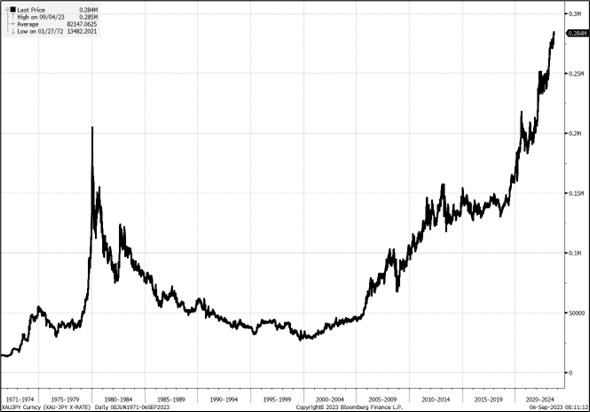
The JPY is depreciating fast against everything, including gold. Element 79 just made a new all-time high vs. the yen. This is yet another sign that the JPY is historically cheap / weak.
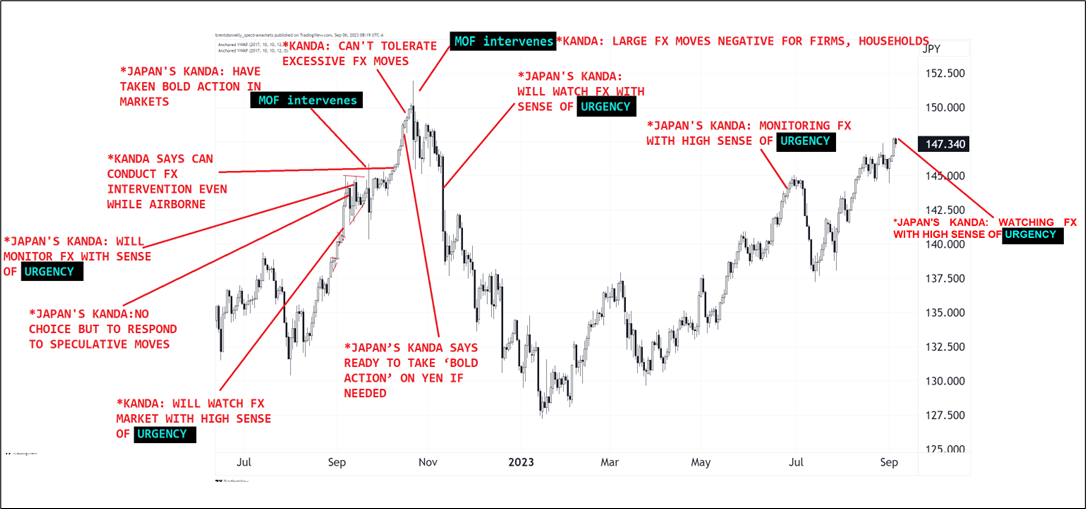
Japan’s top currency diplomat Masato Kanda fired off an early-warning intervention flare last night.
*JAPAN’S KANDA: WATCHING FX WITH HIGH SENSE OF URGENCY
*JAPAN’S KANDA: WON’T RULE OUT ANY OPTIONS IF FX MOVES CONTINUE
*JAPAN’S KANDA: SEEING SPECULATIVE MOVES IN FOREX
“High sense of urgency” is code for: “We’re a few yen away from intervening.” Here is a short history of Kanda comments with a focus on the “high sense of urgency” comments and actual MOF intervention.
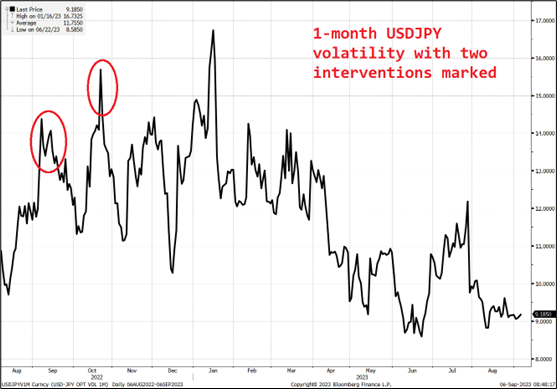
Positioning to make money off intervention is one of the most fun and challenging cat and mouse games in FX. USDJPY needs to go up more, first, before the intervention will happen. So, you need to have the view that both a) USDJPY will go up a few more big figures and b) MOF will intervene. Both seem pretty reasonable right now.
Note that one urgency comment was made in late June, but the MOF got a respite after we had that strange and aggressive broad USD selloff as it looked like (from circumstantial evidence) China did a rebalance out of USD to tame the USDCNH rally. Also note that the very first urgency comment was at 140, the MOF intervened at 145, and then USDJPY blew up to 152 before the MOF gave it the final WWE Smackdown. USDJPY 1-month vol seems low given the outsized volatility that results from intervention.
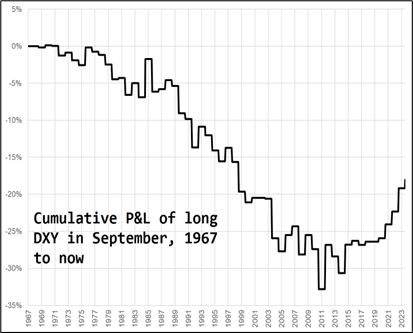
I had a few questions about why DXY seasonality is bearish in September when it’s been up the last five years. From my experience, sample sizes <15 are not useful and >25 is better but obviously you have issues with regime changes in there… So, for your viewing pleasure here is the cumulative P&L of long DXY only in September back to Bretton Woods. You can see it’s a bad month generally from 1971 to 2014 but has been good of late. Make of that what you will.
One way to handle this (as suggested by my other friend JJ) is to weight the seasonality by recency. If you use a linear smoothing mechanism where you divide each input by how many years old it is, you get a completely different seasonal pattern than if you treat each year the same. While linear or exponential weighting requires parameter selection that can feel a bit arbitrary, I suppose it makes more sense than equal weights. A big move in stocks in 1955 probably doesn’t have the same relevance as a move in 2011.
Here’s the seasonality of the DXY using linear weighting by age and equal weights. The one on the right is the chart I used yesterday. Also note that even in my chart above, DXY ends up near flat in September because it sells off the first half of the month and rallies the second half.
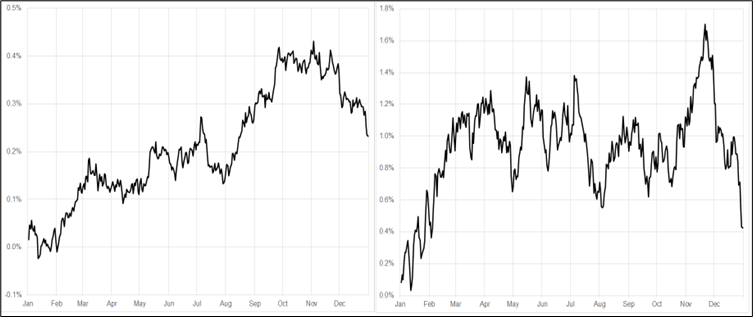
I think the discretion of the user of the data is important here. If you think the past 5 years are much more representative of 2023’s market, the seasonality is flat in the first half of the month and bullish in the second half.
If you prefer the larger sample and don’t think there has been a regime change since 2019, then you would say it’s bearish for the first half of the month and bullish for the second half. Overall, my view would be that there is no clear seasonal pattern here. A sample size of 5 is way too small to matter, but the long and short of it is that it’s choppy and you can have whatever dollar view you like without feeling as if you are on the right or wrong side of the seasonals.
Have a beautifully-designed day.
The Spectra FX Positioning and Momentum Report
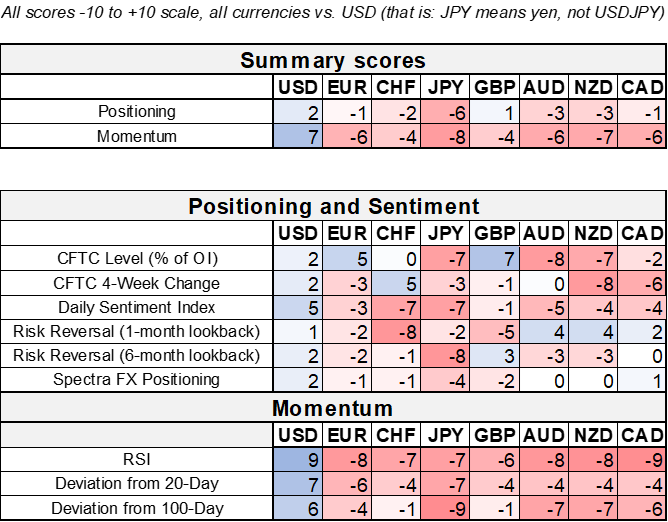
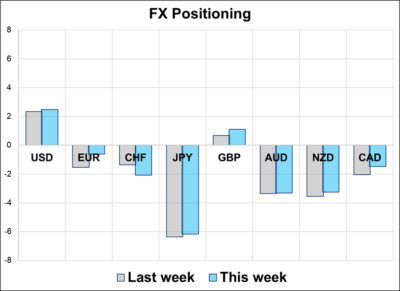
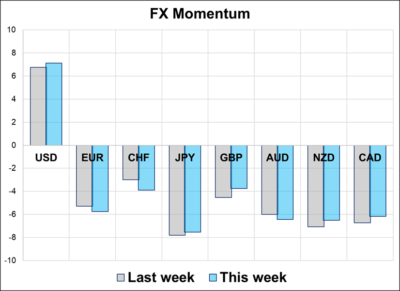
FX positioning remains close to unchanged as USD momentum remains strong with the dollar back near the top of its 2023 range. Trend followers and carry junkies remain committed to the dollar while fast money and macro specs see the end of the Fed hiking cycle and exploding US deficits and remain stuck in the view that the USD will eventually turn.
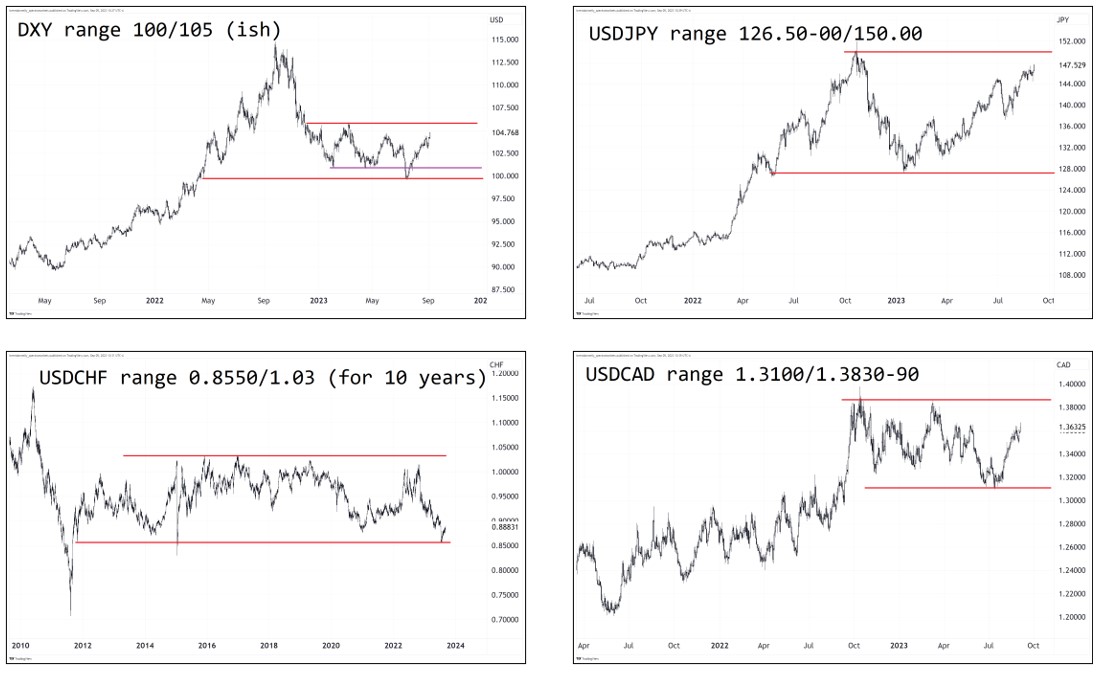
1. Many USD pairs are approaching their range tops, but most are still a few percent away. Interesting timing right as USD seasonality turns bearish. Still, it is hard to make a strong case for short USD in the near-term given its persistently strong performance across multiple regimes. Below, we show four examples of ranges that have been loosely in force for more than a year. Note the USDCHF range has pretty much held for 10 years (!!) with one brief peek outside after the SNB hit cancel on the 1.20 EURCHF bid in January 2015. CHF is strong on most REER-type metrics into the 21SEP SNB meeting.
2. The CFTC GBP long remains a bit of a mystery as there is no momentum or carry angle that I can see and usually those are the primary factors that determine CFTC positioning in FX. The CFTC long GBP trade is out of the money (weighted average entry point is 1.2835 on the long built up since June 20). CFTC positioning should continue to be a bearish variable for GBP, especially if the data stays weak and the BoE follows the Fed, RBA, and ECB who are all tapping the brakes on rate hikes.
3. Short JPY positions are meaningful but do not send a contrarian signal. Contrary to GBP, where large longs tend to precede bearish price action, large shorts in JPY more often make money.
—
That’s this week’s report. Thank you for reading.


A sort of almost unbelievably large move in Brazil. Plus: Short CADJPY.