
It is hard not to be cynical about the never-ending parade of China stimulus announcements, but the setup might mean this one matters more.


Subscriber-only
Brazil, Canada, yen
A sort of almost unbelievably large move in Brazil. Plus: Short CADJPY.

It is hard not to be cynical about the never-ending parade of China stimulus announcements, but the setup might mean this one matters more.
Image source: Wikimedia Commons

This microwave left justifies the 1’s for the hour of 11 o’clock but right justifies all other 1’s
Flat
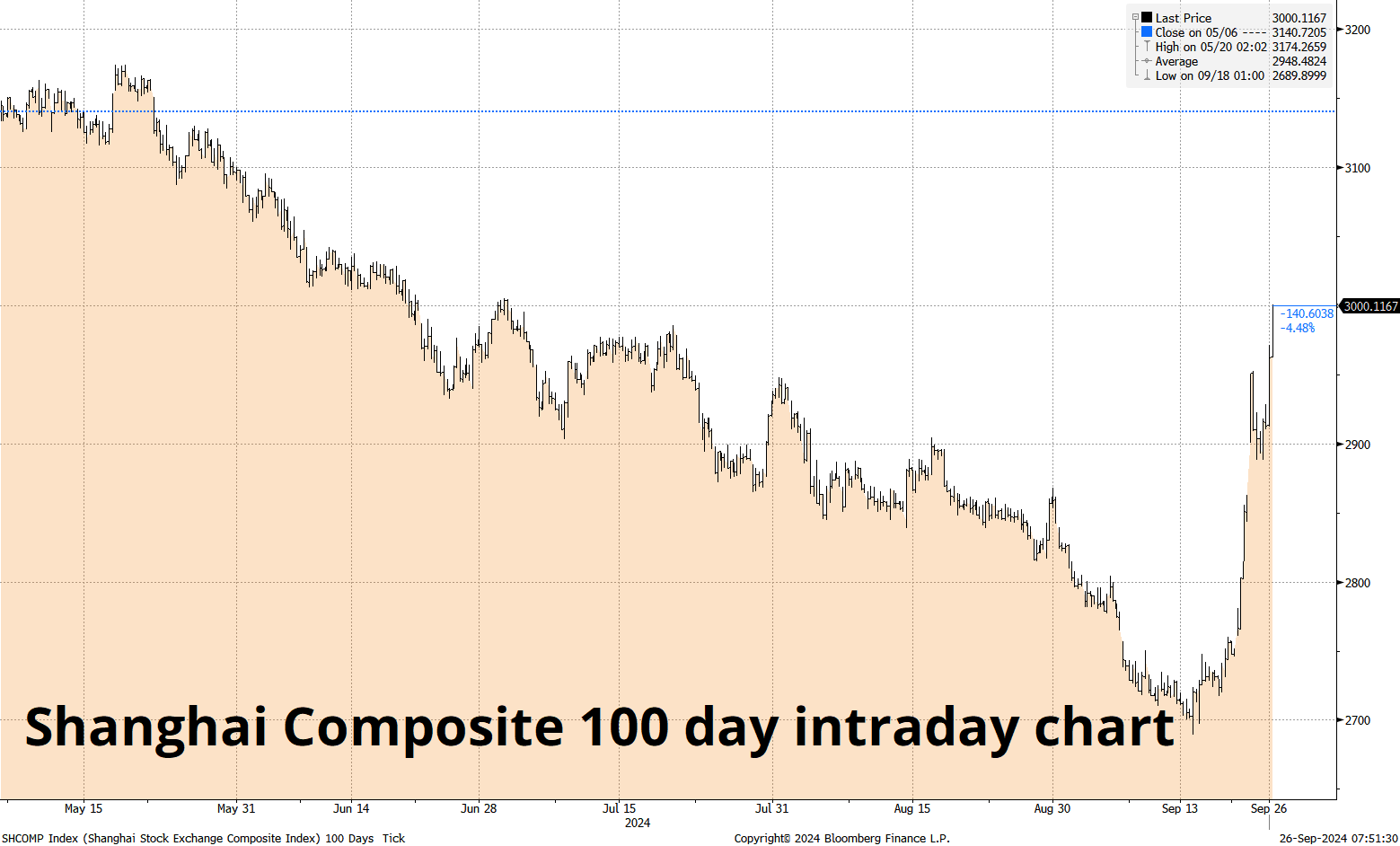
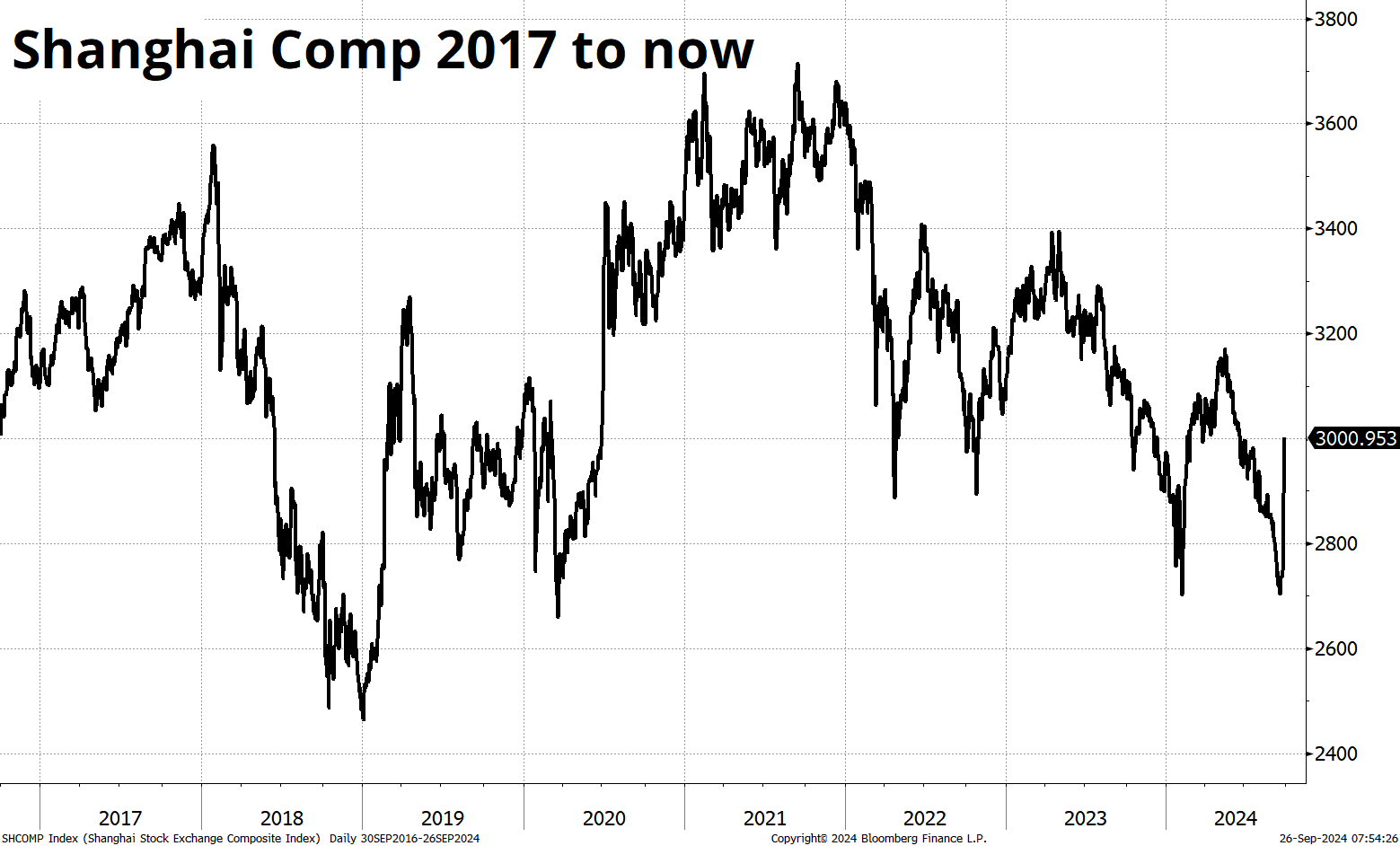
It is groundhog day in China as we get another stimulus announcement, but while it’s fun to be cynical, it’s feels dangerous to fight what looks like a bit of a “Whatever It Takes” moment out of China. Here is the Shanghai Composite at three levels of zoom:

One of my biggest arguments against a meaningful cyclical selloff in the dollar has been that there are no good places to put your money outside the US. Now, with China deemed uninvestable and foreigners mega underweight, and a multi-pronged, double-barreled monetary and fiscal stimulus announcement, we must be moving closer to the middle of the dollar smile. I am giving up on the bullish USD view and probably should be flipping short at “bad” levels.
As such, I’ll take the small loss on the EURUSD short and move on. A more tactical reason to give up on long USD is that the end of the month is here, and US stocks are up decent this month.
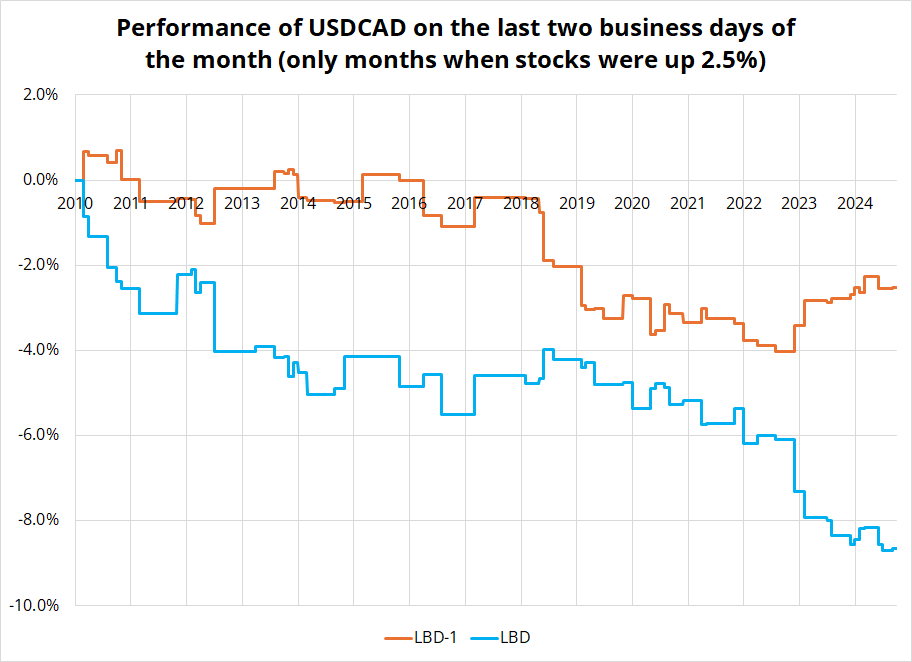
I have written extensively about how the month end model in the USD stopped working as hedgers finally learned in 2020 that funneling billions of USD of rebalancing into a 5-minute window once per month is suboptimal. See RIP: Month End Models for the full writeup. While real money asset managers have reduced their impact at WMR on the last business day of the month, they still need to hedge, and that hedging is now spread out over the days leading up to month end. You can see it in these two charts. GBPUSD and USDCAD are the clearest month-end movers.
I filtered for months where both the SPX and NASDAQ were up 2.5% or more. You can see that LBD-1 (the day before the last business day of the month) was a flatline until COVID and then hedgers started going earlier. The effect was strongest in 2020 and has flatlined since late 2022. Still, if I had to be long or short USD in the next two business days after this China stimulus and a recent, rip-roaring US equity rally, I would choose to be short. Also, equity seasonality looks to have whiffed this year, and early October is often a great time to get long risky things.
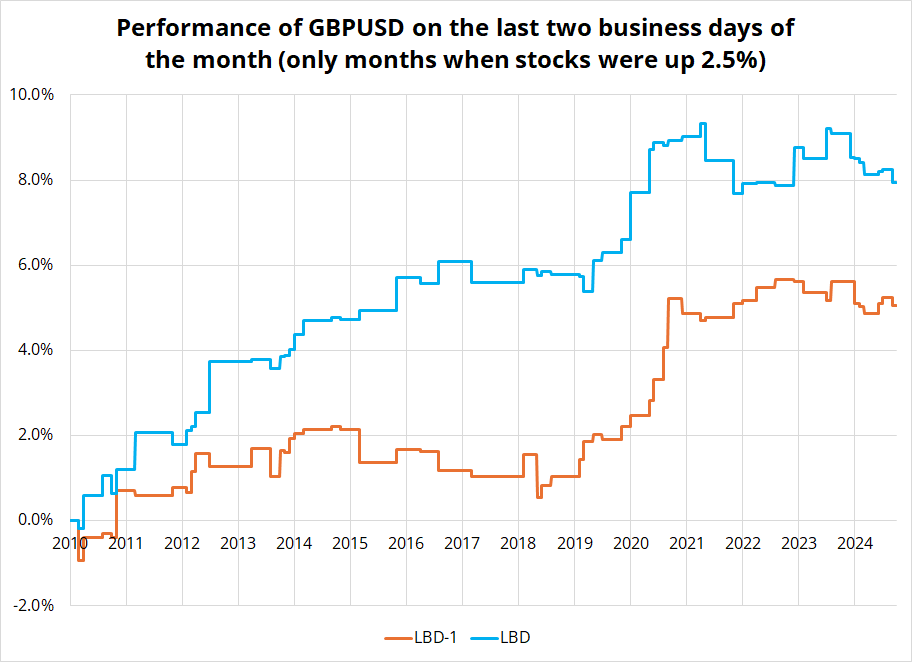
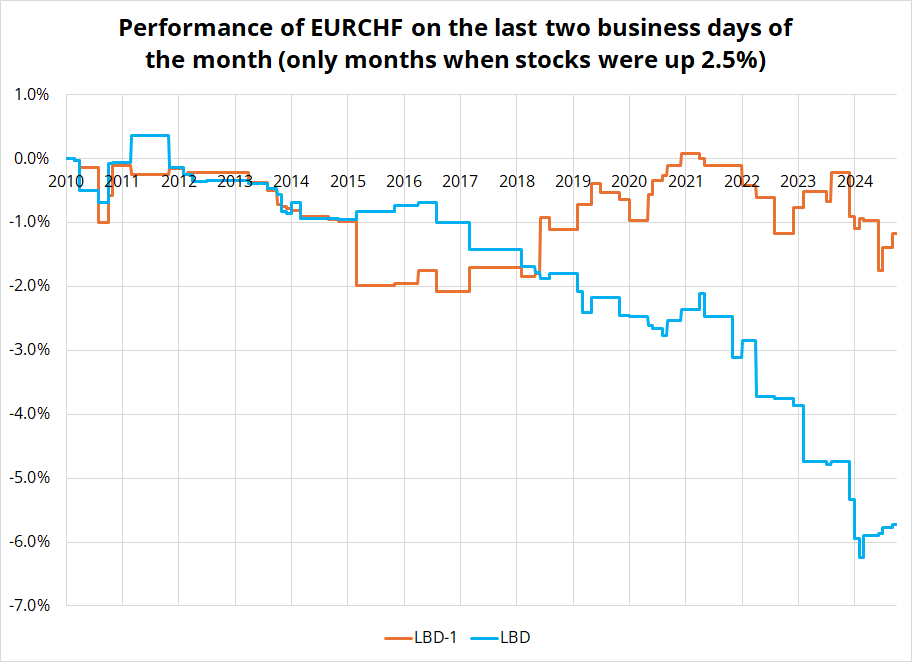
In Switzerland, the Jordan era ended with a 25bp cut in Switzerland, and it’s worth keeping in mind that the end of the month tends to see large CHF-positive rebalancing as you can see here. That blue line is Monday.
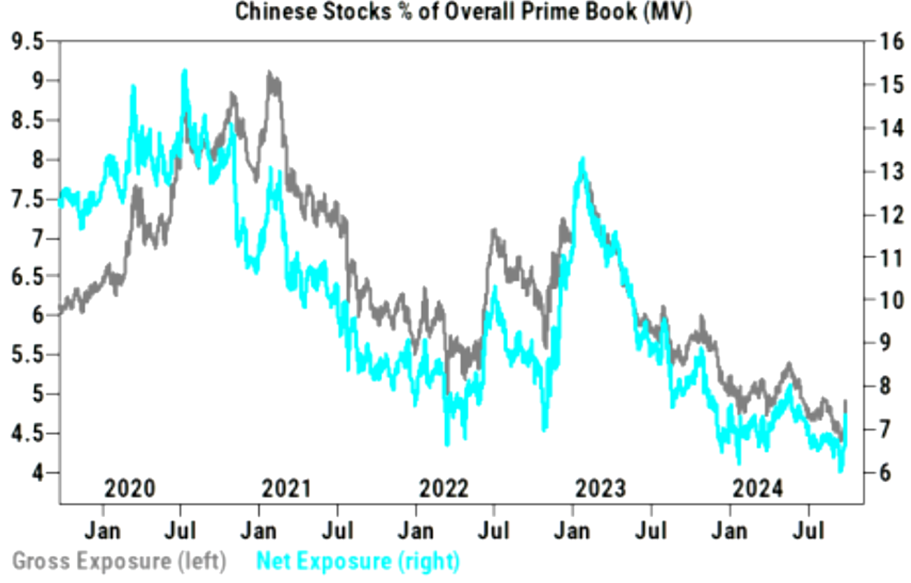
I will refrain from offering a macroeconomic analysis on the China stimulus because there are plenty of professionals out there who can do that better than I can. What I will say is that Xi and Co. have delivered something that looks pretty big after years of “Fool me once, shame on you…” skeptical rejection of their efforts. The setup this time might be better for them as the permanent, structural balance sheet recession view is so well entrenched. See this chart from GS, for example, to get a sense of the China underweight.
If you look at one-year correlations to the Shanghai Comp in FX world, you get KRW, NZD, AUD, and ZAR.
If you look at them vs. copper you get AUD, CLP, NZD, and ZAR.
US growth is fine, China is stimulating, inflation is lowish and falling, central banks are cutting. Not a bad setup for emerging markets? Hard to get overcommitted with the election coming up, but with negative equity seasonality surrendering to the bullish macro impulse, we might see Uptober for EM. The entry point is kind of horrifying in ZAR, so I would pick CLP or BRL as better longs over the next four weeks.
The paper linked below is a bit hard to understand, but it’s one of those things where you read it and you sort of partially get it, and end up a bit smarter when you’re done. Tyler Cowen calls it one of the most important economic papers of the year and I trust his judgment! The gist is that we should be aware that our decision-making is often less responsive to important factors than it should be, especially when we’re dealing with complex or unfamiliar situations.
Behavioral Attenuation, by Enke, Graeber, Oprea, and Yang
Abstract:
We report a large-scale examination of behavioral attenuation: due to information processing constraints, the elasticity of people’s decisions with respect to economic fundamentals is generally too small. We implement more than 30 experiments, 20 of which were crowd-sourced from leading experts. These experiments cover a broad range of economic decisions, from choice and valuation to belief formation to strategic games to generic optimization problems, involving investment, savings, effort supply, product demand, taxes, environmental externalities, fairness, cooperation, beauty contests, information disclosure, search, policy evaluation, memory, forecasting and inference. In almost all experiments, the elasticity of decisions to fundamentals decreases in participants’ cognitive uncertainty, our measure of the severity of information-processing constraints. Moreover, in decision problems with objective solutions, the observed elasticities are universally smaller than is optimal. Many widely-studied decision anomalies represent special cases of behavioral attenuation. We discuss both its limits and why it often gives rise to classic phenomena of diminishing sensitivity.
Have an angelic and numerical day.
11 o’clock? Left justify the 1’s.
All other times, right justify the 1’s.
OK.
A sort of almost unbelievably large move in Brazil. Plus: Short CADJPY.

NZD has a bunch of bullish kickers: Election, seasonality, and inflation

