

MacroTactical Crypto #27
Failure to regulate
The SEC had one job
You can listen to this episode right here.
Today’s note is 1700 words (7-minute read)
Failure to regulate
It’s more fun to write about raging bullish or bearish views in MTC, but the dull fact right now is that we have downside stabilization in crypto (as described in my last two notes) but we don’t have fuel for any sort of topside acceleration. In other words, while the money has stopped rushing out of crypto… It is unlikely to flow back in anytime soon.
The recent Coinbase news could be a huge disincentive for new institutional inflows.
Regulatory uncertainty puts institutional inflows at risk as the existential risk of retroactive prosecution in lieu of clear regulation makes the calculus of investing in non-bitcoin crypto impossibly complex. Capricious, random prosecutions are on the table and with no clear definition of what tokens are, or are not securities, we may enter a bit of a deep freeze here.
What we got here is… Failure to regulate
Remember, it was only April 2021 when the SEC approved the Coinbase IPO in a tacit endorsement of Big Crypto and retail crypto trading. Now, the exchange (and every other crypto exchange, by implication) faces existential risks as nobody knows what is legal or illegal anymore. The SEC complaint asserts that nine random crypto tokens are securities, setting the stage for months or years of hand-wringing by lawyers as everyone tries to get inside the mind of regulatory tortoise.
The SEC was formed in June 1934 in a reaction to the stock market crash of 1929. The agency was meant to protect investors from shady dealings pre-1929 as unscrupulous companies issued worthless securities and then pumped them via paid promoters and dumped the overvalued paper on leveraged retail before the securities crashed.
Sound familiar?
By failing to regulate the thousands of crypto tokens and failing to communicate how crypto fits into the existing regulatory framework, the SEC has now failed to do the exact job it was set up to do. In 2017, they saw the raft of ICOs and cracked down, but the exact same story repeated in 2021 as new security-like offerings were all the rage. Insiders were handed tokens at 0.0001, they pumped them via paid promoters, and then dumped them on leveraged retail for 100X profits (or whatever) before those tokens subsequently crashed to ~0.
I covered this phenomenon in MTC 7: These Charts All Look Like Mountains. The existence of these tokens on US exchanges trading them in broad daylight provided the appearance of propriety to what the SEC has now deemed illegal.
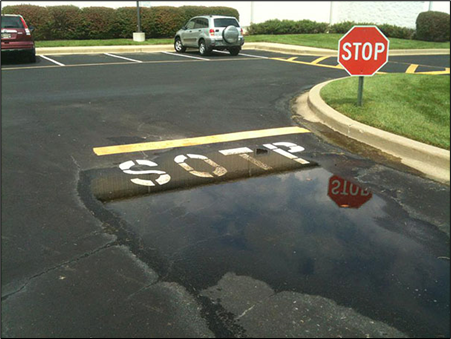
The SEC had one job
The SEC had one job years ago. Provide regulatory clarity. There was a simple solution ex-ante: Establish a commission or committee to rule on each token, before issuance, to provide clear guidance to investors on whether or not that token was a security.
Instead, the SEC said nothing, but allowed the tokens to proliferate into what essentially became a giant multi-trillion dollar gambling ecosystem where lotto tickets could be bought and sold intraday. Normally, US lottery income goes to public works, education, police, roadwork, and the treatment of gambling addiction. In this case, the lottery proceeds were channeled to influencers, founders, and shills. Instead of funding public works, they funded yachts, parties, and private bank accounts.
I’m not saying every token was a scam, there will be tremendous innovation down the road once we sort through the rubble. But the issue is that if you set up a game where the prize is huge money, and you don’t have any rules, the worst bad actors will win. Much as the inability to properly tax externalities is one of the biggest flaws in capitalism as it drives the worst actors to pollute, embrace moral hazard, send spam email and robocall me 20 times/day … An unregulated crypto ecosystem makes it hard for the good actors to participate fairly.
I know from conversations with multiple senior people inside the crypto industry that it is almost universally accepted that if you want to be a good actor who attempts to follow the rules, you are at a massive competitive disadvantage.
Anyway, the ship has sailed. The SEC has lurked while ponderously rubbing its chin for five years as the relentless inflows continued. Now, they are going to establish some precedent by prosecuting where they think they can win, while exchanges, investors, and crypto projects look up at the Sword of Damocles.
Keep an eye on flows going forward as my guess is that retail is tapped out and institutional inflows will slow dramatically until some clarity on regulation is achieved. The stock market crash was in 1929 and the SEC was formed in 1934. The Global Financial Crisis was in 2008 and Dodd-Frank passed in 2010. Regulation takes a long time.
The Ethereum Merge date
It’s not all bad news. The Ethereum Merge could be less than two months away. If you are not familiar with The Merge, this explainer is good. Here is a nice visual from that piece:

The next critical date in this long-running saga is August 10th. That is the expected date for the Goerli Merge and it’s one of the last big hurdles before there is certainty that The Merge will happen the week of September 19th.
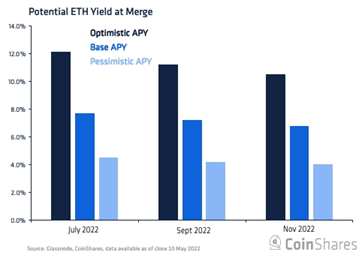
Why is The Merge bullish? The general view is that Ethereum yields will rise significantly after The Merge and this will make ETH into something like a commodity-linked bond. Estimates vary on what the post-merge equilibrium ETH yield might be, but consensus is: “definitely higher than now.” This piece from Coinshares is one attempt to guess post-Merge yields. It includes this chart:
So while a higher yield is the main bull story (there are others, but that’s the main one), you can also make some bearish arguments, for example:
· Yields are hard to estimate and are more an equilibrium supply/demand story than a math equation.
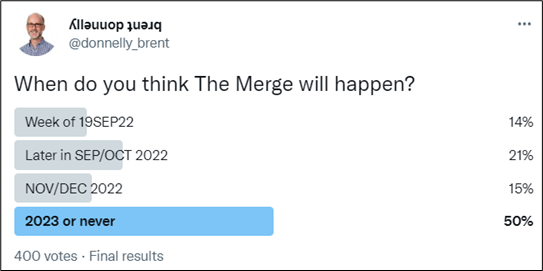
· This is an event the market has been anticipating for six years. It’s hard to imagine it’s not somewhat priced in. That said, I could see more speculative buying into the event. Then again, it’s not fully priced in as there is still quite a lot of skepticism given the repeated failures to launch. This survey is surprisingly pessimistic:
“Buy the rumor / sell the fact” is my base case for ETH prices through The Merge.
· Moving from proof of work to proof of stake makes ETH more like SOL, ALGO, and other PoH/PoS tokens. It highlights the fact that ETH has competition and BTC does not.
· Last, but certainly not least: If the primary selling point of ETH post-Merge is that it’s becoming more of a bond-like yield product… That makes it look more like… A security? Given the highly uncertain regulatory environment, that isn’t necessarily awesome.
Of course, the biggest ETH risk in the short-term is another Merge delay. August 10 is key.
Speaking of gambling
I am surprised there are not more successful Betfair clones in crypto. Every sports bet can be seen as buying or selling a token which resolves to 0 or 1, depending on the outcome of the game. As such, it seems pretty easy to program and deliver as a frictionless market. My bet is that this form of sports gambling will eventually prevail as the 5% juice model that has dominated the bookie business since I was a kid seems hopelessly outdated. Five percent? Cmon.
Anyway, check this out:
https://overtimemarkets.xyz/#/markets
I am not associated with overtimemarkets.xyz and I pretty much know nothing about it. The concept is cool, though.
Conclusion
The base still looks decent in crypto, but the topside is capped by regulatory uncertainty and low retail confidence. August 10th is a key date for ETH.
As explained last week, there are two ranges to monitor in BTC. Nearby range is 20000/25000 and 18700/28300 on the wide.
With the big jump on the Merge date announcement, the ETH chart is more interesting. There is a big triangle that capped the first rally, while the old flag break and triple bottom major support at 1700 is now primary resistance. Support is the 200-hour at 1350 and then the triangle bottom just below 1200. Here’s the chart:
ETH with a triangle and the 200-hour MA
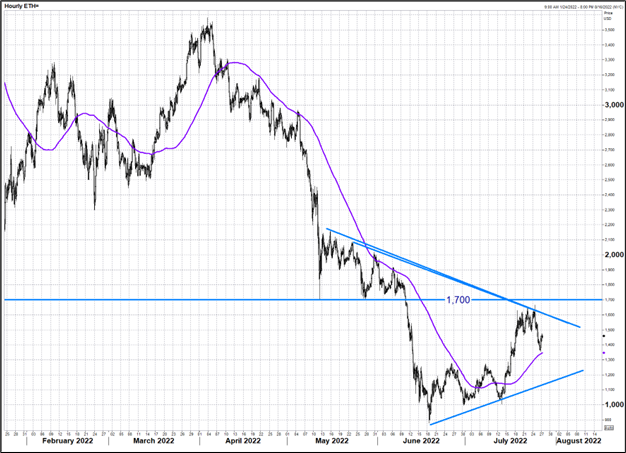
If you’re looking to buy the dip into The Merge, entering at 1350 with a stop below 1200 makes sense.
That’s it! Thanks for reading.
This is MTC #27 and … This happened a few hours ago.
What does it mean????
See you next week.
bd
Subscribe to MacroTactical Crypto here
Subscribe to Trader Education (50 Trades in 50 Weeks) here
This material is solely for informational and discussion purposes only. Spectra Markets is not a registered investment advisor or commodity trading advisor. This material should not be viewed as a current or past recommendation or an offer to sell or the solicitation to enter into a particular position or adopt a particular investment strategy. Spectra Markets does not provide, and has not provided, any investment advice or personal recommendation to you in relation to any transaction described in this material.
Spectra Markets is affiliated with Spectra FX Solutions LLC, an introducing broker that is registered with the NFA; Spectra FX Solutions LLP, which is a registered entity with the U.K.’s Financial Conduct Authority; and SpectrAxe, LLC, a swap execution facility that is currently in the process of registering with the CFTC. The disclosures for Spectra FX Solutions LLC and Spectra FX Solutions LLP related to the separate businesses of Spectra FX can be found at http://www.spectrafx.com/.
“We do not consider that this commentary constitutes “research” or “investment research” (together “Research”) as described in Commission Delegated Directive (EU) 2017/593 (“MiFID Delegated Directive”) or referred to in Directive 2014/65/EU (“MiFID II”). However, each recipient remains responsible for determining whether this communication constitutes research and therefore if there are any restrictions on their receipt or use of this communication for the purposes of the MiFID Delegated Directive, MiFID II or otherwise.”