

August 31, 2022

You can listen to MTC 32 right here.
Not a paid subscriber? Sign up here before the price goes up at the end of August
Today’s note is 1800 words (8-minute read).
ETH: Stiff competition and hard truths
My views from last week are mostly unch’d:
- New cycle lows coming for crypto in September.
- The 2000 top in ETH and the 25000 top in BTC look like cycle highs. MSTR is finding gravity after briefly leaving the atmosphere into wildly overvalued territory as BTC flops and Saylor is arrested for fraud (again).
- I am less bullish USD overall so that’s good for crypto at the margin, but any respite in the dollar is probably just a short-term thing into the 08SEP ECB meeting. Anyway, part of the reason I’m less bullish USD is that the ECB looks to finally be getting some hawkish religion. Global real rates are ripping and that’s bad for fiat debasement plays like crypto. If crypto is a hedge for loose policy and idiotic monetary excess—you don’t need that particular hedge these days. Central banks are not loose!
- 17500/21000 expected range for BTC over the next week.
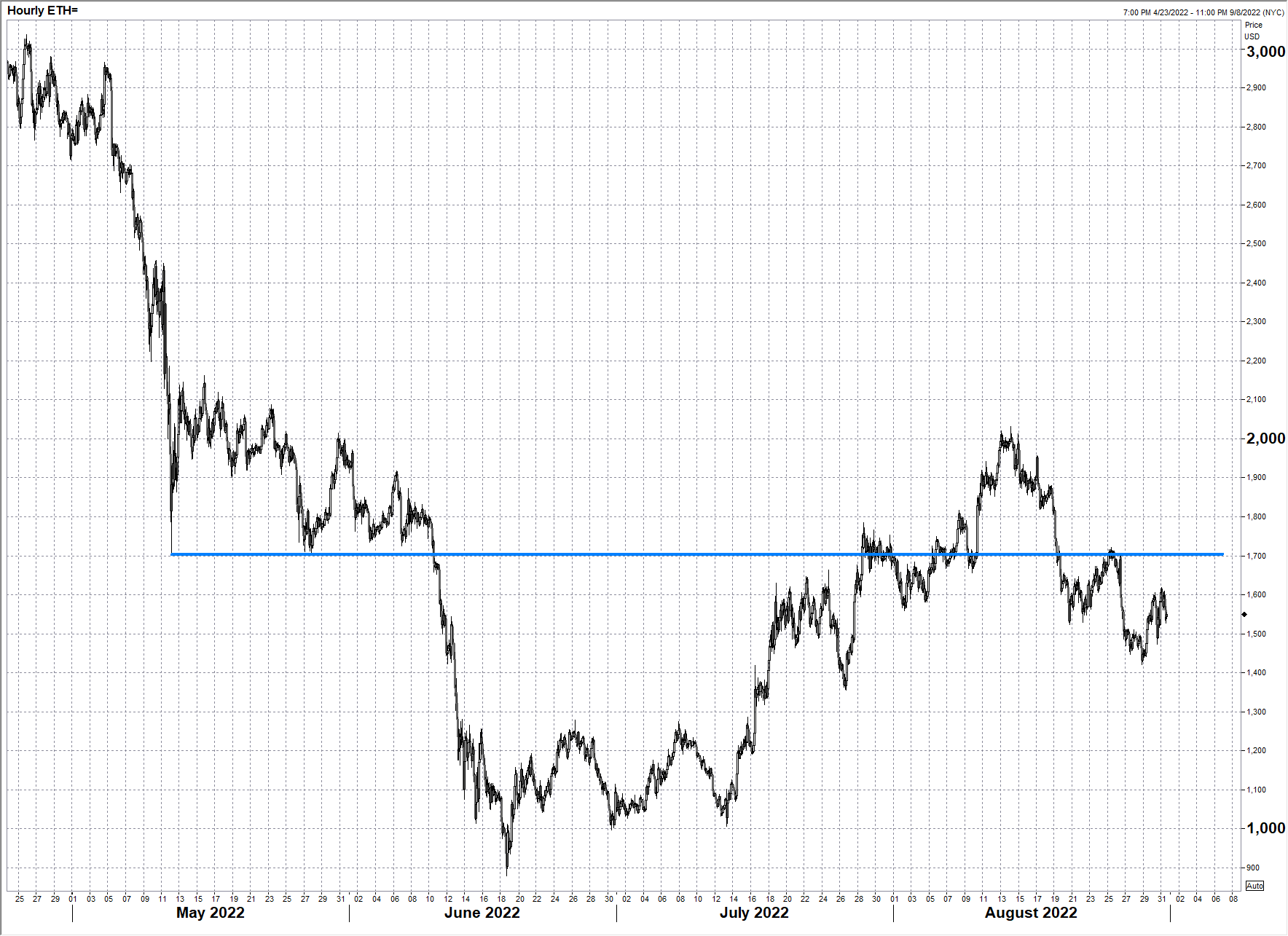
- ETH is now sell on rallies (1700/1770 sell zone) as the pre-Merge load up and buy the rumor happened pretty early and The Merge looks fully priced to me (more on that later). Longs are looking for exit opportunities and there’s now big resistance at 1700/1770.
The 1700 level was huge support in ETH in May. When it finally broke, that became resistance. We chopped around it for the first half of August, Merge hype took us up and away for a week or so, but we failed and 1700 is a ceiling once again. ETH really does not like it above 1700. Here’s the chart.
ETH hourly April to now
Who is going to buy ETH after the merge?
The reason “buy the rumor / sell the fact” works as a general pattern in financial markets, especially markets populated mostly with inexperienced investors, is that everyone wants to be long when good stuff is about to happen, but once the anticipated good stuff transpires… There is no real reason to be long anymore. After the expected catalyst or event happens, everyone tries to sell at the same time post-event… And whoosh.
Almost all highly-anticipated events in crypto have been textbook buy the rumor / sell the fact trades. Elon on SNL, the futures launch, the futures ETF launch, El Salvador adopts bitcoin day, and so on. An important and notable exception to this is that bitcoin halvings are known events that have resulted in prolonged bull markets, not buy the rumor / sell the fact. So, I am by no means guaranteeing The Merge is buy rumor / sell fact, but if you think ETH rallies post-Merge, you need to be able to answer this question:
“Who is going to buy ETH immediately after The Merge?”
Because there is a 100% chance of significant selling by short-term specs in the hours and days after the Merge. They are simply (and logically) front running the event. I’m not talking about long-term buyers and inflows… Those will come when they come. Crypto hedge funds are not sitting on the sidelines waiting for the Merge to happen so they can buy ETH at 1550. They’re either long already or they might be leaving bids lower, but they are not waiting for the Merge to get out of the way so they can go to market.
While Vitalik’s cocky promotional photo-op for The Merge was funny, I wonder if it adds another layer of doubt for institutional investors already nervous about ad hoc regulatory slapdowns. Maybe there is less institutional wood to chop than people think. Ethereum has erected significant barriers that make it hard for others to compete. But ETH still faces stiff competition from similar solutions that are better on various metrics, regardless of the ETH use case examined.
The big argument for post-Merge ETH longs is the digital bond hypothesis. “It will be an ESG compliant, commodity-linked digital bond!” is a key to the bull case. I can’t get past the simple TradFi notion that ETH is way (wayyy) too volatile for any institution to care much or at all about the yield.
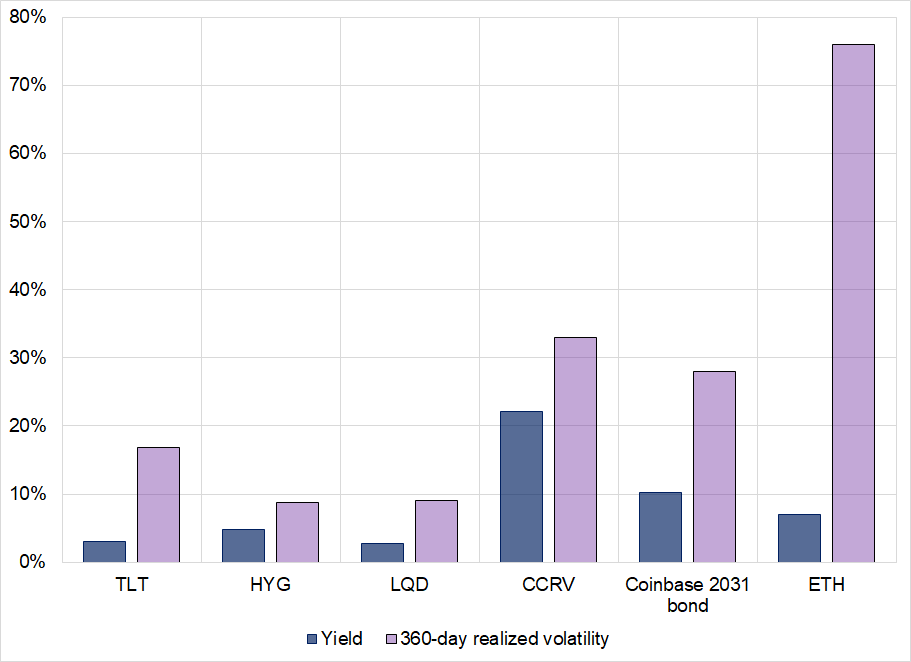
The reason bond yields are useful is because they are proportionate to the volatility of the underlying instrument. ETH as a 70-vol bond that yields under 7% makes little sense under any normal framework for evaluating fixed-income securities. Plus, if it’s a digital bond, it’s a security. Howey test and all that. But that’s a different discussion.
When an institution looks at a carry product (a bond, currency carry basket, etc.) the standard metric they use is the carry/volatility ratio. That’s the best snapshot of how much principal risk you are taking to earn a given yield. Here is carry versus vol for some well-known yieldy instruments, along with ETH. I have very generously assumed a 7% annual yield for ETH.
Yield and volatility of various “bond-like instruments”
Here is the same data expressed as the carry/volatility ratio:
Carry/volatility ratio of various “bond-like instruments”
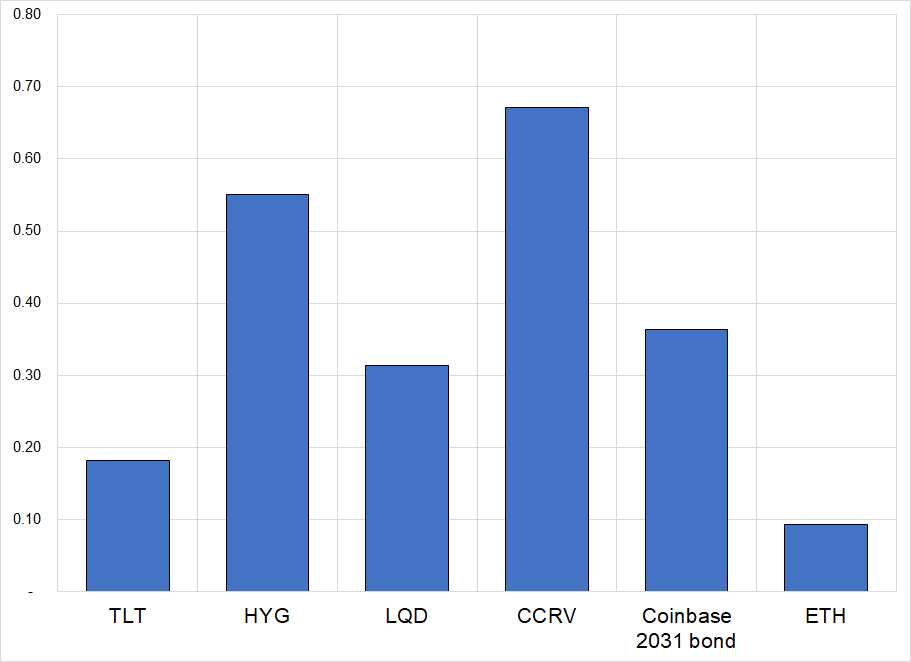
If this all sounds a bit Boomer/TradFi to you… Guess who runs the institutional money? TradFi Boomers. The packaging and marketing of ETH as a digital bond rings hollow to me because it doesn’t stand a chance against other bond-like instruments.
The only way ETH works as a digital bond is if volatility collapses or if you package and hedge it and repackage it and/or lend and overcollateralize it into a synthetic derivative. Initial post-Merge uncertainty will increase volatility, not diminish it. And synthetic on-chain hedged ETH solutions are attractive to some, but introduce a lot of complicated, hard-to-measure basis risk (and execution and risk management inconveniences). The synthetic ETH bond is probably only going to appeal to the most diehard institutional fans of crypto. One River Digital has been talking about this kind of digital yield product for a while and it surely has appeal. But it’s niche and it existed before The Merge so I don’t envision some massive stampede into synthetic digital yield post-Merge. Digital yield is covered in MTC 14.
So, it you own ETH, it mostly still comes down to whether number goes up. If number goes up, you win. If number goes down, you lose. That’s not how bonds work and thus, this is not a bond. A yield of 3%, 5%, or 7% isn’t going to make a difference because the dominant driver of the return will be the move in the price of ETH, not the level of yields. If you want to create a synthetic bond, that’s fine, but I doubt institutional demand for that product will shift noticeably post-Merge. That product has plenty of more-transparent competition with less career risk for the fund or asset manager.
Bankless presented an excellent two-sided debate on ETH up or down post-Merge. This is commendable because the arguments for both sides are valid, and 99% of crypto industry content is bullish, all the way up and down in every cycle. It’s good to see a crypto publication allow an alternative viewpoint to the consensus permabullish mantra.
My view remains: Sell ETH into and on the merge announcement.
If you care about this topic, I would set aside 20 minutes to read the two pieces:
Bankless: Is the Merge Overhyped?
Bankless: A Rebuttal to Jordi Alexander & The Merge
How is Shiba Inu still worth seven yards?
In currency trading, one billion is called “a yard”. As in, “We just bought 3 yards of EURUSD, and it only went up six pips and the client is asking for an improvement on the risk price we showed.” The slang “yard” comes from the French word for billion: milliard.
Someone in a crypto newsletter last week asked: How is Shiba Inu (SHIB) still worth 7 yards? I believe the answer to this question is the same answer that comes up often in stonks: There is nobody left to sell. Often, a company will go bankrupt and it’s clear the equity is worth zero. Don’t @ me about Hertz, I know the Hertz story. :] I’m not talking about Hertz here; I’m talking about a Chapter 11 with literally zero upside. Yet that stock will still sit there trading at $1.14 or whatever. For weeks or even months.
The reason this happens is that generally bankruptcies attract short positions all the way down and those shorts are willing to cover down near a buck since there’s no juice left in the trade. And randos who like cheap things are willing to bid too. But there is nobody that wants to sell down there. The asymmetry of a short at $1.14 is unpleasant, and anyone who is still long can’t be bothered crystallizing the loss down 99%. So the thing just floats there like a turd in a pool.
Most of the bombed-out altcoins are the same deal. Nobody who bought Shiba Inu in October 2021 is going to sell down here. ‘Wen Moon?’ is the question in their head (though in real life they will sell if they get back to their entry point. “Back to break even; I’m out!” (that’s called anchoring bias)).
So yes, SHIB is worth $7B. But no, it’s not. The market is in a stable non equilibrium and can stay there forever. There is no orderly liquidation process for sh*tcoins, they just grind inexorably, in slow motion, towards zero.
Oh, GameFi…
The 2021 business model in GameFi was overpromise and underdeliver as the incentives in the industry were constructed exactly bass-ackwards to how a video game business usually works. Normally, a game is built with private money then sold publicly, but in GameFi 2021, the money was raised publicly via unregistered securities with a cool trailer or some basic game assets built in Unity (or MS Paint). Then, tokenholders hoped to 10X their money as everyone out there in the real world realized how awesome the game was.
But mostly, there were never any games. The vaporware approach was transparent at the time (see my review of Star Atlas in MTC #10: Literally, not a game, for example) and while the various projects made announcements full of sound and fury in a relentless attempt to keep gravity from acting on their coins, their efforts to produce a fun video game mostly faltered.
Axie Infinity was a game, at least, but projects like Star Atlas kept tossing up trailers and fake non-game mini-games and such to prolong the inflows as long as possible.
Last September, when ATLAS (the Star Atlas coin) launched, the white paper indicated that the lockup for insiders would come off September 2022. I had this in my calendar because lockups can be massive bearish events for securities like ATLAS. But… Ummm… Forget it.
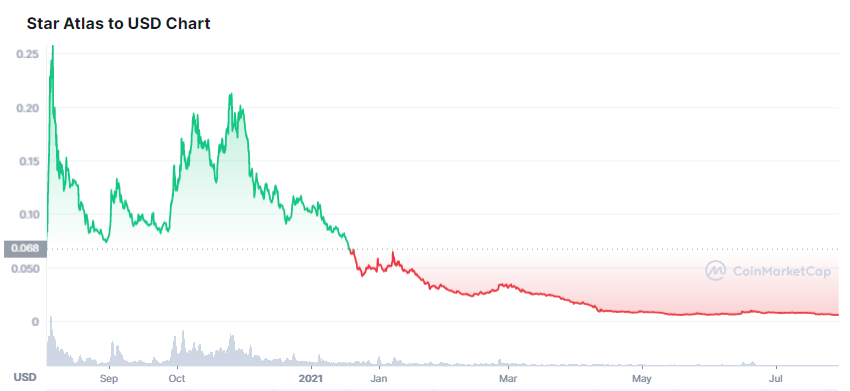
Be sure to check your decimals. It’s trading at 0.0058. 97.8% off the high.
Finally, an article: https://blockworks.co/fanduel-execs-bitdex-bet-crypto-can-disrupt-sports-gambing/
That’s it ! Thanks for reading …
Don’t follow the crowd. Don’t fight the crowd. Think for yourself.
bd