There is no safe port in this storm.
Hello. It’s Friday. Thanks for signing up. I’m Brent Donnelly.

There is no safe port in this storm.
Hello. It’s Friday. Thanks for signing up. I’m Brent Donnelly.
Here’s what you need to know about markets and macro this week
It has been quite a week for markets as Anthropic goes public and fear rules. Liquidity is being sucked out of the system by aggressive forward guidance from Chris Waller and other members of the Fed who are now in a full-on civil war with Kevin Warsh. Waller specifically called out the bossman, saying he disagrees with Warsh’s approach to forward guidance and does not give two fudges about his supervisor’s preferences.

“I’ve been in this game a long time.” ! Gnarly.
I have been questioning the Fed’s commitment to the inflation target for about two years as they cut and declared mission accomplished when inflation was still above target and continue to promise they will get inflation to target tomorrow, just like Jane Says, she’s done with Sergio. She’s going away to Spain. When she gets her money saved. She’s gonna start tomorrow. Tomorrow.
But now, it seems like Waller has finally found a hawkish set of wings just as the commodity and stock markets are rolling over, AI capex spending has peaked, and the housing market rescales the y-axis to print new lows month after month. There are three ways to run monetary policy:
In a supply shock, monetary policy is difficult. But no sane layman or PhD in economics or macro commentator would support door number three. You either forecast, or use real-time data. There is zero logic to a framework that focuses on lagging data. But that’s what Waller is doing. Instead of looking at the world as it is or as it will be, he’s looking at it as it was.
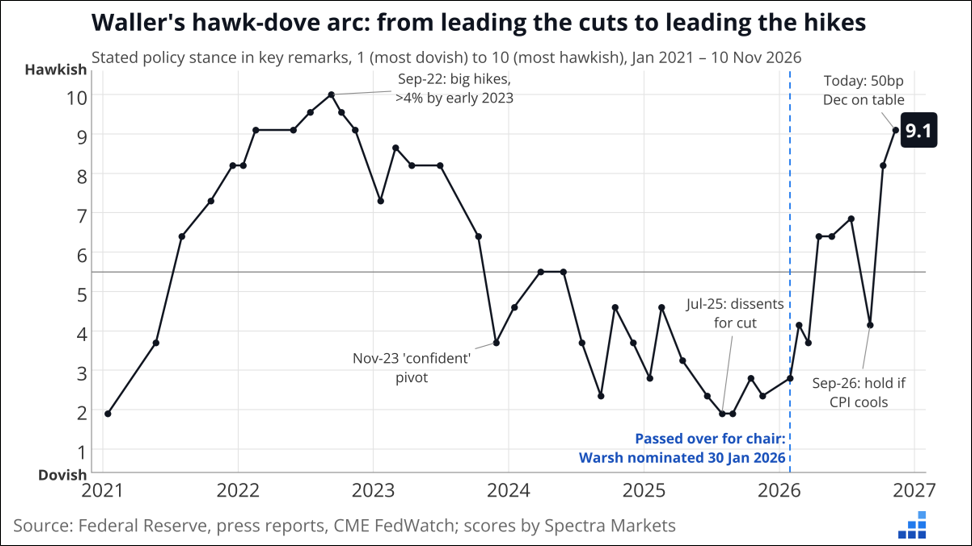
This is not some hindsight fitting exercise; in his most recent speech, Waller explicitly stated that his policy framework is to watch the current monthly CPI reading and calibrate monetary policy based on that. Here’s the quote:
If the October CPI inflation data out later today are similar to the past two monthly readings—with core CPI inflation around 0.3 percent or even higher—then a stronger policy move may be needed. In that case, I believe a 50 basis point hike in the policy rate should be considered at the December meeting. Hiking only 25 basis points would put our credibility at risk, a risk I am not eager to take.
That is a bit bananas. Anyway, this is all looking a lot like 2018, where you had a new Fed Chair coming out of the gates super hawkish, midterms to the Democrats, and swooning equity markets. If you are old enough to remember that period, the Fed was extremely hawkish and hiked at their December meeting. Then, 16 days later, Powell did a 180 and came out max dovish. They cut in July.
Here are some charts!
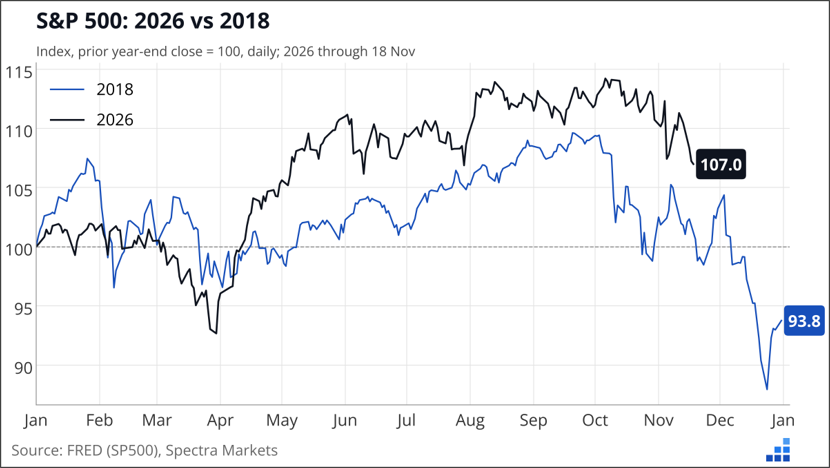
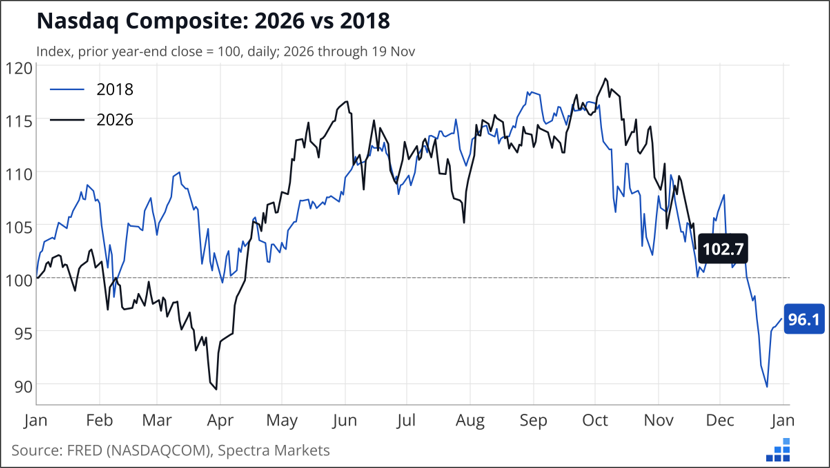
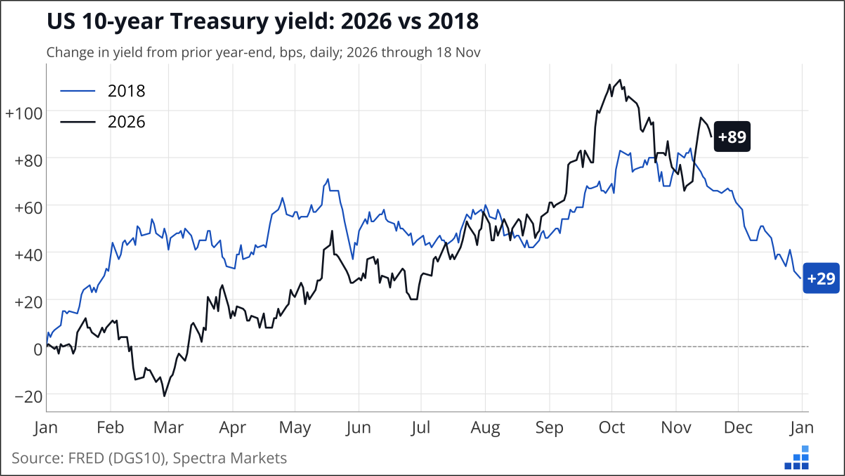
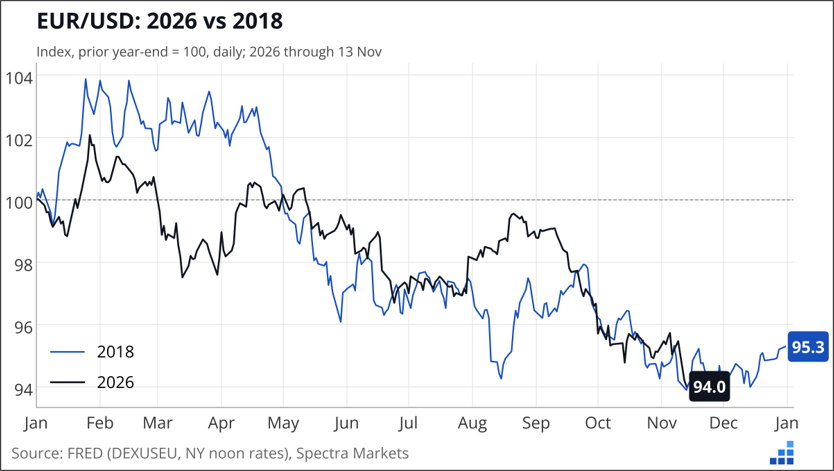
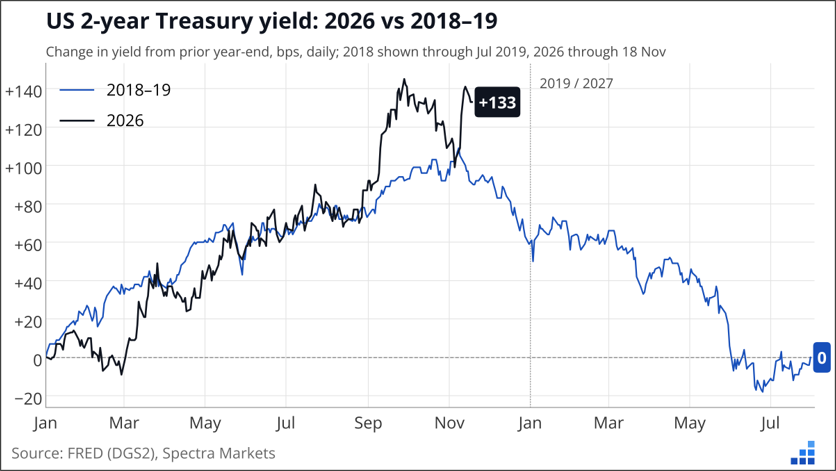
That last one is a humdinger as I extended the x-axis out to July 2019 so you can see the full glory of the Fed pivot. All this gives us plenty of reason to fear the next four weeks as it’s hard to imagine a Fed pivot until after the one-two punch of an FOMC meeting and a negative MoM CPI report the next day.
Outside the U.S., the Reserve Bank of Australia is struggling to find a working compass, too, as they have hiked into a broad-based employment slowdown and a failure to launch in the domestic AI space. Australia has one of the largest exposures to AI capex (as a % of GDP) and we went from pricing multiple RBA hikes to now pricing cuts by March 2027! This has crushed the AUD and sent Aussie bills flying.
If NASDAQ futures get to 24,000, which is 20% off the high and about 2,000 points below current levels, the Fed will turn substantially more dovish and a December hike will either be off the table, or it will be the last before a series of cuts in 2027. In the meantime, the big level to watch is 26,000/26,400.
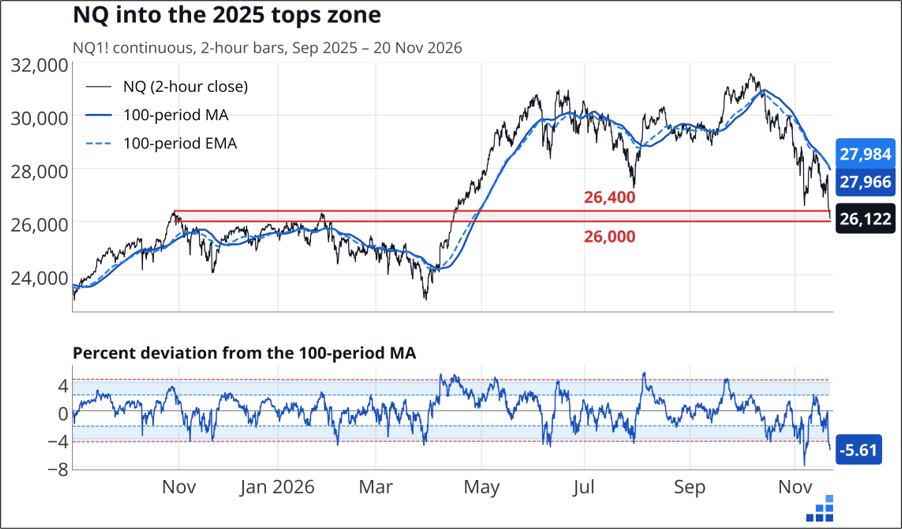
You can see from this chart we are right in the buy zone, in theory. I am bullish, and scared. If you need more reasons to be bullish, Exhibit A:
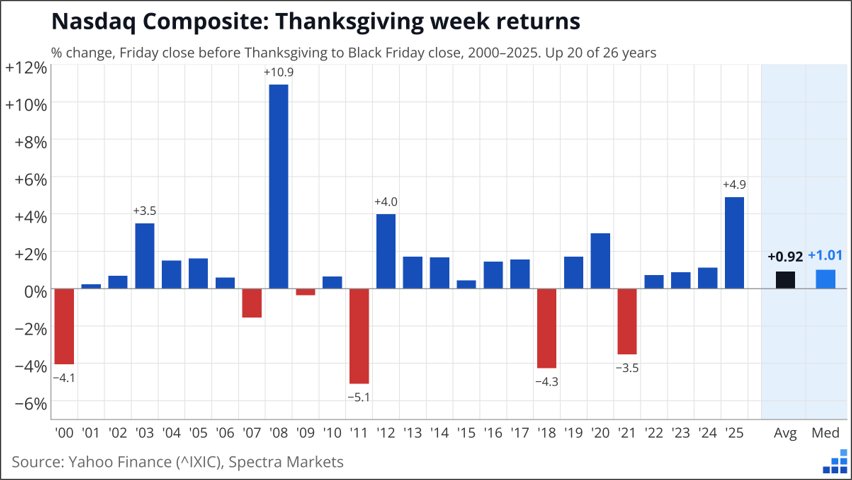
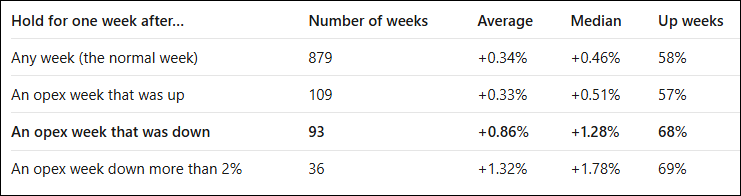
Exhibit B, performance of NASDAQ after OPEX week:
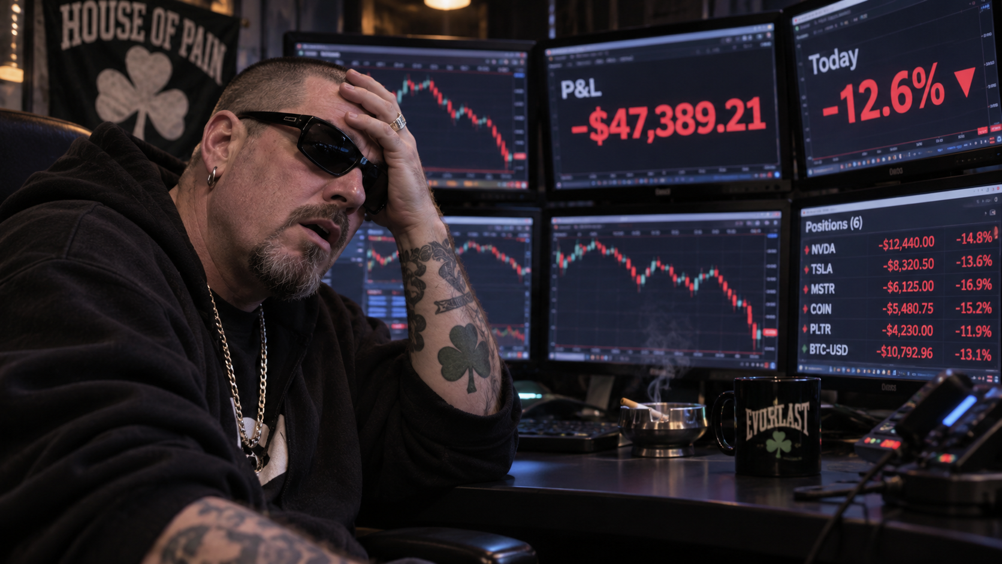
Buying ANT near the IPO price, say $84/$86 does not seem like a bad idea to me. In the meantime, I am long DRAM and SKHY at bad levels and trying to hold on. This is a selfie I took this morning.

Oh, with all the excitement, I forgot: Jensen Huang is out. If the writers of this mad simulation are any good, Intel will hire Jensen Huang as its new Head Of Network Engineering, Yield, Processing, Operations & Technology.
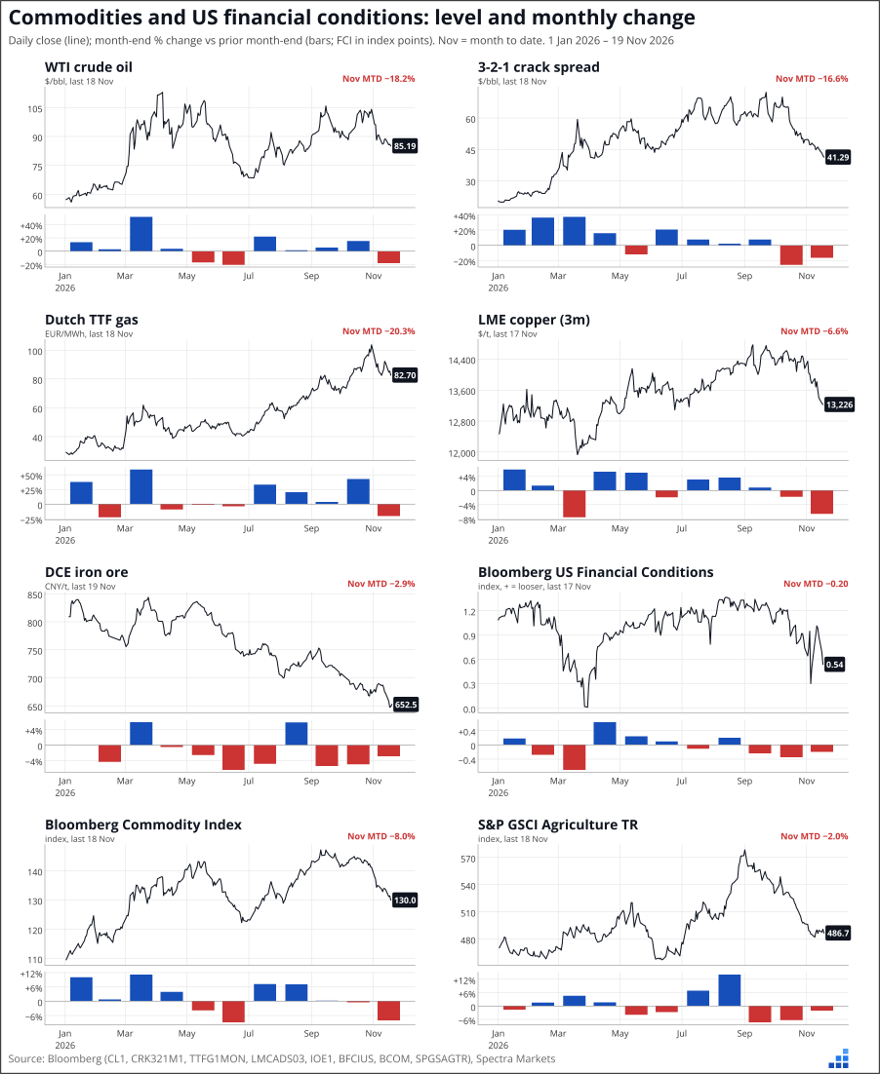
Yields don’t know what to do because the foreverwar is still percolating in the background, but commodity prices are tanking and even oil can’t hold a bid. The U.S. economy is printing strong data but the forward-looking picture is becoming increasingly sus as the AI capex thrust is over and the rest of the economy is wobbly. Consumer spending might be tested as the wealth effect diminishes with NASDAQ 14% off the highs and the popular momentumy stuff down much more.
My strongest view right now is that the Fed will not hike in January. I explained it in am/FX; let me quote myself here (from am/FX, 18NOV):
—
excerpt
I have fallen into the “too much is priced in” trap. I do not believe the Fed will hike 50bps in December and I do not believe they will hike at all in January. But I have been caught offside because I am trying to take the other side too early.
The goal in trading and investing is to envision a future different from the one that has been priced in by the market, but that requires excellent timing because the process of pricing in new information is not instantaneous. The market has spent the last few weeks pricing in higher U.S. yields and today’s comments from Waller continue to push that narrative.
There is a tension between sticking to the view and getting caught in the woodchipper before the view can come to fruition. Still, I have not changed my mind. There are two reasons I do not think the Fed will hike in January. First, they seem weirdly anchored on spot CPI as an indicator, and headline CPI will likely print zero or negative in November.
This is known to the market, but the Fed seems to wait for the CPI release, instead of using real-time information that is widely available. They are eschewing a real-time or forecasting approach and choosing instead to anchor policy on lagging official release data. When November CPI comes out negative headline and 0.2 core, I envision a rapid walkback of the extreme hawkish message and a revision to something more like: “November CPI provides some reassurance on inflation and we can proceed to hike at a measured pace.”
The goal now is to survive what I think will be the hawkish apex as it lands right around now.
This chart shows you current betting odds for headline CPI in NOV.
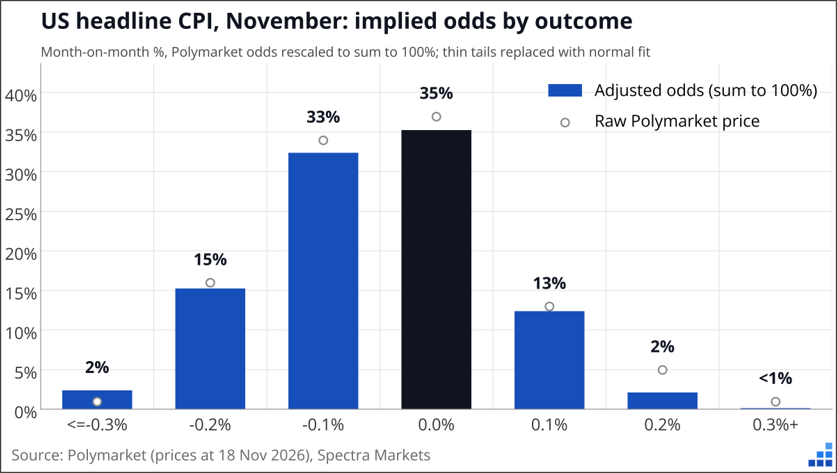
There is an 84% chance that the figure comes out flat or negative. The awkward thing is that CPI comes out on December 10, the day after the FOMC meeting.
Here is the expectation for November Core CPI, released 10DEC.
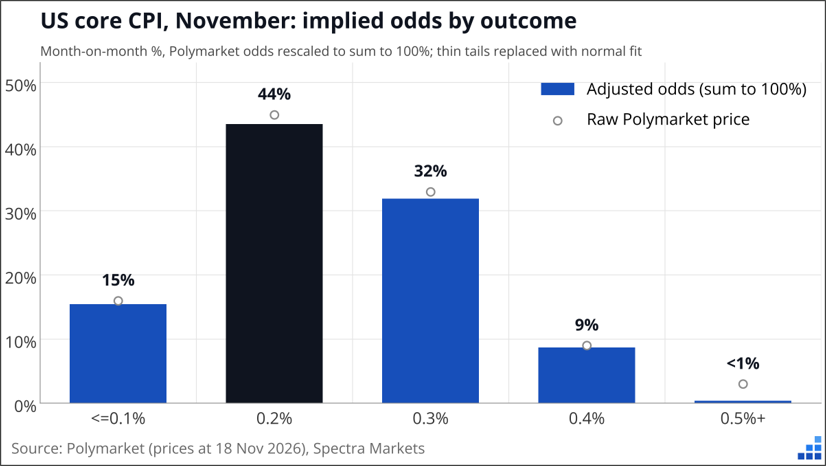
To me, this means that the following scenarios are most likely:
There is an NFP in there, too, but I have no strong view on that. The other reason I think a January hike is unlikely is that the Fed has only ever hiked in January or February one time since they moved to the SEP in October 2007. See chart. They are a conservative organization with dovish DNA that likes to talk tough on inflation but act meek most of the time.
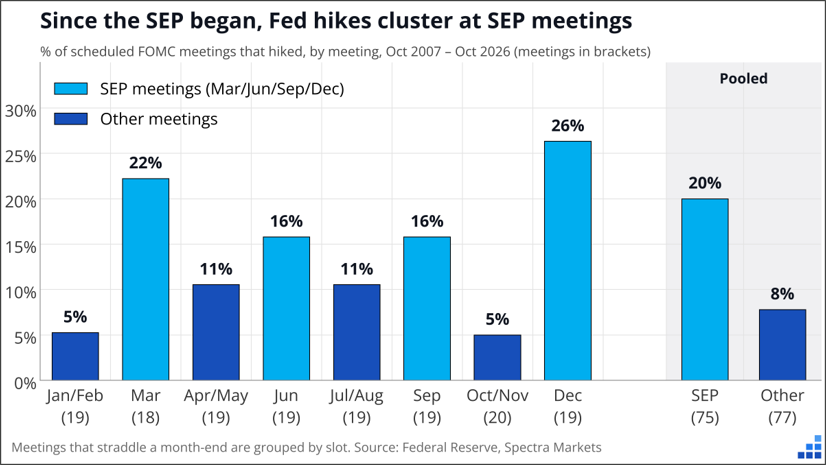
For them to be hawkish like they were in 2022 requires an emergency. There will be no such emergency visible in January as inflation will have cooled substantially due to tightening financial conditions and substantially lower commodity prices. The big supply shock from tariffs, the war, and AI capex is cooling off for a variety of reasons.
I mean, you probably know all this. I think this will all matter by January. The simple trade is to receive January FOMC in a way that you make money even if they hike in December. OIS and Polymarket are simplest but you can do it in Fed Funds, too. Polymarket has no JAN hike around 64% and WIRP has it around 70%. I am putting this as a trade idea in the sidebar because I really like it a lot. Not investment advice, just my view, which is always subject to change. This trade has staying power because you don’t need to stop out and the risk/reward is excellent.
—
Okay, that ends my excerpt. This is not investment advice. Trade your own view! If you would like to subscribe to am/FX and get my views daily, in real time, please subscribe here.
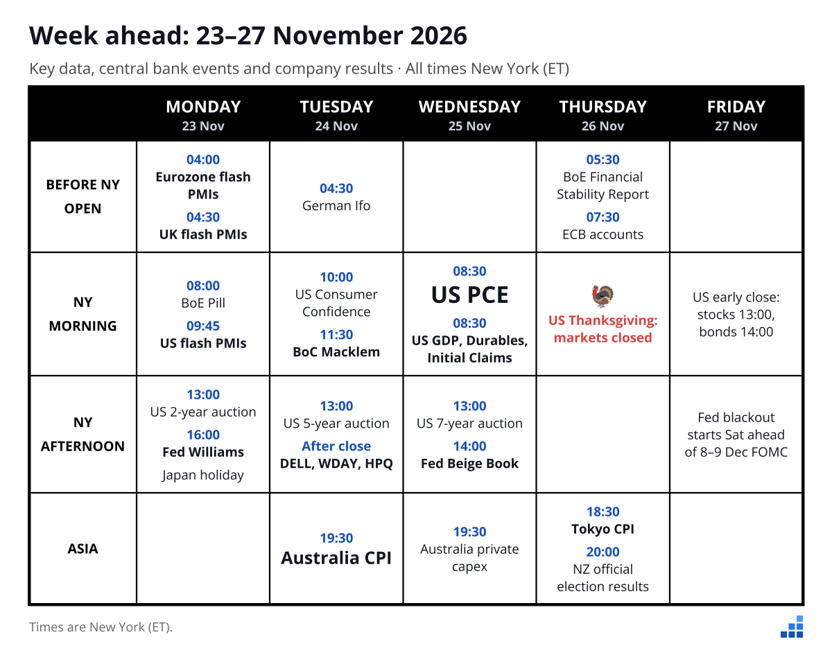
Here is what to prepare for next week:
FX is very hard right now and nobody is happy. The issue is that what most perceived to be a USD-negative event (re-rating of AI capex growth pre- and post-election) has been anything but. EURUSD has tried hard to go up a few times, and it looked reasonable to me to go short USDCHF or USDJPY and yet the USD does not yet want to sell off.
My view is that we are in the middle of a timescale mismatch where initially equity selling is USD-bullish due to rebalancing and fear and then eventually it’s USD-bearish because money flows out and doesn’t come back to the U.S. exceptionalism trade. You can see the power of the mechanical USD buying, and the USD buying for the ANT IPO by looking at the divergence between what rate differentials suggest and the level of EURUSD.
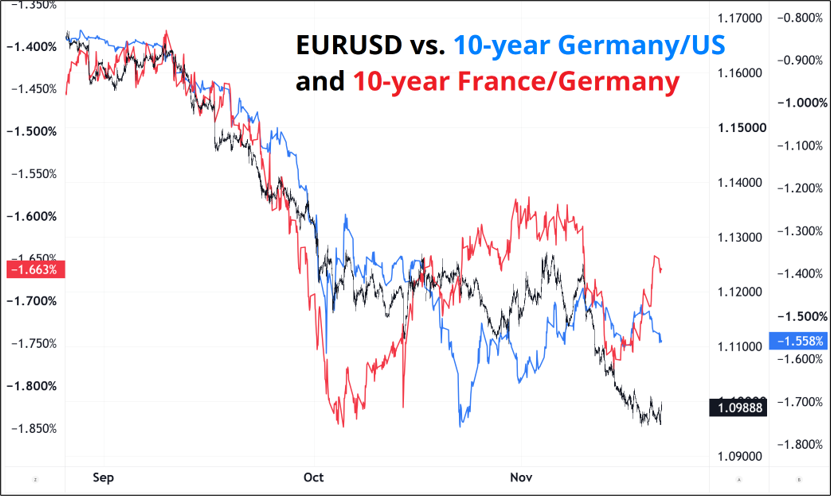
There is no law that says this divergence has to close, but I think it will. I have been wrong for about eight days now, so factor that into whether or not you choose to agree or disagree with me. Sometimes you just have to survive the pain before joy returns. I believe this is one of those moments. Large, mutant USD buying does not care about price or macro. But when it’s done, macro normally prevails.
HEY! If you’ve read Trade Outside the Box – please click here to leave a quick review. Thanks! And if you have not… Buy it here:
TRADE OUTSIDE THE BOX: Advanced Thinking for Professional Traders.
Here’s the one-pager.

The book is written for experienced traders. If you are new to the game, I would suggest you start with Alpha Trader. If you have been trading or investing for more than five years, this book is for you (and you don’t need to have read Alpha Trader to enjoy it).
Crypto has all the same problems as gold, silver, and stocks, but also has a litany of existential risks because of the Binance hack, AI hacks, and quantum risk at some point. MSTR is trading at $85 and even STRC has buckled (again) and is down to $93. There is a point in 2027 and 2028 where you have to start wondering how MSTR will look as the maturity wall looms. It’s a Rube Goldberg Machine, in a bad way.
For reference, here is the chart of MSTR, back to 1998.
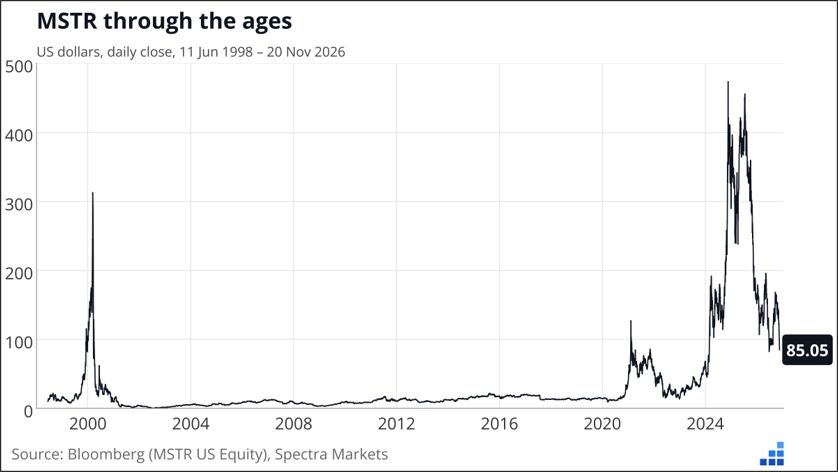
While the deterioration in the MSTR financing model is happening now, liquidity issues are still some distance away. Assuming no further capital raising, annual servicing costs of $1.4 billion, and investors exercising their puts on the convertible debt, MSTR has enough cash to get through the first $1 billion repayment in September 2027. Things get considerably more interesting in March 2028 when another $2 billion comes due. That is roughly when the cash runs out, depending on how you model it. At that point, the company might need to start selling bitcoin. Obviously, a lot can happen between now and then! But the fact that Strategy is now issuing common equity primarily to buy back preferred shares, rather than to buy bitcoin, tells you everything you need to know.
Copper finally broke down in slow motion as the AI capex buildout slowdown story logically means less demand for the metal. The 20NOV CPER puts I mentioned a few times were solid as CPER has cratered but I took profit ages ago and am currently sad about that.
Commodities are plummeting across the board…
That’s it for this week.
Get rich or have fun trying.
*************
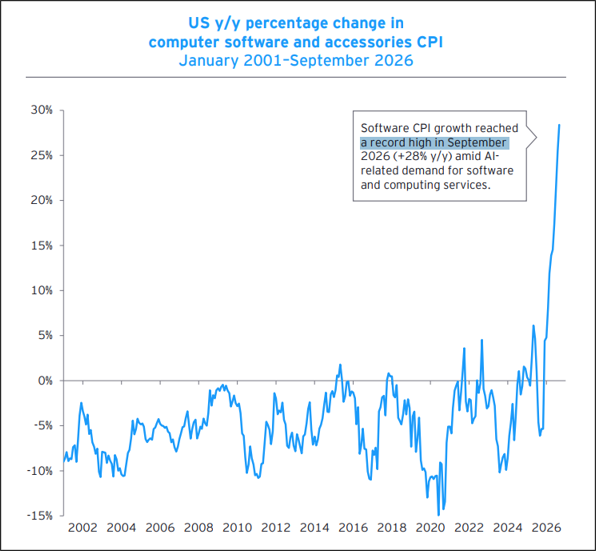
From Mike Zaccardi on Twitter
*************
*************

GTA 6 review scores:
*************
Rage Against the Machine, first public performance. Note how the crowd builds as time progresses.
*************
Thanks for reading the Friday Speedrun! Sign up for free to receive our global macro wrap-up every week.


Betting against a January hike gives you staying power because CPI is after FOMC