Many scary factors are lining up at once.
Not a real textbook
It’s Friday.
Today is my Dad’s birthday and contrary to how I often see it play out: My Dad is still my hero, even now that I am over 50.

Many scary factors are lining up at once.

Not a real textbook
It’s Friday.
Today is my Dad’s birthday and contrary to how I often see it play out: My Dad is still my hero, even now that I am over 50.
Here’s what you need to know about markets and macro this week
Macro is getting interesting again as everyone has forgotten that the war in Iran is not over and we have all moved on to Fed policy, the rising USD, and the meltdown in crypto. Today’s NFP reinforces the view that the USD is well-supported and yields should go up.
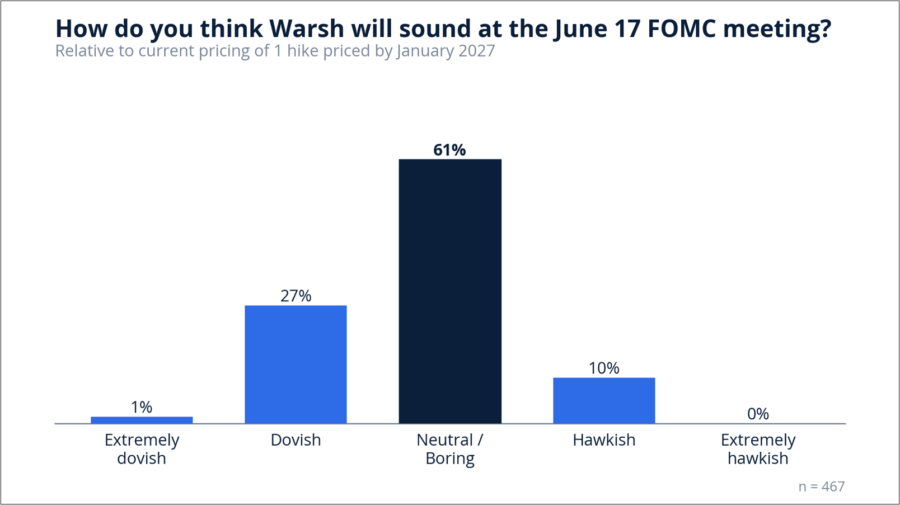
I conducted a survey to get a sense of how people are positioned for and thinking about Warsh and oddly enough, people expect a dovish Fed chair, but are positioned long USD and paid rates nevertheless. This kind of makes sense as Warsh is but one of a committee of voters and the reality on the ground is in direction contradiction to any dovish view, no matter how unashamedly you cherry pick your inflation data.
467 respondents makes for an excellent sample. The first question asked about Warsh’s tone…
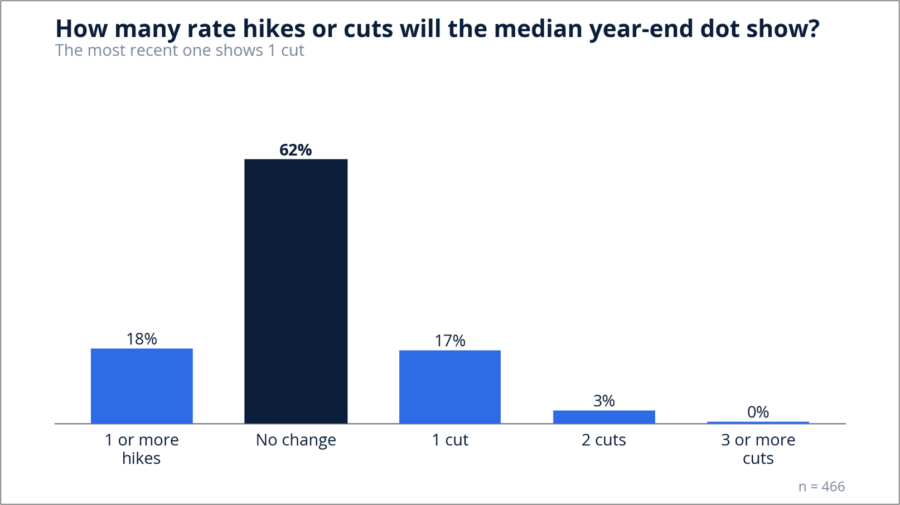
Then, the median dot. A large majority of respondents expects the median dot to go from one cut to no change.
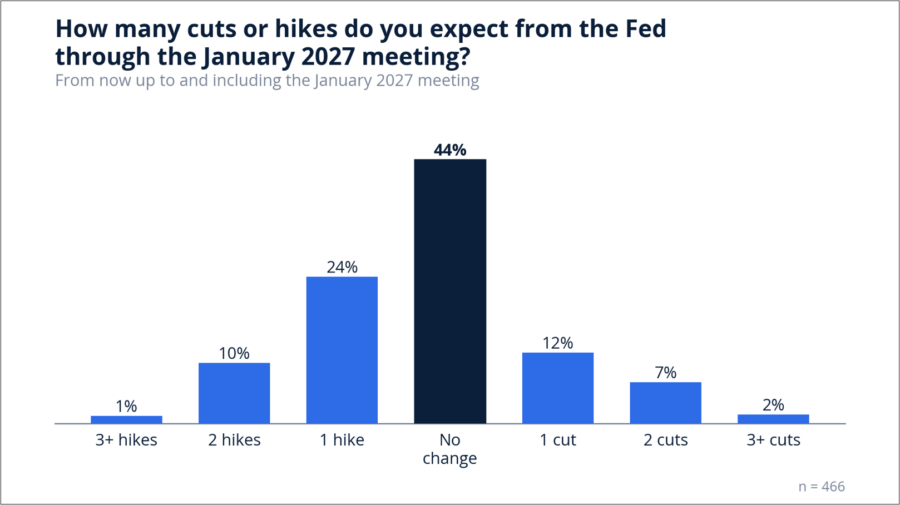
There are still some people looking for a Fed cut this year, which is mildly interesting.
This distribution of USD positioning matches our weekly positioning indicator and fits with common sense observation.
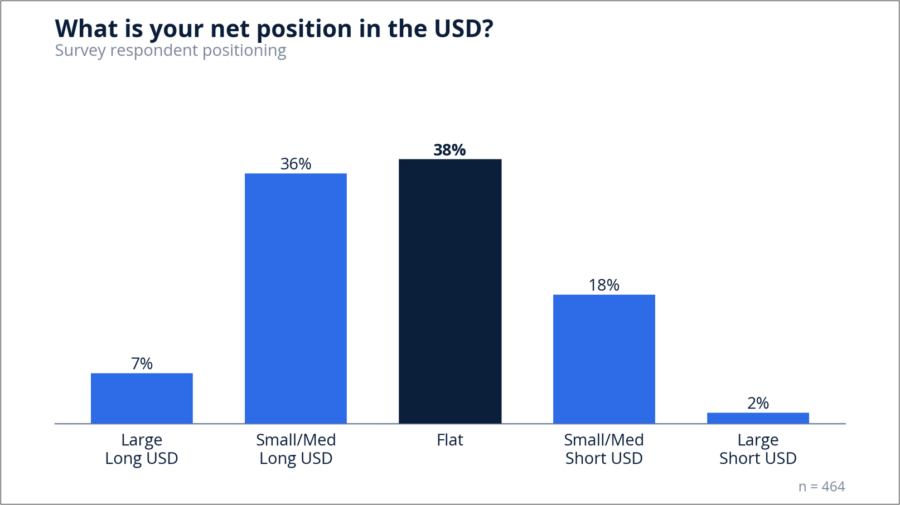
And the skew in rates makes sense, too.
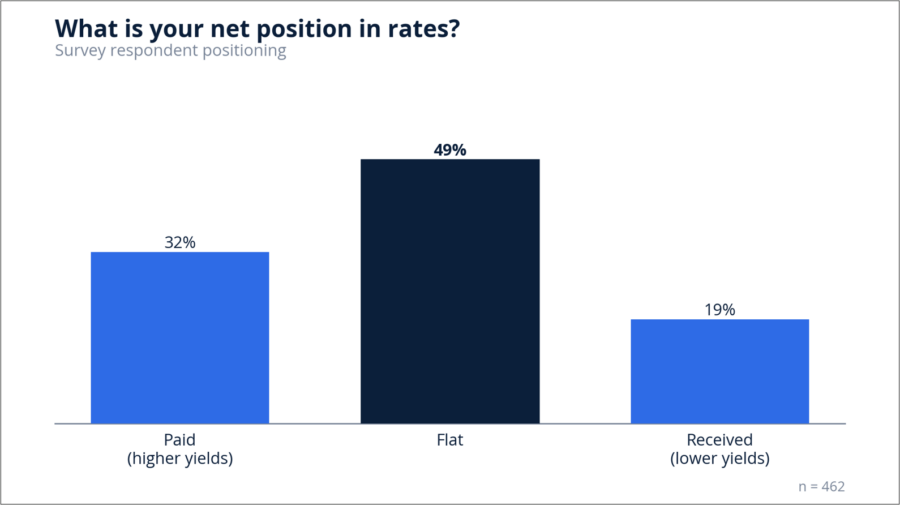
The market is not willing to sit around and wait for Warsh as the U.S. economy is heating up again thanks to AI Capex and continued spending from the top of the K and here we are.
Next week’s calendar is highlighted by CPI, BoC, and ECB.
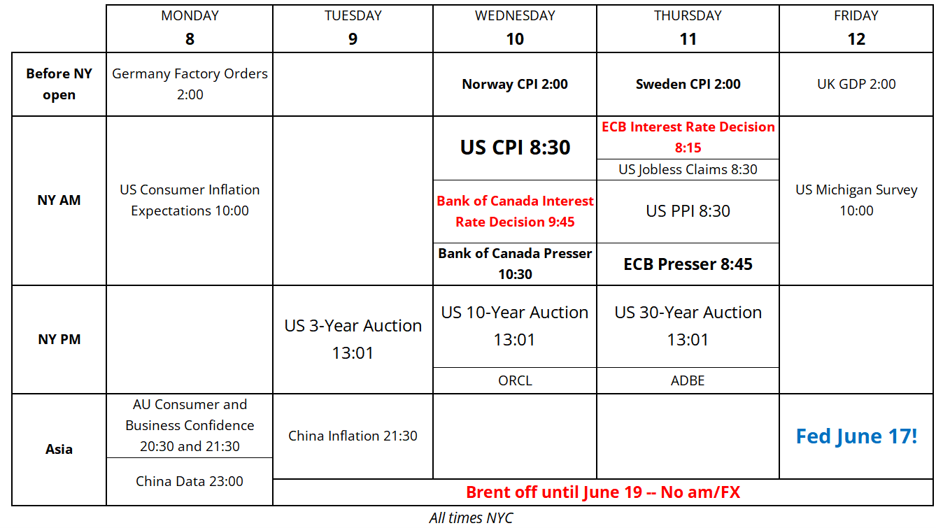
Look what’s coming at the end of June!!!
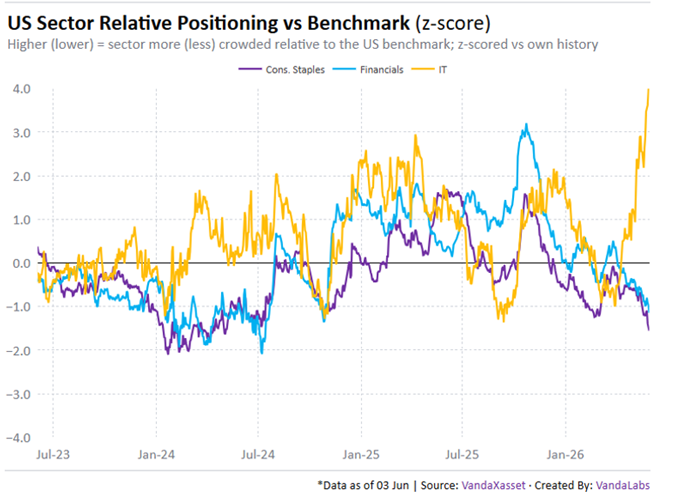
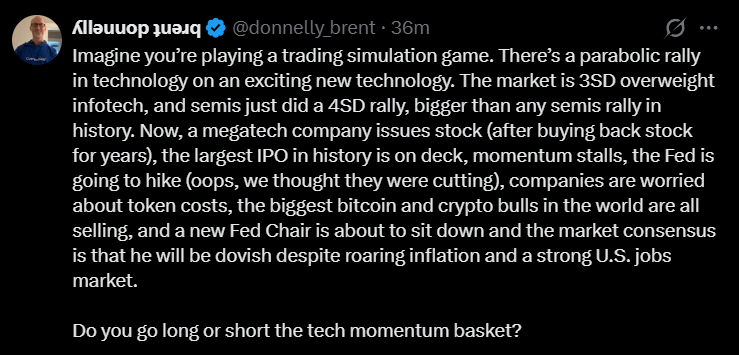
Momentum is the primary factor driving equity returns these days and it’s doing way too much work, in my opinion. I have been shorting ASTS, DRAM, and MTUM, mostly with success but also some stop outs in DRAM as it did one last leg up to 70.00 a few days ago. The SpaceX funding trade is likely to suck money out of things like TSLA and VCX, and could lead to broader selling if people are already nervous and overweight. Check out this humdinger from Vanda:
AVGO wet the bed a tad this week and that hurt chips and momentum. At this stage of the cycle, anything less than perfection means you get Old Yellered and that’s what has happened to AVGO. The rising cost of tokens and the rising narrative around corporates pulling back from AI spend due to extreme cost overruns is an argument in favor of the idea that frontier models are going to be optimized more for efficiency than for performance going forward. The cure for high prices is high prices. If memory is too expensive, they will find a way to use less memory.
The “it isn’t 1999” argument mostly hinges on earnings. And it makes some sense. But to believe that semiconductor earnings will continue to grow at anything close to the current pace requires a heroic bit of extrapolation. Parabolic prices moves don’t usually end with a consolidation or a small dip.
And speaking of no small dip, check out the post-IPO performance of the largest offerings of the past 20 years. Yuck.
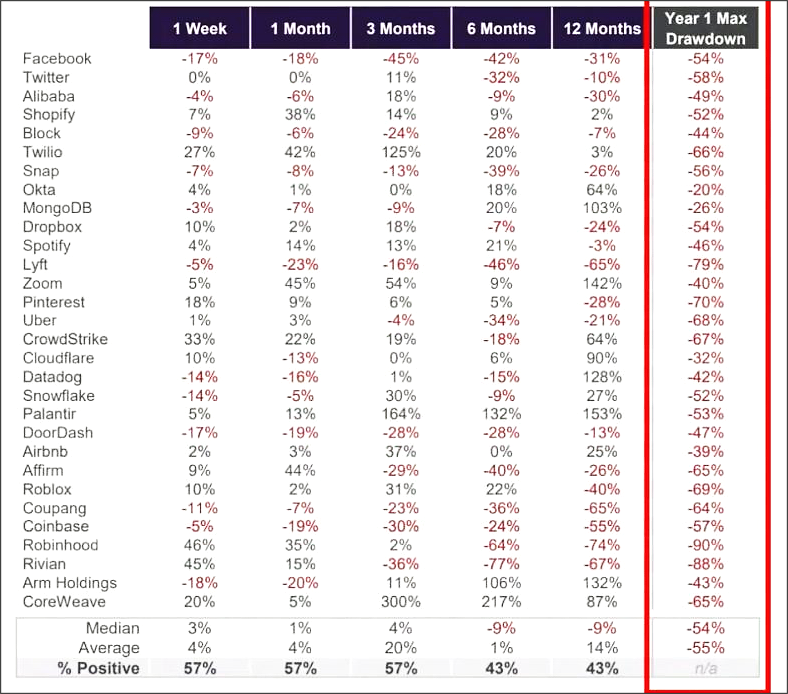
These moves are calculated by Keith Lerner from the closing price on the day of the IPO (not the IPO price itself). Max drawdown is the most bearish way to look at this stuff, but still. In this new era of IPOs by mature (overpriced?) companies, the risk is even greater than it used to be.
Here’s Aswath Damoradan’s most up to date take on SPCX.
Never underestimate the power of an Elon Musk stock, of course! Congratulations to S&P for having a spine, something few U.S. institutions possess in the year 2026.
Meanwhile, Google issued stock, in a 180-degree flip from years of conducting buybacks.
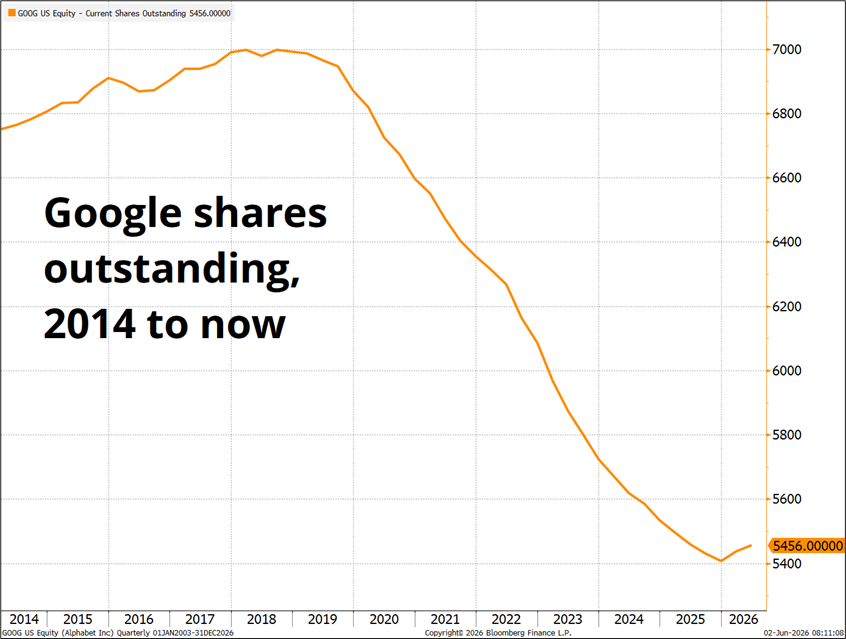
Google raising capital is a major turn of events. This is the turn from capex light money-printing machine to capex heavy hardware thing. While Google issuing shares to raise money for capex isn’t a complete shock, it’s important. It necessarily means that they will no longer be conducting buybacks and that is a major change in capital structure policy.
It’s not like you just go short Google today because of this, but the change in shares outstanding is one of the strongest predictors of stock returns. It is a known anomaly across all stocks, on average, but not a thing you use to trade individual stocks. Here is a famous paper on the topic: Shares Outstanding and Cross-Sectional Returns. And the abstract:
Post-1970, the change in shares outstanding exhibits a strong cross-sectional ability to predict stock returns. This predictive ability is more statistically significant than the individual predictive ability of size, book-to-market, or momentum. Our finding is related to research that finds that long-run returns are associated with share repurchase announcements, equity offerings, and stock mergers.
To check on how it played out after that (i.e., out of sample), I looked at equity returns vs. shares outstanding for the S&P 500 from 2015 to now. Here is the result.
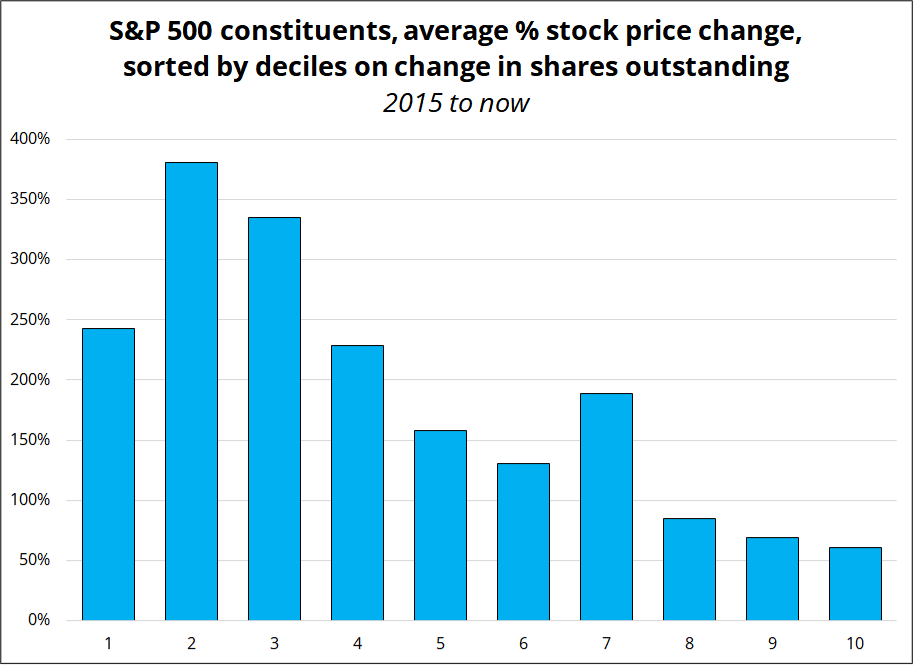
It makes sense! Price is a function of supply and demand. If you reduce or increase supply, price responds in the expected direction. And it jives with Sparkline Capital’s finding:
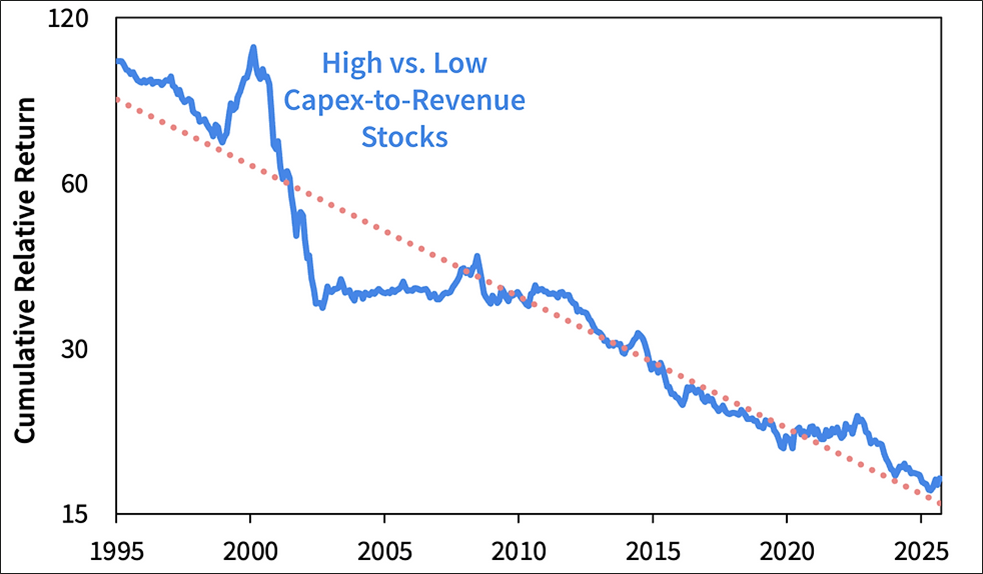
Obviously one key here is knowing ex-ante who is going to have higher or lower share counts over time. But Google just told you and other megatech is likely to follow now that they’ve opened the floodgates. This is good empirical evidence from a different period showing that share counts matter. There are simple reasons share counts matter (supply and demand) and more nuanced ones (issuance leads to higher capital spending, which lowers returns). Anyhoo, I thought that was interesting.
If you want the bear case on the financials around AI, Brandon Carl does an excellent job here. Brandon is an even-keeled and super smart guy. I worked with him at one point.
https://x.com/brandonjcarl/status/2061635331179311557?s=20
Here is this week’s 14-word stock market summary:
Momentum is cresting right into a tsunami of issuance and higher yields. That’s bearish.

https://www.spectramarkets.com/subscribe/
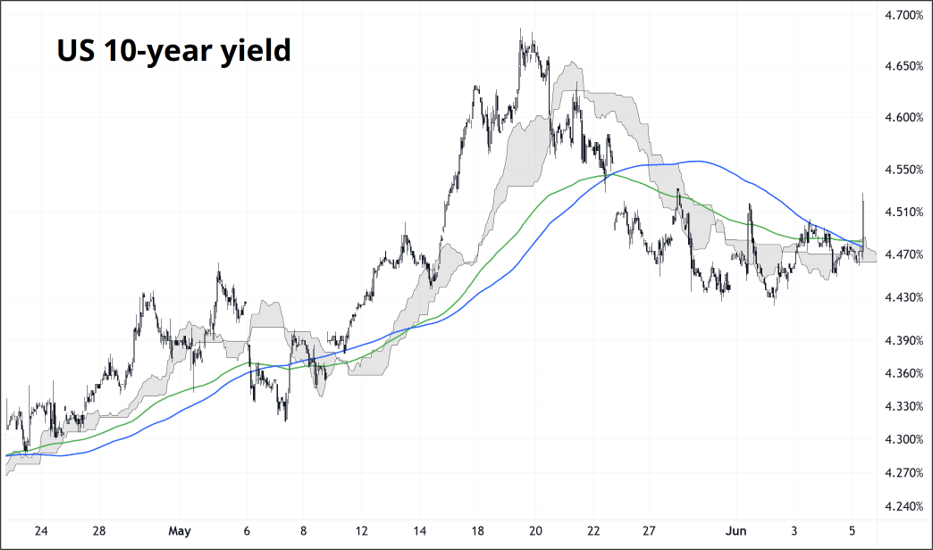
The bond market was trending for a week or two, but that trend in lower yields is busted. You can see we took out the moving averages and the ichimoku on NFP and that is about as textbook as it gets.
Warsh has been pointing at a specific trimmed mean measure of inflation that he likes, but that measure is just a lagging indicator, and it will almost surely catch up to more timely measures of inflation soon.
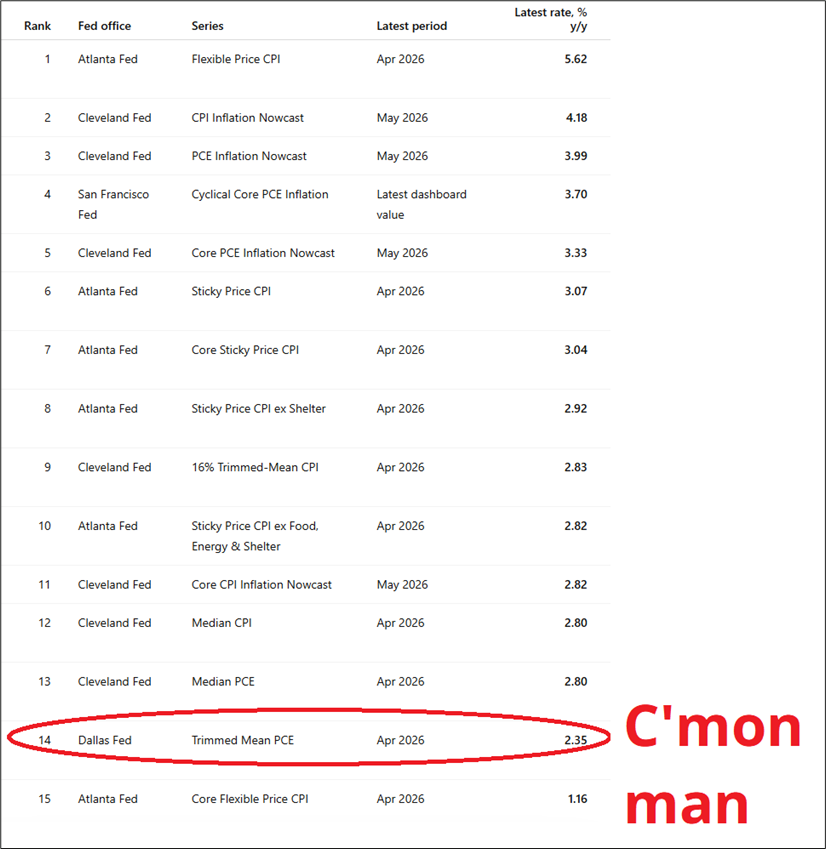
The setup allows the Warsh Fed to pick and choose whether it wants to be dovish or hawkish as markets are screaming for a rate hike bias while Warsh has indicated he prefers to cherry pick one of the lowest of 75 or 80 possible inflation series as a way of looking through the current inflationary surge.
If you look at Dallas Fed Trimmed Mean vs. Core PCE, you can easily see that the Dallas series is simply a lagging figure. Here’s the chart:
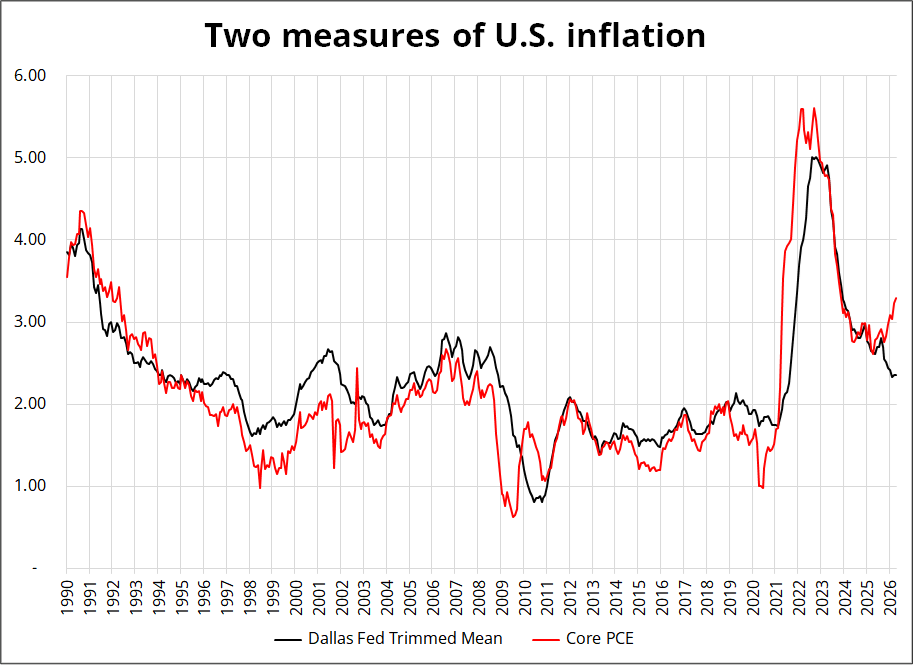
Every single turning point, Core PCE moves first, Dallas Fed follows. It’s easy to see the red line leads the black line, but if you want numbers to back it up… If you lag Dallas Fed by four months, there is a 92.1% r-squared to Core PCE. Here’s the scatter of Core PCE today vs. Dallas Fed Trimmed Mean in four months. C’mon man.
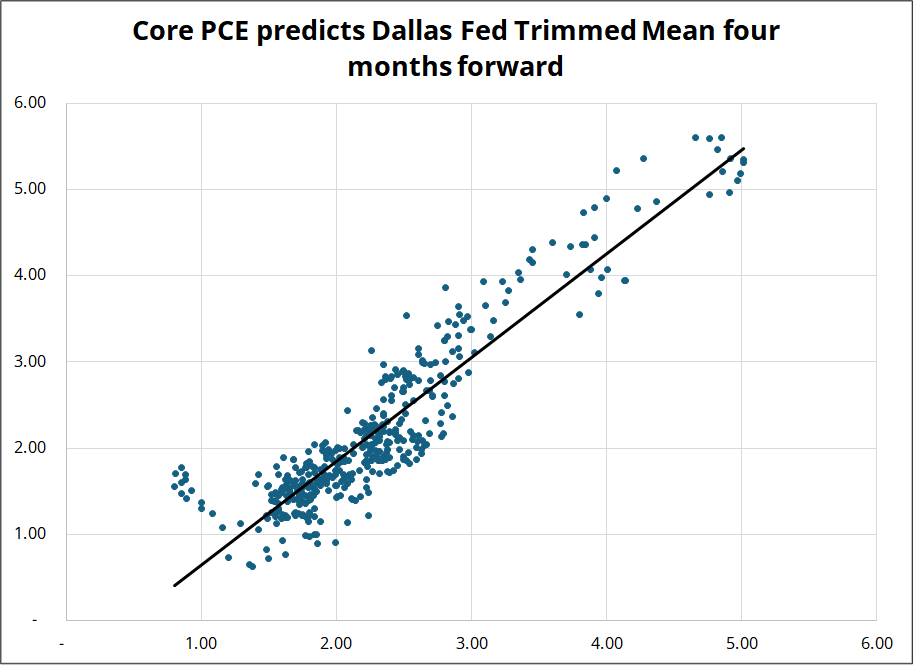
Anyway, if Warsh wants to cite trimmed mean as his north star, it’s going to be ripping higher in four months so he’s not buying himself all that much time. But it will allow him to sound dovish June 17, potentially. For your guide, here are all the Fed inflation metrics ranked highest to lowest.
June 17 is a big day! I will be travelling in Ireland, but you should be at work for sure that day.
EURUSD has been going nowhere for a few months as you can see from this chart:
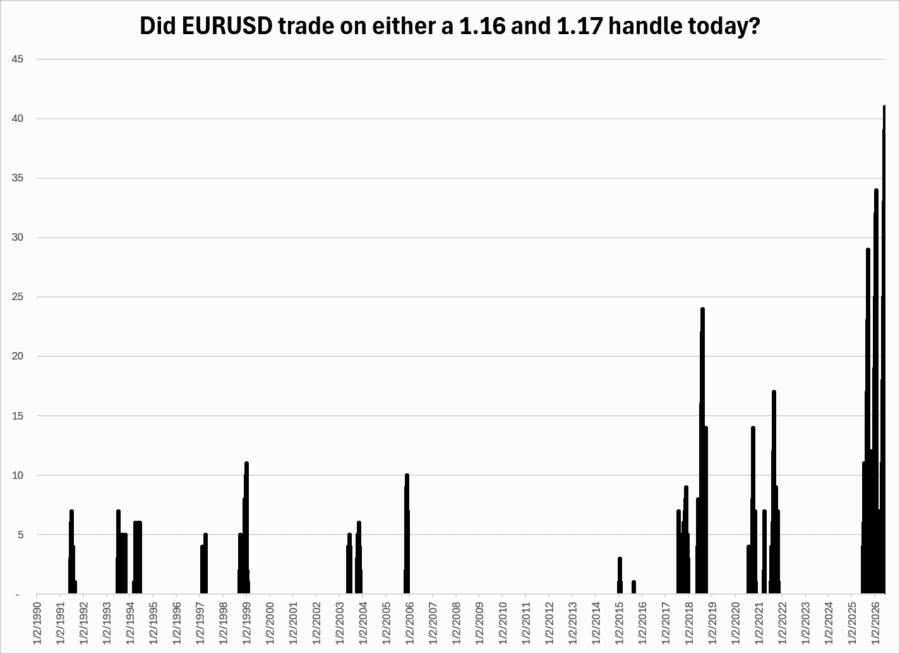
But G10 FX finally broke out today as the USD is ripping on NFP. It’s not always the case that we see a big USD move on NFP, even with a beat of the size we saw today. I guess those negative NFP revisions were meaningless after all.
USDJPY is weird because fundamentals are driving it higher, but the MOF wants it lower. Will they intervene in the face of rising bond yields and a strong U.S. economy? I think above 161, they will have to.
Not even HYPE and PURR could survive the bloodbath in crypto as The cryptocurrency universe has lost half its market cap in eight months.
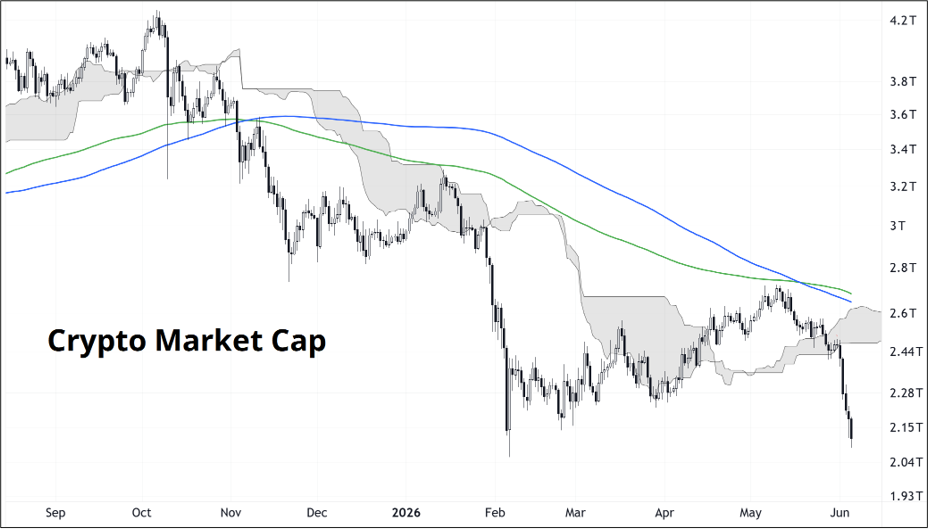
The crypto DAT stupidity and new worries about whether or not Saylor has any plan to pay back MSTR’s monster debt load are pushing the digital coins lower.
This is not so much a sentiment story as a flow story. The same guys that were buying BTC at $100,000 and ETH at $3,500 are now selling.
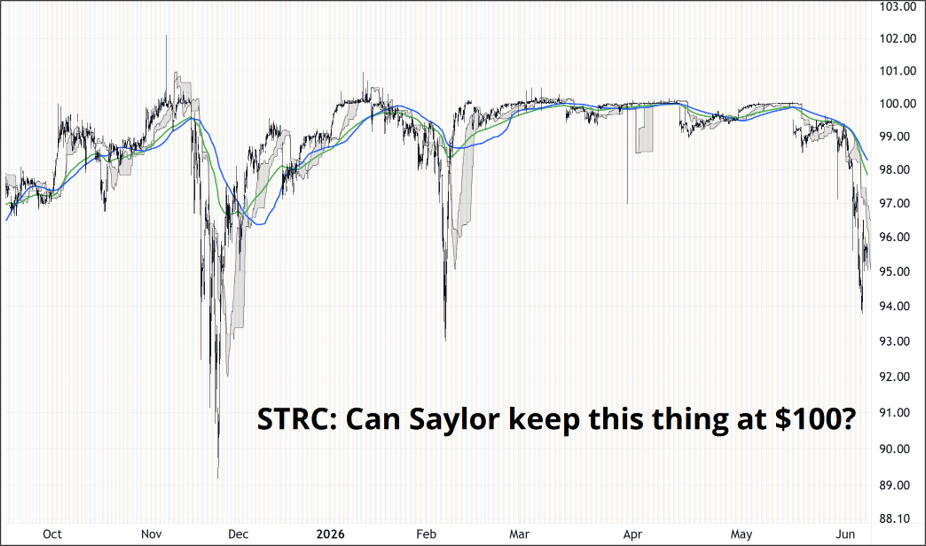
The death spiral / contagion theory is in full force, and we may start to see some true craziness in STRD, STRF, STRK, and STRC as the market prices in the fact that the mechanics behind the MSTR Rube Goldberg machine look a little bit like the mechanics behind LUNA.
You can see the same situation in the ETFs… The buyers went wild above $100,000 and now are in full capitulation mode. Selling every day.
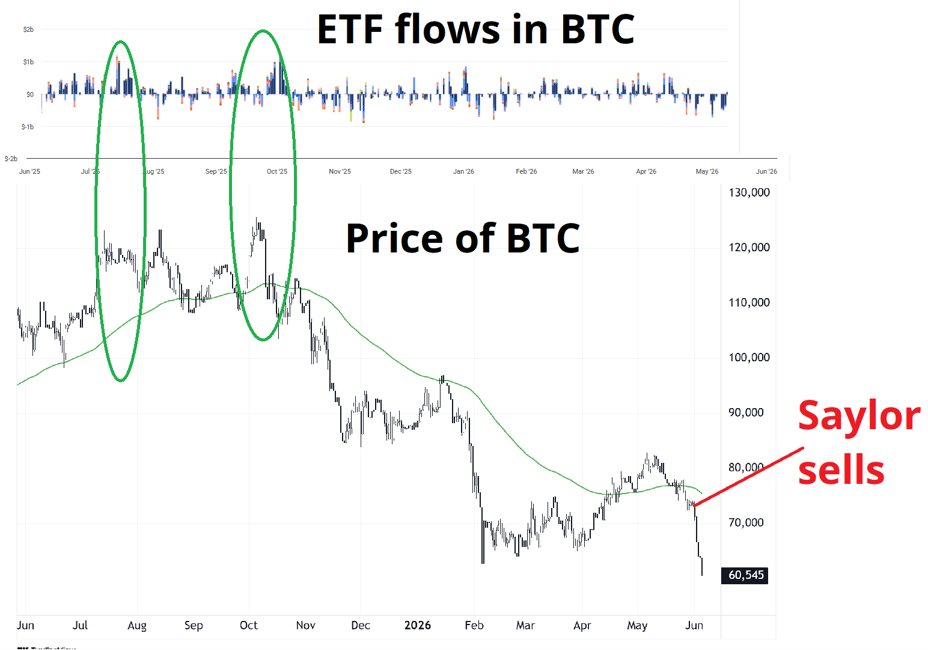
Normally, all this bearish sentiment would be bullish but with the death spiral in crypto DATs, I am thinking we take out BTC 50,000 before it’s safe. And the problem is: The lower bitcoin goes, the more difficult life becomes for the nightmarish capital structure at Strategy.
Recall that the tickers for the MSTR preferred shares are:
MST F
MST C
MST K
MST E
MST D
In the novel-writing business, we call this foreshadowing.
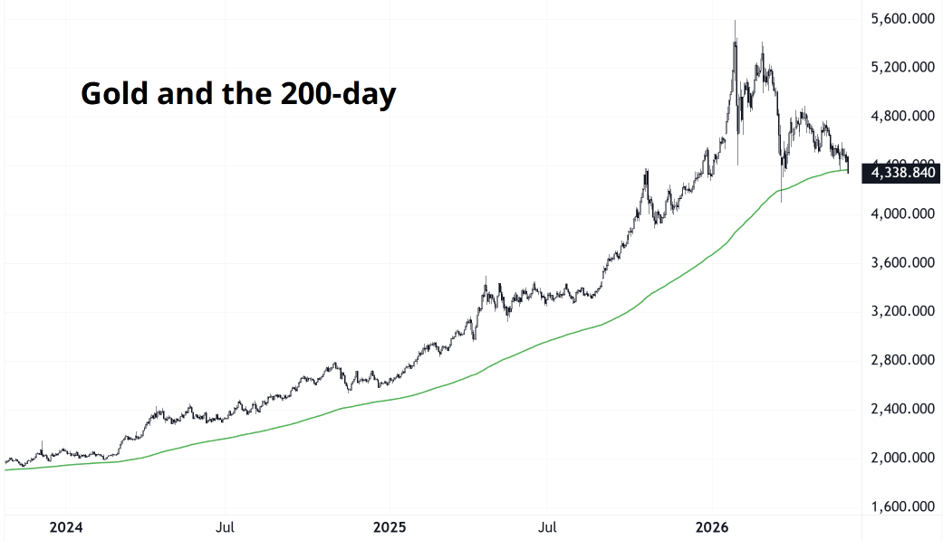
Gold is acting like analog bitcoin as it dumps back toward the 200-day moving average. I had tried a long, thinking it would be a risky asset that would follow stocks to new all-time highs, but this was wrong. It goes down when stocks selloff and goes nowhere when they rally. And has negative carry. The central banks are buying theme has turned into the central banks are selling theme (different CB’s, but yeah). No bueno. I cut my bullish gold view for a small loss and I feel much more comfortable having done so. Below the 200-day watch out.
Oil is going nowhere.
The CME might start trading compute soon, which is cool. If you’re a young trader, a huge edge is possible if you decide to specialize in a new product and become the expert in that thing before anyone else.
That’s it for this week.
Get rich or have fun trying.
I want it. But I don’t like it.
My new article on Panoptica.
This isn’t another ‘smartphones are bad’ article … I mean, they are and it is … but living in the world-as-it-is means minimizing our smartphone ‘dark flow states’, not eliminating them. This is my reckoning with the relationship, and practical strategies for managing it.
Part of a new series from Ben Hunt.
Related:
If you’re interested in writing as a skill/craft, here’s a 17-minute video about how I write.
*************
Useful knowledge to bookmark, from Marc Andreesen
*************
*************

*************
Follow SPCX price before it IPOs. On this perp, $150 = $1.75T
*************
Thanks for reading the Friday Speedrun! Sign up for free to receive our global macro wrap-up every week.