JPY
We got comments from Bessent this morning. He admitted the “buy JapaNeSE YeN” on his notepad was staged for reporters (as expected) and he suggested that intervention now requires backup from the BOJ if it’s going to work. As discussed yesterday: If Bessent was trying to flex his credibility or scare the market, this was not the way to do it.
*BESSENT: WANTED TO MAKE SURE REPORTERS KNEW THE SYMBOL ‘JPY’
As Cuppy D used to say: What are we doing here?
Of the many headlines, these ones are potentially relevant:
Intervention won’t work unless the BOJ plays ball…
*BESSENT: INTERVENTION CAN GIVE MARKET SIGNALS BUT POLICY IS KEY
*BESSENT: BELIEVE BOJ GOVERNOR UEDA WILL DO WHAT IS NEEDED
*BESSENT: HIGHLY CONFIDENT JAPAN WILL DO POLICY FOLLOW-UP
Watering down the EURJPY intervention
*BESSENT: ASSURED EUROPEANS IT WAS JUST RESERVES RE-ALLOCATION
The U.S. runs only tiny FX reserves (see here) because the U.S. dollar is the global reserve currency. As such, reserves re-allocation by the United States is not like China reserve re-allocation. The U.S. has something like 22 billion euros and 12 billion USD worth of JPY, and then some SDRs and a whole lot of gold. If it’s only doing reserve re-allocation, that waters the cooperation down somewhat.
U.S. authorities have other, theoretically-infinite ways to intervene, of course (like the Exchange Stabilization Fund and help from the Fed), but the silly notepad thing and the fact Bessent is advertising this intervention as coming from FX reserves both water down the ferocity of the policy. The most effective intervention is all-in with no caveats, coming from a scary policymaker willing to do whatever it takes. This is not that, despite Bessent parroting the line Draghi copyrighted in 2012.
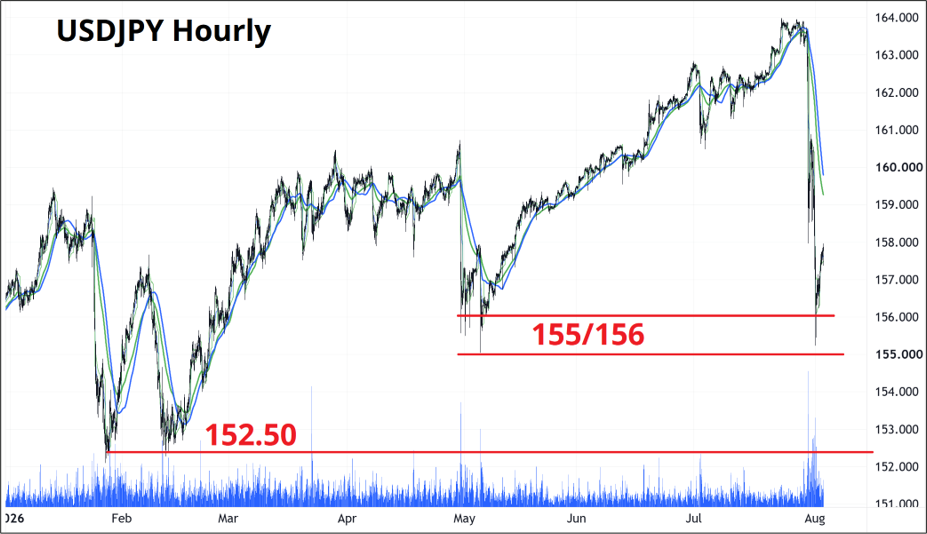
I continue to believe (as discussed yesterday) that the fun part is over for JPY, and we are going to be 155/159 for a while. The next intervention (if there is one this week) is a fade. The big line in the sand is 152/153.
In yesterday’s am/FX I showed how even successful coordinated intervention does not turn the entire FX market on a dime. There are pullbacks and retracements and retests. I do believe that bigger picture, USDJPY and cross/JPY are sell rallies setups because you have MOF, US Treasury, and GPIF all onside (and maybe BOJ?). But that doesn’t mean there won’t be some great long USDJPY trades in the meantime.
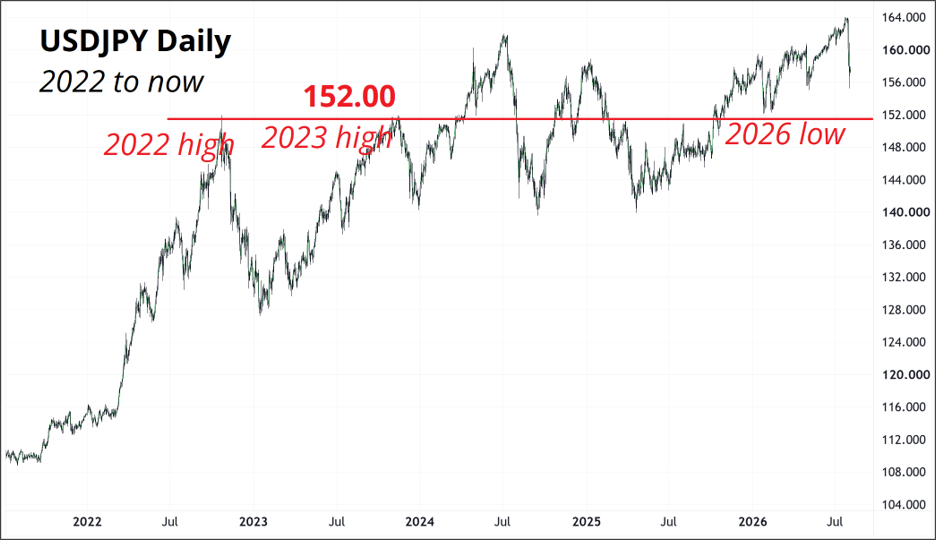
Looking at the chart, you can see that 155/156 is critical and 152.00/50 is a nice double bottom down there. Because I sold out my USDJPY hedge last night (I am long a 157.50 put that expires Thursday), I am net short USDJPY and getting bullish. I will look to buy my full notional at 156.50/60 if we get there and go long USDJPY at 153.60 with a stop loss at 151.64. That entry point is obviously far away and would require more intervention. 152.00/153.00 is the dream entry point for long USDJPY if you’re bullish. Not only is it that double bottom support from February…
… It’s also the 2022 high, the 2023 high, and the 2026 low.
To summarize my view: Coordinated intervention is meaningful, but not a one-way bet in the short run. Bessent’s credibility was strong coming into his role as Treasury Secretary, but the halo has dimmed over time as most of his wishes have not come true. Instead of lower yields, smaller deficits, lower oil prices, and lower inflation, we have all four metrics going the wrong way since he started. As such, the Bessent Magic that some expected from an experienced hedge fund manager in the driver’s seat at Treasury has not materialized. While much of this is probably not his fault really (unless he was in on the tariff and war decisions), it does make his wish for lower USDJPY less credible. That said, he has many levers at his disposal! I am not completely pooh-poohing America’s cooperation. It’s important! But it’s not going to take USDJPY to 150 in a straight line—the market’s just not that scared.
If you’re a vol person, and you are a good risk manager, selling 150 and 152 strikes while they are still overpriced is probably a nice bet.
In the weeds on put spread P&L accrual
This section is a bit in the weeds on trade structuring and trade management. Feel free to skip if that’s not your bag.
On July 10, 2026, I entered a 10SEP 199/196 CHFJPY put spread as GPIF noise started and other reasons. Today, I was thinking about whether to take it off or keep it. After talking to Matt Gittins, our local expert in trade structuring and practical options trading, here’s what I concluded.
The thing cost 74 pips, is currently worth 200 pips, and will be worth 300 pips if we are below 196 on September 10. My base case is that USDJPY and CHFJPY are modestly lower in a month, but not much lower.
This first chart shows how the P&L looks at three future dates and various levels of spot. Those wavy lines are roughly what I would have envisioned for the payout going forward.
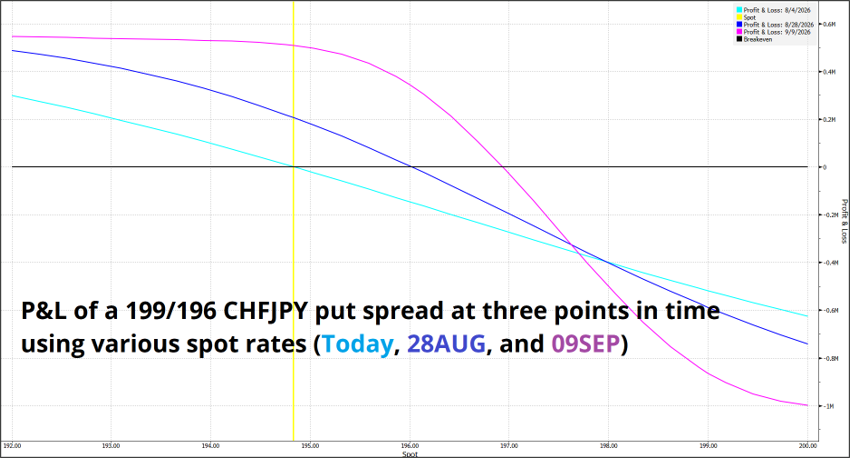
But something I did not fully appreciate was how non-linear the decay looks as September 10 approaches. The option earns money each day we’re below 196.00, but most of the money is earned near expiry. I am supposedly an options expert, but I did not appreciate how the decay (or accretion) is so steeply backloaded. Here’s how the P&L progresses if spot stays unchanged right here.
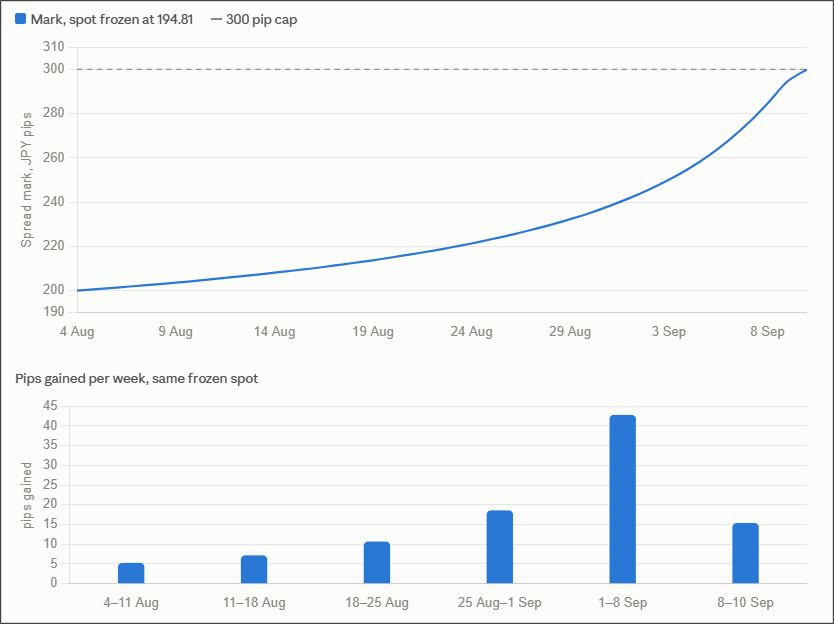
The weird thing about decisions like this is that you are looking at something where you are risking 200 to make the final 100. That feels like bad leverage. But if you cut everything at this point, you never get the leverage you thought you were getting when you put the trade on.
That is: I paid 74 pips to make 226. That’s almost exactly 3:1. But if every time a trade like this goes in the money, you cut it because you don’t like the remaining lack of leverage; at inception you were really risking 74 to make 126. Riding stuff to expiry is scary, but it’s very often positive EV. With MOF likely to cap at some level of USDJPY, vol likely to fall as the chaotic phase is over for JPY, and CHF continuing to trade like a legit funder: I will keep the CHFJPY put spread hoping to milk the final 100 pips over the next 36 days.
Astute readers may recall that USDJPY and cross/JPY seasonality turned mega bearish on July 20. That was bonkers timing, obviously. Skeptics will write it off as luck, but the seasonality signals have a near-60% win rate out of sample since we started publishing them in 2023. Anyhoo, CHFJPY’s most bearish seasonal period is August 8 to September 7; so that’s one more reason to hang on.
I hope you d-d-d-d-do your best today. I promise to write about something other than JPY tomorrow.