Going through Warsh’s statements to land on PPI

Going through Warsh’s statements to land on PPI

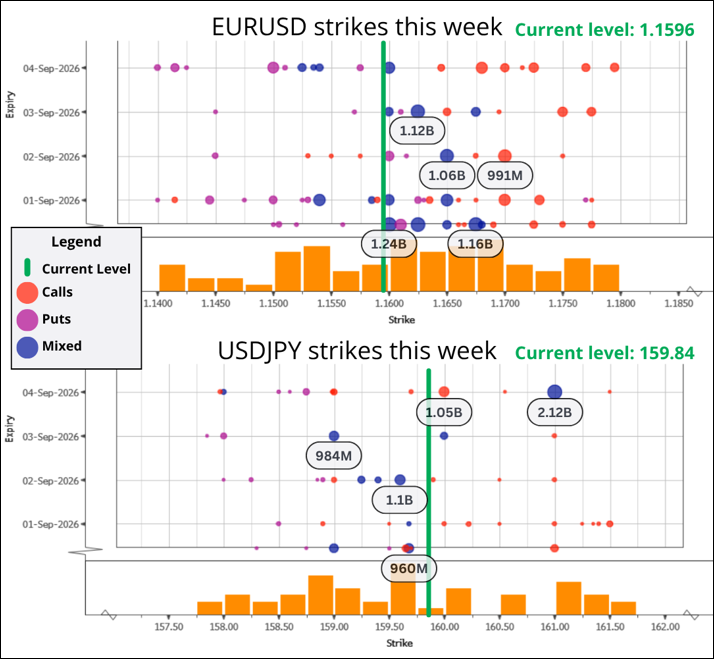
Short EURUSD and USDJPY 02SEP vol
as described in am/FX on 26AUG (pin trade)
1.1650 vs. 1.16/1.17 and 159.30 vs. 158.80/159.80
Short EURJPY @ 184.80
Stop loss 186.37
09SEP USDCNH call spread
6.7300/6.7400 for 42 CNH pips
10SEP CHFJPY put spread
199/196 for ~37bps off 200.50 spot
30NOV Long 1.23/1.25 AUDNZD c/s
vs. short 1.18/1.19 p/s
Cost 2.5 bps off 1.2093
The market responded to the Warsh speech with a zippy move in 2s, DXY, and gold, while stocks and crypto shook it off. I understand the hawkish market response, though I remain a bit skeptical because much of the language is a repeat of June FOMC. Still, the hike bar just dropped a bit.
Take a look at the black line in my first chart and you will see that September hike odds closed at 61% after the June FOMC, and after Warsh’s recommitment to the inflation target and reiteration that 65 months above target is not good last week… September hike odds spiked back to… 61%.
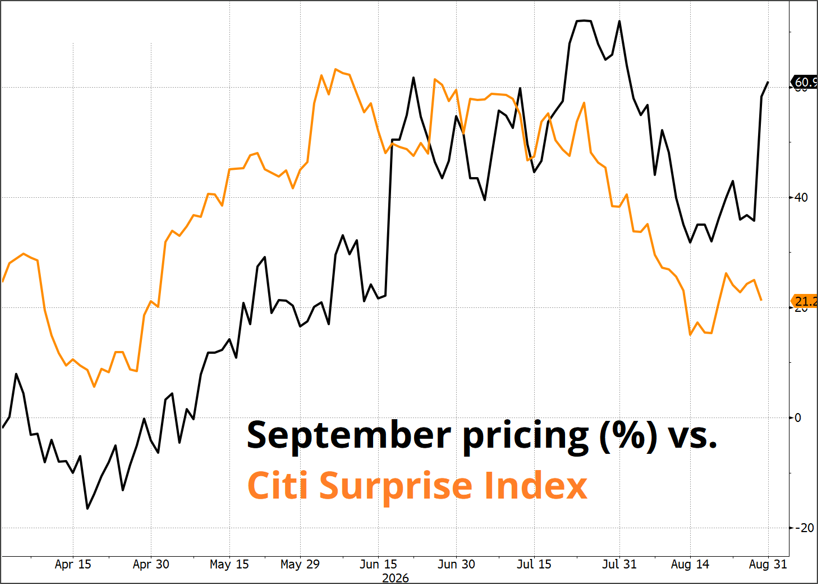
This is meaningful in the context of softening economic surprises. Warsh is saying the bar for a hike is lower than people thought. We appear to be at one of those ridiculous moments where the next monetary policy decision will come down to one data point, right before the meeting.
Given that Warsh gave very specific guidance as to what data points he will be watching from here on in, and the market took that guidance to mean the odds of a September hike have increased, I figured it might be useful to parse the speech so that I know which macro data points are worth monitoring and which are not into and after the FOMC.
The speech, titled “In Our Time,” Warsh offered this closer: “Here is my standard: We must be confident that underlying inflation is moving to our objective, clearly and at sufficient speed. Otherwise, we have work to do.”
It’s an interesting statement because it leans towards the idea that change is good enough, even if the target level (2%) is not achieved. That is, there is an assumption that if there is downward momentum, it will continue, and so a reasonable forecast is to simply extrapolate the current rate of change. This is important because it’s one of the main reasons the Fed keeps missing the inflation target: As soon as inflation starts to improve, they ignore the level, cheer the rate of change, loosen up policy and trigger looser financial conditions that push inflation back up.
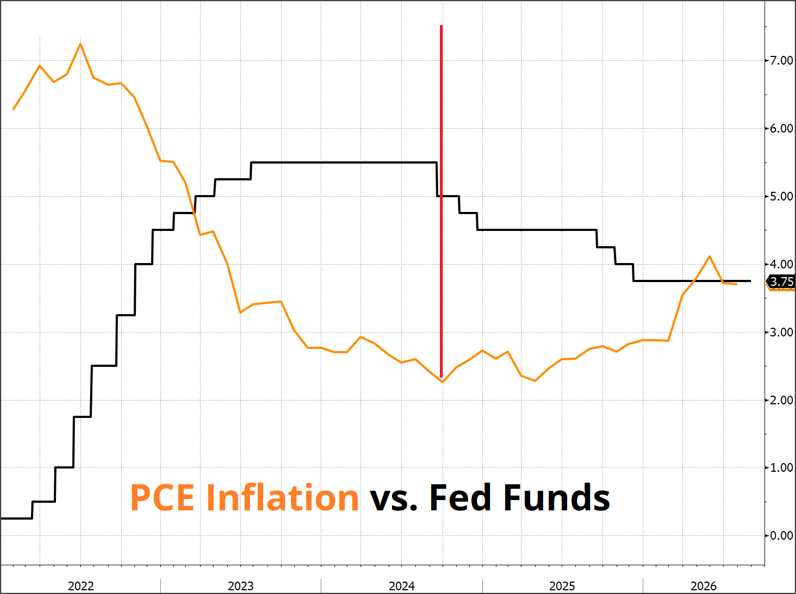
The red line on that chart shows the bottom in U.S. inflation and the start of the two mini rate cut cycles. Maybe a coincidence that inflation bottomed at the same time as the Fed started cutting, but… Probably not? War made things worse, of course, but inflation bottomed in 2024 and the war was in 2026, so you can’t blame it entirely for the Fed’s inability to reach the target. You know what the pharmacist says:
Don’t stop taking your medication just because you start to feel better! To quote a random health website:

So, for now, the market appears to believe that the bar for a rate hike is low and it comes down to NFP and CPI. What if I told you the key release is not NFP or CPI, but PPI? Let’s look at all the most important data points Warsh discussed and see what that might mean.
Inflation data
Inflation expectations
Financial conditions
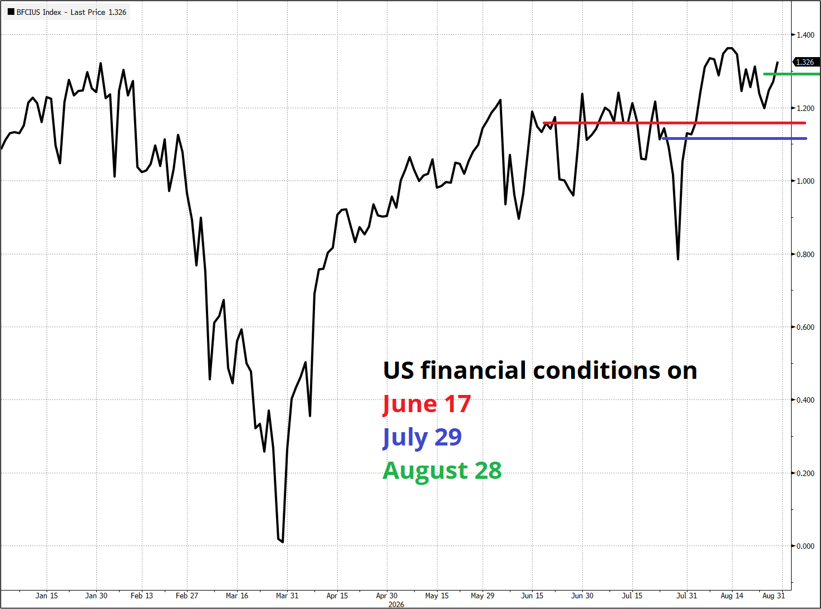
This is more hawkish than his past statements, which have been all over the place. Here are Warsh’s characterizations of financial conditions in June, July, and August. Note that measures of financial conditions from GS and Bloomberg show almost no change in financial conditions over this period.
June: Financial conditions are mixed, or uneven.
COLBY SMITH. So just following up, I guess on the current policy settings then, I am curious how restrictive you think things are at the current moment, given the flow of data that we’ve seen and, you know, forecasts that are coming down the pipeline.
CHAIRMAN WARSH. Yeah. I—I’ve heard characterizations, both inside in the Fed about that. I’ll give you my own. It’s uneven. And, if I look at the housing markets as one example, Fed policy isn’t the, the single determinant of the state of the housing market, but broadly I would say, there, Fed policy appears to be somewhat restrictive. I would have a hard time managing to say those words if I were to see what’s happening in financial markets, so I’d say it’s uneven.
July: Financial conditions have tightened.
We’re going to deliver on the remit. You don’t have to take my word for it. If you look broadly at market prices, they are certainly not saying “all clear,” but they are working in concert to, to keep us on our toes, and they have tightened financial conditions in this intermeeting period. And, and that has given us a—that has provided us some—some comfort that, that we’ve got the ability and capability to deliver.
August: Financial conditions, on balance, are not restrictive.
Credit spreads on corporate bonds and leveraged loans are near the low ends of their historical ranges, and issuance volumes in these markets have been quite strong this year. Looking beyond fixed-income markets to the banking business, in the July Senior Loan Officer Opinion Survey on Bank Lending Practices, banks tell us that standards for commercial and industrial loans are on the easier end of their historical range. That helps explain the growth we’ve seen this year in those loans. Credit and loan markets are showing few signs of policy restraint. Certain sectors—like housing and agriculture—are showing strains. But, on balance, I would be hard pressed to describe broad financial conditions as restrictive.
While Warsh still gives a nod to housing weakness, he spends most of his time talking about low equity vol, tight corporate spreads, easy lending practices and so on. Instead of the uneven financial conditions he saw in June, and the tightening ones he saw in July, he now finds it hard to describe financial conditions as restrictive. I suppose he could have just said “financial conditions are loose.”
For context, here is a look at financial conditions at the open on the three Warsh speaking dates.
Labor market
BOTTOM LINE: We have a slightly more hawkish central bank and a laundry list of data points to watch. With September FOMC still close enough to 50/50, and Warsh saying he is not at all worried about jobs, the answer to hike or no hike is most likely to come from the inflation data. The FOMC is before the next PCE release, so it’s only CPI and PPI that matter. This month is one of those weird ones where PPI comes out before CPI. The market does not always fully appreciate how correlated the misses are between PPI and CPI, so there is an edge in going hard after PPI if it signals a particular direction for inflation.
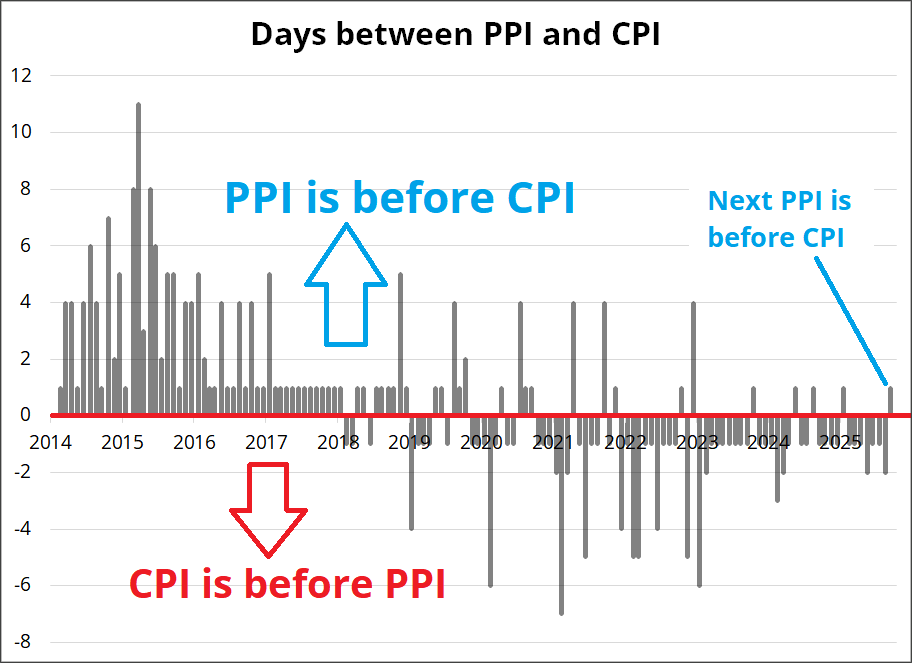
The market is used to PPI being a nothingburger, but that is mostly because it normally comes out after CPI and thus contains very little new information. When PPI comes out first, it matters. I will discuss this more as the PPI date (September 10) nears, but for now just know that the miss in PPI is an excellent predictor of the miss in CPI.
While the above section gets us to the point of knowing that PPI is probably the most important release for traders before the next FOMC, the bigger picture question is whether any of this matters much (or at all). One or two hikes from the FOMC will have essentially zero impact on, or transmission to the real economy. So, while rates and FX are logically moving in response, it also makes sense to me that equities should give little or no concern to a tiny recalibration cycle. Even if the Fed hikes in September, this is not a meaningful change in monetary policy. They are fiddling around with the dials.
This week’s calendar has some interesting moments. The RBNZ meeting will be particularly important for the long AUDNZD trade because that trade rests partly on the idea that too much is priced in for the RBNZ given rising unemployment, weakish growth, and soft housing. If the RBNZ lowers the rate track, that should unlock some AUDNZD topside.
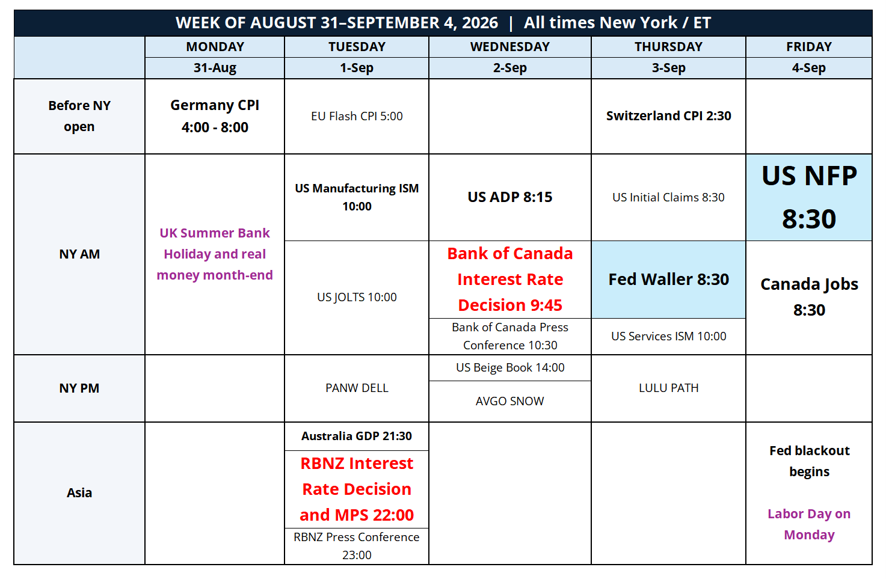
The BoC is less interesting.
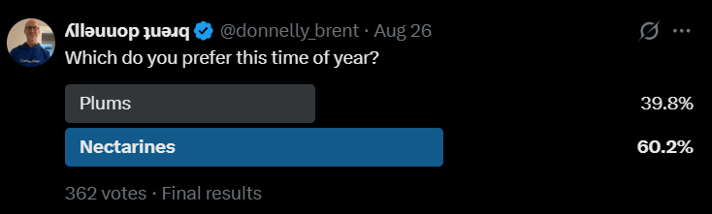
Have a peachy week. Positioning Report to follow. Thanks.
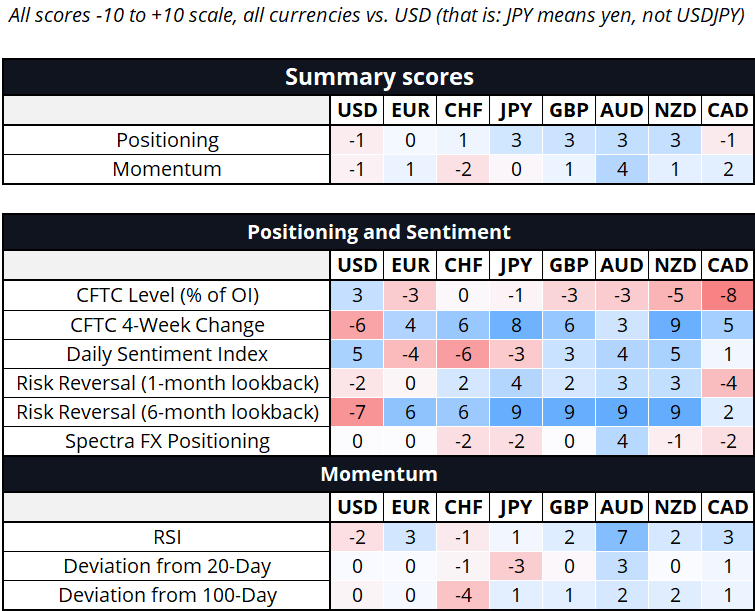
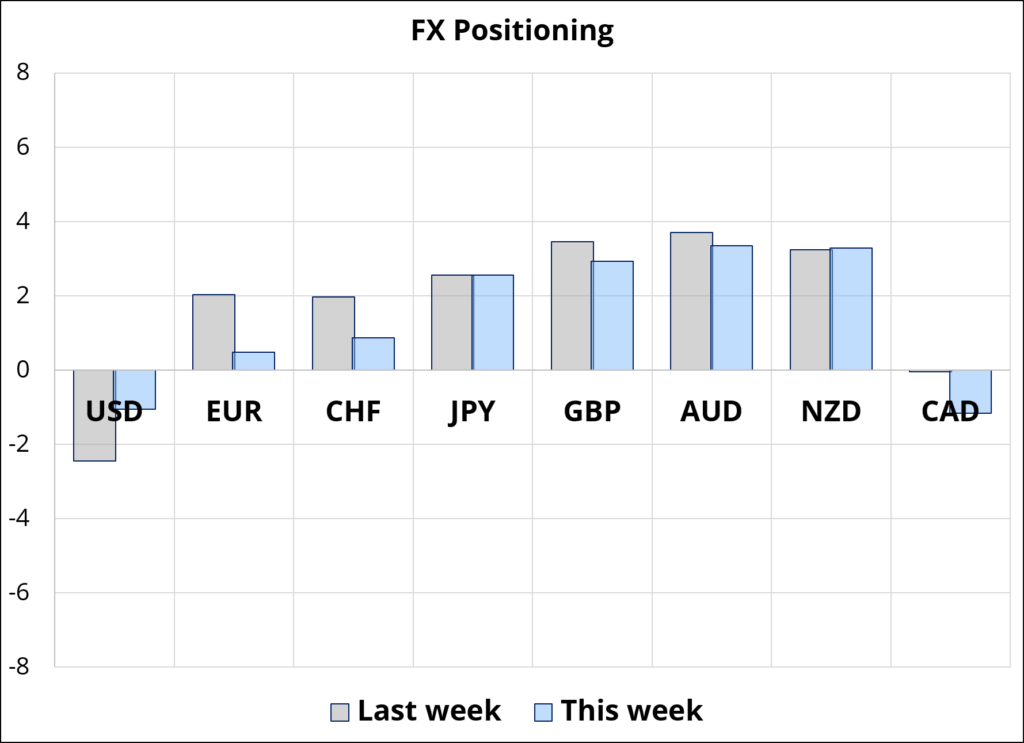
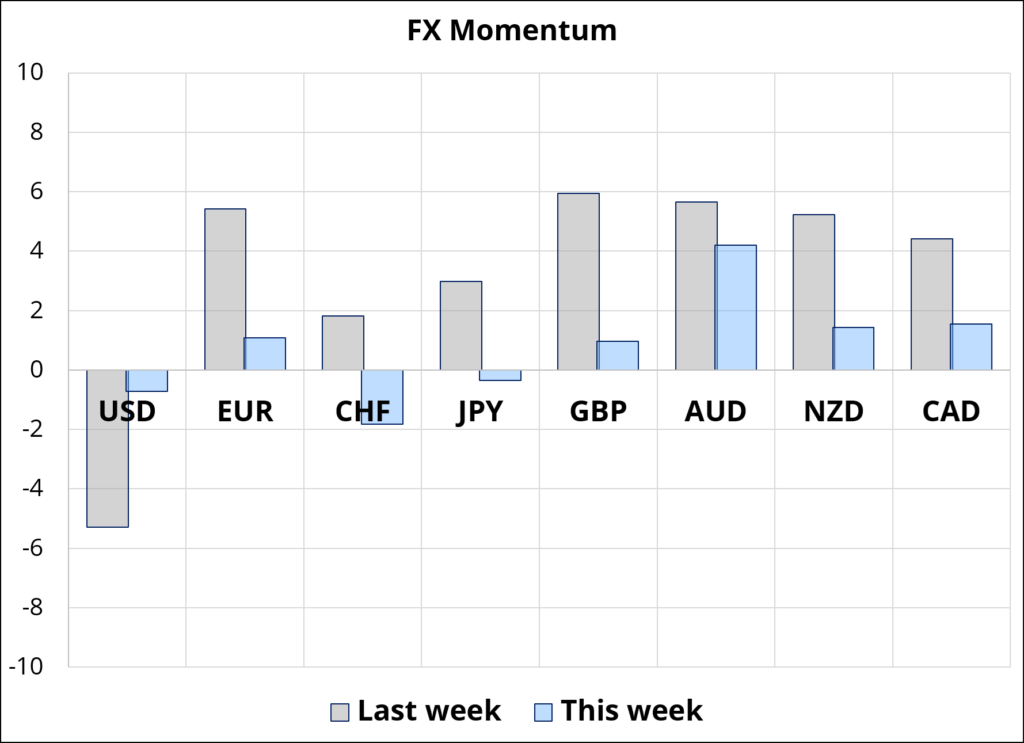
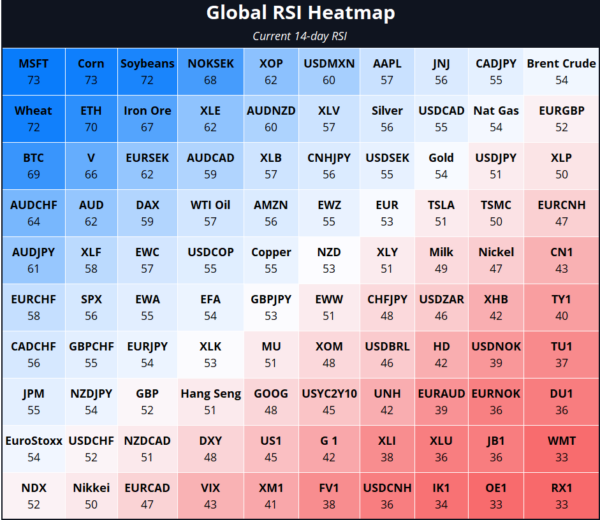
Hi. Welcome to this week’s report. (To read about how I use and trade this report, see here.) The USD bear trade has been stamped out by Warsh’s most recent attempt to convince the market that the Fed is serious about rate hikes. AUD has become quite popular on the crosses, while the CFTC is rapidly reducing its mega short JPY. 1.1600/75 is jammed with EURUSD strikes. Ags dominate the top left corner of the RSI table as El Niño and other factors take hold. Crypto has dropped out of the top rankings as ETH and BTC consolidate.
The nectarine shown in this next link is less shocking than I had hoped.
Extremely disappointing, to be completely honest.
https://www.guinnessworldrecords.com/world-records/heaviest-nectarine