

August 23, 2022
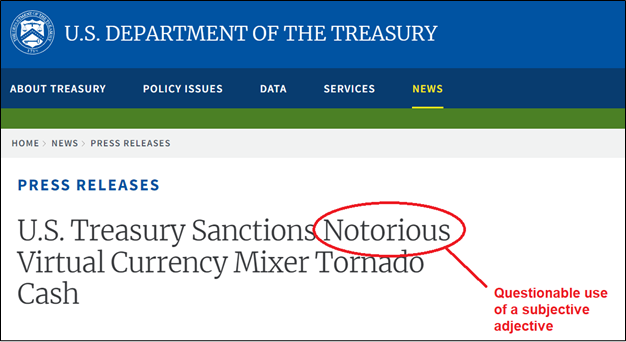
A useful tip for better nonfiction writing: Limit the use of subjective adjectives
You can listen to MTC 31 right here.
Not a paid subscriber? Sign up here before the price goes up at the end of August
Today’s note is 2800 words (12 minute read).
Algorithmic Layering: Sanctioned
Since the last MTC, a lot has changed.
- I have been calling for a bottoming process since the end of June with stability, a bullish bias, and a BTC range of 20000/25000. That’s how the last six weeks have played out. Now, we topped out at exactly 25000 and I think we are entering another bearish phase for crypto as Merge enthusiasm fizzles early and macro headwinds return.
- New cycle lows coming for crypto in September.
- The 2000 top in ETH and the 25000 top in BTC look like mini cycle highs. Now the USD is ripping, MSTR is finding gravity after briefly leaving the atmosphere, and everything looks wobbly.
- The sanctioning of Tornado Cash has offset the positive Merge ETH vibes. Is everyone still 100% confident that 1ETH = 1ETH?
- The EU and UK energy crisis are pushing the USD higher and risky assets lower.
- The SPX bear market rallied peaked exactly where it should have after a perfect touch of the 200-day moving average.
- Powell’s speech at Jackson Hole this Friday has the market hunkering down and nervous about a recommitment to the hawkish message after a somewhat dovish-sounding July meeting and minutes.
Even with The Merge as a major idiosyncratic crypto story and the Tornado Cash story pushing the other way, crypto’s anchor is still exogenous: the performance of risky assets and the USD still determines the primary path. Here’s a chart:
ETH vs. DXY (inverted) and NASDAQ futures
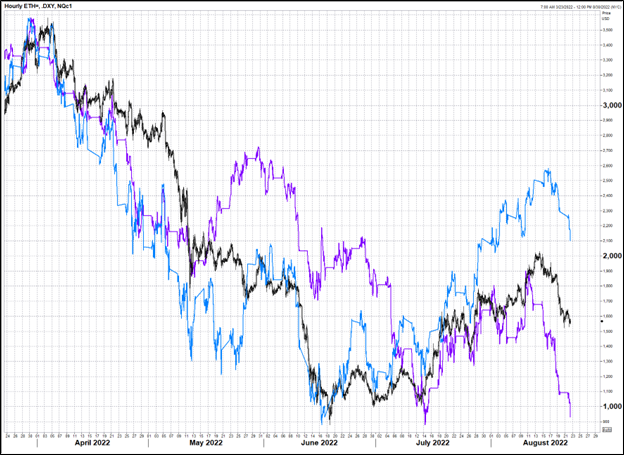
The unstable codependent relationship between TradFi and crypto continues. Crypto is the anti-dollar and the USD is ripping higher. No amount of Merge frontrunning can maintain positive ETH momentum while 55-knot macro headwinds prevail.
I expect the market to continue to buy USD into Friday’s Jackson Hole speech from Jerome Hayden “Jay” Powell. This USD strength is what I call “the run-up trade”. Here is a description of the run-up trade from Alpha Trader.
The run-up trade is a phenomenon where prices move in a logical and predictable direction in the days leading up to a major event. These run-up trades are often easier to predict and monetize than the events that follow.
The idea behind the run-up trade is to identify an upcoming market event and then estimate what traders will do before the event. If AAPL earnings are coming up this week, which way are traders likely to play it? If non-farm payrolls are a few days from now, what might the market do in the days leading up to the release? The run-up trade is usually a function of three things:
- Positioning: Medium-term traders, investors and systematic strategies tend to reduce risk into major events. They do this because volatility tends to be higher and more difficult to predict through events. If they are sizing their bets using forecast volatility (which most do, because that makes sense), they need to reduce their exposure as high-vol events near. If everyone is long, expect prices to fall in the run-up to the day of the event.
- What is the obvious trade? Quite often, the obvious trade works! Plus, traders feel stupid missing obvious macro catalysts so they will tend to position for them in advance then take them off quickly if they do not materialize. If the US economy has been hot, the Fed is thinking about hiking rates, and most indicators point to strong job growth… Expect bonds to sell off in the days leading up to the jobs report as traders get set for a blockbuster figure.
- What is the lotto ticket trade? If a biotech company is announcing Phase 1 results on Friday morning and it looks like a good result could cause the stock to triple while a bad result will cause it to drop 20%… Expect the stock to rally into the news, even if the probability of a positive outcome does not justify the trade from an expected value point of view. Asymmetrical bets will always attract speculators, even if they are bad trades with good optics. So, the run-up trade ahead of an event will often be driven by speculators putting on lotto tickets beforehand.
This is a version of Keynes’ beauty contest.
It is easier to predict what the market will do into an event than it is to predict the event itself. The run-up trade has been pretty good into Fed events over the years, as you can see in the charts that follow.
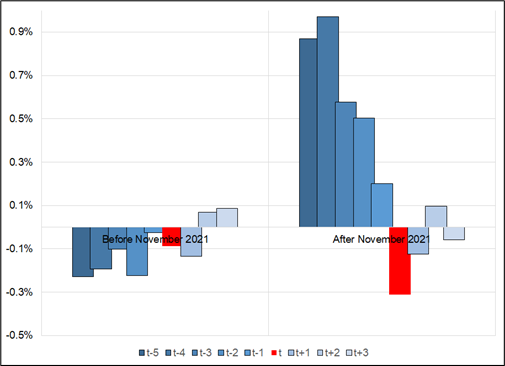
The first chart shows the price action around Fed meetings and Jackson Hole since June 2020. I split it into two buckets, one for before Powell dropped transitory and one for after. You can see the market sold USD into the events before and bought USD into the events after. Then, the event itself was “sell USD” as meetings, on average, end up dovish, even as the Fed is in a hiking cycle. Buy the rumor, sell the fact since last November.
Change in DXY into and after the FOMC and Jackson Hole, June 2020 to now
The next chart shows the granular data for each event. t-5 means the change in the DXY in the five days before the event, t-4 is the four-day change going in, etc. The red bar is the change on the day of the event. Then I show the change in DXY t+1, t+2, and t+3. These are all FOMC meetings except the August 27 moves which are Jackson Hole.
Change in DXY into and after the FOMC and Jackson Hole, June 2020 to now
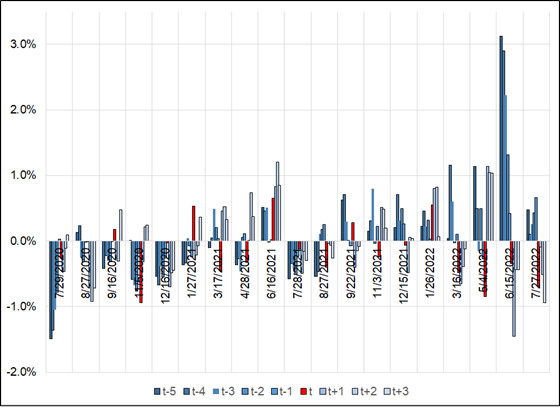
If you look on the left, you see mostly USD selling into the events. Things got mixed starting in June. And then every meeting since September 2021, the market has bought USD going in.
The implication here is that I expect the market to go into Powell’s Friday speech with the USD at the highs and stocks at the lows. If you are looking to buy crypto this week, you will probably see better entry levels going into the Powell speech Friday at 10 a.m. NY.
Tornado Cash
The US Treasury sanctioned Tornado Cash on August 8. This has triggered a massive wave of concern, outrage, anger, navel-gazing, disbelief, fear, beard-scratching and scrambling from the crypto community, even as the historic move garners minimal coverage outside the crypto media. The US Treasury press release is here.
Here are some key points:
1. What is Tornado Cash?
Tornado Cash is a non-custodial decentralized privacy solution built on Ethereum. It is a currency tumbler or crypto mixing service. It increases the confidentiality of transactions by breaking the link in the chain between the recipient and recipient addresses. The idea is to obscure transactions by sending some crypto in and other crypto out so that withdrawals are not traceable.
If you have done any anti-money laundering training in your career (I have done plenty!) you would not be wrong to say that sounds a lot like layering, the second stage in the money laundering process. In fact, most descriptions of layering include the word “mixing” or “tumbling.” For more background on Tornado Cash, see this article which covers most of the main points. The article was written in June, before the sanctions.
Most analysis of Tornado Cash (the entity, and the application) focuses on the illegal aspects of Tornado Cash because laundering money has been the headline use case. There are, however, also legitimate uses, for example if someone in a country run by a dictator wanted to donate anonymously to the opposition party without risking jail, or a person in a nation that doesn’t respect women’s’ rights wanted to donate to a women’s’ rights organization without fear of retribution, etc. Simply, people that don’t want their crypto holdings and transactions known for whatever reason could use Tornado Cash to obfuscate them. While the obvious uses case is for criminals to launder hacked crypto, there are other use cases.
2. Violating sanctions is a big deal. The immediate effect of the announcement was a scramble by anyone remotely connected to Tornado Cash to stand down or risk fines and jail. The most notable tertiary impact was that GitHub (the 83 million user developer hub owned by Microsoft) removed the accounts of Tornado Cash, and three developers who helped write the code (Roman Semenov, Roman Storm, and Alexey Pertsev). These ripple effects create an avalanche of questions around free speech and government power.
Thirty years of hard legal work to establish First Amendment protections around software distribution, blown up in a day by Github and Microsoft.
– Matthew Green, cryptography professor at Johns Hopkins University.
The sanctions from the Treasury don’t specifically name any individuals but a company like Microsoft is not going to take sanctions risk. Aave, dYdX and other big DeFi names also blocked addresses associated with Tornado Cash. Circle, the issuer behind the USDC stablecoin, froze 81 addresses linked to Tornado Cash and around 75,000 USDC. This freezing and blocking triggered venom from the financial freedom and privacy-oriented commentariat but most real life crypto participants are more interested in self-preservation and making money than risking jail time to lead a utopian revolution in monetary privacy.
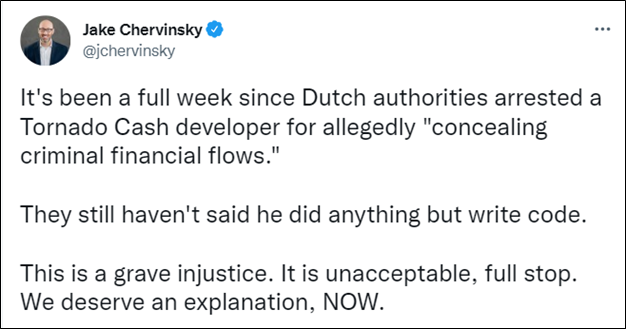
Meanwhile, Dutch authorities arrested a Tornado Cash developer, further opening this can of worms and adding to the outrage. Kyle Davies, Su Zhu, Alex Mashinsky, Do Kwon and others still walk free (for now).
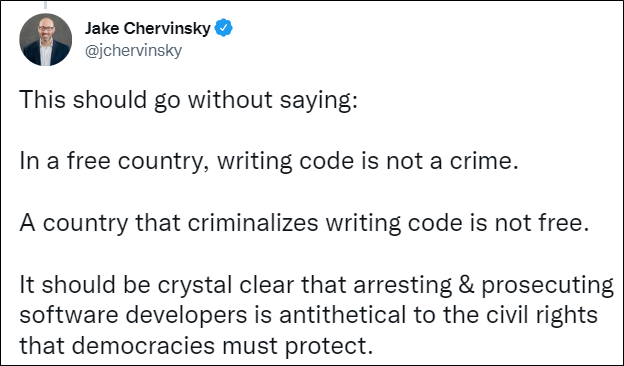
Here’s Jake Chervinsky, Head of Policy for the Blockchain Association:
3. US Treasury seems to be sanctioning a protocol, not an entity. While there is a Tornado Cash website and entity, the application or protocol is essentially sanctioned too as the wording of the Treasury’s action is broad. Sure, someone could cut and paste the Tornado Cash code and build a new app called F5-Cash, or whatever. But the cat is out of the bag and Tornado users are not just going to switch over to F5-Cash! They know any similar application that gathers critical mass risks being similarly sanctioned.
Many question the effectiveness of sanctions but if nothing else they send a stark message and they shut down a known money laundromat. For a deep dive on the legal aspects of this, the constitutional challenges, and the nuances between Tornado Cash (the entity) and Tornado Cash (the code / application / protocol), this is the best read. The Treasury knows they will be challenged in court on this, and they are saying: “Bring it on.”
4. This has refocused the crypto world on the philosophical and technological aspects of crypto now that “number go up” vibes have fizzled. Ideas like “code is free speech” are being tossed around though I’m sure Treasury will say they are not sanctioning the code per se—people are free to cut and paste it as they see fit.
Some are getting that same funny/spooky feeling of authoritarian creep they felt with the sanctioning of the Canadian Truckers. Rule of law is important! Tools which are potentially fine in the hands of a government you trust, may not be fine in the hands of one you do not trust.
Then again, the arrested developer built a public money laundering service, not a Minecraft mod. If you view electronic freedom and the right to monetary privacy as absolute, you are surely up in arms about Tornado Cash sanctions. If you see those as privileges subject to a series of ongoing tradeoffs between protecting the financial privacy of innocent people while prosecuting criminals and state-sponsored terrorists, maybe not.
Since crypto advocates have offered a mountain of vitriolic responses to the Tornado Cash sanctions, and I like to hear both sides of every story, I asked Travis Kimmel for his thoughts.
Travis is sometimes described as a crypto hater, but I think he’s more an informed, unbiased pragmatist who has come to his own conclusions and decided crypto is a dead-end technical path. A differing opinion doesn’t always make someone a hater. I am less pessimistic than Travis on crypto, but I find his views a useful antidote to the much more plentiful religious crypto zeal.
Here is what he said when I asked him about the Tornado Cash sanctions:
The challenge is this: I’m generally a fan of EFF (and a frequent donor), but the framing of “they’re arresting people for writing code oh my god” is just not genuine. They’re arresting people for making a publicly accessible money laundering service, because that sh*t ain’t good for society and isn’t legal. To me the arguments about privacy are just abstractions that are not empirically valid.
Is privacy of money a social good? Well… yes, at some level, but it’s not black and white.
And our current policy framework reflects this: money should be anonymous and frictionless and all that at the base layer of society. Nobody should give a sh*t where I’m buying coffee, or how much, or any of that. The cash economy.
But should people care if I’m buying a house? Yeah, I mean… they kind of have to. Coffee is small enough that the risk of ‘illegitimate transactions’ is smaller than gain experienced by it being frictionless. But as we move up the transaction scale, at some level that changes.
5. To Travis’ point, a great deal of the vitriol in the crypto space does not properly differentiate a dislike for this particular Treasury action from a general distrust of AML/KYC in general. There is a utopian desire for financial privacy in cryptoland, but financial privacy is not a fundamental human right in the United States. There are laws here that limit financial privacy. That’s why AML and KYC exist. If you don’t like the sanctions because you don’t like AML and KYC, you are fighting a battle in a war you can’t win.
Then again, it’s reasonable to argue that the simple act of seeking financial privacy (or allowing others to seek financial privacy) has been criminalized here, which does seem wildly aggressive and overreachy.
Some are making free speech arguments because code is deemed to be speech. And in the US, money is sometimes speech, when that money is being funneled into Washington. I’ll leave these arguments to the constitutional lawyers.
6. Crypto has been through worse than this. Much as it feels like the regulatory walls are closing in… Crypto (and Donald Trump!) always seems to emerge unscathed (or stronger) no matter how long it feels like the walls are closing in. The Treasury action could be another thing to worry about, but on some level its also further vindication of the threat posed by government oversight and validation of the original raison d’être for crypto all along (stateless money).
Still, one key point one is that this creates new uncertainty around the premise that 1ETH = 1ETH. This could have potentially negative implications for the value of ETH if users (and particularly US institutional investors) start pondering existential risks like arbitrary address blocking. And if this action doesn’t change any minds, the next one might. The walls can only close in so far before things go crunch.
Ben Hunt once wrote re crypto: Sauron Remains Undefeated.
Conclusions
There is much to chew on here. For now, I think the implications are:
- Another brick in the regulatory wall that will make institutions nervous about adding to exposure. US investors are likely to be particularly concerned as the regulatory heat rises toward boiling.
- It’s a negative endogenous crypto market distraction and meaningful sentiment dampener offsetting good news on The Merge.
- US VC investors need to check their projects carefully and get rid of anything that smells like money laundering. Maybe they should have done that ages ago anyway, but yeah.
- Speculation will increase as to the next target as the SEC, CFTC, Treasury and everyone else have rolled up their sleeves and are finally regulating crypto. Since it’s all being done with ad hoc after-the-fact prosecutions sans modern relevant laws on the books… Not exactly a perfect environment for institutional inflows post-Merge. For now, the targets chosen by regulators are pretty egregious and obvious ones, so the panic over what’s next should die down pretty quick. Longer-term, the “what’s a security?” question remains the biggest boogeyman.
- The sanctions hurt crypto’s money laundering use case. While money laundering is overstated as a use case for crypto and a favorite punching bag for crypto haters, it is a use case! Maybe suitcases of cash or diamonds are looking a bit less risky now, in comparison. SMSEY is Samsonite’s ticker symbol if you would like to get long suitcases.
That’s it for Tornado Cash. But before I sign off…
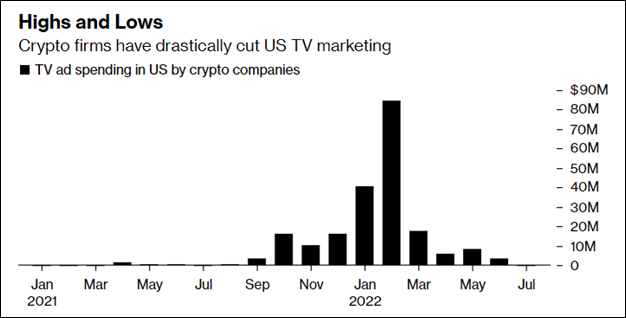
The least surprising chart I have seen in a while
That’s it ! Thanks for reading …
Don’t follow the crowd. Don’t fight the crowd. Think for yourself.
bd