

https://www.youtube.com/watch?v=7qDgCmzh5ao
You can listen to MTC 34 right here.
Not a paid subscriber? Sign up here
Today’s note is 1800 words (9-minute read)
Market update
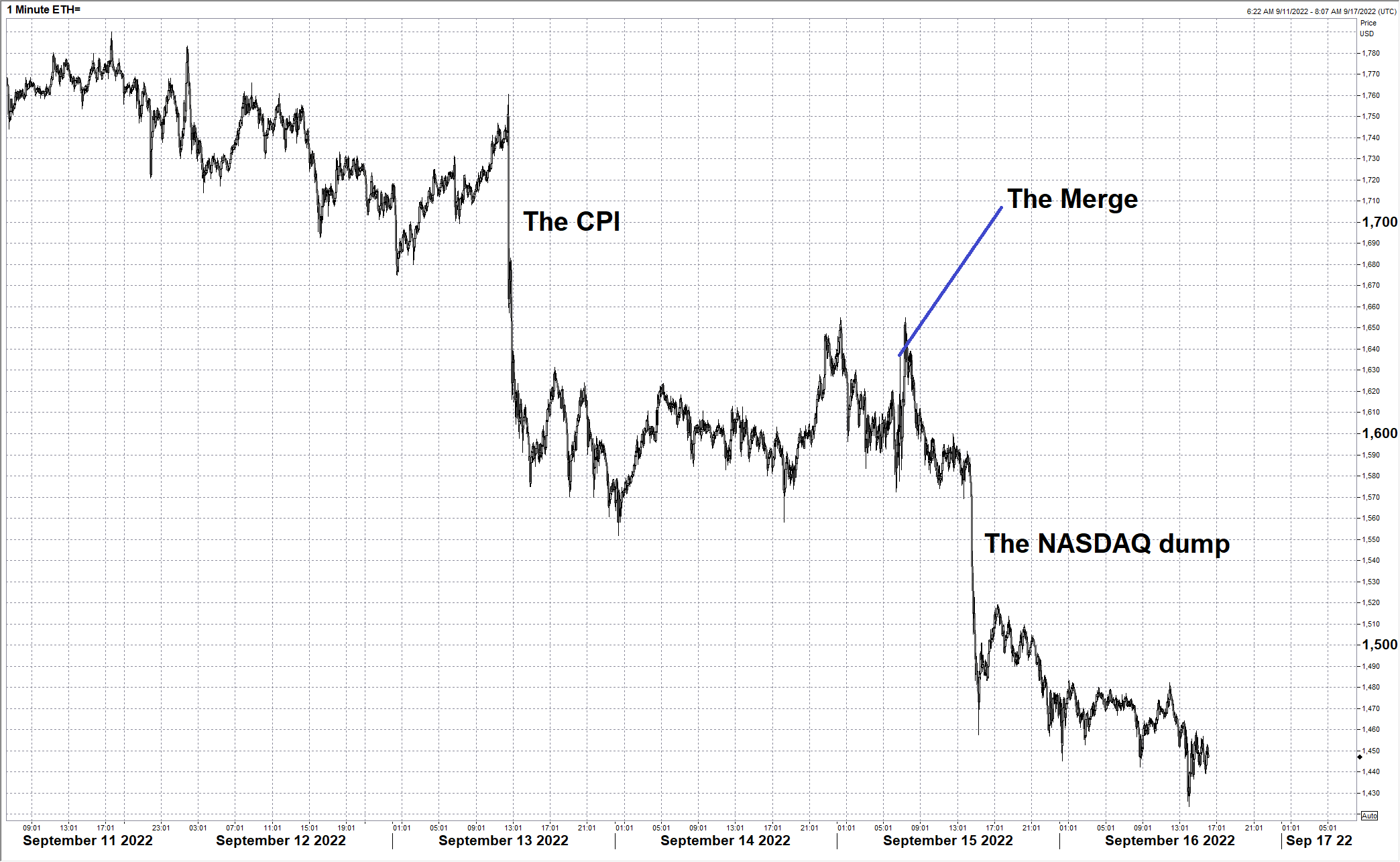
I was right for the wrong reasons. I expected a mix of buy rumor / sell fact on The Merge and stable macro conditions to lead to modestly lower ETH but really it was weak macro conditions and absolute crickets on The Merge that was the end result.
Here is 1-minute price action in ETH around The Merge. There is a jiggle at 6:42:42 UTC but not much more. The movements are dominated by CPI and the dump in the NASDAQ. The Merge was fully priced and so ETH barely moved.
ETH 1-minute chart
This goes back to the issue right now for crypto as discussed last week in “Can Crypto Cross the Chasm?”
Taking the ideas from last week a bit further, you could say that there are two ways that crypto can cross the chasm. One is as a technology with use cases that enter the mainstream. The other is as a financial asset with use cases that enter the mainstream. This is the “institutional adoption” narrative that was red hot in 2021 but doesn’t get as much coverage these days.
The key selling feature of crypto if it were to cross the chasm on the investing side is that it performs some function in a portfolio that traditional financial assets do not. There are idiosyncratic risks and costs to crypto (regulation and custody, particularly) so if crypto only mirrors TradFi assets, it’s only useful as a high-beta MMT hedge.
For a complete explanation of why I think crypto is mostly useful as an MMT hedge, see here. For an MMT explainer, see here.
Here’s a chart of NASDAQ, HYG (high-yield ETF) and ETH back to mid-August.
1-minute NASDAQ, HYG, and ETH
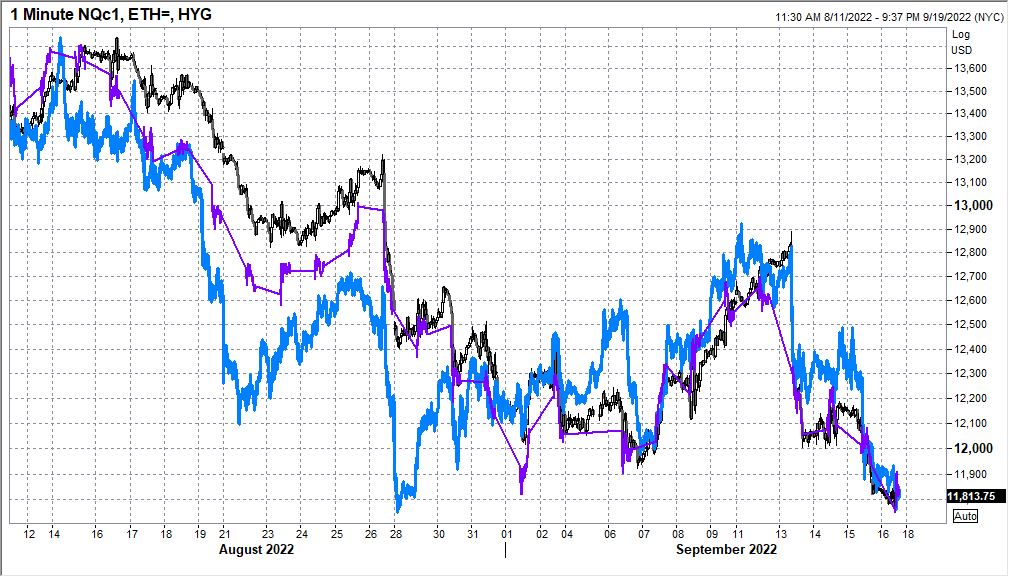
Correlation is not static or stable forever, but crypto / tradfi corr has been hella static and stable for a long time now, and this is not great news for further institutional adoption. And it might be an argument for the idea that institutional adoption is the worst thing to happen to crypto since the ICO craze of 2017.
On-chain synthetic digital yield stuff is not a zero; but I maintain that is a niche market and not big enough to make a bull case for the price of ETH or crypto in general. For now, ETH remains NASDAQ on crack.
Wen Big Bottom?
The bubble in Web3 and crypto in 2021 was a lot like the dotcom bubble in 2001 on so many levels and also a bit like the bitcoin bubble in 2017. Let’s see how they compare in terms of duration and magnitude.
Comparing crypto to Dotcom 2000 is a depressing analogy for HODLers. The NASDAQ was dead money for more than ten years and took fifteen years to make a new high beyond the year 2000 apex. Here is how it transpired.
NASDAQ with key moments marked

If bitcoin follows this timescale, it will bottom in late 2023 and break $69,000 in the year 2036. Financial markets will be a distant memory for me at that point, as I will be writing bestselling contemporary fiction on a beach in Portugal.
That 2036 timeline feels insane and farfetched but I can assure you that such a long timeline would have felt insane and farfetched to NASDAQ bag holders in 2001, too! People that bought the Nikkei bubble in 1990 were not back in the money for more than thirty years! US housing buyers in 2006 broke even in 2020. So, this isn’t ludicrous at all. Rebounds from bubbles are long and highly variable.
Then again, all we have to do is look to the 2017 bitcoin bubble for the optimistic scenario.
BTC 2017 to now
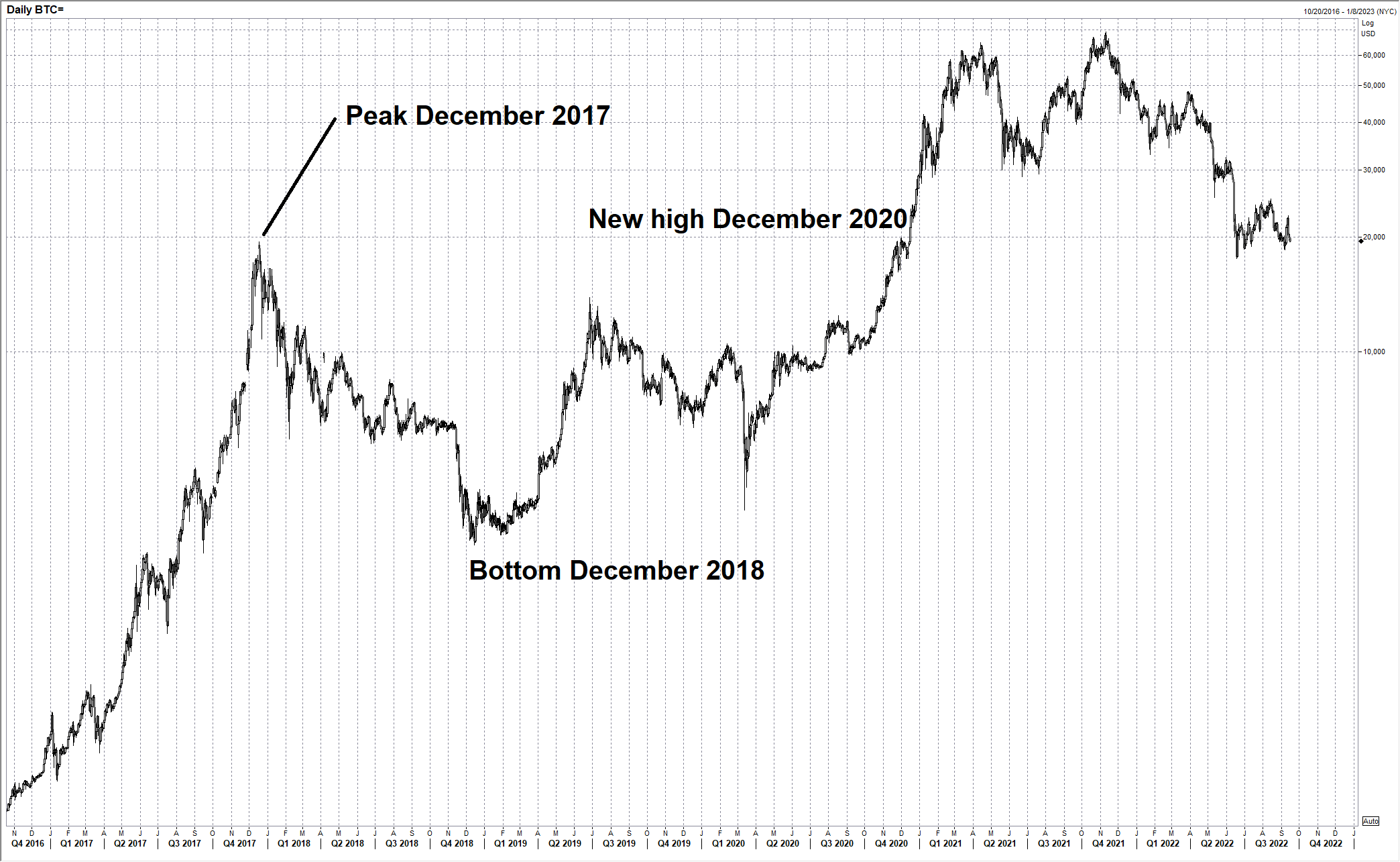
If we use the 2017 timeline following the November 2021 peak, we get 361 days from peak to bottom and 1094 days from peak to new highs (December 2017 to December 2020). Measuring from the November 2021 high, this would give us a bottom November 2023 and a new high November 2024. That is probably an optimistic scenario because it’s going to be very difficult to convince new buyers to come into crypto at the highs after two massive collapses. Then again, humans are funny and fiscal and monetary policy will probably be plenty scary enough at that time to cleanse the dark memories of 2018 and 2022.
The point here is simply to get an idea of the range of outcomes. From looking at other bubbles, my takeaways are:
- A bottom between now and November 2023 seems most reasonable. Bubbles deflate fast and despair takes over pretty quick, generally. If you go through every bubble including Dutch tulips, Nifty Fifty, gold in 1980, NASDAQ, US housing, etc. Bubbles don’t take more than two years to reach a bottom. Furthermore, the new bitcoin halving cycle begins in Summer 2023 and that could help too.
- Some bubbles reflate to new highs and some fade away into the history books. For bubble assets that don’t die, the time to scale new heights can take any amount of time. Like, two years… Or 25 years! The range of timelines is so wide it’s not useful.
- With MMT, fiscal insanity, and “never take any pain” now the orthodox macropolitical policy prescription… My bet is that the new highs come sooner rather than later. But that still probably means 2024 or 2025. HODLers be patient. Diamond hands. DCA. WAGMI.
Note: Sometimes when I use the cringe crypto vocabulary, I don’t even know if I’m being earnest or ironic.
Signs
In MTC 21 (June 8), I went through some possible signs of a crypto bottom, and I thought it would be useful to check in on those now. The original bullet point from MTC 21 is in blue and my current comments are below each bullet, in black.
1. Bankruptcies. This is how the 2000 bubble burst bottomed. WCOM, Enron, pets.com and the many other bankruptcies that rug-pulled investors from late 2001 to mid-2002 were the beginning of the end of the bear market. Worldcom was the largest bankruptcy ever when they filed on July 19, 2002. The NASDAQ bottomed three months later, in October. We are not yet anywhere close to seeing bankruptcies in crypto. Here’s an interesting Jim Chanos take on “the predatory and unsustainable” Coinbase business model.
Well, we got a few bankruptcies right after that note went out. 3AC, Voyager and Celsius. That’s a start, but those were more like peripheral entities. A central Big Crypto entity going bankrupt would rhyme more with 2001.
2. Tom Brady drops the laser eyes.

Not exactly, but Anthony Pompliano (Pomp), one of the best-known crypto podcasters and influencers did recently drop his laser eyes. There are a bunch of people that like to hate on Pomp, but I thought his explanation for dropping the laser eyes was commendable. He called out his own BS and is trying to grow and keep moving forward. Here’s the piece: https://pomp.substack.com/p/did-i-change-my-mind-on-bitcoin#details



As someone who was not perfect in my 30s and is not perfect now, I respect Pomp for admitting some of his faults and moving in a new direction. Let he who is without sin cast the first stone and it is not the critic who counts and all that. I know people have more cynical takes, but I disagree. At least he’s taking real risks and trying his best to grow and not just sitting in the cheap seats tossing crap down onto the field.
Anyway, for bitcoin sentiment.. It’s a plus. No one drops their laser eyes at the highs, obv.
3. Staples Center goes back to being called the Staples Center. Enron Field changed its name to Astros Field on February 28, 2002, six months before stocks bottomed. Stadium naming is the classic sign of loose money overconfidence and capital misallocation. I wrote about it here as an important behavioral reason to sell crypto last year.
Nope. Not yet. Here’s the header of a GQ article in May:
Crypto.com Spent Its Way to the Top. Then the Market Crashed. Now What?
The cryptocurrency exchange rode partnerships with Matt Damon and the home of the Los Angeles Lakers to instant notoriety—and then the crypto market lost a trillion dollars in value in just over a month. But CEO Kris Marszalek is betting you’ll buy the dip.
4. Matt Damon apologizes.
Nope.
5. Tesla sells its bitcoin.
Yep.
6. MSTR sells their bitcoin (not gonna happen!).
MSTR just did an equity shelf offering to fund more bitcoin purchases. This is the classic case of a trader doubling down on a losing trade. It’s the greatest moral hazard trade of all time! Enjoy the show. However it ends, it’s going to be spectacular.
7. The Economist publishes a bearish crypto cover.
Nope.
8. Ex-TradFi employees quit their crypto jobs to go work at banks again.
Nope. If anything, more funds are opening than closing, it seems.
Conclusion
Bubbles go top to bottom fast, usually in under two years. That means crypto should find a bottom between now and November 2023. If you’re a believer, keep that DCA going or slowly turn it up a few notches.
A quick rebound from a bubble burst takes three years to make new highs. A slow rebound takes 25 years. A no rebound is a no rebound. Not every bubble that bursts is destined to come back.
My bet is that crypto will make new highs, eventually, as the toxic mix of MMT, unanchored fiscal policy, fear of deflation, and “no pain, ever!” will create another round of fiscal and monetary easing at some point. And each wave of easing has to be bigger than the last because of rapidly diminishing returns on an ever-larger pile of debt.
Finally, in case you missed it: Michael Saylor’s defense of bitcoin’s energy utilization. Moral judgments about energy use are tricky and personal. Video games and TV use a lot of energy too! Some people probably think those are wasteful. While the energy costs of various industries are easy to measure, reasonable people can disagree on the benefits derived from each industry. This debate will never be resolved because it’s a religious debate over the usefulness of a new form of money.
That’s it! Thanks for reading …
Don’t follow the crowd. Don’t fight the crowd. Think for yourself.
bd