The U.S. economy is a one-legged stool.
Hello. It’s Friday. Thanks for signing up. I’m Brent Donnelly.
The About Page for Friday Speedrun is here.

The U.S. economy is a one-legged stool.

Hello. It’s Friday. Thanks for signing up. I’m Brent Donnelly.
The About Page for Friday Speedrun is here.
Here’s what you need to know about markets and macro this week
I had a good call last week! I am glad I shared it and I hope some people made money. Please remember that my hit rate is 50% to 60% and I am wrong all the time and sometimes I am wrong four or five times in a row.
I did two lectures for a U.S. university finance class this week and I was slightly alarmed to hear that many of the students in the class made money on my short QQQ call. This is mildly disturbing on a few levels!
On the Right Track (1981) stars Gary Coleman as Lester, a 10-year-old orphan who lives in a locker at Chicago’s Union Station, earning money shining shoes and relying on the kindness of station employees. Lester has an extraordinary ability to predict winning racehorses, attracting the attention of social worker Frank and his romantic interest, Jill. Frank initially wants to exploit Lester’s gift to get rich, eventually winning huge sums through gambling. Lester then makes a deal with Chicago’s mayor to use his predictions to raise $1 million for public services, but discovers the money is going to banks and bondholders instead. Disillusioned by the greed and dishonesty of the adults around him, Lester loses his ability to predict horse races. Frank and Jill, who had previously lied about planning to adopt him, finally realize that Lester needs love rather than money and decide to become his family. In the final scene, as the three leave the station together, Lester casually reveals that he can also predict the stock market, suggesting that his remarkable gift hasn’t disappeared after all.
Anyway: Trade your own view.
https://en.wikipedia.org/wiki/On_the_Right_Track
Small enough to fit in a locker!
So back to Global Macro. Inflation came in hot this week as tariffs and wars do, in fact, appear to be inflationary. But that was not the big story. Instead, the market has had a small come to JC moment as the AI trade experiences severe tire damage.

There were three sort of slightly scary things that happened this week…
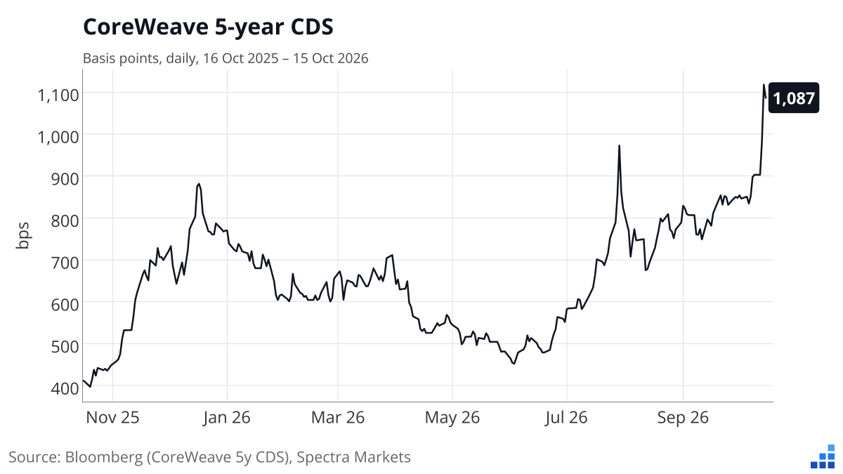
The whole deal here is that companies like OpenAI are spending unfathomable amounts of money to earn unknown amounts of future revenue. In the interim, there is an uncomfortable year or two where everyone either has faith, or they do not. If everyone has faith, the issuers keep issuing and keep crowding out the rest of the economy. If some believers start to lose faith, there is a risk of an air pocket. Welcome to the air pocket.
There is some complexity around recovery rates when calculating default probabilities, but 5-year CDS at 1087 implies more than a 50% chance that CoreWeave goes bust before 2032. Not great news!
That’s four things this week. Not three. There are certainly more, but I think those are the main ones. Anthropic also had its investor day this week, but that kind of came and went without any surprises.
The most important takeaway from the week is that we have experienced a regime shift in correlation. In the Italian-tinted words of my podcast compatriot Alfonso, we have gone from “bonds are oil” to “bonds are KOSPI”. This is a logical regime change in my opinion because the entire U.S. economy is a one-legged stool balanced on the AI trade.
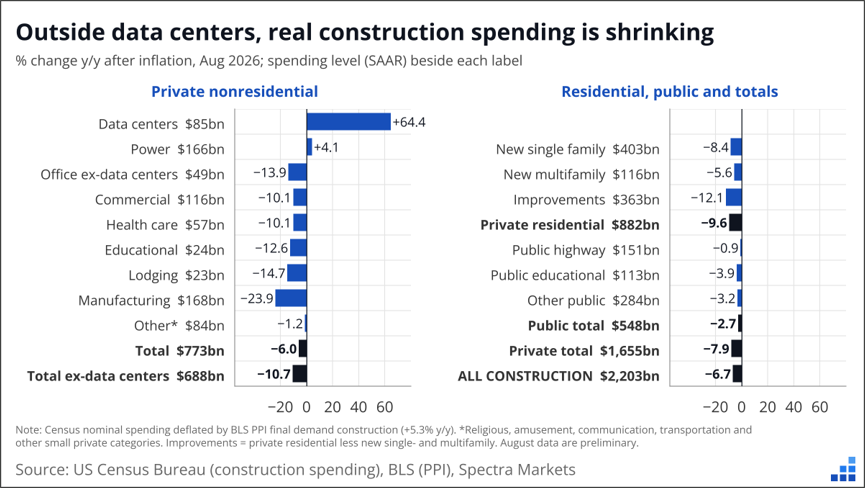
You could argue that there are two legs to the stool as consumer spending is forever strong, but there is a risk that this engine is also powered by AI capex via the wealth effect from stock market gains. If stocks turn, confidence turns, neocloud bond yields spike, stocks fall, earnings fall due to reval effects, stocks fall more, wealth falls, rich consumers pull back, etc. etc.
I am not saying all this is happening now and the AI bubble / bull market peaked for good this month. Maybe it has, maybe it has not. I don’t know. I don’t trade that time horizon. What I am saying is that the market reaction function over the past 24 hours is probably correct. Stocks down, bonds up, USD down is the right framework for a repricing of the AI Capex Machine. More on this in the fiat currency section.
This week we also saw a huge leap in headline PPI and a higher-than-expected Core CPI. The dovish 3-month annualized bros are in tears. The only thing dumber than three-month annualized inflation numbers is when you make a ton of cash on the first trading day of the year and you annualize it.
Let’s take a look at inflation:
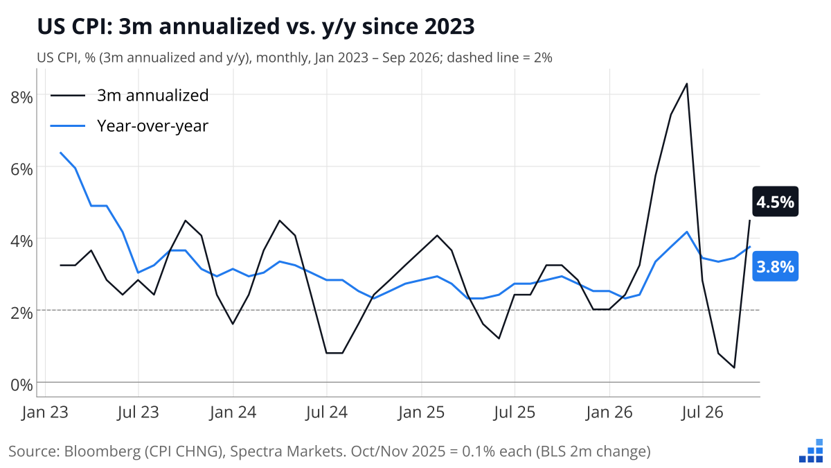
3-month annualized went below 2% five times in four years and every time it did so, doves cried. And vice versa of course, the hawks squawk when it roofs.
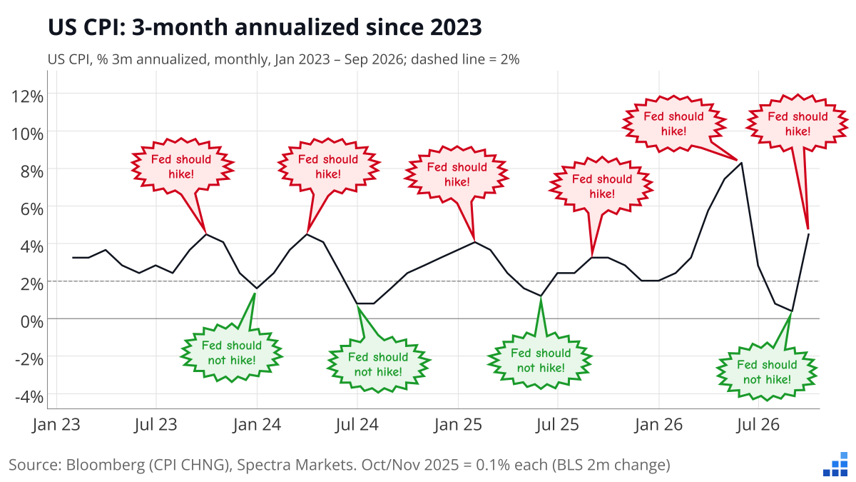
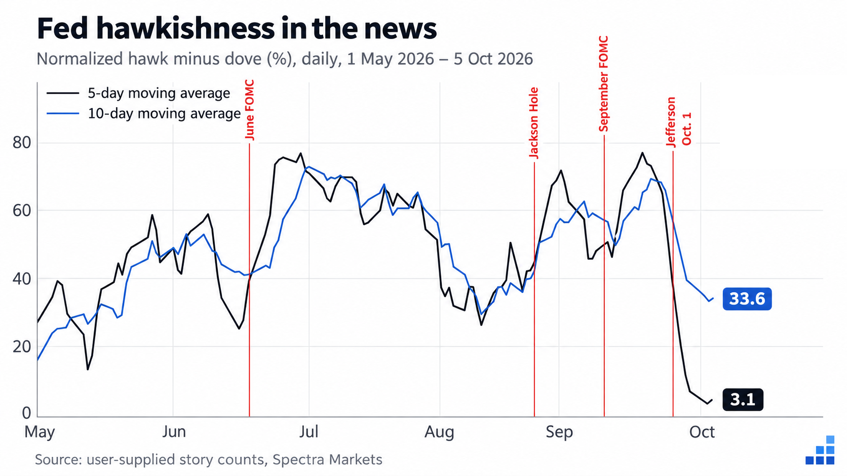
Please do not use 3-month annualized numbers. The weird thing is, despite CPI high and PPI exploding higher, the Fed continues its alternating flip/flop approach—they are wildly dovish one month and then flip hard the other way for no reason the next. October has been dedicated to the doves as Waller and Jefferson pushed back against market expectations as October Fed hike odds exceeded 50%. And Williams bends over backwards to insist there is no need for rate hikes in 2027, either. What are we doing here?
The current Fed is similar to the Yellen Fed where every molecule in the DNA of the policymakers is dovish-biased cut cut cut cut cut cut cut cut and the only time they will hike is when absolutely forced or embarrassed into doing so. This is in contrast to Warsh’s stated sense of urgency in June. One hike in six months with inflation above target for six years is not urgency.
We have Initial Claims at 200k, 4.2% unemployment, and inflation at 3.4% and a Federal Reserve with zero desire to hike rates in any meaningful way. Using data from Bloomberg, here is the net hawkish or dovish tone from the Fed since Warsh took the helm.
This is what the Aussies call: All over the shop.
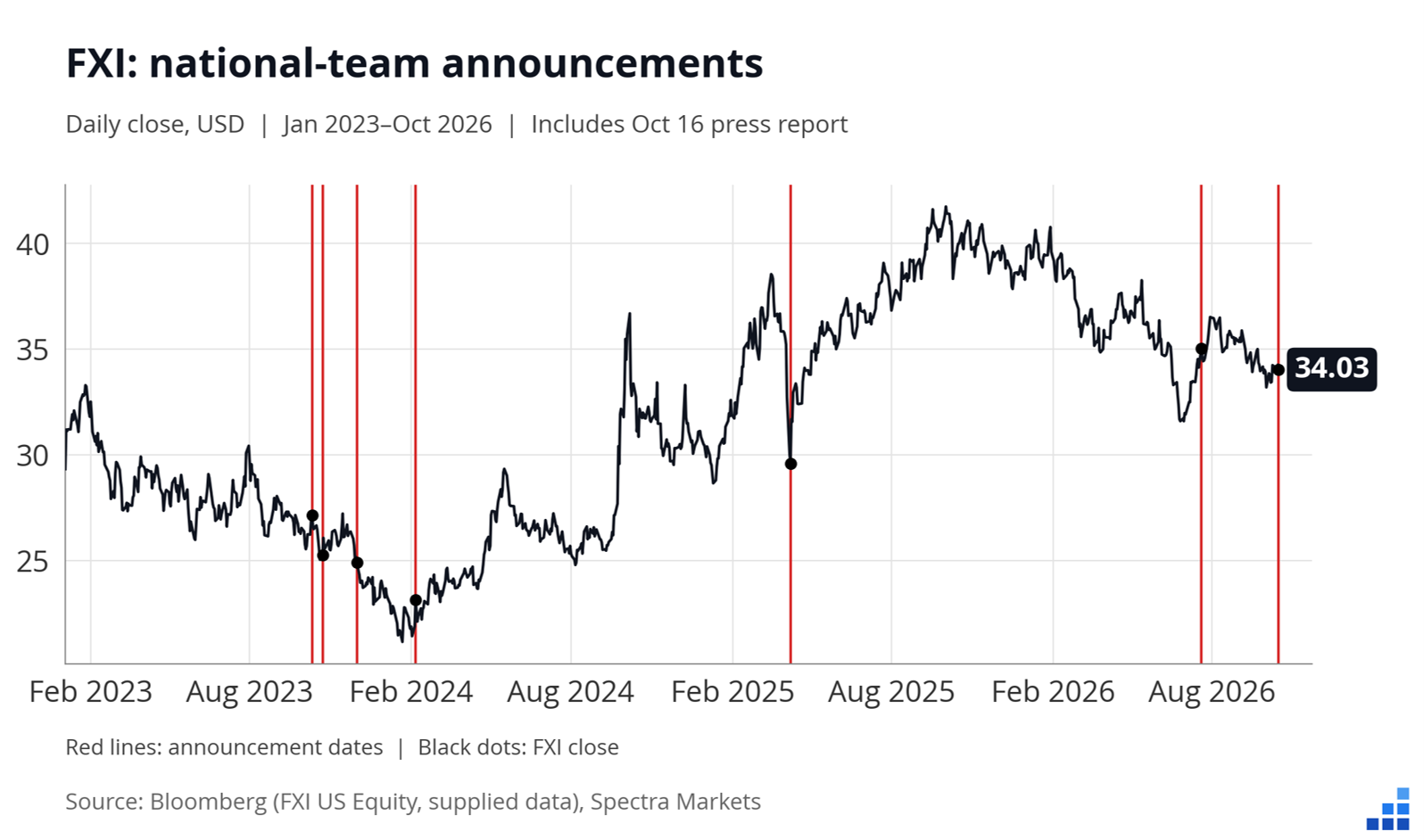
Finally, China’s national team stepped in to buy stocks. Following them is good over a 1-year period, but looking out 1, 3, or even 6 months, there is more pain than gain. Here I show FXI (not a great proxy for CSI 300 but the only one we can trade in the USA) and the national team announcements.
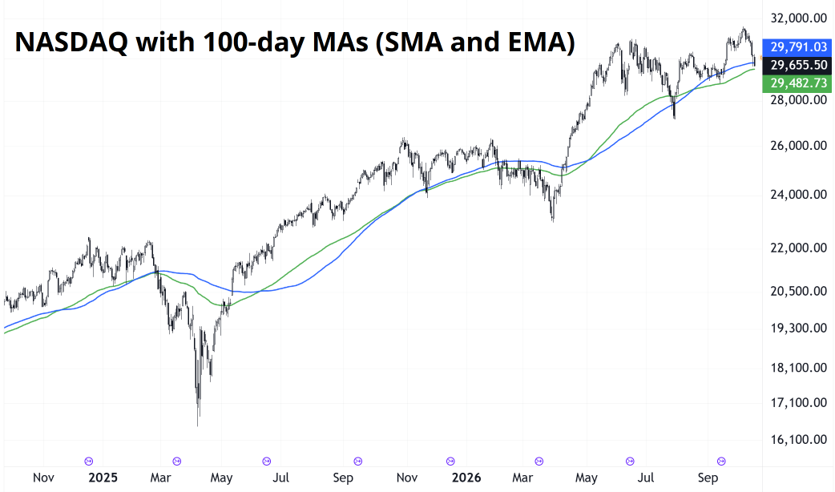
Stocks are lower and I took profit on my short from last week (see FSR and am/FX last week if you missed it). I remain mildly bearish, but when a tactical trade pays out that big and fast in a 15 VIX environment, I am happy to throw in a bid and reassess. There is a ton of support in NQ around here. While not perfect, the 100-day moving averages have given you a pretty good sense of the trend over the past two years and we are right in there right now.
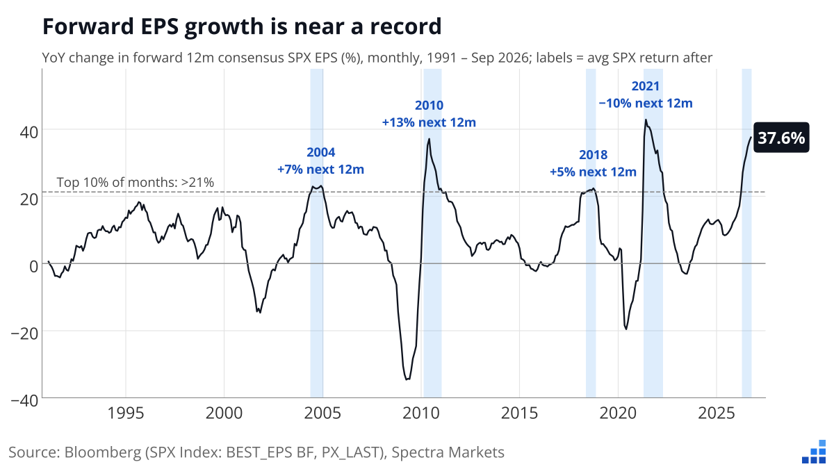
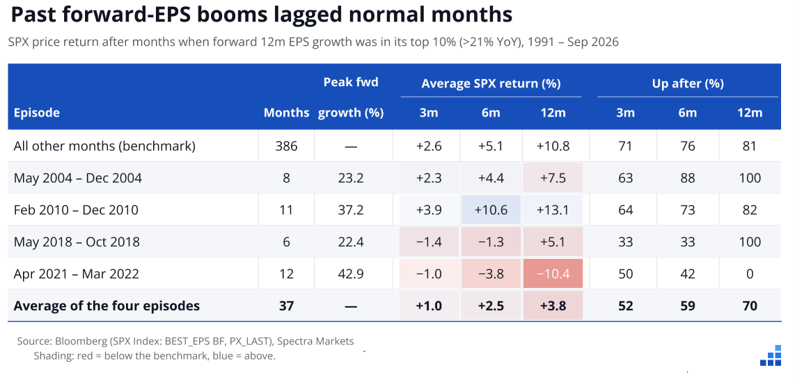
People like to say that earnings are so strong that you just have to be bullish stocks, but this is not really true at all. In fact, buying stocks after earnings have ripped is a way to underperform the index, not outperform it.
This chart shows all the times when forward EPS were zippy and labels them so you can see what SPX did after. There’s a table after the chart to help understand it.
Stan Druckenmiller said:
“I learned this way back in the 70s from my mentor [Speros] Drelles. I was a chemical analyst. When should you buy chemical companies? Traditional Wall Street is when earnings are great. Well, you don’t want to buy them when earnings are great, because what are they doing when their earnings are great? They go out and expand capacity. Three or four years later, there’s overcapacity and they’re losing money. What about when they’re losing money? Well, then they’ve stopped building capacity. So three or four years later, capacity will have shrunk and their profit margins will be way up. So, you always have to sort of imagine the world the way it’s going to be in 18 to 24 months as opposed to now. If you buy it now, you’re buying into every single fad every single moment. Whereas if you envision the future, you’re trying to imagine how that might be reflected differently in security prices.”
I am a short term trader so I am always imagining the world five to ten days from now; same concept of course!
Here is this week’s 14-word stock market summary:
The short was good and I took P but risky assets still look risky.
Betteridge’s Law says all headlines that end with a question mark can be answered with: NO.
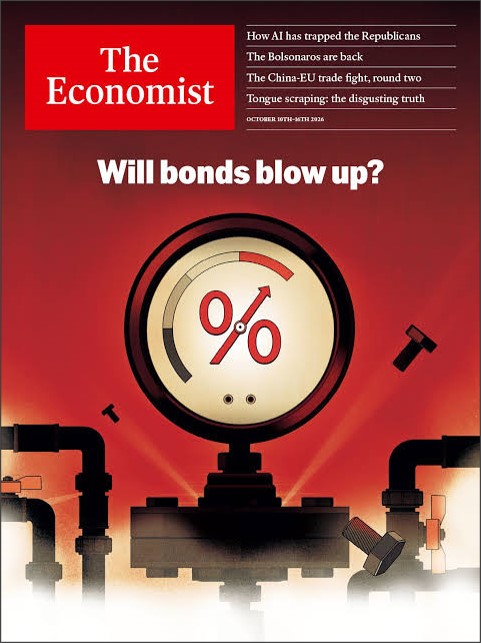
No. No they won’t blow up because they already did. You are asking the question after yields have already gone from 0.4% to 5.5%. It’s a borderline ridiculous question to be asking at this point.
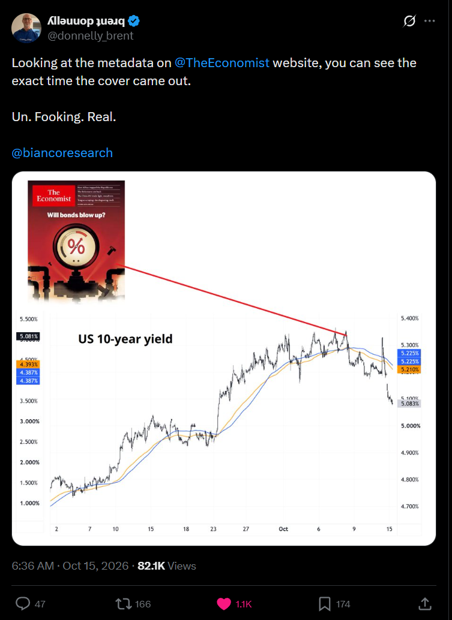
If bonds are going to worry about Peak AI Capex, the correlation will be NASDAQ down, bonds up and that means maybe, just maybe, 60/40 will make a return. Let’s see.
Also, if bond yields have peaked, I would think XHB and RKT are decent medium-term longs as housing can’t get any more bombed out, can it? RKT has substantial leverage to a housing rebound, and it’s sold off a lot so your margin of safety is decent. I am not an expert on this company, at all, so please DYOR and don’t think I am Gary Coleman on this one.
I am going to quote from am/FX for this section because it’s the most relevant thing I can put in this section. If you read am/FX every day, you can skip this section and move to the next major heading. If you do not… You can subscribe here. You will be happy you did it! If you hate it, I’ll refund you. Zero risk, unlimited upside.
The question of the week this week was: “How will the dollar react to a reversal in the AI Capex narrative?” I believe yesterday was an incredibly perfect microcosm of the bigger picture USD response to a reversal in the AI story. The USD reflexively rallies on equity weakness, then reverses hard because the rally was effectively wrong.
Before I go through some history to explain why I believe the correct parallel for the USD here is the 1999/2001 analog, let me offer the most simplistic and effective heuristic for what happens to the USD in a crisis or meltdown: Positioning. When the guano hits the fan, the market squares up.
And now, of course, we have a market that is long USD on European woes, American AI Capex dominance, rising yields, “hawkish” Fed and so on. If we zoom way, way out, there has also been an American Exceptionalism story going on for five years and while that story was similar to 1999, the USD has barely appreciated. In 1999/2000, the dollar had absolutely no headwinds. U.S. hegemony was strong and getting stronger, U.S. soft power was at its height, American deficits were gone (!).
So while the USD rallied to the moon in the dotcom bubble, it has struggled to get off the launch pad in this cycle, despite gargantuan buying of U.S. equities and large private FDI into U.S. tech. Despite the similarities to 1999, particularly U.S. tech dominance and rising real yields, note many structural differences:
A few stats, 1999 vs. now:
All this to say that the USD had many other legs to stand on in 1999. The other important thing to know or remember about the dotcom cycle in the dollar is that the euro was launched right in the heat of the dotcom bubble (January 1, 1999) and the launch did not go particularly well.
By mid-2000, the market was seeing the euro as a soft currency like ITL or ESP (lowest common denominator) not a hard currency like the DEM. So EURUSD tanked from 1.17 on launch to 0.8300 by October 2000. The ECB and G7 had to intervene and support it a few times before it finally bottomed and people started to believe the euro project was coherent and workable.
This extreme weakness and fear of a fragmented euro muddies the water when you are trying to compare now to back then. The USD peaked much, much later than the NASDAQ because it had many remaining tailwinds, even without tech, and the euro was off like a damn squib. Here’s DXY vs. NASDAQ in that period.
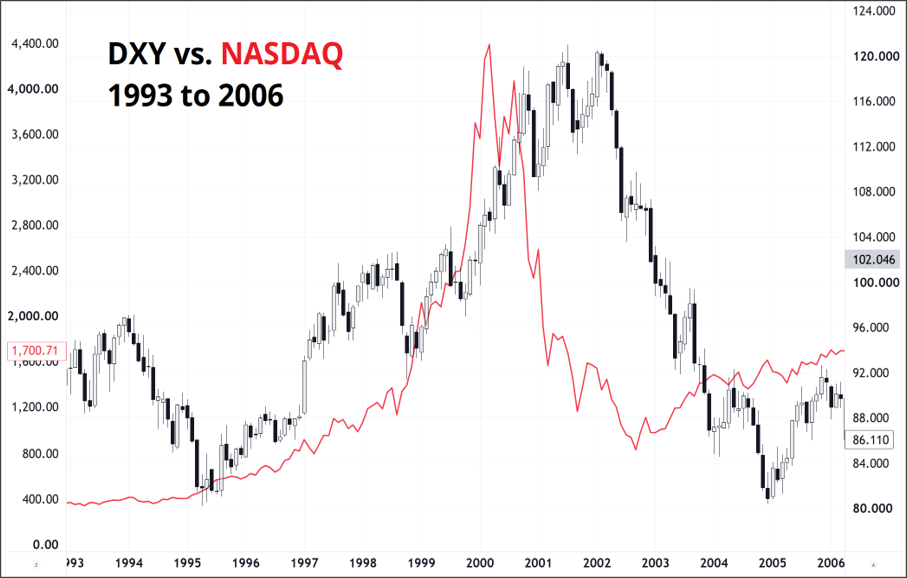
Today, the reaction function of the dollar to a serious repricing of the AI Capex boom should be unambiguously USD bearish. There could be feverish bursts of USD buying like we saw yesterday (partially due to CPI). But if the market is pricing rising odds of peak AI capex, the USD is a sell. The entire U.S. economy is a one-legged stool balanced on the AI trade.
I am not saying all this is happening now and the AI bubble / bull market peaked for good this month. Maybe it has, maybe it has not. I don’t know. I don’t trade that time horizon. What I am saying is that the market reaction function this week is probably correct. Stocks down, bonds up, USD down is the right framework for a repricing of the AI Capex Machine.
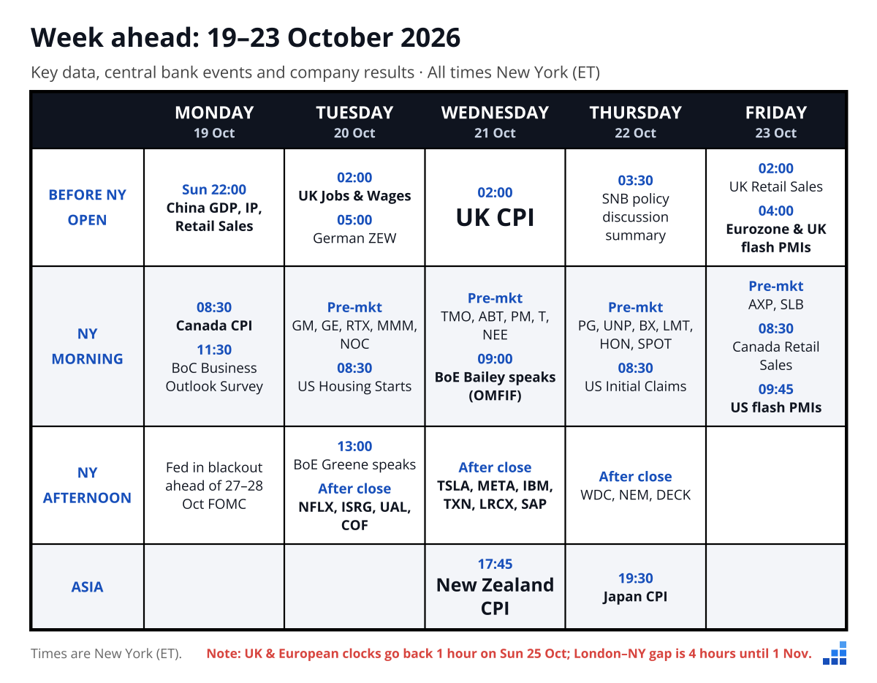
In the short term, I think the current AI wobble is not over, and the market will continue to sell USD first and ask questions later because specs and real money have just spent months getting long USD and yet most people hate the dollar and are much more comfortable short not long. The ferocious turnaround in bond yields yesterday and the Fed’s tiptoeing over eggshells style of rate hikes means the euro might have found a base. There is a budget vote in France on October 20, and that might create some turbulence, and there is a Moody’s review on October 23, so those are the two key dates you need to survive if you go long euros or short USDCHF etc.
Here’s next week’s calendar.
HEY! If you’ve read Trade Outside the Box – please click here to leave a quick review. Thanks! And if you have not… Buy it here:
TRADE OUTSIDE THE BOX: Advanced Thinking for Professional Traders.
Here’s the one-pager.

The book is written for experienced traders. If you are new to the game, I would suggest you start with Alpha Trader. If you have been trading or investing for more than five years, this book is for you (and you don’t need to have read Alpha Trader to enjoy it).
There is risk aversion, and so the hot things are cooling off.
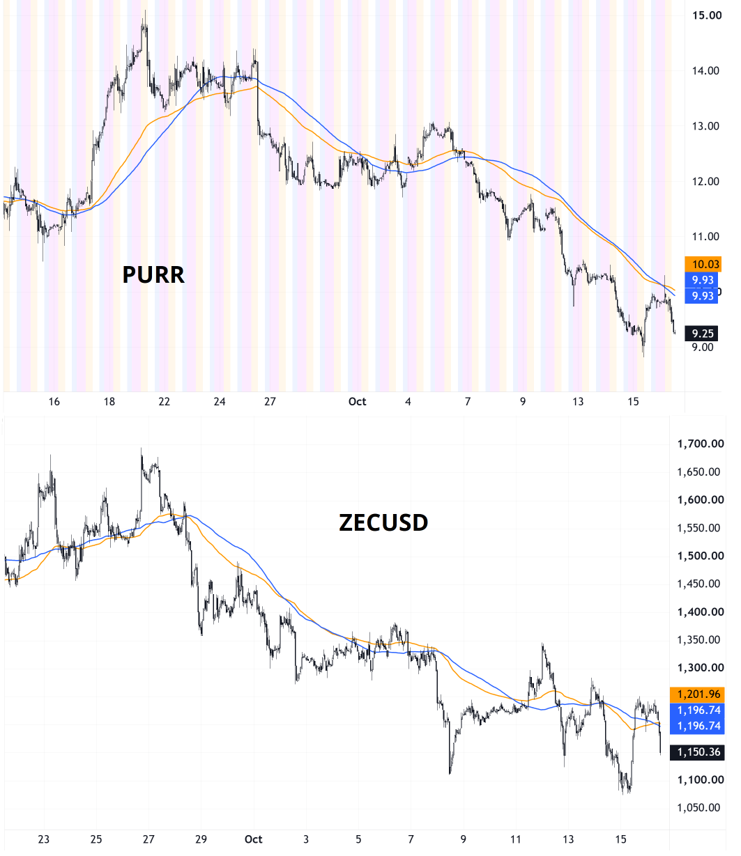
PURR and ZEC trading 30% off the late September prices while BTC and ETH are still holding in okay. Meanwhile, Strategy (MSTR) faces potential removal from MSCI’s global indices after they (MSCI) finalized new rules on October 15. There could be as much as $2.8 billion of passive MSTR selling if this comes true. November 11 MSCI announces the final list of exclusions, and November 30 changes take effect after the close. The Polymarket odds say it’s priced in, but the flows are big and you never know. Sometimes markets are not as efficient as you might think.
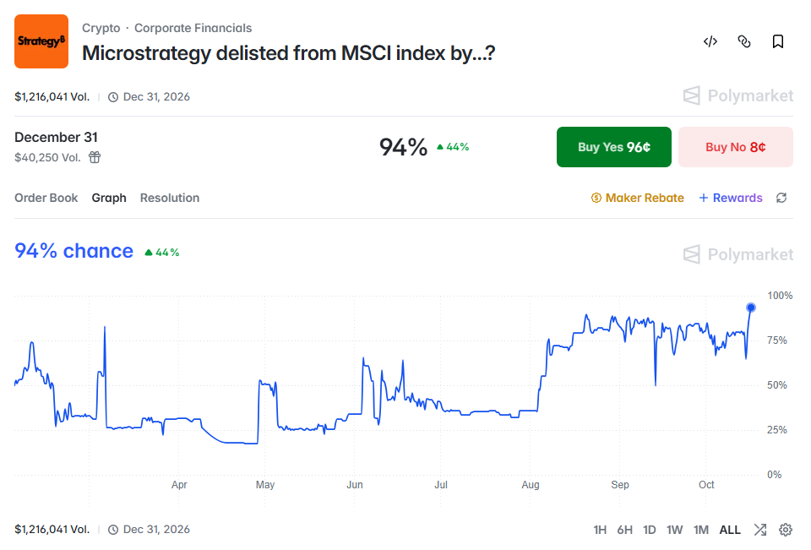
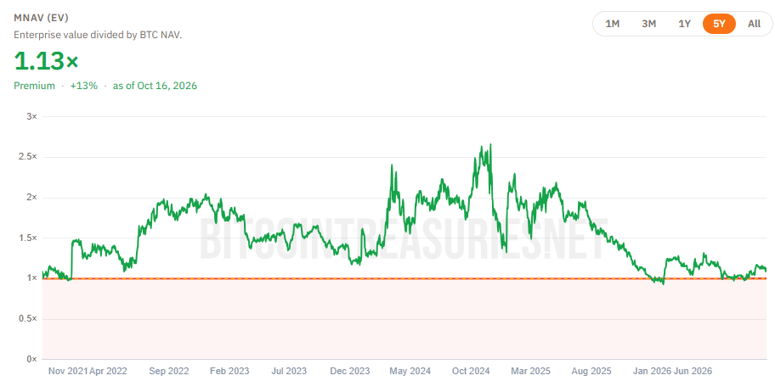
MSTR’s mNAV has flatlined just above 1.0 throughout 2026 as the market finally (FINALLY!) came to understand that buying MSTR at a premium is donkey finance—the financial equivalent of buying $1 bills for $2. The current, tiny premium could theoretically move to a discount around mid-November or early December due to forced selling, so it’s worth keeping this on your radar.
The copper triangle with which I have been obsessed for a few weeks is finally cracking as the market has moved from supply crunch and sideways eight AI let’s go to possible growth scare or financial meltdown on the possibly unpaybackable AI debt blob.
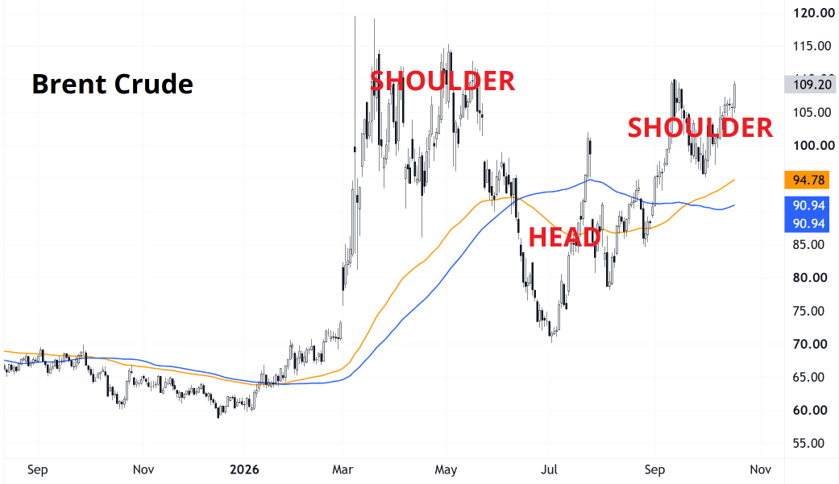
And as the foreverwar continues in Iran, oil and diesel prices continue to lurch higher. The most interesting aspect of oil this week is that people just decided to stop caring about it. We are perhaps at a tipping point where the market has decided it’s more worried about future growth than future inflation. Brent crude through $115/$120 and the market will need to reassess how much it cares about oil.
That’s it for this week.
Get rich or have fun trying.
*************

*************
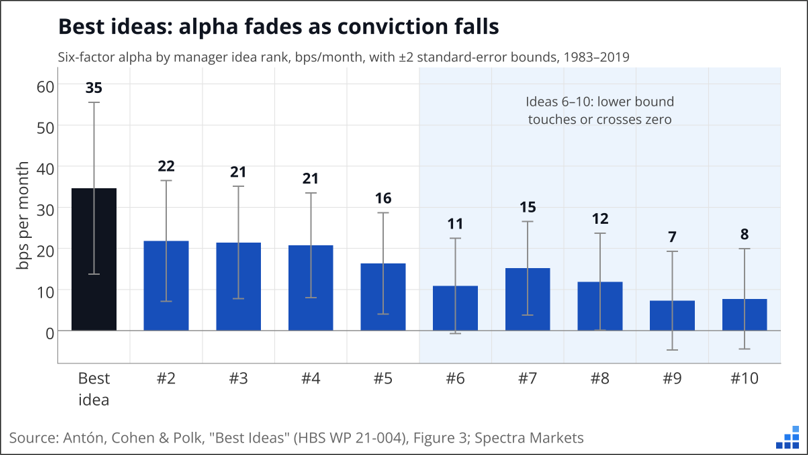
This paper, Best Ideas, is interesting. It makes a fairly compelling empirical argument for something many star traders and investors believe: Concentration is the way to outstanding returns. Diversification is the way to let fees and averaging drag you to perform at or just below the benchmark.
The paper is from 2000, before cool visuals and graphics were the norm, so I redid their Figure 3 in Spectra style to make it nicer to look at and easier to understand.
*************
*************

*************
Thanks for reading the Friday Speedrun! Sign up for free to receive our global macro wrap-up every week.