PPI doesn’t usually come out before CPI. This is useful information.
In vodka, or water…
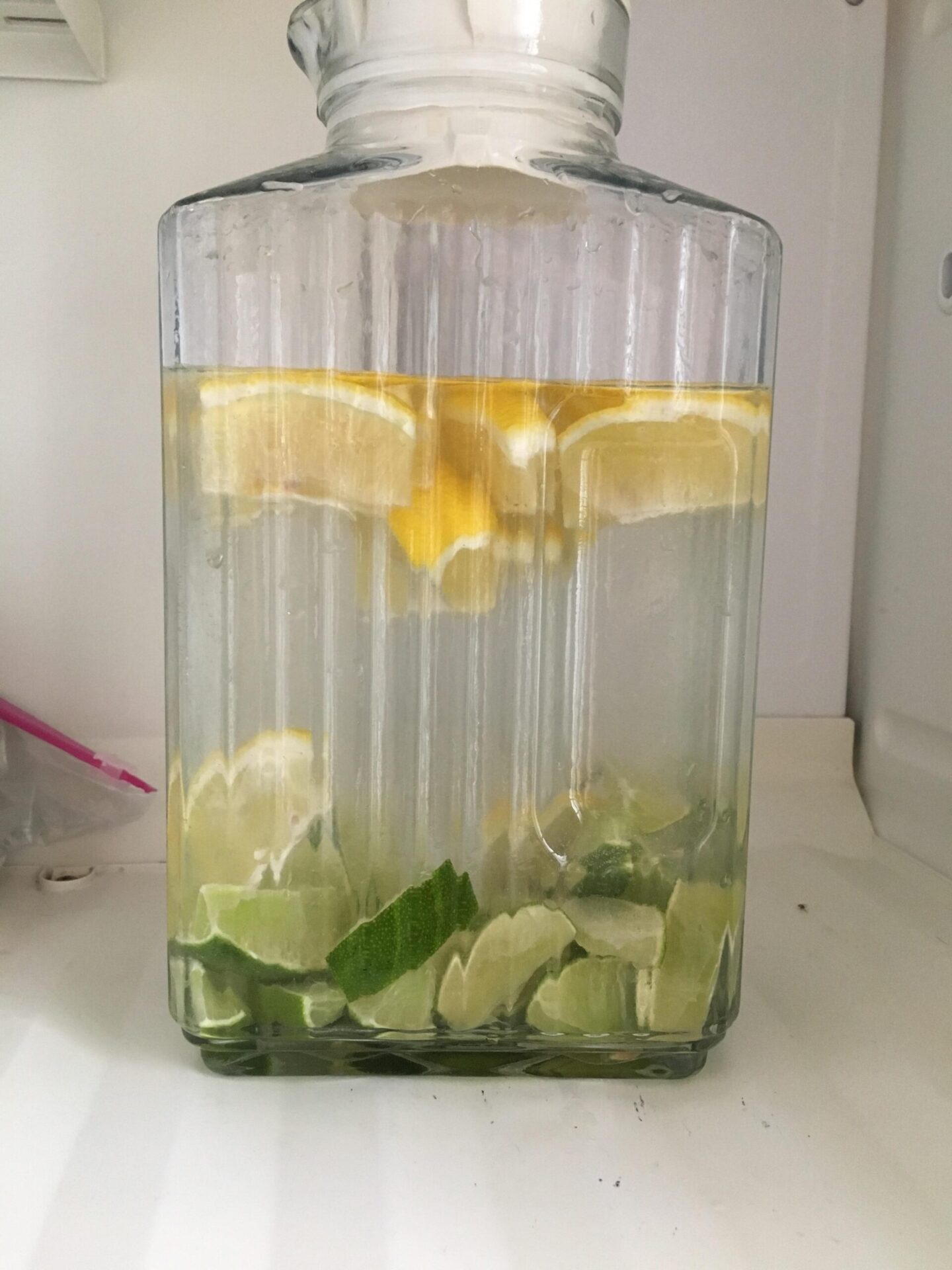
Limes sink but lemons float.

PPI doesn’t usually come out before CPI. This is useful information.
In vodka, or water…
Limes sink but lemons float.
Stop loss 0.6624
Take profit 0.6819
Stop loss at 11.0520 or cover at 11AM NY December 29.
December 8, 2022
Quick clarification regarding yesterday’s email and views. I am tactically bullish risky assets for now. I still think we see a bearish reckoning at some point in Q1 as the Fed hikes into economic weakness. Just not right now.
This is a big deal: Friday, we get PPI. Normally PPI comes out after CPI so it’s not useful as a CPI preview. One or two months per year, it comes out before. This is one of those months. The figure has been a better-than-OK predictor of the miss in CPI. So, while CPI is critical, tomorrow is a nice sneak preview.
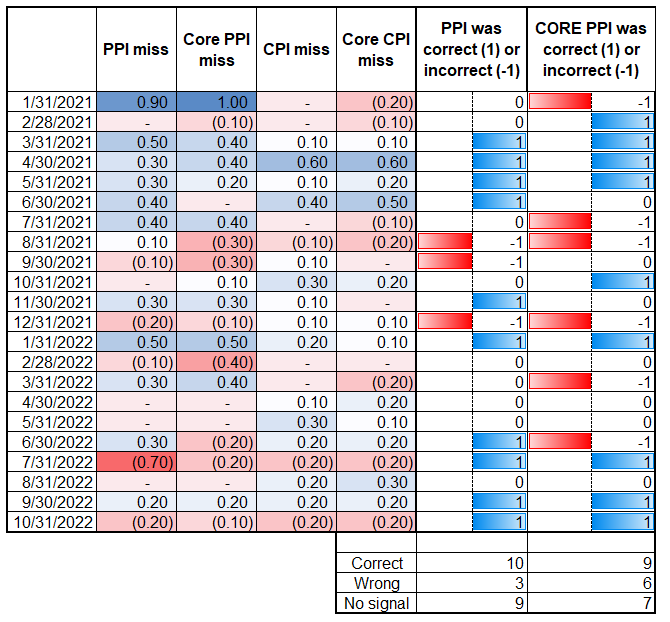
Here is my table, which shows PPI misses lined up against CPI misses. First column shows headline, second is core. The two columns on the far right show whether the miss in PPI (Actual vs. expected) was correct in predicting the miss in CPI. Blue bars are a win, red bars are a loss and blanks are when one of them came out “as expected” and thus there was no signal.
As you’d expect, headline is more accurate in predicting headline because both are driven by a huge energy component. Still, misses on Core PPI have also been a useful guide for Core CPI. To paraphrase Meatloaf, 9 out of 15 ain’t bad.
This looks like AI output from the prompt “American Flag, scrambled up in Excel format.”
Note that because of anchoring, economists were too low with their estimates throughout 2021 and 2022 and I would bet they are most likely to be too high on the way down. That is, even though the estimates are low, they are probably not low enough. If you trade options: Owning the vol tomorrow is worthwhile because it is probably underpriced. Normal PPI isn’t worth that much. This PPI is.
It’s not news that the yield curve is inverted. I wanted to look back at inversions in the 1970s and 1980s to see how far they got, but if you use nominal yields, you get a crazy chart because 3-month yields traded 3.73% below 10-year at one point in 1980. Thing is, yields at that point were 16.88 in the front end and 13.15 in the 10-year! So, even though I know dividing a % by a % is not the greatest normalization technique, I divided 3m/10y by the 10-year yield to see the inversion as a percentage of the current 10-year yield. Here is the chart:
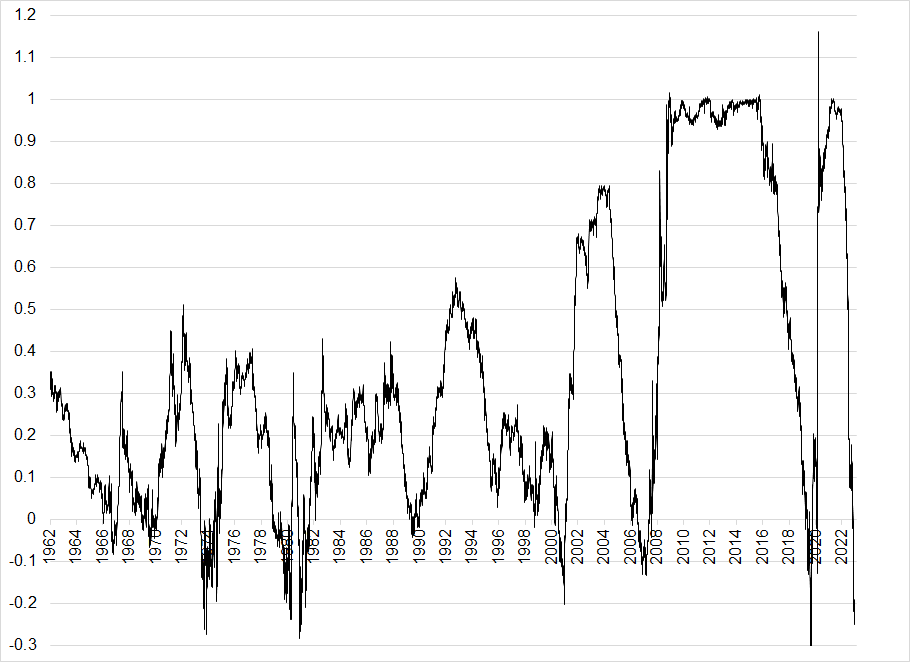
Naturally, you only get this kind of inversion when inflation is high. If you look at equity performance at the extreme inversions, it tends to be bad, most but not all of the time. I don’t need to make a chart to tell you what stocks did after the August 2000 and October 2006 inversions, but here are the ones from the 70s and 80s. I marked the inversions of minus 0.20 or more (again, 3m/10y relative to 10-year yield) in blue.
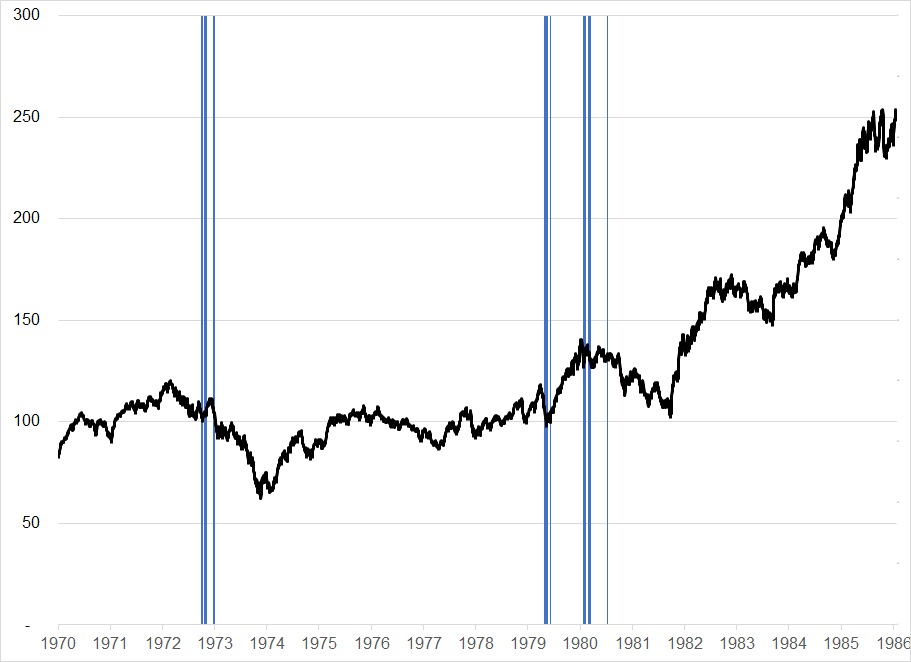
That chart is more big picture bear food for Q12023 but like I said, I’m bullish for now. It’s tricky to be short-term bullish and bigger picture bearish but much, much worse is to just sit there bearish all the time and get roasted on the squeezes. I am nervous, but happy to be bullish into PPI.
Alpha Trader is about to come out in Turkish! I find that exciting. I am looking to sell Japanese rights if you know anyone at a Japanese publisher (not kidding). Here’s my latest educational piece: How to safely sell vol. Have a floaty day.
It’s about density. And this comes from maturity. As citrus develops, there is cell expansion. Along with this comes hollow space created between tissues. These spaces are filled with gasses (not just air).
The result is that overall, the net density of most citrus fruit is less than water, and it will float.
Limes are immature citrus. They have been bred not to become fully mature because we like their sour citrus flavor. Limes are the least mature citrus and thus they have not developed the spaces yet in their tissues. So, they sink.
Lemons, limes, and water all have very similar densities: ~1.0 g/mL.
But limes are jusssst denser than lemons.