2022 was a mirror of 2021. Short term risk reward for USDJPY and cross/JPY shorts looks poor.

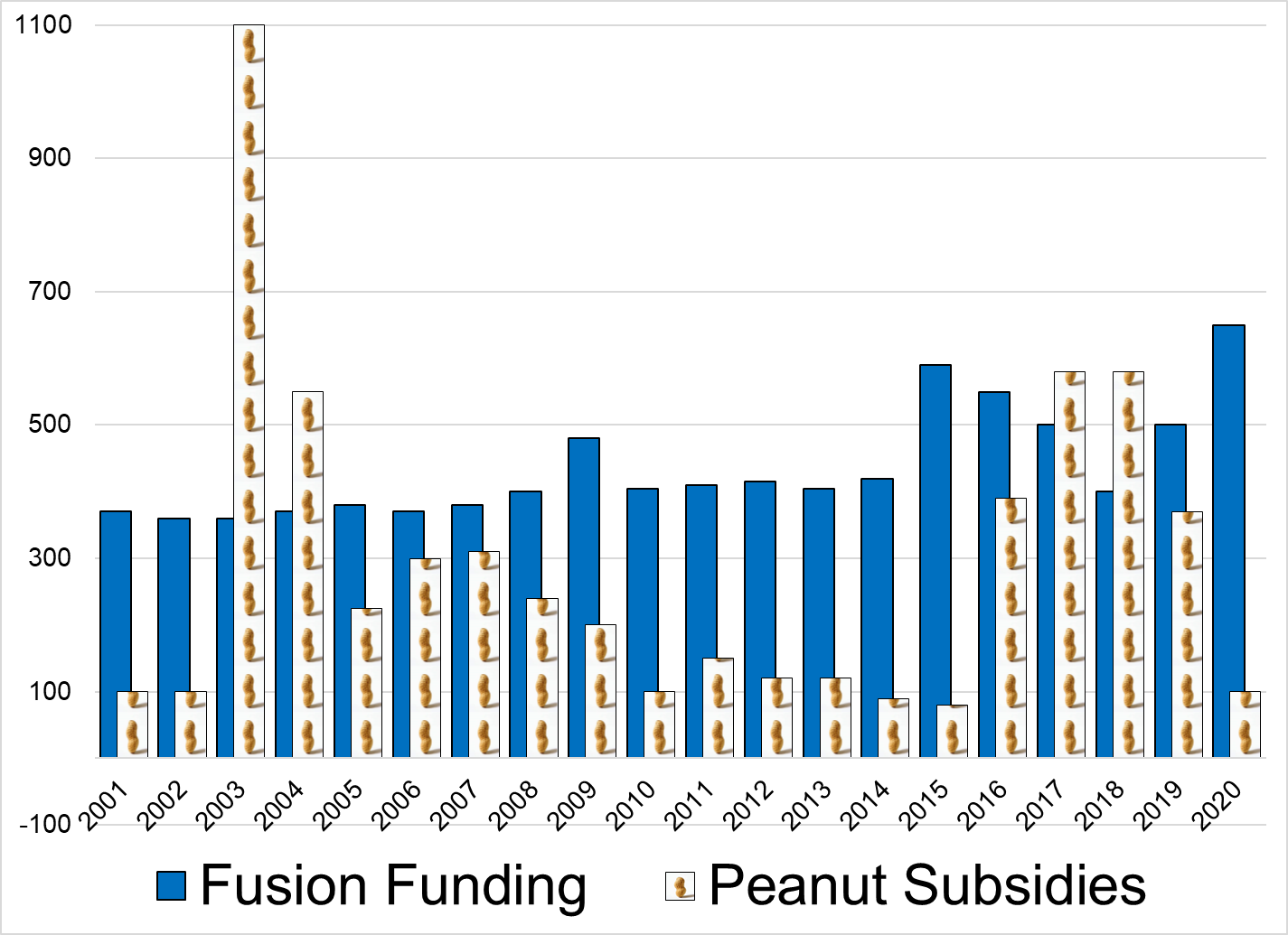
US government spending on
fusion research is roughly equal
to US government spending on
peanut subsidies

2022 was a mirror of 2021. Short term risk reward for USDJPY and cross/JPY shorts looks poor.
US government spending on
fusion research is roughly equal
to US government spending on
peanut subsidies
Stop loss at 11.0520 or cover at
11AM NY December 29
December 14, 2022
Quite a lot of head scratching after yesterday’s epic rip and dip in equities as the market approaches the 2022 endgame. The Fed meets today but it kind of feels like:
Do you really trust this market to do anything logical right now?
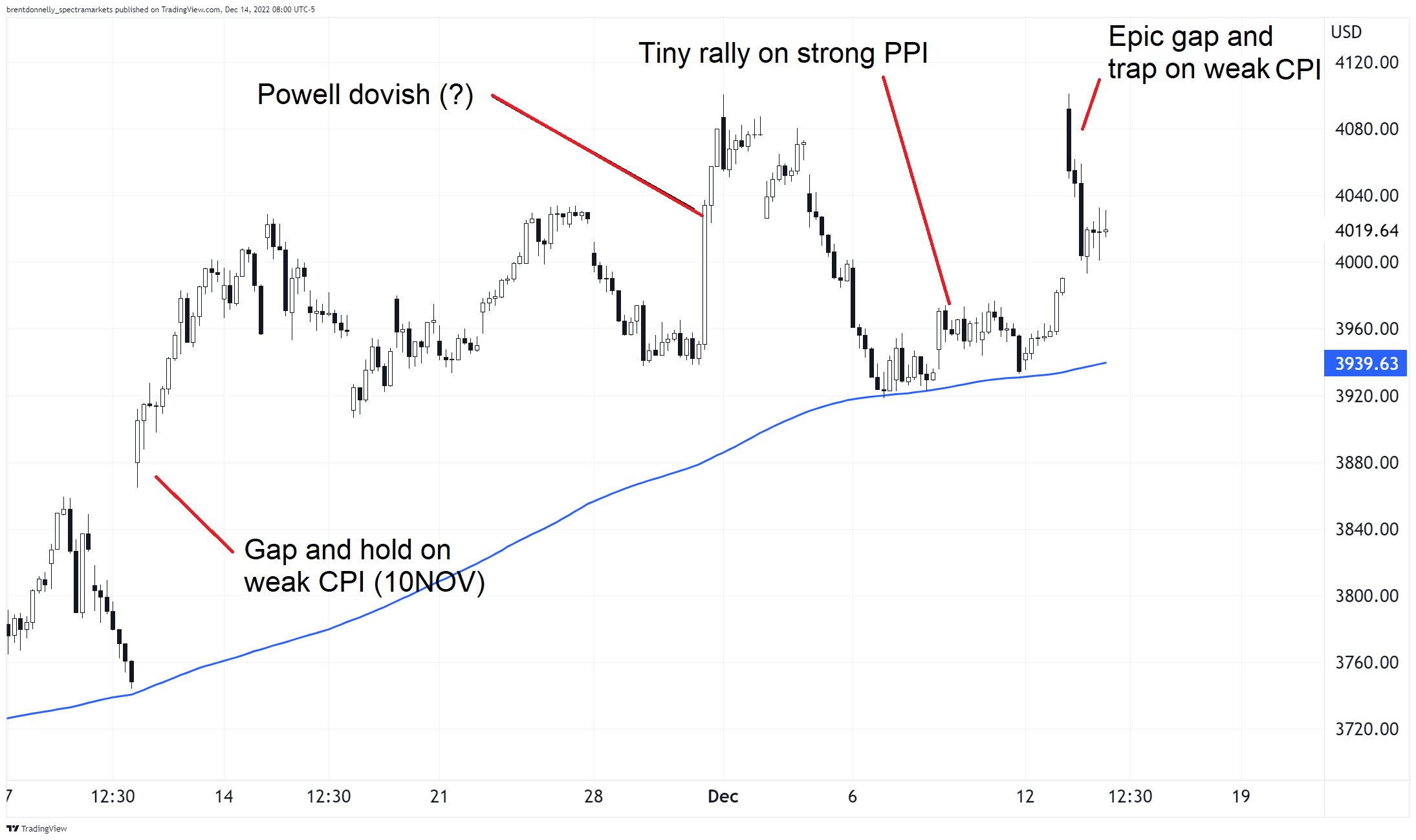
Question mark after “Powell dovish” because it seemed pretty on message to me, not anything special
The market is not committing any major new capital to stocks at the moment so it’s mostly short-term traders chasing price action. While Fed policy and inflation are improving the outlook for 2023 at the margin, there is so much worry about a coming drop in earnings that nobody is going to make a massive bullish bet on stocks here. The tension between the good news on inflation and the bad news on growth continues to keep us just on the south side of the SPX 200-day MA.
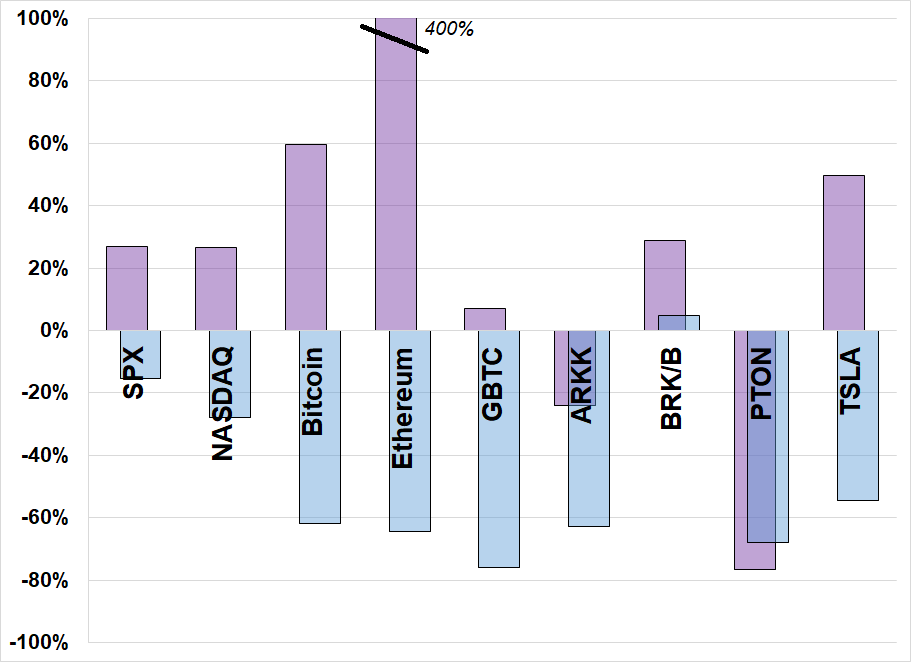
Every year has a different texture and various assets win or lose based on the prevailing macro winds. It’s stunning how little variety there was when you look back at 2021 and 2022. 2021 was the party, and 2022 was the hangover. Most everything that went up in 2021 fell back to earth this year, with the exception of bonds which went down and then down again. Here’s a snapshot.
Change in 2021 and 2022
Of those assets, ARKK and PTON are the only two that are below their closing levels of December 31, 2019. TSLA and ETH are by far the best performers in the 3-year period (%-wise, not vol-adjusted).
USDJPY slipped overnight on a Bloomberg story suggesting the BOJ might review its YCC policy in 2023. I have to say, even as someone who has been keen on lower cross/JPY, partially as the market will certainly get ahead of an imminent change in BOJ policy… The noises from the sources and officials have not been very hawkish. This article is no exception. If anything, I would be covering short USDJPY on this article, not selling USDJPY. Here are key excerpts; you can read the full article here.
BOJ Is Said to See Possibility of Conducting a Review Next Year
(Bloomberg) — Bank of Japan officials see the possibility of having a policy review next year, after wage growth and any slowdown in the global economy are closely examined, according to people familiar with the matter. The need to monitor developments in still uncertain factors make any review unlikely before Governor Haruhiko Kuroda ends his decade-long term in April, according to the people.
In the past, reviews from the BOJ have resulted in changes to policy, including the introduction of the yield curve control program. If an assessment is conducted, one theoretical result is a move away from Kuroda’s ultra-easy policy stance, but it could also end up reaffirming the existing framework.
Officials don’t see having a review as set in stone.
It feels to me like specs are way more excited about a change in BOJ policy than policymakers.
Furthermore, the main drivers of lower USDJPY post-MOF intervention have been: falling yields and the drop in oil prices. Oil has now bounced significantly off the lows, and yields are refusing to capitulate out of this 3.50% equilibrium zone in 10-year yields, even after yesterday’s weak inflation print. With USDJPY near major support in the 133.60/134.10 area, short-term risk/reward on USDJPY and cross/JPY shorts look bad to very bad.
Here are USDJPY, yields, and oil.
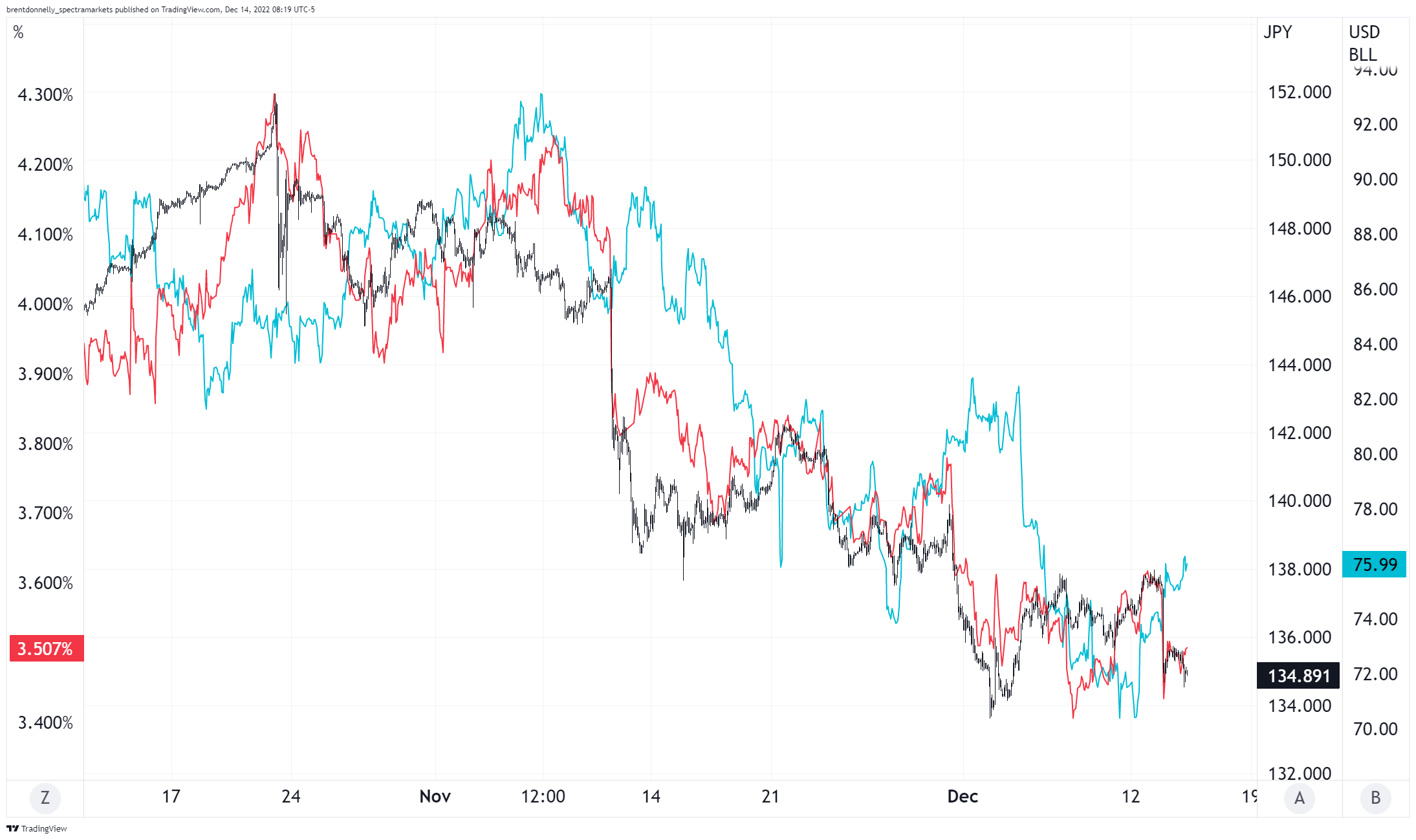
I am keeping an open mind here and certainly not eager to be short USDJPY or cross/JPY.
Howard Marks is always a good read. Here is his latest. Key takeaway:
In a recent visit with clients, I came up with a bit of imagery to convey my view of the effect of the prolonged decline in interest rates: At some airports, there’s a moving walkway, and standing on it makes life easier for the weary traveler. But if rather than stand still on it, you walk at your normal pace, you move ahead rapidly. That’s because your rate of travel over the ground is the sum of the speed at which you’re walking plus the speed at which the walkway is moving.
That’s what I think happened to investors over the last 40 years. They enjoyed the growth of the economy and the companies they invested in, as well as the resulting increase in the value of their ownership stakes. But in addition, they were on a moving walkway, carried along by declining interest rates. The results have been great, but I doubt many people fully understand where they came from. It seems to me that a significant portion of all the money investors made over this period resulted from the tailwind generated by the massive drop in interest rates. I consider it nearly impossible to overstate the influence of declining rates over the last four decades.
Something to think about: Even if successful, applied fusion technology has a 5% chance of happening in the next 15 years… The expected value of the impact is huge! Total world changer.
May your day produce a significant net gain in energy.
Sources:
http://large.stanford.edu/courses/2021/ph241/margraf1/
https://farm.ewg.org/progdetail.php?fips=00000&progcode=peanuts
https://www.aei.org/research-products/report/reflections-on-the-us-peanut-program-its-nuts/


This piece is mostly for people who are interested in backtesting