AUD didn’t drop
The NFP number on Friday was moderately strong as the headline beat by 1.5 standard deviations and AHE and the Unemployment rate came in as expected. This should have, in theory, led to a lower AUDUSD, but it didn’t. I was wondering if that has any implications going forward as you could describe it as a bad news / good price setup for AUDUSD.
Before I did that, I needed to find a standard way to check if the jobs report was weak, as expected, or strong. Of course, I could simply use the headline miss, but given the market has been watching AHE and UR quite closely (and they always matter somewhat), I decided to use a weighting of 50% NFP, 25% AHE and 25% UR and look at the standard deviation of the misses of all those. Here is the resulting output.
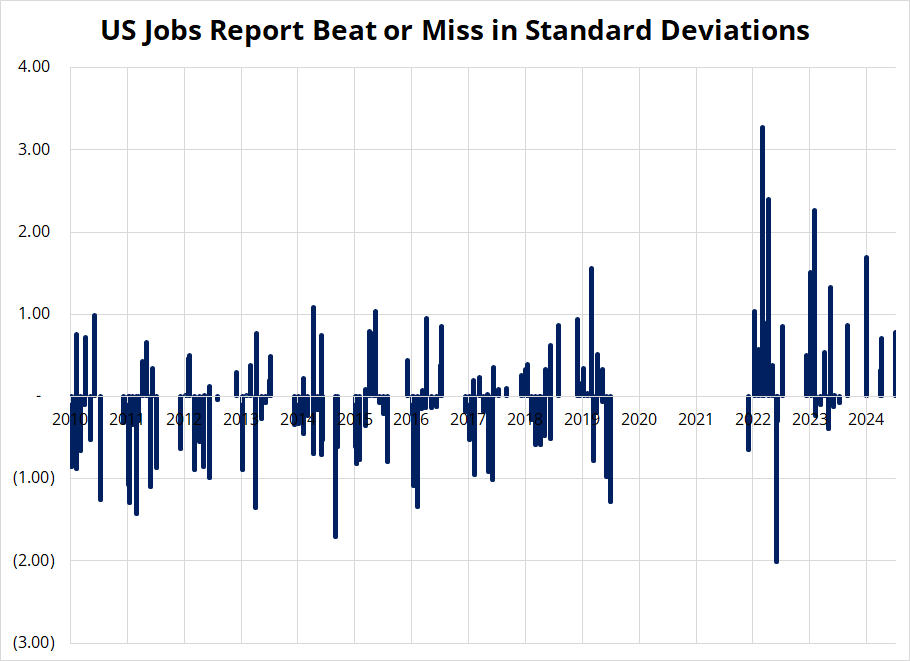
Anyone following US data in recent years will recognize that pattern of lower vol misses with a weak bias before COVID, massive beats after COVID, and slowly declining volatility, but still strong jobs reports in the past two years.
I looked at all the jobs reports where the release was at least +0.5 standard deviations (stronger than expected) and AUDUSD was down less than 20 bps. For the record, Friday’s NFP was +0.71 SD strong and AUDUSD was down 14bps. Here are the results.
The sample size is small, and the results are not particularly strong. There does appear to be a weak bias for AUD to rally, which is consistent with the bad news / good price theory. That is, AUD didn’t sell off on bad news, so it’s bid.
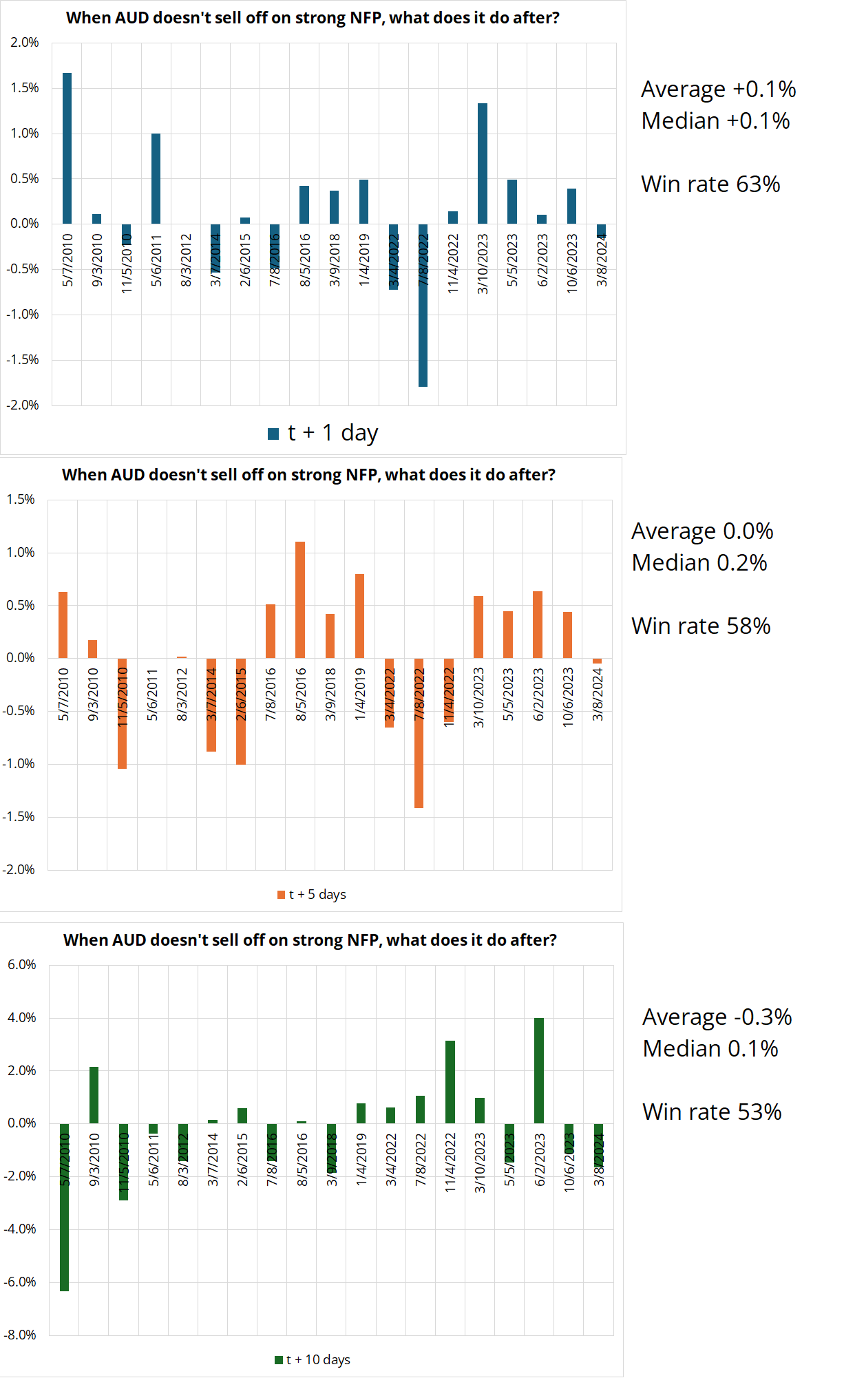
My experience has been that good news / bad price and vice versa are tradeable but have a very short half-life. This data, while not statistically robust, does mildly support that theory. I have written in the past that I treat good news / bad price as a 24-to-48-hour phenomenon as it is primarily psychological, but it also may have some signal value with regard to short-term supply and demand. Either way, if you’re short AUD and NFP comes in strong, and AUD doesn’t go down… You are more likely to cover over the next 24-48 hours, not add.
I think this description of how individuals behave works in aggregate and something that can’t sell off on bad news will be more likely to go up over the next day or two, and then the market will find supply/demand balance and life will go on.
In the interest of further studying this effect, I’m going to find some more studies like this so I can get more data and confirm whether or not my theory is correct. I’ll do more work on it.
Calendar
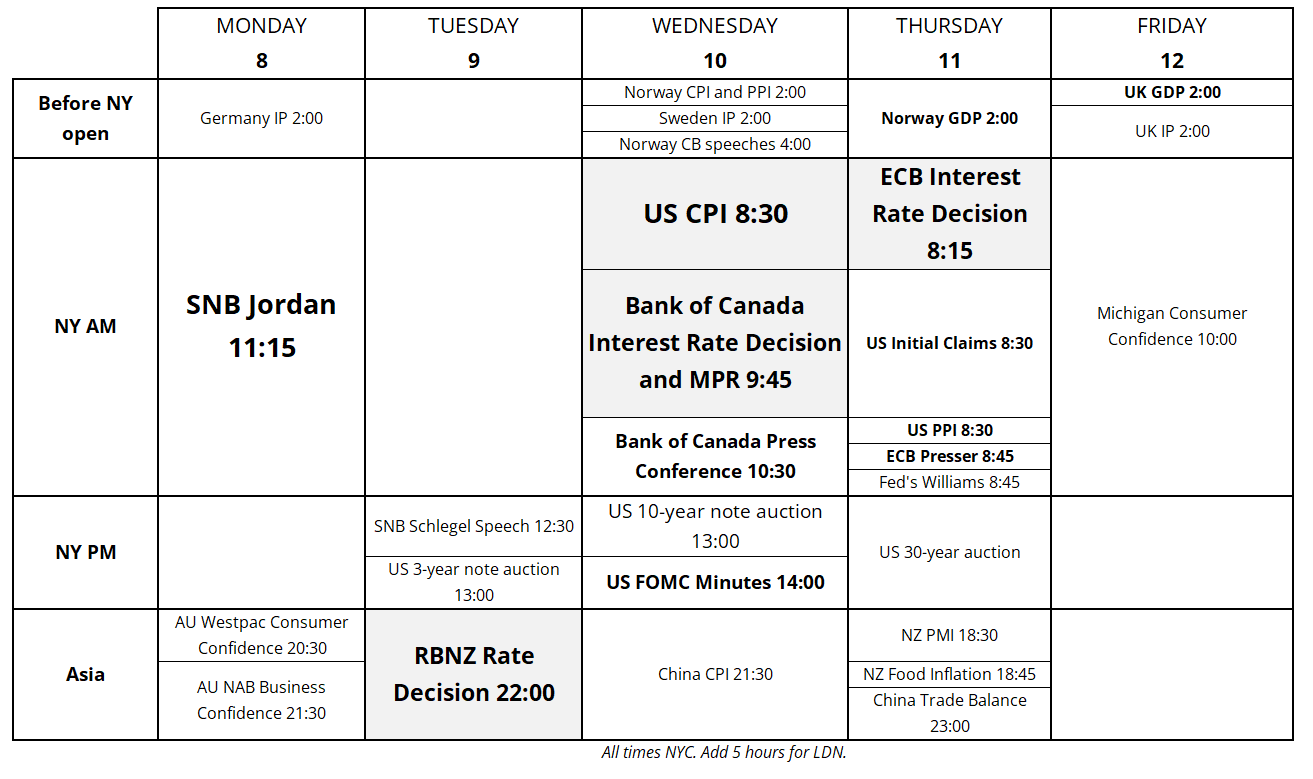
This week we see a flurry of high-importance events with US CPI and the RBNZ, BoC, and ECB on tap. The Bank of Canada meeting is particularly interesting given the abysmal Canada jobs data. Sadly, I was stopped out of the short USDCAD on Friday. The AUDUSD, USDNOK, and EURGBP continue to be decent and profitable, but not spectacular trades.
Final Thoughts
If you have not read Arthur Burns’ famous speech, The Anguish of Central Banking, today is as good a day as any to do so. It reads like a warning to Powell today. The interplay of fiscal, monetary, and inflationary forces then has many parallels to the MMT forces operating now. See this excerpt, for example:
The interplay of governmental action and private demands had an internal dynamic that led to their concurrent escalation. When the government undertook in the mid-1960s to address such “unfinished tasks” as reducing frictional unemployment, eliminating poverty, widening the benefits of prosperity, and improving the quality of life, it awakened new ranges of expectation and demand. Once it was established that the key function of government was to solve problems and relieve hardships—not only for society at large but also for troubled industries, regions, occupations, or social groups—a great and growing body of problems and hardships became candidates for governmental solution. New techniques for bringing pressure on the Congress— and also on the state legislatures and other elected officials—were developed, refined, and exploited. The Congress responded by pouring out a broad stream of measures that involved government spending, special tax relief, or regulations mandating private spending.
Here’s my reflation-focused podcast with Alf, in case you missed it. Happy trading & enjoy the eclipse.