Thinking about how things now are not all THAT dissimilar to how they were at the end of 2019.
A food for thought piece.

Thinking about how things now are not all THAT dissimilar to how they were at the end of 2019.
A food for thought piece.
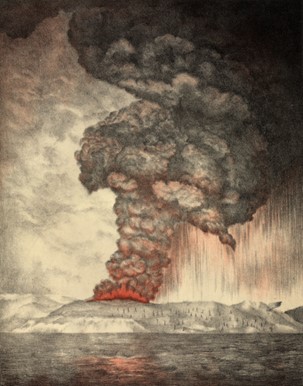
The loudest sound in recorded human history is the 310 decibel sound of Krakatoa erupting in 1883.
The sound was heard clearly as far away as Alice Springs, Australia.
Long 10DEC EURMXN
18.70/18.20 put spread
~50bps EUR
off 19.16 spot
November 28, 2023
Since the summer, the FinTwits and commentariat has been aggressively worried about the runoff in US excess savings. Then, there was a revision to the data and some more wire got added to the fuse that counts down the “tapped out consumer time bomb.” Here is how the San Francisco Fed presented it.
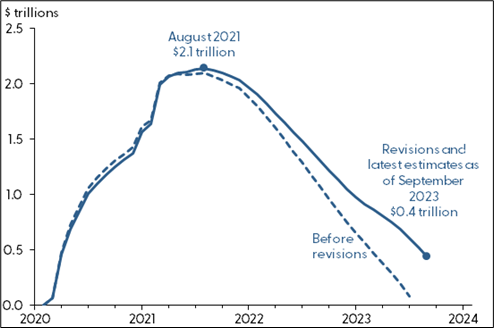
https://www.frbsf.org/our-district/about/sf-fed-blog/data-revisions-and-pandemic-era-excess-savings/
It’s not clear to me why a return to pre-pandemic levels would mark the death of the US consumer. It should just mark a return to 2019 levels of savings and spending and possibly a return to that sort of OK-but-not-booming economy. The old new new old new normal or whatever. It’s not controversial to say that the economy from 2020 to 2023 was an aberration unlike anything you or I have ever seen.
It is more controversial to just assume we are going back to the 2010s stagnation regime because there have been some huge changes in the world, like reshoring, supply of labor, wage expectations, and so on. Then again, the primary drivers of lowflation in the 2010s were technology and demographics. Technology is accelerating with AI likely to be deflationary, and US demographics are struggling to get back to pre-COVID:
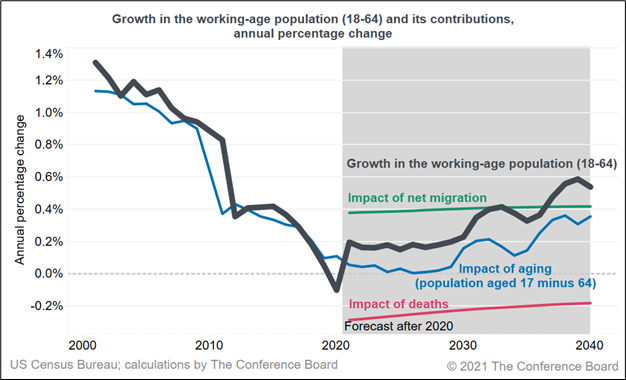
I am not making a big call here that we are about to return to secular stagnation, but it does seem like a scenario that is underpriced, underappreciated, and underdiscussed. If you look at where things are now vs. 2019, there are more similarities than differences in many cases. I made a huge grid to summarize it all.
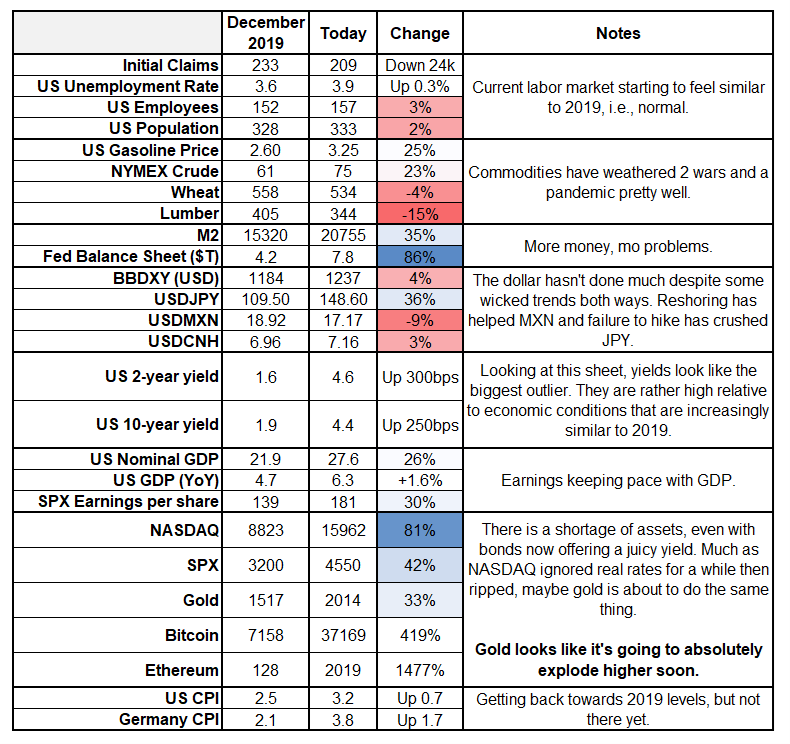
This is food for thought. I would be happy to hear your view on why we might head back to sub-2% inflation or why we might not. A one-time increase in money supply and a COVID shock created the inflation spike of a lifetime, but now the money shock is over, supply chains are back online, shipping costs are collapsing, commodities are stable, labor supply is returning, and things look more to me like 2019 than 2021 or 2022.
The good news is, with economic volatility falling fast, the YoY numbers for 2024 won’t be polluted by nearly as many base effects. A huge drop in yields in 2024 should be on everyone’s bingo card, at least.
I was trying to build a regression model that uses gasoline prices, NASDAQ, and Initial Claims to predict Consumer Confidence and I was surprised to see that the sign on NASDAQ was backwards. That is, there is essentially no relationship suggested when you regress NASDAQ vs. Consumer Confidence. This runs against my memory and experience from the 2010s so I decided to make a little scatter plot by various regimes.
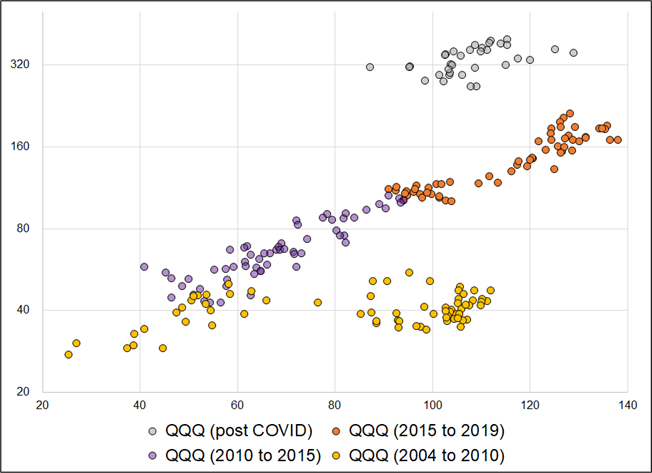
You can see that my memory was correct. From 2010 to 2019, there was a nice correlation between levels of QQQ and Consumer Confidence. This was the golden age of US exceptionalism and an era where most people believed higher tech stocks were a good thing. Big Tech had taken over from Big Finance as the most appealing job for new graduates. In contrast, you can see that 2004 to 2010 (post-dotcom bubble burst) and 2021 to now (post COVID, social media hate, etc.) there is no link between consumer confidence and the NASDAQ. Stronger megatech brought skepticism post-dotcom and it brings vitriol over monopoly and concentration now. Neat.
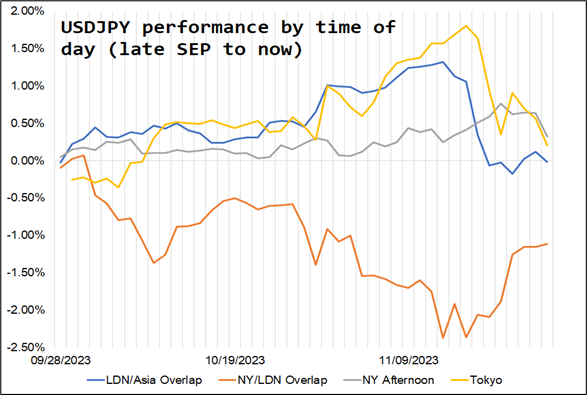
USDJPY goes down in Tokyo time almost every night these days. I think that is a meaningful trend change signal that started November 16. HT Shady.
I am not going to reload GBPUSD or EURUSD for now as I would prefer to keep an open mind and wait for better levels. 1.2500/20 looks like the ideal reload point for GBPUSD.
Have an explosive day.
The Spectra FX Positioning and Momentum Report
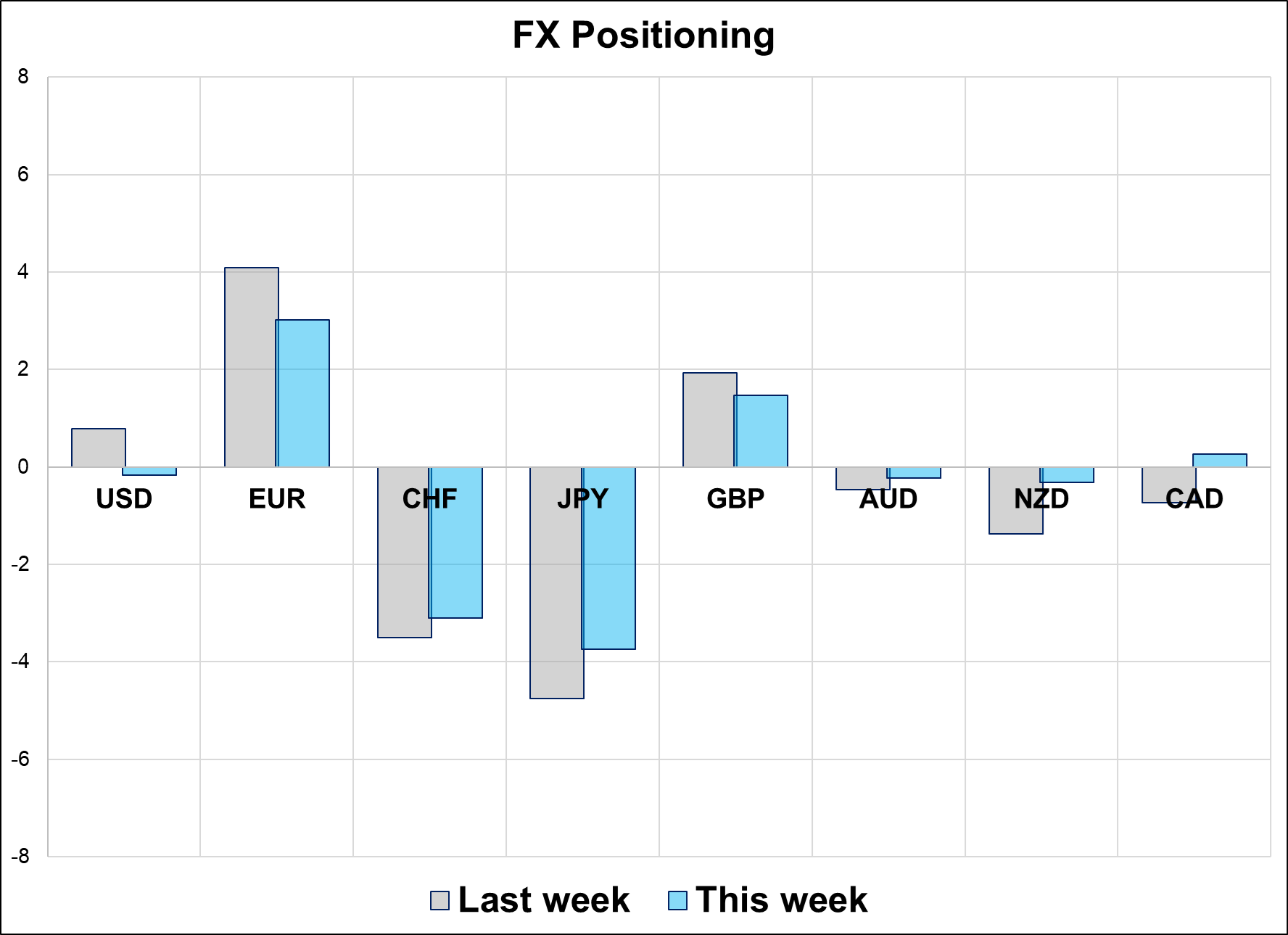
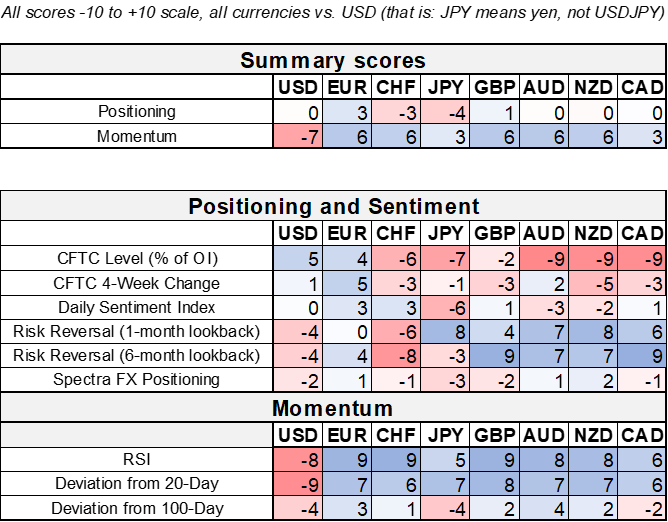
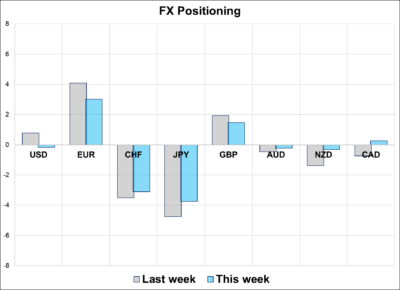
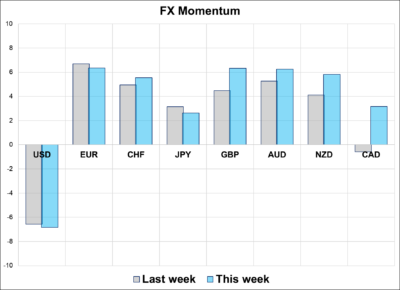
Hi. Welcome to this week’s report. Positioning has come off the boil substantially as the big turn in momentum necessarily triggers a reduction in USD longs. Specs are net close to home though the CFTC is heavily involved still with AUD, NZD, and CAD shorts looking large and precarious into the mega USD down seasonal that often dominates dealings in December. No strong signals from positioning at the moment, but it will be interesting to see what the CFTC do into the end of the year.
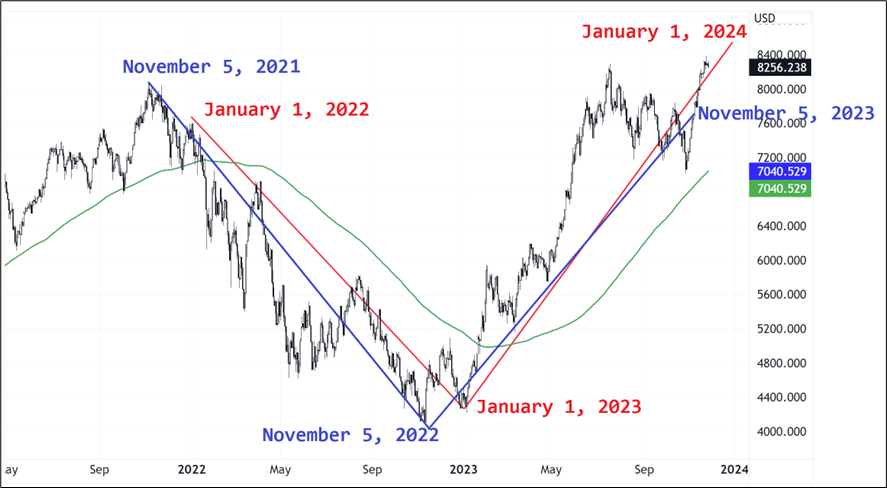
Given there is nothing significant to report regarding FX positioning, how about stocks? This chart from GS is wow.
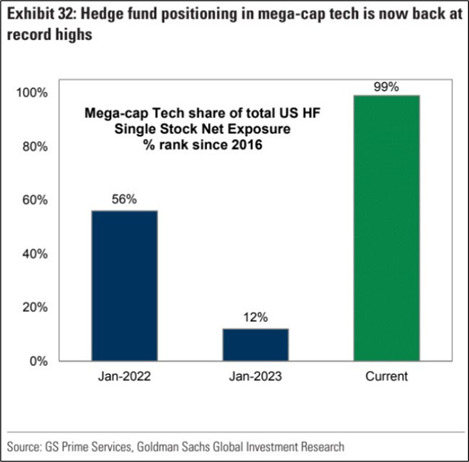
It would be lovely symmetry if we were to close at the highs in megatech this year just as we closed at the lows at the turn of 2022/2023. We have exceeded the symmetry suggested by the 05NOV21 to 05NOV22 moves and you can see the turn process started both years in November and accelerated in January. It’s probably worth taking a shot at short megatech vs. long equal weight SPX in early January as window dressing takes megatech to new all-time highs around Christmas.
—
That’s this week’s report. Thank you for reading.
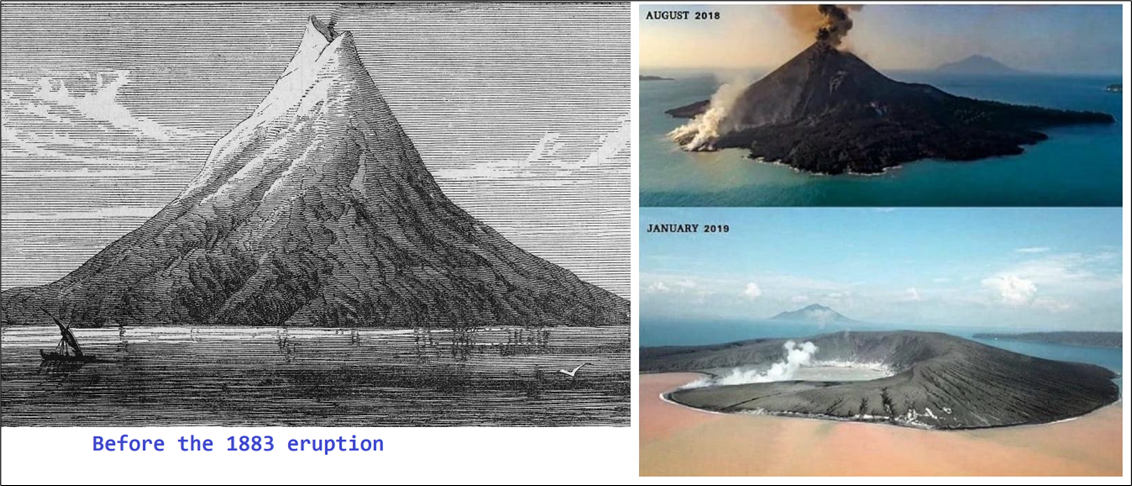
https://www.bbc.com/news/world-asia-46669280
Below is excerpted from “Science questions from toddlers” via fivethirtyeight. The entire article is chalk full of amazing and interesting facts.
Q: I want to hear what the loudest thing in the world is! — Kara Jo, age 5
No. No, you really don’t. See, there’s this thing about sound that even we grown-ups tend to forget — it’s not some glitter rainbow floating around with no connection to the physical world. Sound is mechanical. A sound is a shove — just a little one, a tap on the tightly stretched membrane of your ear drum. The louder the sound, the heavier the knock. If a sound is loud enough, it can rip a hole in your ear drum. If a sound is loud enough, it can plow into you like a linebacker and knock you flat on your butt. When the shock wave from a bomb levels a house, that’s sound tearing apart bricks and splintering glass. Sound can kill you.


This piece is mostly for people who are interested in backtesting