Here’s a crazy thought: What if the inverted yield curve doesn’t just predict recession, it partly causes it?
Seen near the beach
on holiday. What?

Here’s a crazy thought: What if the inverted yield curve doesn’t just predict recession, it partly causes it?
Seen near the beach
on holiday. What?
March 17, 2023
Conventional wisdom is that an inverted yield curve shows market pricing of current vs. future growth prospects and that’s why it is good at predicting recessions. Here’s a crazy thought: What if the inverted yield curve doesn’t just predict recession, it partly causes it? If everyone knows that yield curves are a strong predictor or recession, the very fact that the yield curve is inverted should change economic actors’ behavior.
Banks should be most familiar with the predictive power of YC inversion and thus when the yield curve inverts, they would logically tighten lending standards. Today’s first chart shows gray lines marking yield curve inversion (3m/10y) and a blue line showing the percentage of domestic banks in the US tightening lending standards.
There is a major cause/effect circularity problem here, but with so many accurate signals from the yield curve in the past, its self-fulfilling nature should increase every cycle until it finally head fakes everyone with a false positive. Higher rates can obviously drive tighter lending standards on their own, even without inversion. But perhaps tightening of lending is nonlinear as the yield curve approaches and moves into inversion.
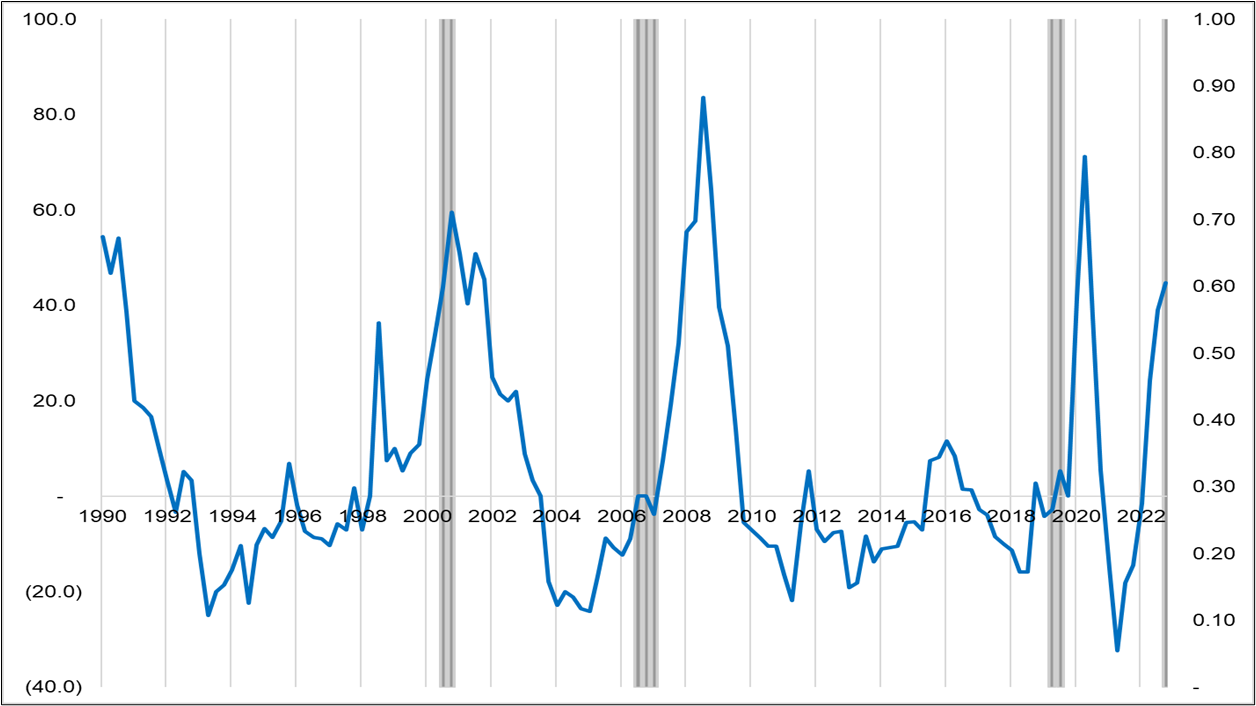
3m/10y inversions marked in gray
Furthermore, I have been thinking about my own behavior of late and the behavior of my friends and family. As yields went up in 2022, we left cash balances on deposit at banks out of laziness. But at some point, in recent months, even $20,000 in a bank account feels stupid when SHY is yielding 4+% and other products yield even more. So, I pulled my bank deposits and put them in SHY, the short-term bond ETF. As did most of my friends and family, over time.
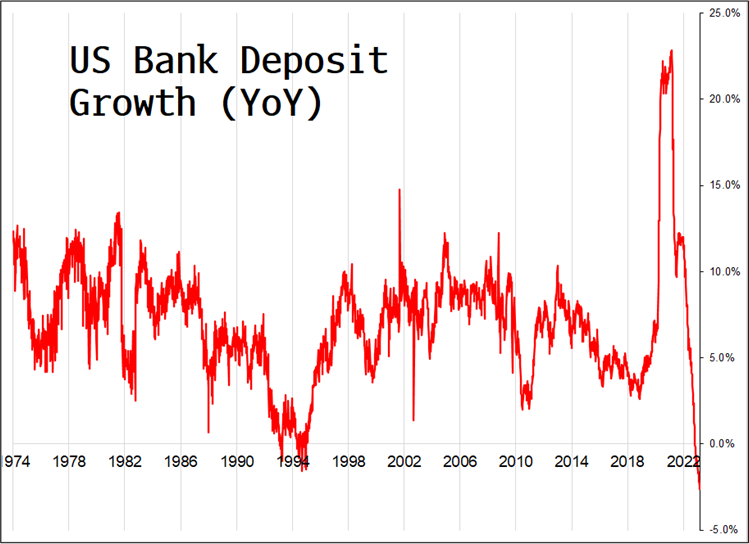
Banks are slow to raise deposit rates at first, much as oil companies are slow to bring down retail gasoline prices when oil prices fall. There is a lag. That lag in deposit rates can lead to massive deposit outflows when short-term rates are rising quickly because the opportunity cost (the spread between deposit rates and T-bills) widens in a hurry. Deposit growth went negative YoY just twice in the USA… 1995 and now. Both times of rapid rate hikes.
It is worth noting that this year’s drop is partly the result of base effect. It’s easier for deposits to drop after a crazy, historic rise than it is for them to drop in normal times. The yield curve never quite went negative in 1995, but it was extremely close.
Rapid rate rises have a nonlinear impact on deposits and also (probably) lead to tighter lending standards as inversion kicks in. This is probably a significant mechanism whereby inversion causes recession; it doesn’t just predict it. I bet there are fancier, more Zoltan-ish ways of breaking this all down but from 30,000 feet, I think the mechanism is causation as much as prediction. Happy to hear pushback on this as I know the whole thing is rather circular, so I don’t want to overstate my confidence in this theory.
Anyway, this also happened:
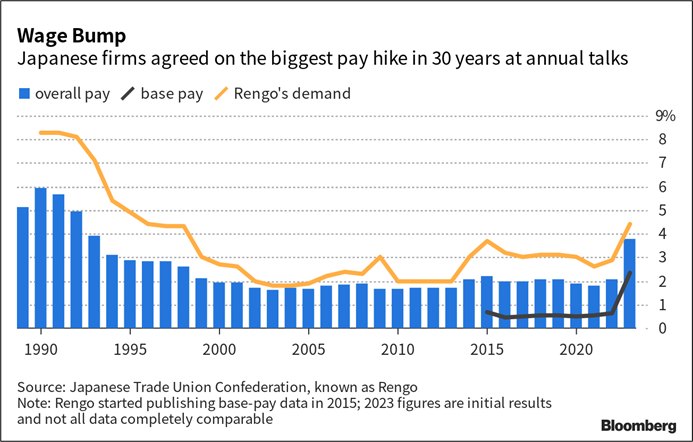
I suppose the market was kind of expecting strong wage growth out of Japan for quite some time now, but I’m still a bit surprised at the lack of reaction in the JPY to the shunto wage outcome last night. 30-year highs in wages open the door for Ueda to normalize as Kuroda’s 3% objective has been reached. April 27 BOJ will be a hot ticket.
USDJPY just hung around on a 133 handle all night after the release, though it’s dumping now as US yields drop on the NY open. Despite all the excitement around the BOJ story and the changeover from Kuroda to Ueda… The dominant driver of USDJPY on 19 out of every 20 days remains US yields, not BOJ expectations. Here is the chart:
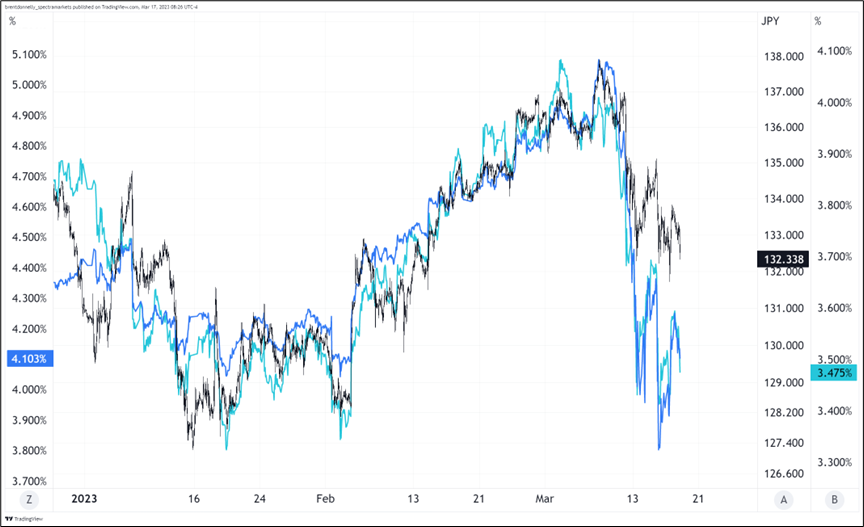
My view, as discussed yesterday, is that yields have made their cyclical high and the path of least resistance for the USD is down. That means 130.00/134.00 is the new short-term range for USDJPY from here.
Risky asset forecast for the next few weeks: Mostly sunny with a few short, violent thunderstorms.
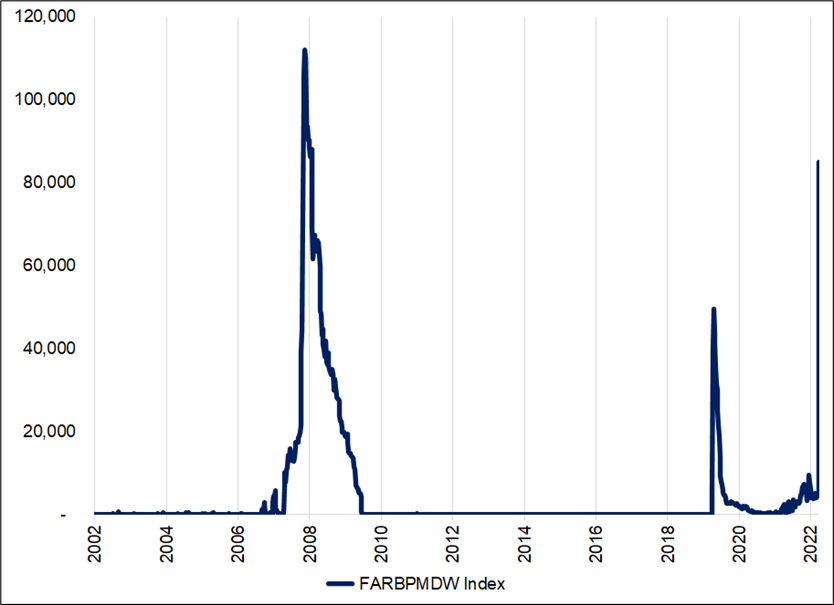
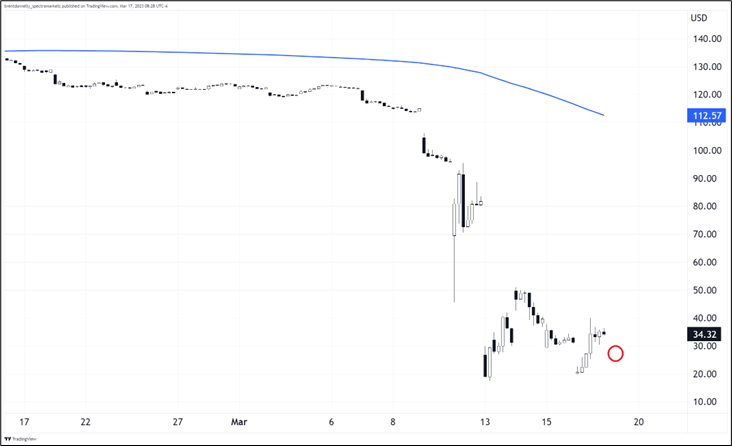
I am surprised at the lack of bounce in FRC. The deposit merry-go-round where investors pull their money out of FRC and put it in JPM and Citi and then Citi and JPM put it back in FRC has not restored confidence in the equity recovery value. The good news is that the search for the next SVB has not turned up any new victims, yet. Right?
Meanwhile, yesterday Yellen said out loud what everyone already knew: The US has a two-tier banking system comprised of large, diversified systemic banks where your deposits are safe, and small, non-systemic banks where deposits are not safe. If you are a depositor, the choice of where to put your money is not difficult.
Sammy the Bull in the lead in the NCAA Pool after day one. Have a sunny weekend.
A muster station is where you assemble during an emergency
(usually on a cruise ship but sometimes on land).



This piece is mostly for people who are interested in backtesting