Wait, he’s not writing about the jobs report, is he?
Image source: Wikimedia Commons

Wait, he’s not writing about the jobs report, is he?
Image source: Wikimedia Commons
Flat
I’m not sure how much time to spend on NFP today given it’s taking place a few days before the election, but it seems worth a page or two of discussion, at least.
There has been considerable weirdness in the household survey of late, but it’s always worth remembering that the household survey is garbage and has no relationship to the real economy on a month-to-month basis. It’s pretty much just the establishment survey with a massive noise factor added, as you can see in today’s first chart.
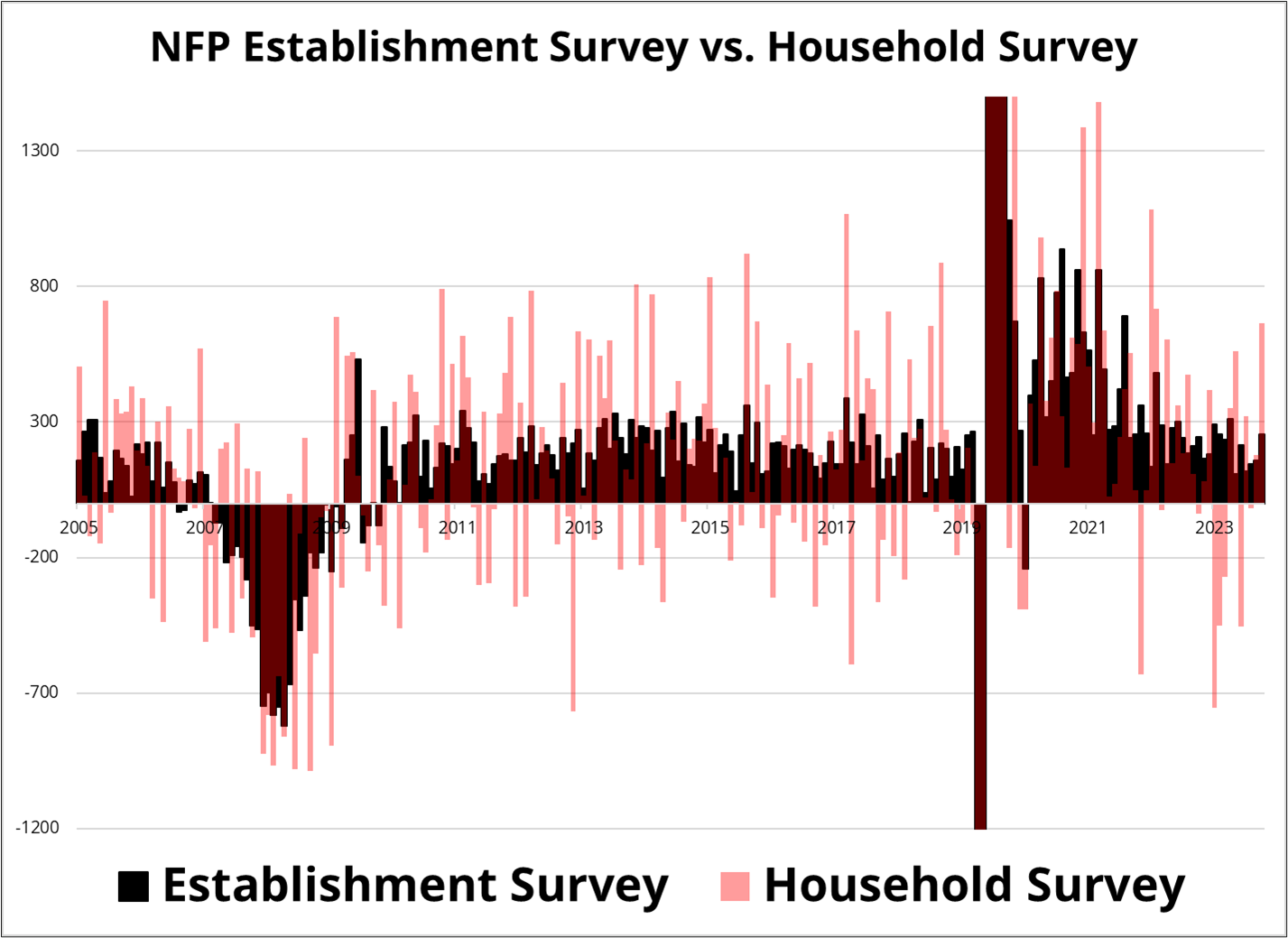
Still, the craziness of the seasonal adjustments and noise factor in the household survey probably do suggest that the UR was a bit understated last month.
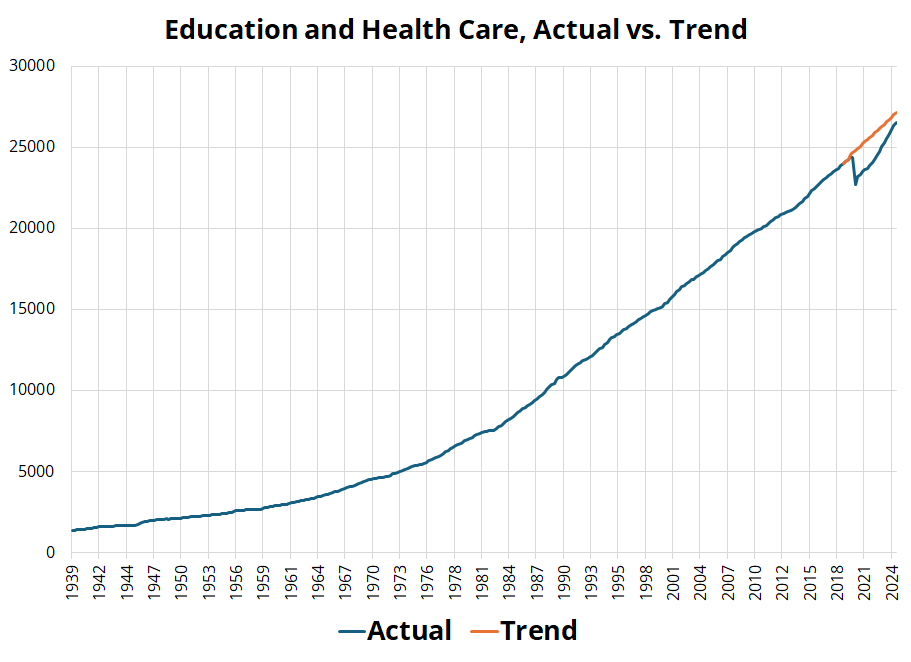
Other factors suggest business as usual in the more reliable establishment survey as most sectors continue to show employment growth, while US government jobs in particular continue to grow briskly as the jobs shed during the pandemic are slowly added back. Recall that nurses and teachers were a major part of the Great Resignation.
My second chart shows how education and health care workers, a major portion of the government workforce, continue to unwind the shortage created by the Big Quit. As the education, health care, leisure, and hospitality industries get back to pre-COVID trend, the jobs market has cooled and found a healthier equilibrium after the massive dislocation and worker shortages experienced by businesses in 2021 and 2022. This does not mean that we are going into a recession. It just means that there was a shortage, and that shortage is almost rectified.
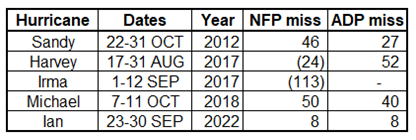
There is a question about hurricane impacts on the jobs data, but if you look at past hurricanes, there’s no visible distortion at all in the establishment survey or ADP.
The large beat on ADP yesterday points to a small positive skew for NFP tomorrow, while the huge miss on JOLTS does not have any negative predictive power. JOLTS is always one month behind NFP, but if you look at months where JOLTS came in 400k or more worse than expected, the NFP result in the following month skews positive not negative.
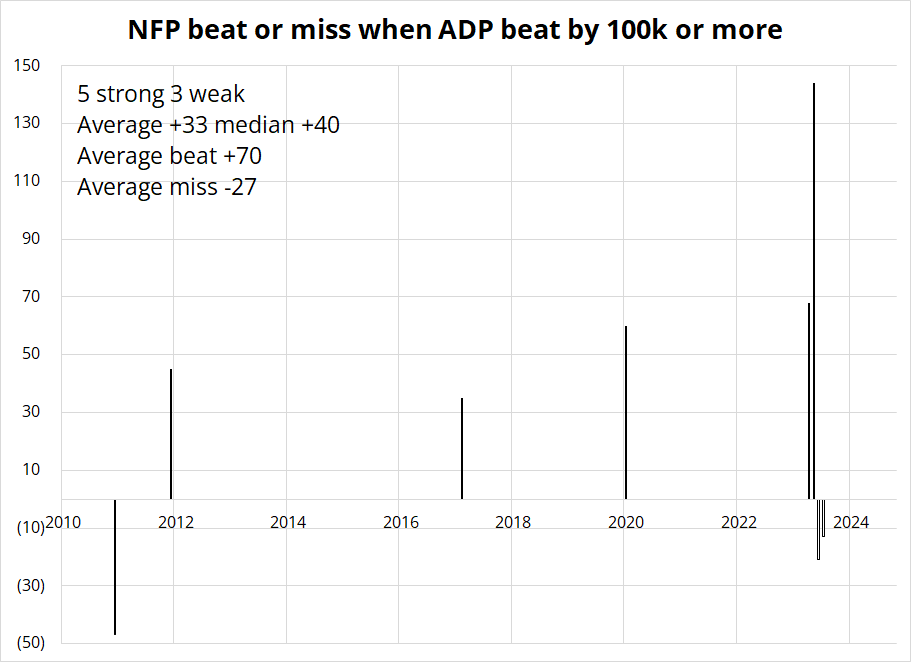
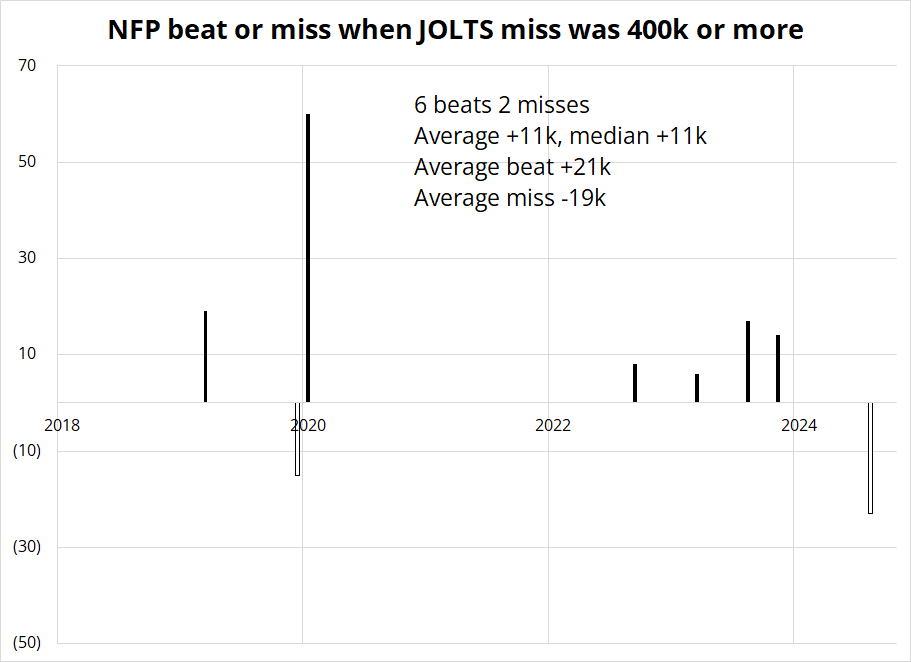
So, there is nothing that suggests to me a weak figure. Further down the page I show what’s trading for NFP on Kalshi and what the economists are predicting. Using the Kalshi distribution is much better than looking at what economists expect because:
One thing to note on the Kalshi odds is that as you go out the spectrum towards less likely outcomes, the bid / offer gets pretty wide. So you can’t really say whether “above 300k” is trading at 4% or 7%, but it doesn’t really matter that much. The meaty part of the distribution trades enough and even if it all trades 3% to 5% wide, all the time, it’s still better than stale and herdy PhD forecasts.
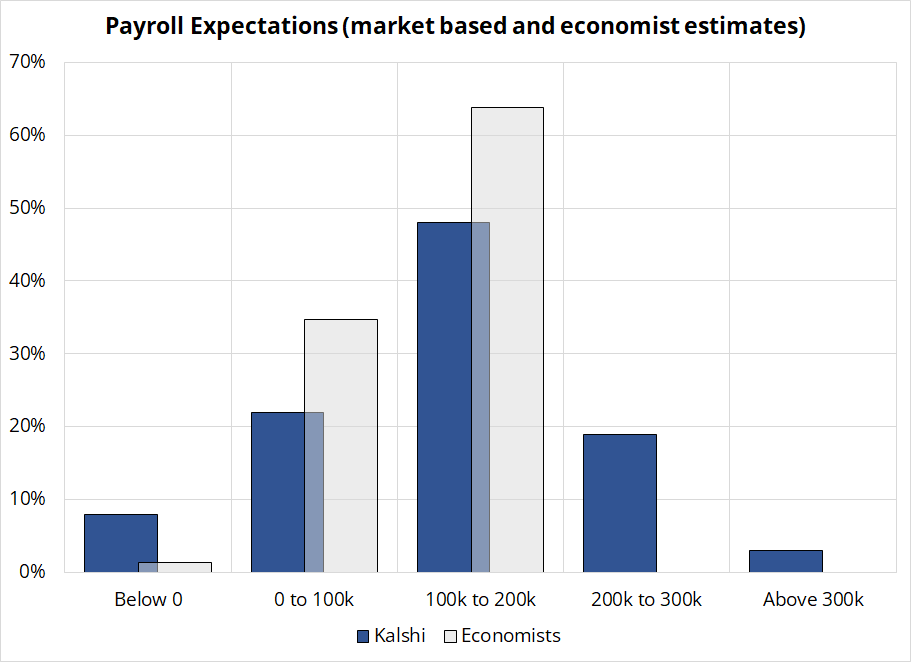
This is all interesting and stuff, but in the end, tomorrow’s release is more a fade than a go with. A strong figure is more of a surprise and will likely have more impact on the market because a weak number will be more easily written off as an artifact of storms and/or pre-election uncertainty. A strong number could also be attributed to pre-election hiring, of course, but it would be consistent with the narrative and reality of stronger USA for longer. NFP could have an impact on the November Fed meeting outcome if it’s a barnburner either way.
I still think Harris trades are the better bet at current levels, and USDMXN put spreads look super reasonable to me even at current vols. A 1-month 19.50 / 19.10 put spread costs something around 60bps and pays 200bps if it works. If you play around with the election simulators, there are so many close outcomes and as I mentioned yesterday, I would rather bet on overcorrection in the polls, not a repeat of the 2016 and 2020 polling errors. So, to me buying the USDMXN put spread looks like a 48/52 bet that pays more than 3:1. You can do similar stuff in USDJPY, which is equally attractive as Ueda looks like he wants to hike in December. Probably best to wait until after NFP to do this stuff, though.
My sincere condolences to Aaron Judge as he will have a tough summer reliving the dropped fly ball. Anyone that has played baseball knows that horrible feeling of dropping a routine liner and that feeling must be amplified a million times on the biggest stage.
Finally: This is pretty cool, and just 3 pages. Milton Friedman: “The Island of Stone Money”. The world is just stories all the way down. Have an orange Halloween.
The paths at Ohio State University were paved based on the students’ desire paths.
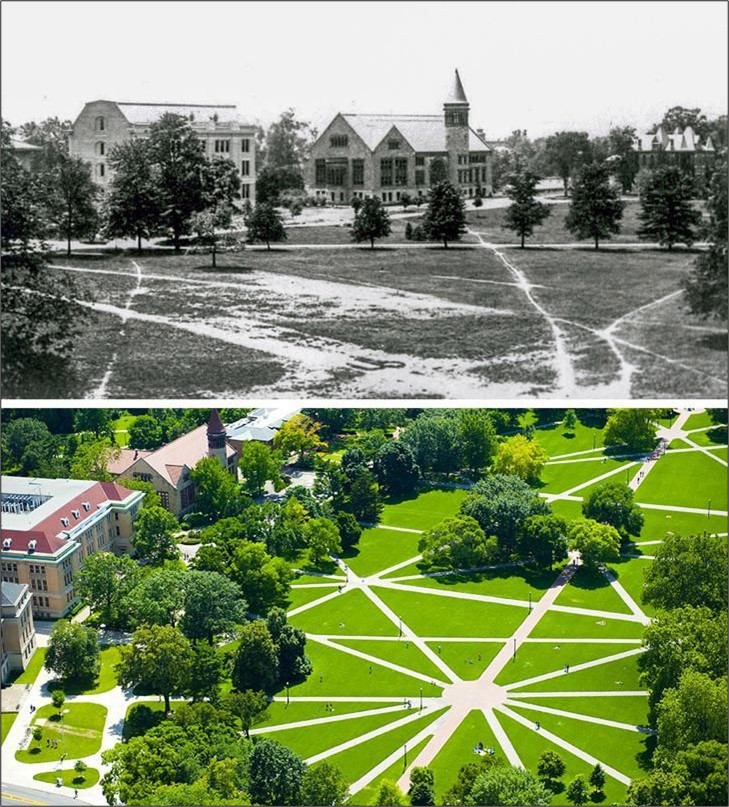
A desire path is an unplanned path that people choose to take instead of a designated route. They are also known as desire lines in transportation planning. Desire paths can be created for a number of reasons, including:
https://www.reddit.com/r/DesirePath/



This piece is mostly for people who are interested in backtesting