Reprehensible performance by AUD and NZD on the HSI rally.
Also: Jared Dillian has a new book ! Review inside.

Reprehensible performance by AUD and NZD on the HSI rally.
Also: Jared Dillian has a new book ! Review inside.

Jared’s got a new book!
Buy Friday 26JAN 0.6050
put for about 27bps
Off 0.6080 spot
Long EURSEK @ 11.26
Stop loss 11.1440
January 23, 2024
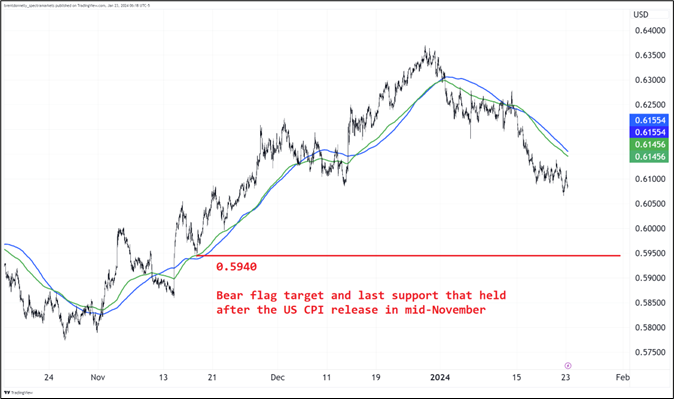
Good news / bad price in NZDUSD and AUDUSD overnight as the huge rebound in HSI on “China mulls 278B stock market rescue” has left both pairs unchanged from where we left them yesterday after brief impulsive rallies. With NZ CPI tonight I like NZD lower over the next few days targeting .5940 at some point. USDMXN higher and bitcoin struggling further bolster the view.
One could argue that an organic stock market rally on the back of higher growth expectations is worth more to the commodity currencies than an engineered short squeeze. The counter to that is that stabilization of confidence in Chinese equities is perhaps enough to stabilize the economy itself. Whether there is transmission from higher stock prices to stronger consumer demand and GDP in China is questionable given the real estate situation and the ongoing balance sheet recession.
NZDUSD rallied to 0.6118 on the China news, just short of my sell zone, so I have pulled the trigger here on the NZD put (see sidebar). If you’re short spot, it shouldn’t go above the 200hour MAs 0.6145/55.
NZDUSD hourly back to mid-October with 200-hour MAs
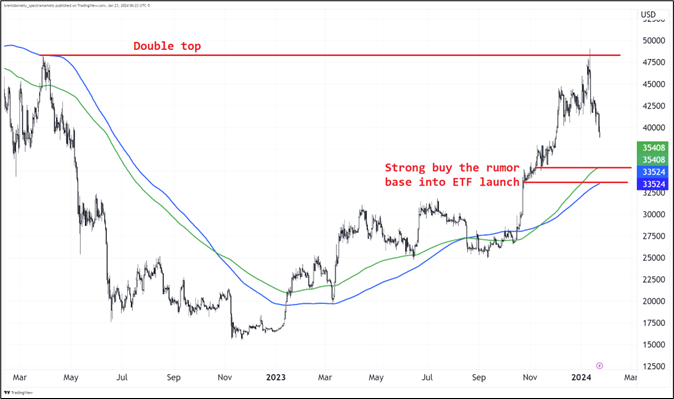
Bitcoin is following the script laid out last week so far with big support a few k lower—tons of support 33500/35000. Could be coincidence, but bitcoin and currencies like AUD and NZD are moving up and down in tandem over the past few months.
Bitcoin daily with 200-day MAs (simple and EMA)
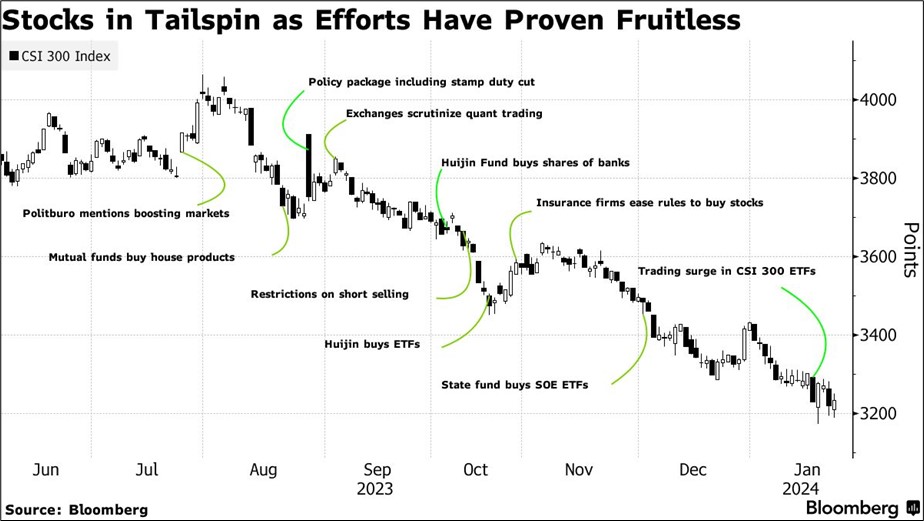
US and Japanese exceptionalism remain the main theme even as money stopped flowing out of China for one day. The keyword in the China headline is “mulls” and it’s unclear whether or not this is the kind of stimulus that matters anyway. Check out this amazing chart from Bloomberg:
The US story comes into clearer focus later with Thursday’s flood of data and then the QRA next week. I can’t think of any reason why Yellen would do anything other than keep the dovish bill vs. coupon mix, but that’s a story for next week, not right now. If you have a view on why Yellen may actually increase coupons in the mix (hawkish) I would love to hear the reasoning as my default is that the QRA as a policy tool will remain dovish for political and risk management reasons as Yellen is all in on the soft landing. She must be enjoying her newfound power to move markets again.
Jared Dillian’s new book comes out today! It’s kind of a personal finance book in a way, but it’s not in the “boring financial planning” genre. I don’t read many personal finance books because:
I also believe that personal finance is not that complicated if you are doing it right and I’m a topline guy, not a cost reductions guy. I’m never going to stop sipping that beautiful, sweet nectar called Starbucks, even in 2028 when it’s $22.75 for a grande dark roast with a single espresso shot and a bit of oat milk.
Anyway, Jared Dillian is my friend, so I said I would read his book. And it was a pleasant experience! The book isn’t a how to guide for cheap folks who keep a line item .xls of potato chip and Band-Aid expenditures. It’s a big picture guide that’s more in the self-help or Psychology of Money category. What does money mean to you? What do you want money to do for you? And so on.
One part particularly resonated with me because I believe it to be true. The part about getting a few big decisions right. I wish I thought more about my home purchases specifically because I don’t think I ever appreciated just how much luck is involved with primary residence real estate or how captive you are to an enormous McMansion once you buy one. Here’s the quote from Dillian:
“There are a few things you must get right or you will not be financially successful:
Remember, this is not about being financially successful. This is about being financially happy.
The American Dream™ (and your mortgage lender) gently nudge you towards the idea that you should buy the biggest house you can afford. As some shady guy from Lending Tree guy said to me once in 2006: “Don’t even worry how much the house costs, just tell me what you want your monthly payment to be, and we’ll work with that.” But buying the biggest house you can afford is probably wrong for most people. A large home is a large fixed cost with high variable costs and (depending on the situation) often offers zero marginal utility for the incremental spend. As Dillian puts it:
This is the way to being happy—get the big things right, and don’t worry about the little things. The reason this works is because people are more easily able to forgo large luxuries than small luxuries. You can live in a 2,500-square-foot house instead of a 3,000-square-foot house. You’ll still be happy. You won’t be sitting in that house thinking about how miserable you are because you don’t have a bigger house. You’ll be perfectly happy in that house—and you will be saving $110,000 in interest. We’ll have a lot to say about houses later.
I think this is solid advice and it reflects Jared’s knowledge of human nature and behavioral finance. Humans don’t want to scrimp 12 times per day on stupid five-cent measures, but they can sometimes be convinced to make a thoughtful decision when it’s time to fork out big bucks.
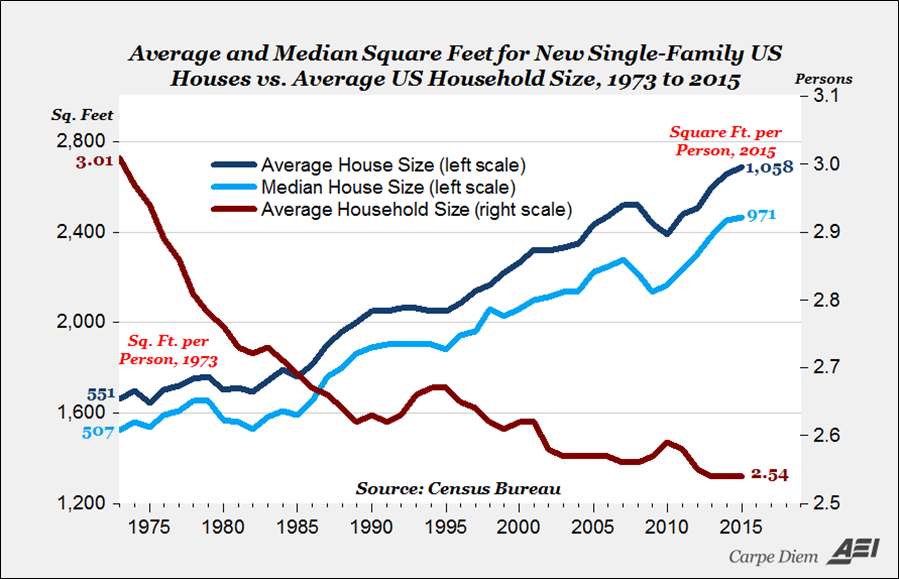
I had to buy a way-too-big-house and then rightsize by building a different, smaller house to learn that lesson. Costly! Think about the home you grew up in. It was probably way smaller than the one you live in today. Was it claustrophobically small? Or was it just your house. That you lived in. I threw in that chart at right for reference, it’s not from the book.
No Worries is a quick read—it’s punchy. The concepts are easy to grasp, and I like the way he boils everything down to identify the most important levers. For example (start of Chapter 3):
The purpose of this book is to help you to minimize financial stress.
There are only two sources of financial stress: debt and risk. There are no other sources of financial stress. All financial stress can be boiled down to debt or risk. It’s worth repeating: not having money is not a source of financial stress. There are a lot of broke, perfectly happy people out there. I am envious of them, actually. Their lives are so uncomplicated. And as we will discuss in the next chapter, not having enough money is a solvable problem.
The first source of financial stress is debt.
No Worries is not the stereotypical personal finance book. Nor would I expect it to be given it’s written by Jared Dillian. His writing is always fun and conversational and digestible and that’s true in this book as he keeps it like Hemingway. Clear, to the point. And useful. The book is like a combination of Morgan Housel’s The Psychology of Money and Mark Douglas’ The Disciplined Trader. Not in terms of content, but in the way that they get you to go one level deeper, below the surface, and think about how you think about money. What it means to you. What it can do for you. And what it cannot. How to think about debt, luck, spending, and the interplay between financial decisions and overall well-being.
It’s a book about stress minimization, not wealth maximization. And I think that’s a good way to approach personal finance. I rate the book 5 out of 5 stars and I’m sure you will too. Don’t be a CF; Buy it for your 23-year-old niece.
Dillian’s book got me thinking about a related quote from Shane Parrish (Small Surface Area)
As a rule, the larger your surface area, the more energy you have to expend maintaining it. Of course, when most of us think of surface area, we think of the area of a rectangle or how much grass we have to mow. But there is a surface area of life, and most of us never realize how much it consumes.
If you have one house, you have a relatively small surface area to maintain (depending on the age and size of the house, of course). If you buy another one, your surface area expands. But it doesn’t expand linearly – it expands slightly above that. It’s all the same work plus more.
Friends are another type of surface area. You have a finite amount of time to spend with friends before you die. The more friends you have, the less time you can spend with each one individually. Money is another form of surface area. The more money you have, the more you have to keep track of different types of assets and investments.
When your surface area expands too much, you hire people to help you scale. Assistants, property managers, family offices, etc. They’re scaling you – but they’re also scaling the surface area of responsibility. This, of course, only masks the rapidly expanding surface area by abstracting it.
Beliefs are another type of surface area.
The thing about surface area is that the more you have, the more you have to defend and maintain. The larger your surface area, the more you are burdened with mentally and physically.
If you think in terms of surface area, it’s easy to see why we are so anxious, stressed, and constantly behind. We feel like we need more time, but what we’re craving is more focus. What we need is a smaller surface area. Your surface area becomes part of your identity. She’s the ‘busy person’ with her hand in every project. He’s the guy with four houses.
Competition can drive expansion. Most people want a bigger house to compete with someone else who has a nicer house. We are animals, after all. On a group level, this causes great benefits. On an individual level, it can cause unhappiness.
https://reasonstobecheerful.world/safe-drinking-water-atms-rural-entrepreneurs-india/
Have a worry-free day.
The Spectra FX Positioning and Momentum Report
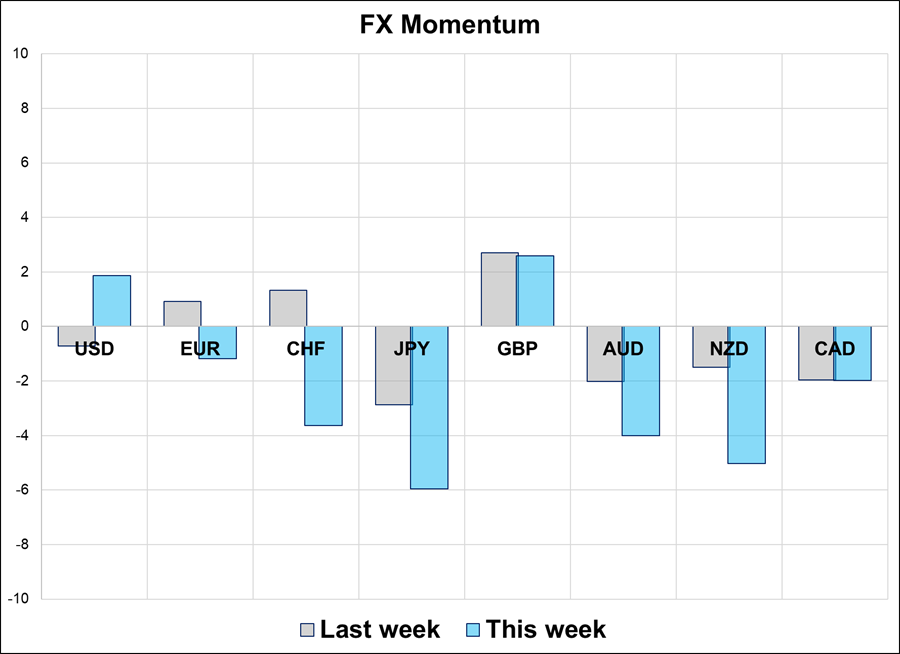
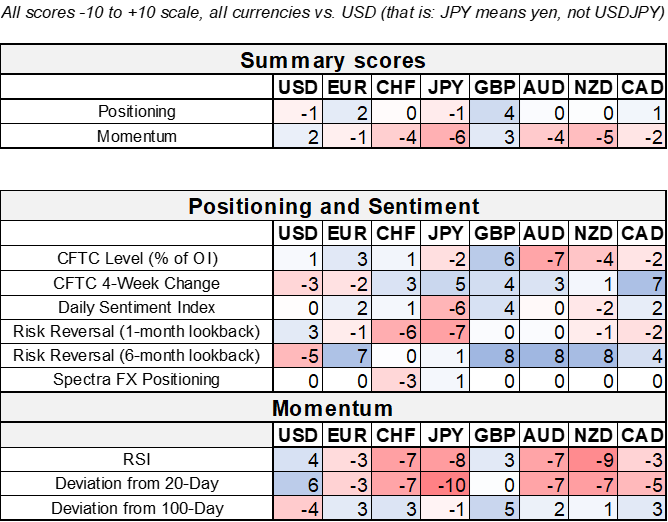
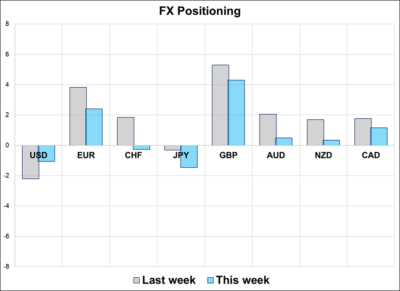
Hi. Welcome to this week’s report. Positioning remains close to flat as the market is priced for a US soft landing and most punters are unsure what that means for the dollar. With the Fed ready to ease, but most other global economies weak or very weak, there is no clear direction for the USD. Client interest has been focused on trading crosses (NOKSEK, AUDNZD, GBPAUD, etc.) and on selling vol / buying carry. 1-month DNTs in USDMXN and USDCAD have been the favorite structure for selling vol. It all feels a bit like the first half of 2014. Back then, we were sitting in the valley of low vol, waiting for the Fed to get going on rate hikes. Now we’re waiting for them to get going on cuts.
Three Observations
1. This is the first BOJ meeting in a while where there is absolutely no excitement. One can interpret that two ways, either a) potential opportunity or b) sounds about right. Positioning in JPY is now very close to home as the CFTC did a large position reduction in December and our Spectra FX topline number for JPY looks like this:
Spectra FX JPY Positioning Summary Score, October 2022 to now
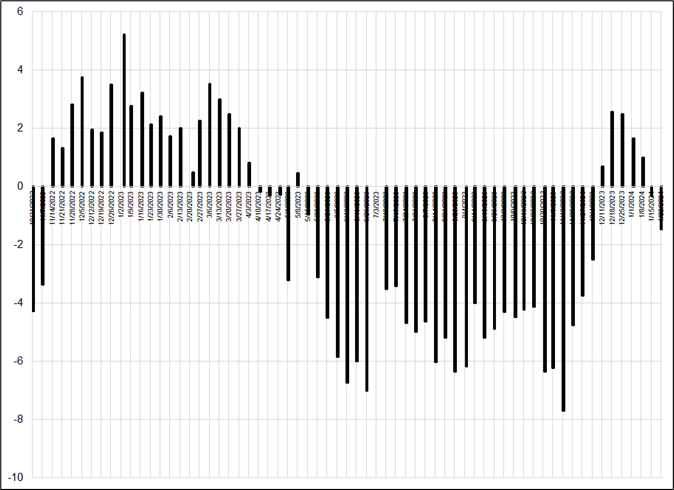
If the BOJ stays quiet and US yields tick higher, there is plenty of room for the market to buy USDJPY again. This is the first time in two years where it seems like nobody has much on in yen. For a long time, it was all about the BOJ normalization trade (long JPY), then it was about the carry trade (short JPY). Now, it’s wait and see.
2. The market (like me) has whiffed on the short CHF trade. There was an incredible opportunity to buy EURCHF on the year-end madness distortion as the WMR on the last day of the year came in around 0.9280. But those with insufficient patience (like me) missed Thomas Jordan at Davos as he talked down the CHF and signaled worries about future lowflation. The issue at these levels is that the SNB meeting is too far away, and SNB credibility is too low to make short CHF attractive here. That said, it is worth buying a dip in EURCHF.
3. As discussed in this report a few times of late, GBP positioning remains curiously bullish along with the price action into 1.2600. There is no strong narrative around the UK right now, but the market seems to have tired of the stagflation theme and is playing the idea that cable is cheap and trades well. PMIs in the UK have ticked higher this year while CPI and Retail Sales have dropped, but the market views the Retail Sales figure as an aberration and is happy to wait and see what happens with the Bank of England. There are currently 4.2 BoE cuts priced for 2024 compared to 3.5 in New Zealand, 3.8 in Canada, and 5.4 in the USA. All four central banks have a policy rate between 5% and 5.5%.
—
G10 FX Positioning and Momentum Scores
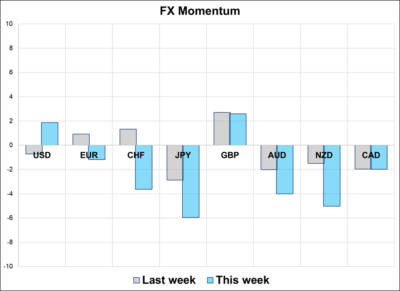
That’s this week’s report. Thank you for reading.


This piece is mostly for people who are interested in backtesting