Maintain short USDJPY and betting on the first ever Derby winner from the 17 hole
Yum.

Maintain short USDJPY and betting on the first ever Derby winner from the 17 hole
Yum.
Short 1/3 USDJPY at 157.19
Limit orders to sell USDJPY rally 157.40 157.99
Stop loss on all if done: 160.11
Rabbit rabbit. USDJPY rallied into the bottom of the sell zone overnight and one of my three limit orders was done. For a full explanation of what I see as the sell zone, please see yesterday’s am/FX. And as always, see sidebar for trade details. The MOF dropped another chunk of USDJPY onto the market overnight and they appear to be serious. While intervention is rarely a force that instantly turns the market, this buys time for normalization of oil prices and gives Japanese importers better levels.
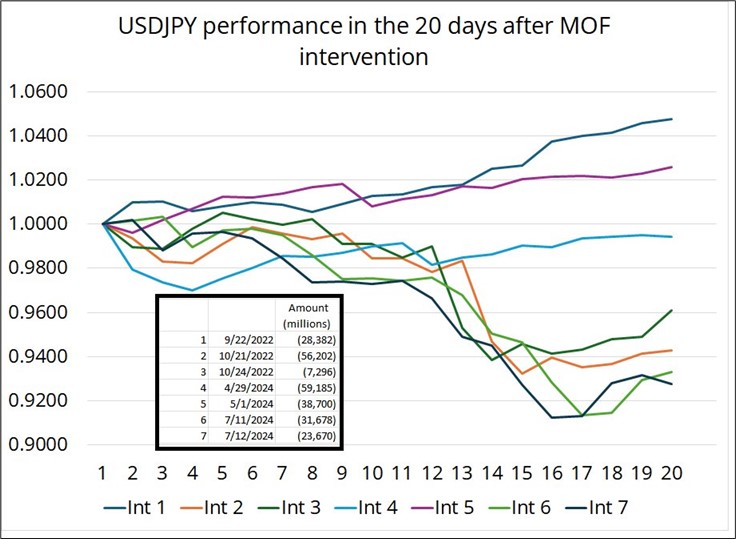
Looking at past interventions, USDJPY either went up a little bit, or down a lot in the twenty days after the MOF appeared. This chart shows the moves in USDJPY indexed to the close on intervention day. For context, we closed at 156.60 yesterday.
0.92 X 156.60 is 144.07, so that would be a max move in the next twenty days. 0.95 X 156.60 is 148.77. Looking at the two times when USDJPY rallied, 1.02 and 1.04 times 156.60 are 159.73 and 162.86. Given the intervention yesterday came purely in response to a breach of the 160.00 level and it had nothing to do with rate of change, I would suspect that we are either going to grind to 159.50 or crap out to 150.00. This asymmetry is the reason I want to sell rallies.
The bearish technical and behavioral signals in crude oil also support further yen strength. We had good news / bad price + Slingshot Reversal + The Economist says oil is too low all yesterday. Some questioned the validity of the Slingshot given it happened on expiry day in the front contract and that’s a fair critique.
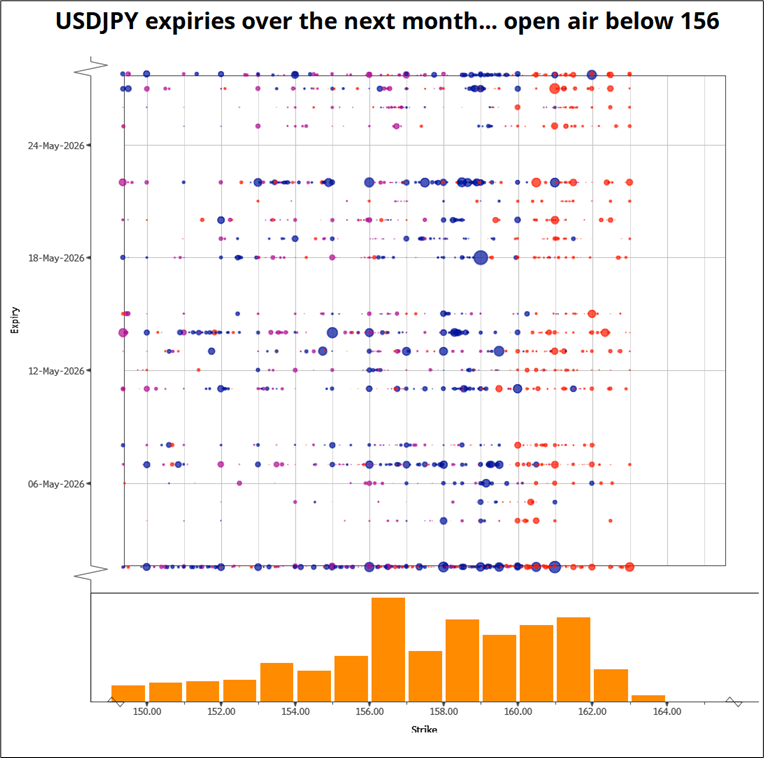
The USDJPY intervention was a surprise to most in the market because we are used to a rate of change condition being important for the MOF, and so very few people own strikes below 156.00. That makes it easier for USDJPY to go down if it wants to.
For the past two weeks, the sidebar featured:
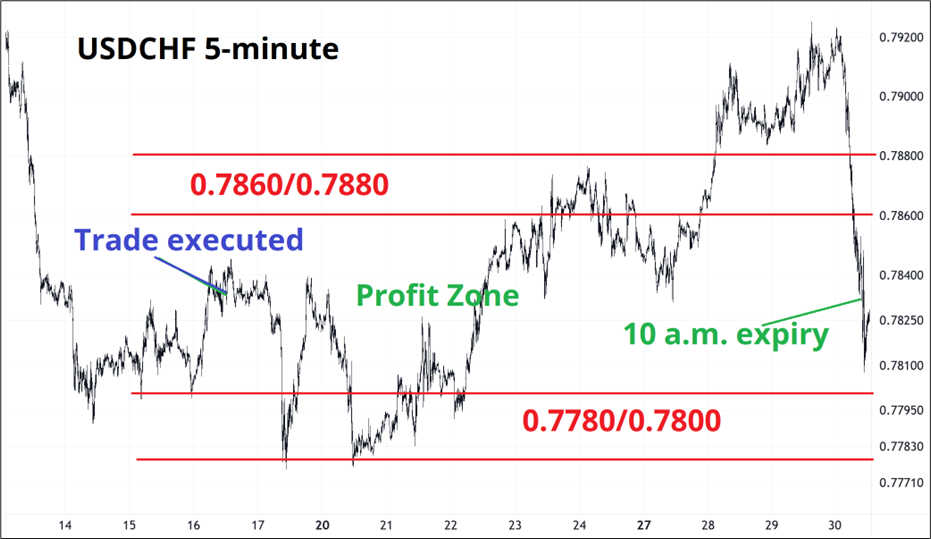
Short USDCHF vol expiring 30APR
Sell put spread: 0.7800/0.7780
Sell call spread: 0.7860/0.7880
A few readers asked me to explain it. While I know this option structure is familiar to most institutional traders, it’s worth going through for those that don’t use it. For whatever reason, iron condors are not popular in FX, and I don’t really know why. So here’s a short walkthrough. The structure is called an iron condor and it’s a view that spot will go nowhere. You are short vol, but your downside is limited. This makes it an attractive structure when you think nothing is going to happen, but you don’t want the blow up and hard-to-sleep-at-night risk that comes with outright shorts in vol. I very rarely short vol outright, and if I do, it’s in a size where I could still come to work the next day and have a job, even after a five sigma move.
In this particular structure, you collected a bit more than you were risking. For example, if you did it in $140 million USDCHF, you collected $210,000 and if it blew through one side or the other, the spot loss would be $375,000 for a net loss of (375 – 210) = $165,000. So you are risking $165,000 to make $210,000 or 0.78x to make 1.00x.
People prefer directional bets that pay 8:1 to something like I am describing here because those are more fun and sexy and will move the YTD P&L needle more if they hit. But payout ratios and convexity are overrated by most humans, compared to expected value. And it’s best to maximize EV not leverage.
These trades can be done in most products, and are especially juicy in short-dated equity options because IV tends to be high and overpriced in those markets. One sneaky risk with this sort of trade is that if the option reaches maturity in the middle of one of your zones, you will get exercised. As such, you cannot really do this structure in a billion USDCHF because on the off chance you fall in the middle, you have too much liquidity risk as you attempt to square up the unwanted spot position. Here is a chart of how the trade played out in real life.
As I said, these trades are not exciting. But the more years that pass, the more I try to avoid being a one-trick pony because markets don’t always reward that one thing you love to be really good at. My true inner self is a leveraged directional guy, but there are times when the inner vol-selling guy needs to be contacted if there’s nothing going on in the market and I still want to make money.
This is a theme in my new book: The ability to execute various structures, not just be one particular mode of trader, is an edge. Don’t be a breakout trader, or a vol-seller, or a leveraged directional bet person. Just do whatever you think is going to make money. Use various structures to bet on different paths and endpoints. Don’t be a one-trick pony. If you do 20 of these in a year, and 14 make money, that’s two million dollars of P&L you might not have had otherwise.
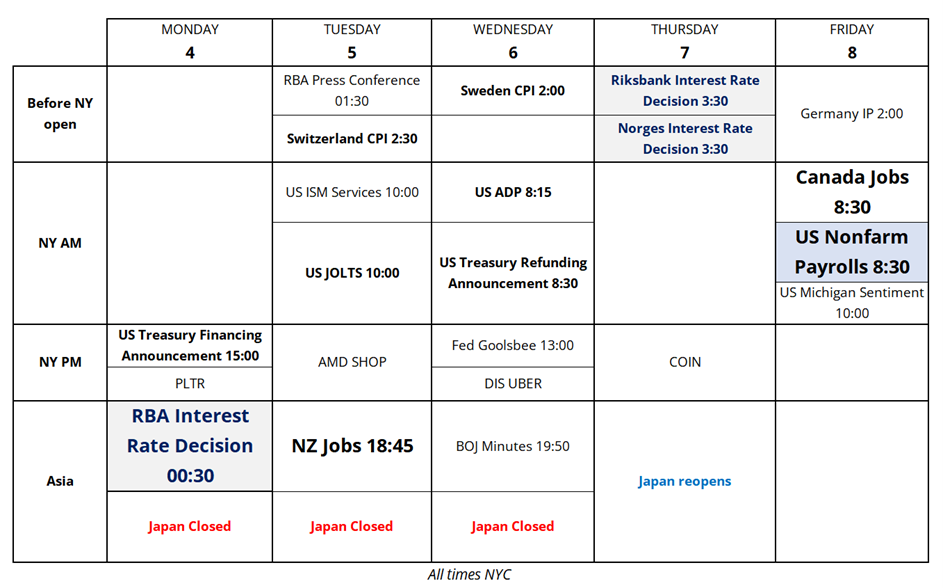
Next week’s trading calendar is interesting because we are going to be caring about economic data for the first time in ages. There seems to be some evidence that the U.S. jobs market is strengthening (see Initial Claims, ADP Weekly data, etc.) and while the market is extremely shy about pricing rate hikes for the U.S.A., it could happen. The ECB and many other central banks are in hike mode and there has to be a point where the Fed blinks. Right?
Right?
As I explained last year before the Derby, some of the common languages I speak with my kids are music, Clash Royale, and Magic the Gathering. When I was a teenager, my Dad and I spoke two main common languages: baseball and horse racing.
I have been to the races >100 times throughout my life, including two Breeders’ Cups (Miami and Louisville), The Travers Stakes, and about a zillion visits to degen cigar-infested awesomesauce venues like Rideau Carleton Raceway and Connaught Park Raceway in Ontario. Once upon a time, in the year 2000, a group of friends and I even bought a racehorse. It won a single race, then broke its foot… And we quickly learned why long racehorses = short carry.
So, I love the races, and despite betting $200 to win $1618 on various Mystik Dan-heavy bets in 2024 and hitting some exactors for a decent win last year, I can confidently say that I have no edge. Still, there is something romantic about doing the work so that if your bets pay off, you feel smart, not lucky.
The hardest thing about the Derby is that the field is ginormous. This isn’t some 5-horse race with a clear favorite paying 4-5 on a sloppy track where you bet the second favorite and pray. This is seven or eight amazing horses in with 12 or 13 other OK-to-meh horses. A jam packed, 20-horse field.
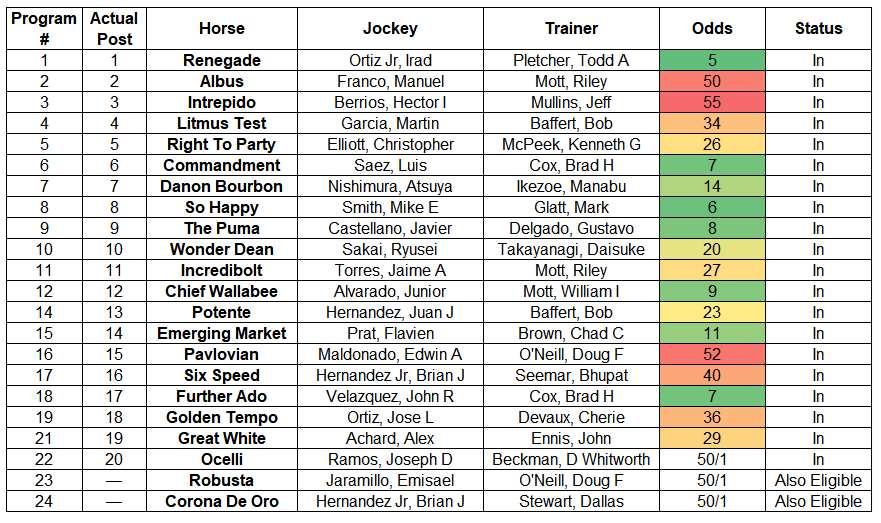
Instead of starting with who I like in the Derby, I start by eliminating who I don’t like. The best horse does not always win the Derby, because you need a great horse and a great trip on the same day. There is a lot of bumping and rubbing in these races, and a horse thrown off kilter usually has trouble getting back on stride. But still, you want to start with the best horses and then hope for a good trip from a decent post. Here’s the field. Note that due to scratches, not all program numbers match the post positions.
I start my elimination process by looking at speed. Two good ways to measure horse racing speed are 1) ratings like Beyer, and 2) finishing times, like the last 3/8 and 1/8 of the contenders’ prior races.
Beyer is a pure speed thing and does not account for whether the horse races well at the start, middle, or end, while final stretch times show closing speed, which is as important as overall speed. Closing speed tells you whether the horse will give ‘er on the backstretch in a tight race. 16 of the last 18 Derby winners won with a Beyer Speed Figure of 100 or higher. Yet only four horses in this race have ever posted a Beyer above 100. Note Mystik Dan had a 100 Beyer in 2024; that’s part of why I picked him at 18-1 odds. Here are the four 100+ Beyer scores for horses racing in 2026.
Further Ado 106
Commandment 101
The Puma 100
So Happy 100
That 106 Beyer from Further Ado was in the Blue Grass where he won by 11 lengths. The video is impressive.
Normally I look at closing speed, but there are 11 of 20 horses in this race with sub-38-second final 3/8 times and so there isn’t a lot to choose there. All the contenders have zippy finishing times in their final prep race.
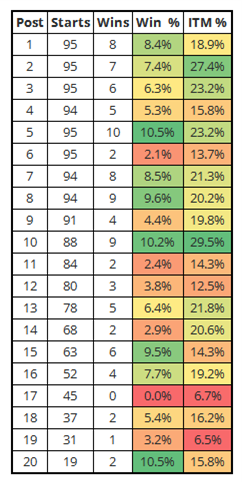
And the table here shows how the various post positions have performed. Further Ado draws the 17 spot, which is historically the only spot that has never won a Derby. That is really annoying because that’s the horse I liked the best. And it’s not like 17 is totally randomly bad. 16 and 18 are bad too. It’s hard to get all the way in from way out there.
I cannot plug my nose and forget about Further Ado despite his post position. With so many horses trading middling odds, you need to eliminate some, and I am going to throw out Renegade, the favorite. He has never run a 100 Beyer, and his training runs have not been great because his foot is sore.
So that leaves Further Ado, The Puma, So Happy, and Commandment.
18, 6, 8, 9
I have $1000 in my Twin Spires account from last year (I only bet on the Triple Crown races, really) so I am going to do something like this:
$20 Triactor Box 6 8 9 18 $480
$20 Exactor Box 6 8 9 18 $240
$280 Win 18 (Further Ado) $280
This is the year the 17 slot wins! While wearing number 18.
Or not.
Good luck!
Bucky Charms
Cap’n Carry
Excellent liquidity