September 27, 2023
First up: We have a new book! Fifty Trades in Fifty Weeks (One year of good ideas, dumb mistakes, and timeless trading lessons) is now available for purchase on Amazon. Buy 50 Trades in 50 Weeks right here. The idea first came to life as a blog on Substack, and this book is a permanent record of the weekly process that spanned from February 2022 to May 2023.
Each week, I shared a new trade idea and walked readers through my thought process. Lessons include a wide range of topics like global macro, technicals, backtesting, correlation, narrative analysis, mindset, risk management, position sizing, and of course the psychology of successful trading. 50in50 lets you watch real trade ideas come to life in real time. Probably a nice Christmas present for the young, up-and-coming trader in your life. Or Halloween present, I guess.
A complete description of the book is right here: https://www.spectramarkets.com/50in50/
Is normalization good or bad?
Stocks are following the seasonal pattern incredibly well through the Fall Equinox and the focus now is on the JPM collar (4210), and a bunch of levels down in the 4200/4250 area. I still think it’s a bit early to be getting long for bullish yearend seasonality, but if the Price is Right®, it’s not crazy to go a bit early. The seasonality is well-known and that means markets will want to get ahead of it, especially as plenty of traders seem to have caught the down move. Recency bias ensures that if one seasonality trade works, the next trade will be spotlighted and oversubscribed as speculators front run it.
I published the year-end seasonality around pre-election years yesterday, but the year-end effect is not highly conditional. For example, 2011 and 2015 were fierce bear market years, and the effect still worked. 1995 and 1999 were fierce bull markets, and the effect worked. Here are the average seasonal paths of the SPX, NASDAQ, Russell 2000, and DAX back to 1998. Sweet spot for entry is 01OCT/09OCT.
Seasonal path of four major equity indices, 1998 to 2023
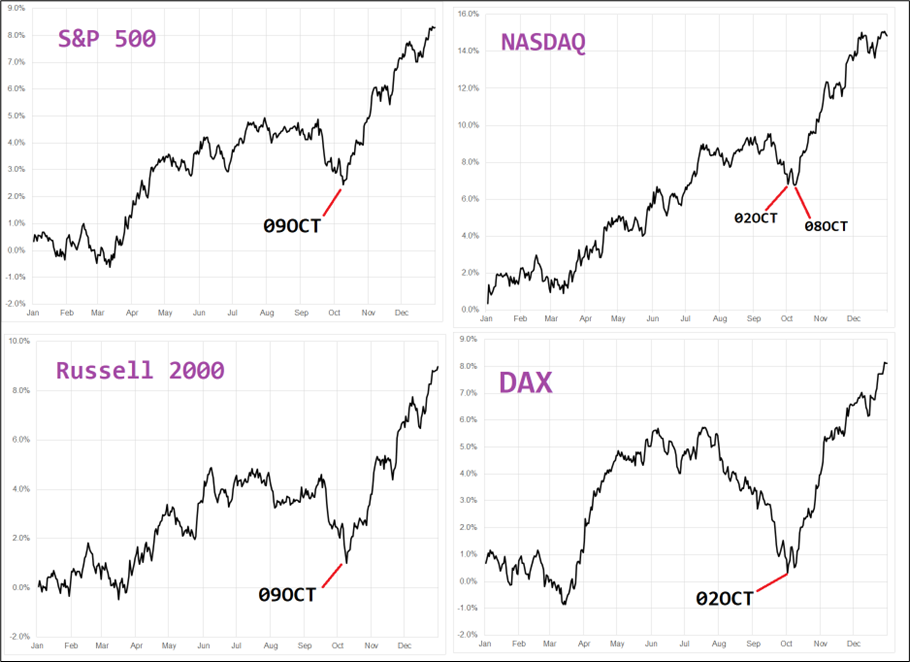
I realize that today is only the 27th of September, but my guess is that we make the lows on the early side of that 01OCT/09OCT window this year as the gamma wall at 4210/4250 will be a major take profit zone for the decent-sized cohort of traders and fast money that are short stocks. The turn of the month will usher in a turn in sentiment, I think.
The UAW shutdown, student loan restart, and US government shutdown, and Moody’s downgrade of the USA (!) all feel a bit priced in and yet amazingly yields are at the highs. Much of the debate on the future of the US economy and risky assets comes down to a simple question: Is interest rate normalization good or bad? One side views rising rates and the inverted yield curve as a ticking time bomb and the other side views positive real rates as a sign of health and proper economic functioning after 10 years of secular stagnation and malinvestment due to zero rates. Oddly, many of the commentators railing against zero rates and saying they will lead to certain doom are the same commentators saying that positive real rates will also lead to certain doom.
Fun.
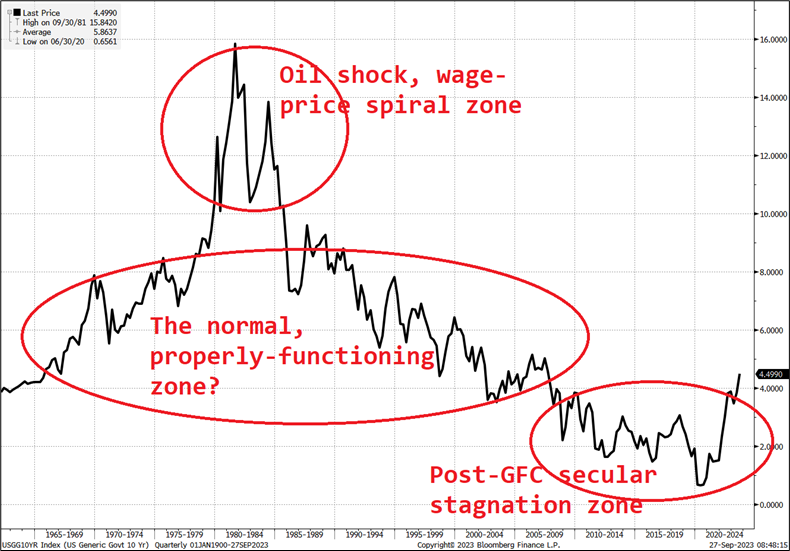
There is a reasonable argument to be made that 10-year yields in the 4%-8% zone are “normal” for capital allocation and savings in a properly functioning mixed capitalism economy like the US. Or you could argue that all the new debt accrued during the 2008-2021 period is going to blow up as rates rocket higher. Both arguments seem kind of reasonable! But you can’t argue that low rates are bad, high rates are bad, rising rates are bad, and falling rates are bad when the golden goose of US capitalism keeps on innovating and laying shiny eggs.
MOF
The three most viable strategies for the MOF are (in my opinion):
- Intervene now. Most are waiting for 150 so there is an element of surprise if you drop the hammer now. This strategy is hurt a bit by the month-end flows but if they are going to sell another 50 yards, the flows will get filled in pretty fast.
- Wait for 150 to break. This is the most predictable and least effective strategy because it’s exactly what people expect. Then again, tactics don’t matter that much when you are firing such a large gun.
- Wait for a final rip through 152. This would allow the MOF to let USD shorts capitulate and new FOMO dollar longs get on board. They will get a ton of bang for their buck this way and it’s the path of least regret, perhaps, as they might get lucky and it just turns by itself. They don’t want to intervene, so waiting as long as possible makes sense.
I think 1 or 3 are more likely because I respect the MOF’s tactical thinking. CHFJPY lower continues to make the most sense of anything on the cross JPY bingo card. It has traded perfect techs, refilling the gap to 164.00 perfectly and now looks headed to 159.00.
Final Thoughts
The AUD target remains 0.6290/0.6320 so the plan is to scale out of the put in that range if fortune cooperates.
Here’s hoping you LOL out loud a few times today.
good luck ⇅ be nimble