South Africa goes to the polls. Plus: An interesting study on “finfluencers”.
The springbok is South Africa’s national animal. When they leap in the air with an arched back and stiff legs, that’s called “pronking”

South Africa goes to the polls. Plus: An interesting study on “finfluencers”.

The springbok is South Africa’s national animal. When they leap in the air with an arched back and stiff legs, that’s called “pronking”
Flat
South Africa, the 6th largest country in Africa by population and 9th largest by area, goes to the polls tomorrow. The ANC are expected to get less than 50% of the vote for the first time since they took over after the end of apartheid.
I am not an expert on South African politics, but I like to keep an eye on major events and will thus provide a summary of key information here in case you are not in the weeds on this topic. First, here’s the results timing from the BBC.
The electoral commission says the final result will be known by Sunday 2 June at the latest, but the count will start as soon as polls close on Wednesday and figures will be released as the tallying in various areas is completed.
Most of the votes should be counted within the first 24 hours but more time might be needed to verify the tallies and deal with objections.
South Africans have been used to knowing the results by the Saturday after polling day, but this time things are expected to take longer as there will be more ballot papers to count because of the extra vote.
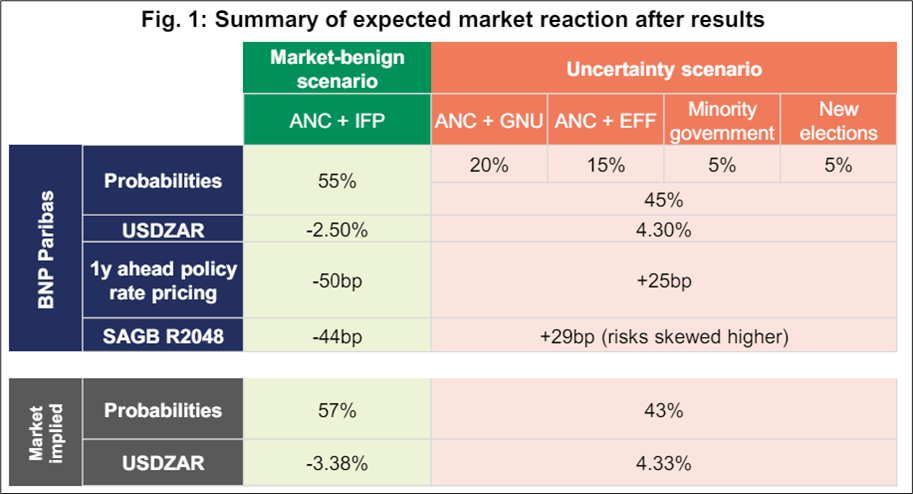
And here’s how BNP handicaps it:
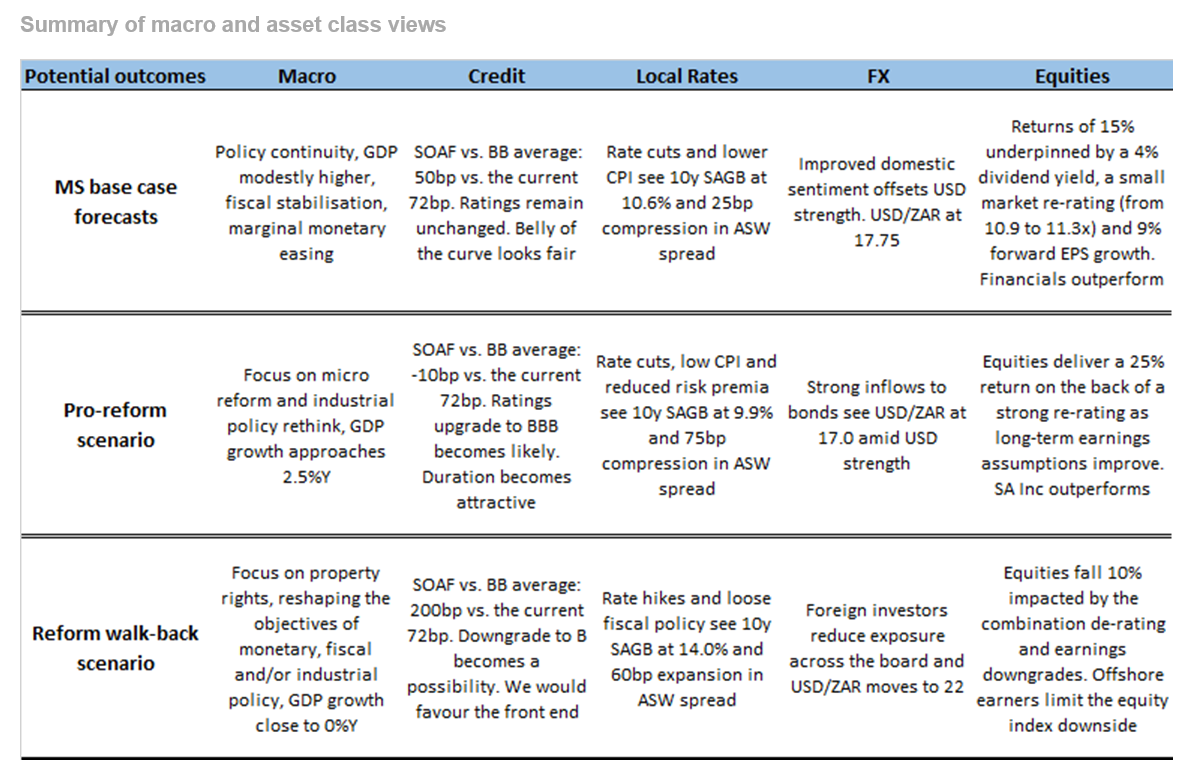
And here’s Morgan Stanley’s grid:
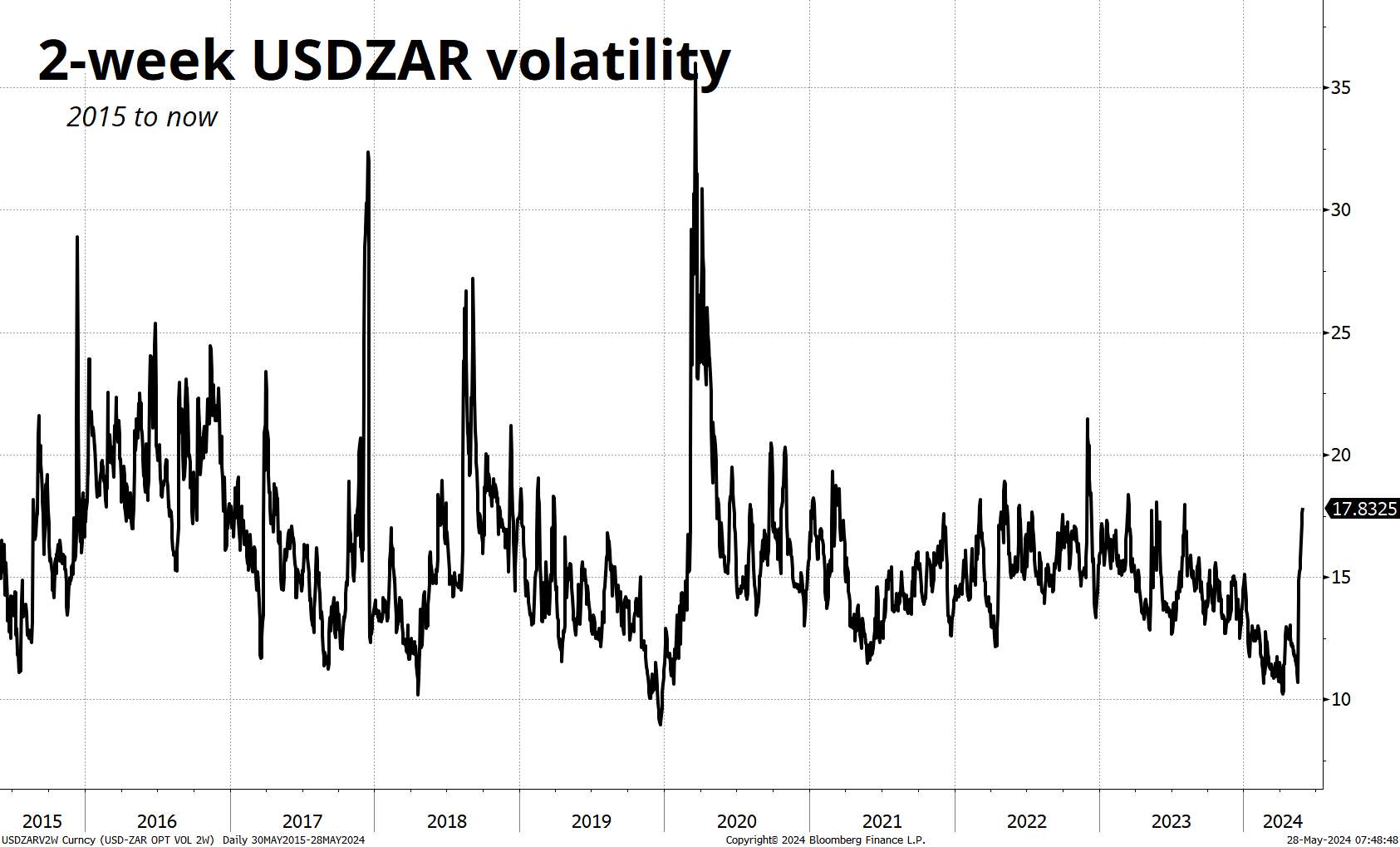
Volatility is high for the event, but not stratospheric.
And here are the outstanding strikes in the market:
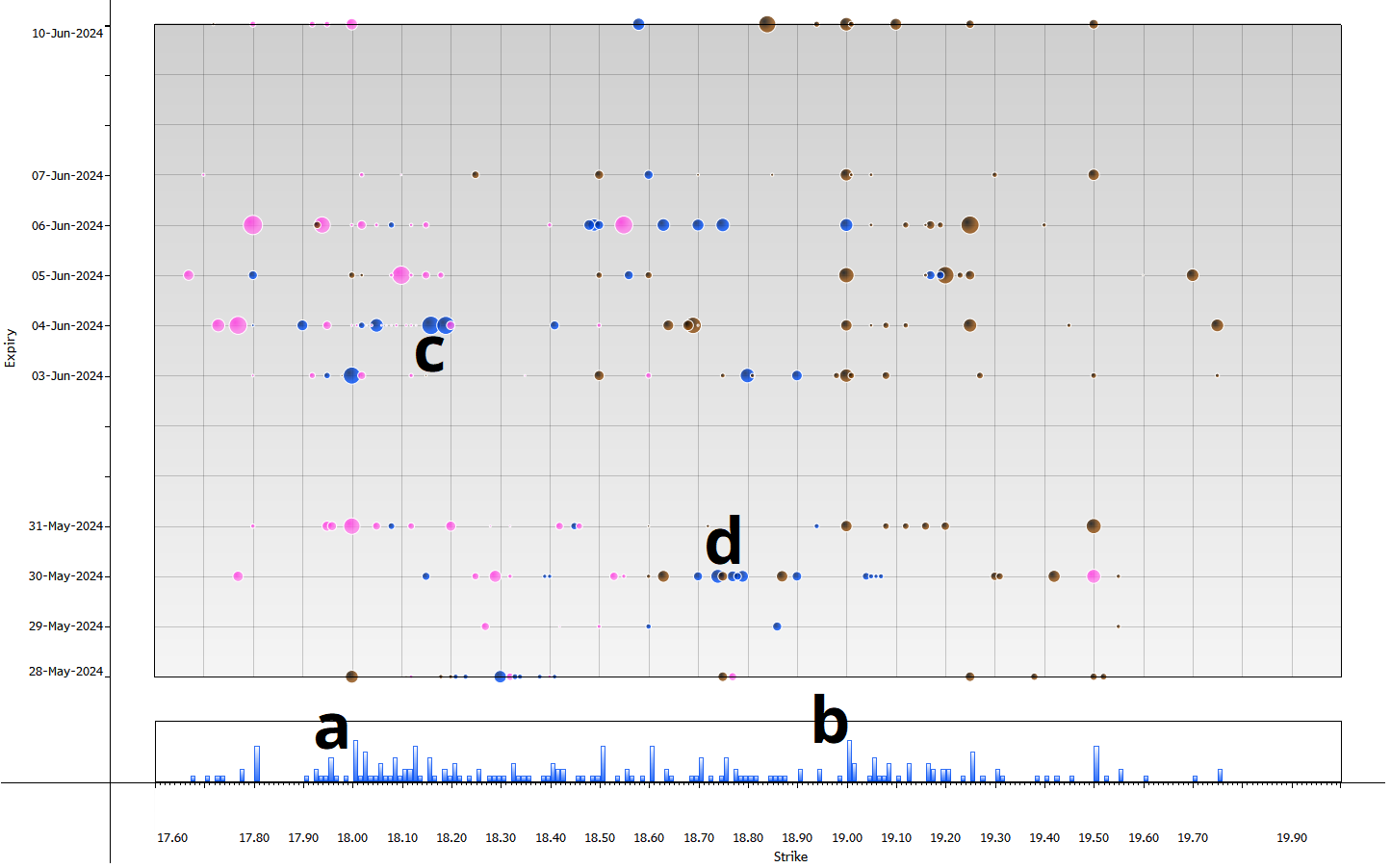
A few quick notes:
a. Quite a lot of strikes around 18.00
b. Another layer of strikes at 19.00
c. 04JUN 18.16/18.19s
d. A bunch of expiries 18.75ish coming off Thursday
The strikes make sense as the market expects down 2% or up 4%.
Down 2% is 18.00 and up 4% is 19.07.
I would like to highlight an interesting paper, even though it employs the word “finfluencers” a total of 235 times. I put the “word” finfluencers in the bucket of abominable terms like staycation, mancave, and impactful, but don’t let the cringe word deter you. Unsurprisingly, the paper is called: Finfluencers. I think the takeaways may have broader applicability.
The abstract is as follows:
Tweet-level data from a social media platform reveals low average accuracy and high dispersion in the quality of advice by financial influencers, or “finfluencers”: 28% of finfluencers are skilled generating 2.6% monthly abnormal returns, 16% are unskilled, and 56% have negative skill (“antiskill”) generating -2.3% monthly abnormal returns. Consistent with homophily shaping finfluencers’ social networks, antiskilled have more followers and more influence on retail trading than skilled finfluencers. The advice by antiskilled finfluencers creates overly optimistic beliefs most times and persistent swings in followers’ belief bias. Consequently, finfluencers cause excessive trading and inefficient prices such that a contrarian strategy yields 1.2% monthly out-of-sample performance.
Here are the most fun parts of the paper (all bold is mine):
We find that 28% of finfluencers provide valuable investment advice that leads to monthly abnormal returns of 2.6% on average, while 16% of them are unskilled. The majority of finfluencers, 56%, are antiskilled and following their investment advice yields monthly abnormal returns of -2.3%. Surprisingly, unskilled and antiskilled finfluencers have more followers, more activity, and more influence on retail trading than skilled finfluencers.
To explain the popularity of anti/unskilled finfluencers, we check what strategies the different finfluencer groups pursue, what belief biases their advice induces, and why competition does not drive out anti/unskilled finfluencers. Skill correlates with observable tweeting patterns, suggesting that social media platform users have a preference for anti/unskilled finfluencers. Following the advice by antiskilled finfluencers creates overly optimistic beliefs most times, overly pessimistic beliefs some times, and persistent swings in followers’ belief bias. An investment strategy contrarian to antiskilled finfluencers’ recommendations yields 1.2% monthly out-of-sample performance.
And:
We find that skilled finfluencers are less active than unskilled and antiskilled influencers. Users who tweet more frequently are less skilled in that a ten times increase in the total number of tweets posted by a user is associated with a 3.7% decrease in the probability of being skilled and a 0.08% decline in the monthly expected true alpha. Additionally, the tweet composition correlates with the degree of its informativeness as users posting more negative tweets tend to be more skilled.
And:
We then dissect finfluencers’ tweeting strategies, that is when and what they tweet, to check whether they possess unique skills or just follow commonly known investment behaviors including momentum, contrarian, return chasing, and herding. We find that skilled finfluencers are return-, social sentiment-, and news-contrarian. They also do not chase returns and do not herd on other users’ tweets. Antiskilled finfluencers ride return momentum and social sentiment momentum and are likely to chase returns.
And:
The advice by skilled finfluencers has little to no impact on retail order imbalances… However, the advice by antiskilled finfluencers strongly predicts retail order imbalances, and in a way that they follow the flawed advice leading to negative returns for retail investors. Moreover, in line with retail investors stubbornly following the crowd of antiskilled finfluencers, we find evidence for the “wisdom of the antiskilled crowd” in in-sample and out-of-sample tests.
And:
Retail investors have been shown to demonstrate several behavioral biases and traits. Social media users follow finfluencers with similar beliefs and, as a result, live in their own bubbles, a phenomenon called information siloing. Social media users then predominantly receive information that confirms their existing beliefs, leading to underperformance.
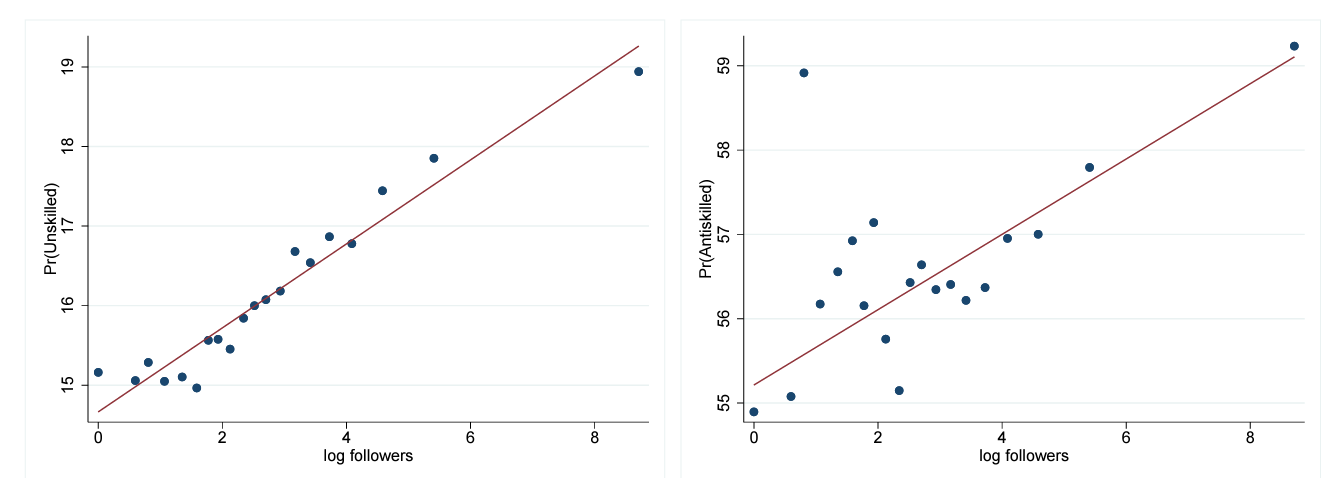
The charts are spicy as they show a strong positive correlation between p(unskilled or antiskilled) and number of followers:
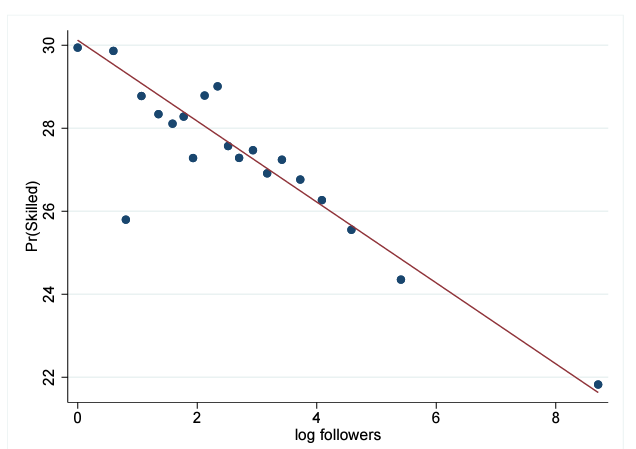
And (logically!) the exact opposite slope when mapping probability of skilled vs. number of followers:
The results in Table 6 show that skill is not a significant determinant of survival.
Not surprising, but definitely amusing.
Also, activity levels (number of tweets) appear to correlate negatively with skill (and positively with p(unskilled)).
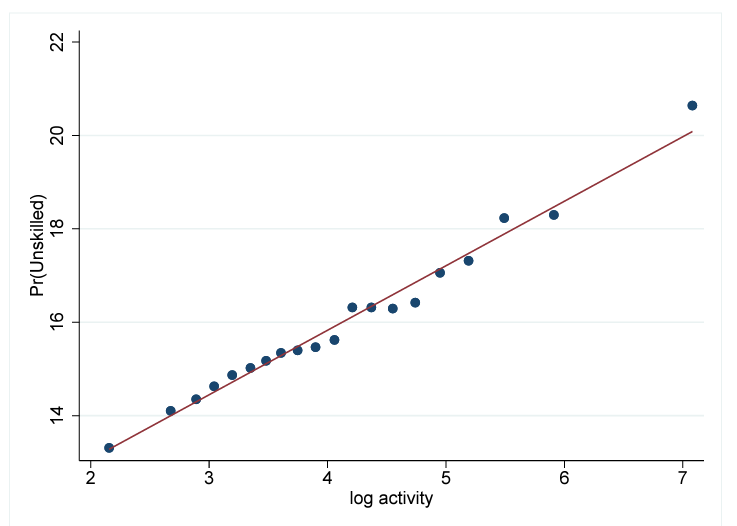
Note from Brent: Do these binscatter plot fits seem a little TOO perfect to you?
And:
Less active finfluencers with fewer followers are more likely to be skilled. Skilled finfluencers are return contrarian; they make positive tweets after negative returns and negative tweets after positive returns. Skilled finfluencers are also social sentiment and news contrarian; they make fewer positive tweets when social sentiment is positive and more positive tweets after negative news. Similarly, they make more/fewer negative tweets when social sentiment is positive/negative and fewer negative tweets after negative news.
Finfluencers with more followers have a higher likelihood to be antiskilled. Antiskilled finfluencers ride return and social sentiment momentum. They make positive tweets after positive returns and negative tweets after negative returns. Antiskilled finfluencers are more/less likely to make positive/negative tweets after positive social sentiment. Antiskilled finfluencers are also less/more likely to make positive/negative tweets after negative news.
And:
Conclusion
Social media has gained great importance in recent years for sharing and acquiring information. An important question is whether competition among users of social media platforms is such that followers can easily identify skilled financial influencers, so-called finfluencers, and drive out unskilled f influencers from the market for social information. We find that the answer is no.
Social media users can use the tweeting behavior of finfluencers to identify their skills. However, instead of following more skilled influencers, social media users follow unskilled and antiskilled finfluencers, which we define as finfluencers whose tweets generate negative alpha. Antiskilled finfluencers ride return and social sentiment momentum, which coincide with the behavioral biases of retail investors who trade on antiskilled finfluencers’ flawed advice.
These results are consistent with homophily in behavioral traits between social media users and finfluencers shaping finfluencer’s follower networks and limiting competition among finfluencers, resulting in the survival of un- and antiskilled finfluencers despite the fact that they do not provide valuable investment advice.
Investing contrarian to the tweets by antiskilled finfluencers yields abnormal out-of-sample returns, which we term the “wisdom of the antiskilled crowd.” These findings shed light on the quality of finfluencers’ unsolicited financial advice and the competition among and economic incentives faced by finfluencers which the SEC has been concerned about.
An important note on this and other economics research: You may be aware of the fraud and replication crises going on in academic research. There is tremendous pressure on academics to publish, and there is strong selection bias in what gets published and what does not. If you conduct an experiment, and the result is interesting, you publish. If the result is boring, many researchers will take a different tack, looking for something more compelling to deliver.
This leads to a situation where outlier results are more likely to get published, while the null hypothesis and boring results will not. There have been many recent attempts to replicate papers across various fields, and the results are not encouraging. For example, here’s what the Fed concluded in 2015:
We successfully replicate the key qualitative result of 22 of 67 papers (33%) without contacting the authors. We replicate 29 of 59 papers (49%) with assistance from the authors. Because we are able to replicate less than half of the papers in our sample even with help from the authors, we assert that economics research is usually not replicable. We conclude with recommendations on improving replication of economics research.
So, take those perfect-fit binscatter plots with a grain of salt. Take all research with a grain of salt. Especially when it’s spoiled by conflicts of interest. To take just one of a zillion examples:
Before you read another health study, check who’s funding the research (The Guardian)
“Is it really true that food companies deliberately set out to manipulate research in their favor? Yes it is, and the practice continues,” wrote Marion Nestle of NYU in a commentary that accompanied a new report criticizing the sugar industry.
Or see here (food). Or here (pharma). Or here (lotta companies).
Freakonomics did a good podcast on this: “Why is there so much fraud in academia?”
Anyway. Cool study, bro. :]
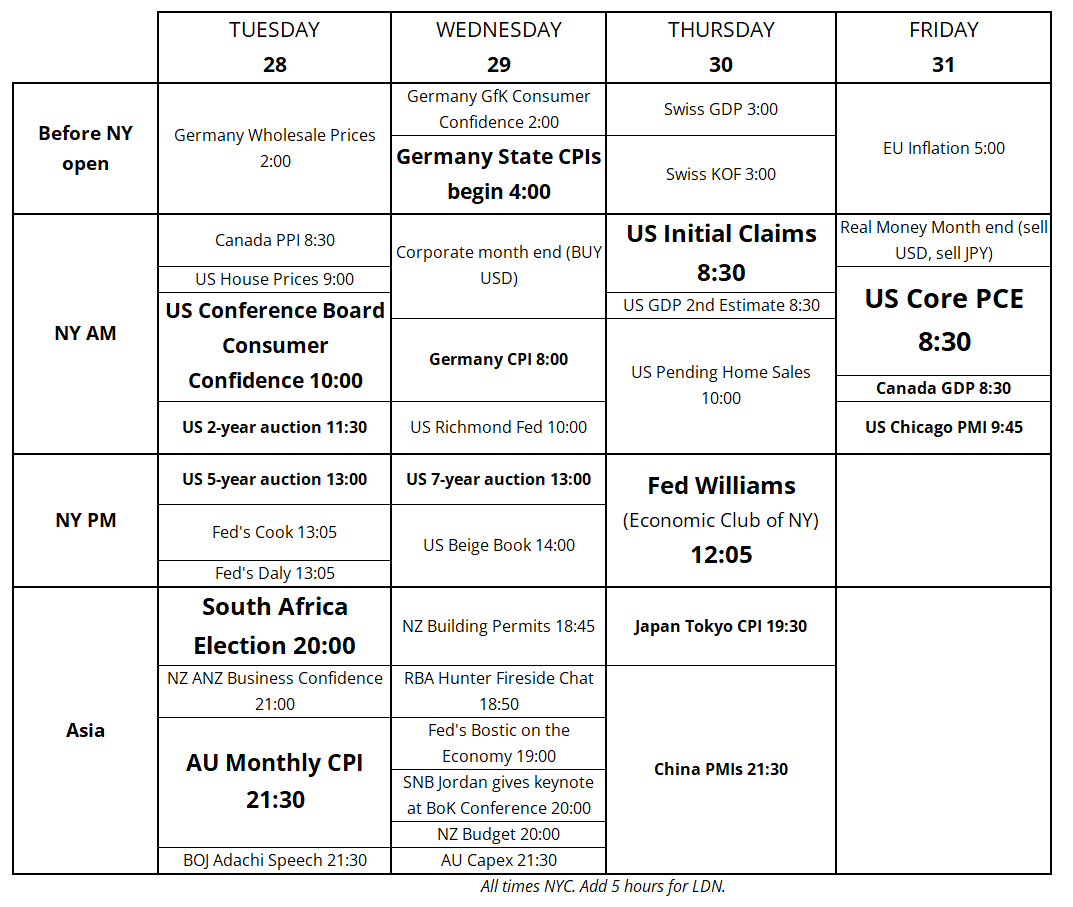
A low-medium level of excitement in the calendar this week with the largest fonts highlighting the election in South Africa, US Consumer Confidence, Claims and Core PCE, plus German CPI, and Fed’s Williams at the Economic Club of New York for lunch on Thursday.
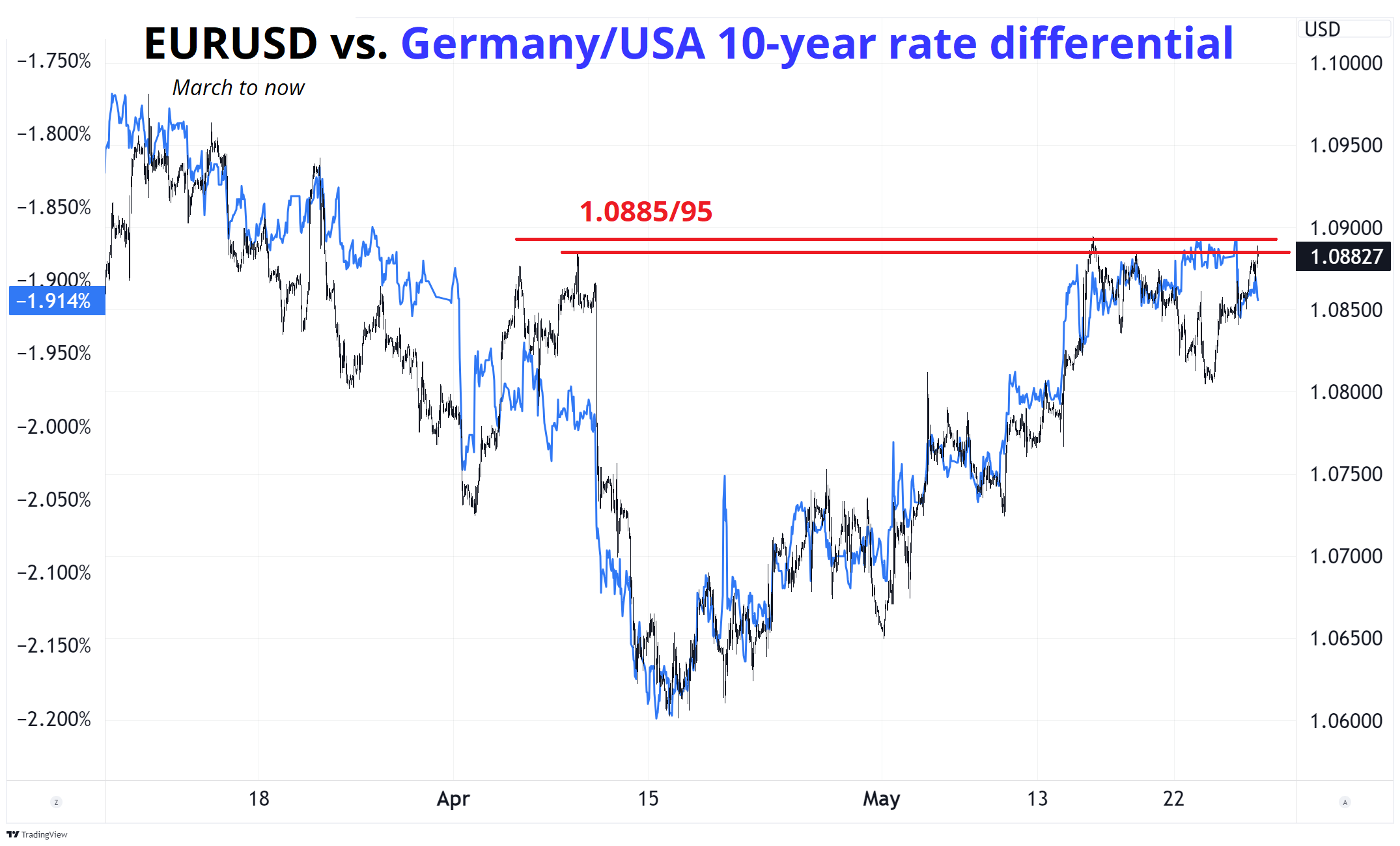
EURUSD continues to follow rate differentials. The rate spread has flatlined over the past two weeks, as has EURUSD. 1.0885/95 continues to work as major resistance and we’re right there now. My general view is softer US data, softer yields, lower USD, strong euro, but I don’t think there is much to do at current levels. Tomorrow’s German CPIs should be important as the ECB and the market back off multiple cuts and wage growth suggests maybe all is not unicorns and/or lollipops on the German inflation front.
Pronks for reading.


This piece is mostly for people who are interested in backtesting