February 17, 2023
390, Inflection Point
This is a good time and place to take profit on long USDJPY. Half the position hit the 50% take profit at 134.44 yesterday and I’m covering the other half now. Here is why:
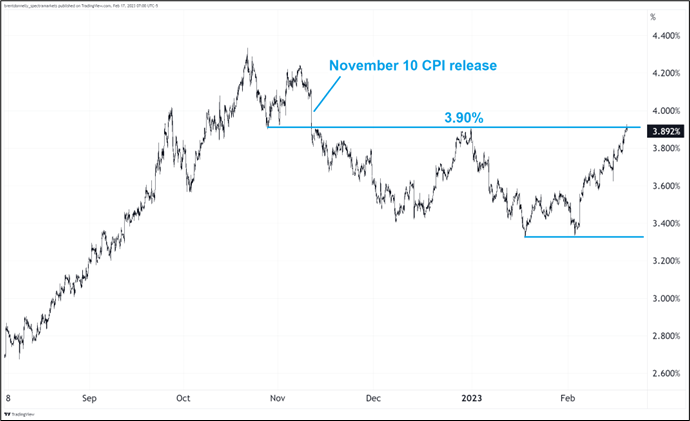
1. Yields are at a critical inflection point. US 10-year yields bounced off 3.90% in late October then crashed through that level upon the release of CPI on November 10 (see chart). We then got a bounce to 3.90% into the new year and failed there. Here we are again.
Yes, CPI, NFP, and PPI put Fed hikes back into play but we have now come from 3.40% to 3.90% in about two weeks. Maybe that’s enough for now? The main basis for my bullish USDJPY view was that USDJPY was lagging the rise in US yields. If yields top, USDJPY should too. A daily close above 3.90% opens up the highs (4.20%/4.30%) but I think it will be hard work getting through here.
US 10-year yield, hourly since August 2022
2. Ueda speaks next week and what he might say looks like a coin toss to me at this point while something more dovish is priced in. The market seems to have come to the conclusion that Ueda will lean on the dovish side, but I don’t see much reason to believe that. People are cobbling together clues from past speeches and such, but those utterances came at a different time. A time before Japanese wages were increasing at the fastest rate in 30 years.
Ueda wears MIT academic stripes, so it’s not unreasonable to assume that his approach to monetary policy will be orthodox. In this environment, orthodox policy for Japan is much tighter and rate hikes should be on the table for Q3. But betting on something hawkish is difficult too because even if he’s planning to normalize, there is some game theory here as he might deem optimal strategy is to keep the cards close to the vest.
The options market is pricing in 20 vols for the event vs. 12 to 14 for days before. 20 vols seems totally reasonable and maybe even cheap because it will be hard for Ueda to thread a low-impact needle. He either talks about hawkish normalization or he sticks to the dovish Kuroda line which he held to in brief comments on February 14 after the nomination announcement. Then, he said that BOJ monetary policy is appropriate and there is a need to continue easy policy.
With the market leaning a bit more dovish on Ueda, options markets pricing in a big move, and me sitting here with no firm view on Ueda just as yields hit mega resistance, it makes no sense to hold onto the position, especially when I’m already long USDCAD and USDMXN. Note: I moved the stop in USDCAD way up.
Adding to my unease with the forward trajectory of US yields is this cover from The Economist out yesterday.
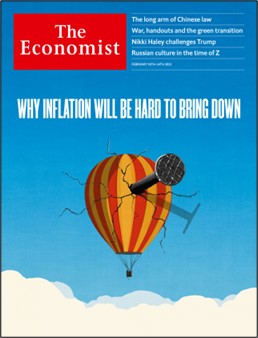
As you might know, The Economist has a verifiable contrarian track record. When an asset class, country, or market is on the cover, it signals an extreme has been hit with regard to narrative. Only when a narrative is fully baked and close to exhausted does it finally appear on the magazine’s cover.
The past 12 months have provided stunning example after stunning example of this (see table below). You can read my full analysis of why Economist covers are contrarian here.
After I wrote that article (late 2021), I created a spreadsheet to track all subsequent covers. This table shows the results of fading The Economist since I wrote the article. (The study also includes Time Magazine, but they rarely cover market-relevant stories).
Magazine Cover Capital, portfolio tracker
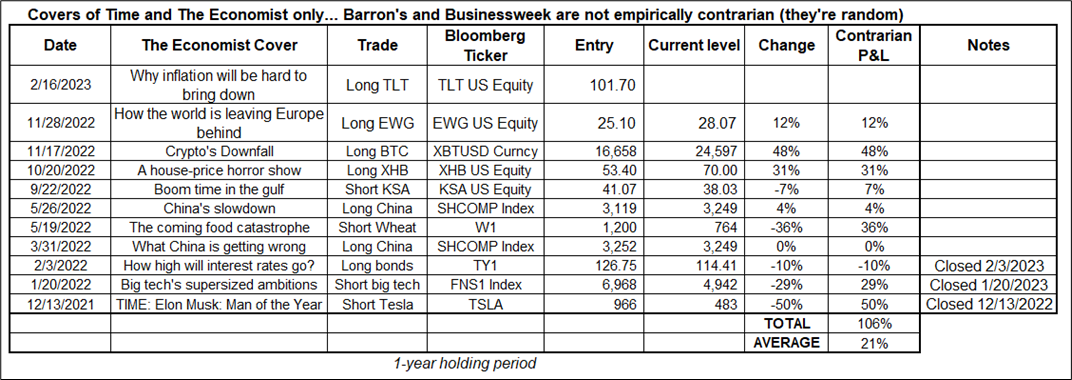
I’m not 100% sure “Long TLT” is the perfect expression of the contrarian view to that Economist cover so if you have a better suggestion please let me know (it must be a listed product, and a simple expression of the idea).
Final Thoughts
Next week’s RBNZ meeting is going to be particularly interesting with the floods on the North Island disrupting lives and commerce while the housing market slumps and overall economic confidence was already falling. Then again, the floods could be inflationary (rebuilding will exacerbate labor shortages and supply issues), so it is probably not going to change the RBNZ’s calculus much. Kiwibank wrote a note suggesting the RBNZ should pause for one meeting given the uncertainty around the cyclone and flooding, but that seems like wishful thinking.
Finally, here is an analysis of rising US middle class pain: https://americancompass.org/2023-cost-of-thriving-index/
Have a heavy metal weekend.
good luck ⇅ be nimble