
Hawkish geopolitical alarm bells from a variety of China experts.


Subscriber-only
Brazil, Canada, yen
A sort of almost unbelievably large move in Brazil. Plus: Short CADJPY.

Hawkish geopolitical alarm bells from a variety of China experts.
Dog years are similar
to cat years
20JUN USDCHF
0.8850 digital put @ 20%
spot ref. 0.9275
21JUN USDJPY
123 digital put @ 20%
spot ref. 131.30
April 24, 2023
It’s a quiet Monday in FX, so today I give you my takeaways from Day 2 of the GIC conference I attended in Sarasota last week. Day Two was all about China.
Disclaimer: Today’s am/FX is my best effort to distill the commentary of the China experts at the conference. I am not an expert on China/US geopolitics. I probably know less than you know on the topic. The views espoused were generally very hawkish and some readers may find them controversial.
—
Session I: Panel Discussion about China
The resumés on these people are off the charts. Riddell was a CIA spy and paramilitary officer in China in the 1970s and 80s. You can read more about him here. Leland is a sane, smart guy I have known a long time (he runs China Beige Book) and Michael Drury writes my favorite economic weekly. He has a deep knowledge of China as well as the US economy, ags and commodities. Alejandra kept things flowing and added her own expertise on the economics side.
Before I get into the specifics of the session, I wanted to say that the vibe overall at the conference was kind of alarming with regard to the escalating threat from China.
The possibility of a war in Taiwan does not seem remote in the minds of most of the experts there and two of them specifically said they think that the odds of a hot conflict have gone up significantly in the last 12 months. I tend to be anti-alarmist, but it was hard not to be alarmed by the potential risks of military conflict.
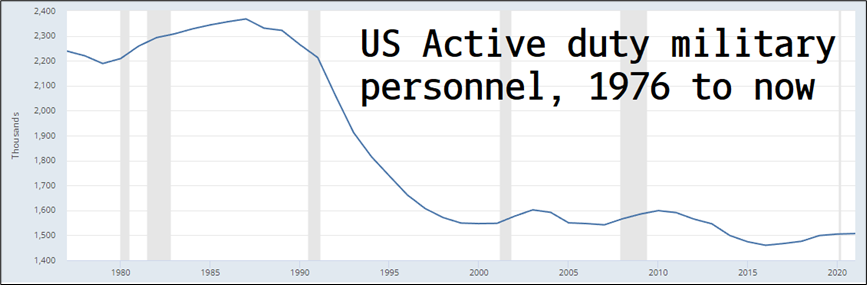
Before the session started, Major General David Scott Gray (US Air Force) gave a short talk and he spoke about the decline in active-duty forces due to demographics, obesity, opioid use, and other factors. The chart below gives you a sense of the decline. Keep in mind the US population increased 55% in the interval from 1976 to now, and so this nominal drop in troops is way larger in per capita terms.
General Gray said his personal opinion is that the US will need to reinstate the draft in the next five years and will draft women for the first time ever. As someone with a son who is draft-eligible, I found this rather eye-opening and scary.
Anyway, the topic for the first session was labeled as “Economics” but the overlap of economics and geopolitics is inevitable these days when discussing China. Leland Miller gave a positive view on China in the short term but emphasized that he saw only 2-4 strong quarters of a cyclical rebound as underlying structural problems remain. This cyclical bounce in Chinese growth is a product of easy comps given the weak growth during COVID-zero. He sees the cyclical rebound as a headfake because the Party is no longer gunning for strong growth. The dominant paradigm is still a slow return to more socialist, less capitalist policies.
This shift by Xi toward more Marxist policies was a big point of discussion as the view is now that middle class wealth has been achieved, it’s time to think more about global power and a return to socialist values. Strict and absolute party control is more important to Xi than economic growth hence the crackdowns on tech billionaires, limits on video games, and so on.
On the geopolitical side, the panel agreed that Xi has confidence that history is on his side as the East is rising and the West is falling. He wants to go down as the greatest leader in Chinese history and reunify China. He is committed to Taiwan as the centerpiece of his legacy. Xi’s geopolitical and internal control goals are not bullish for the economy but he doesn’t care.
The challenge for the US is to figure out how to deal with an adversary that is such an integral part of the US economy. While US politicians (and to some extent the US public) have realized the threat from China (hence the tariffs and the recent executive orders, CHIPS Act, and so on)… Most large American businesses are still fully engaged with China and highly reliant on China for cheap production.
The administration sees a spectrum for decisions where there is very often a tradeoff between national security and economics. American businesses are making no such tradeoffs. The panel argued that until US businesses recognize the China threat and are willing to take economic pain for national security reasons (like corporations did in World War 2), it will be extremely difficult to disentangle from the economic relationships, even as the diplomatic relationship frays.
The vibe from several of the experts was that China-US conflict was overhyped for many years but is now underappreciated. A major part of the reason for this is that US capitalists do not want to recognize the geopolitical threat because doing so will remove their ability to produce things cheaply.
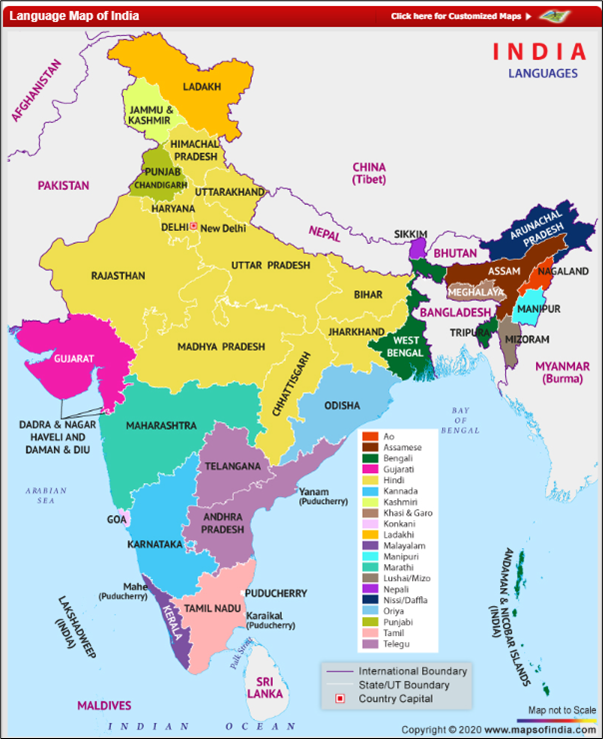
While there is talk of India rising as their population exceeds that of China, Michael Drury made the point that China is 1.4 billion people that mostly speak the same language and whose productivity is channeled by a single autocratic leader with total control. India is a fractured country of many provinces with 22 official languages, 122 major languages, and 1599 languages overall. See graphic at right.
It’s more difficult, though not impossible, to get things done. Apple just opened their first store in India, perhaps an important symbolic move.
Other points made by the panel: Xi may appear less rational going forward as there are fewer checks and balances and he has total control. Taiwan is important to the US because of semiconductors, but it’s also about alliances and maintaining US military hegemony. There are not many encouraging paths forward as some sort of Reagan/Gorbachev outcome looks impossible here.
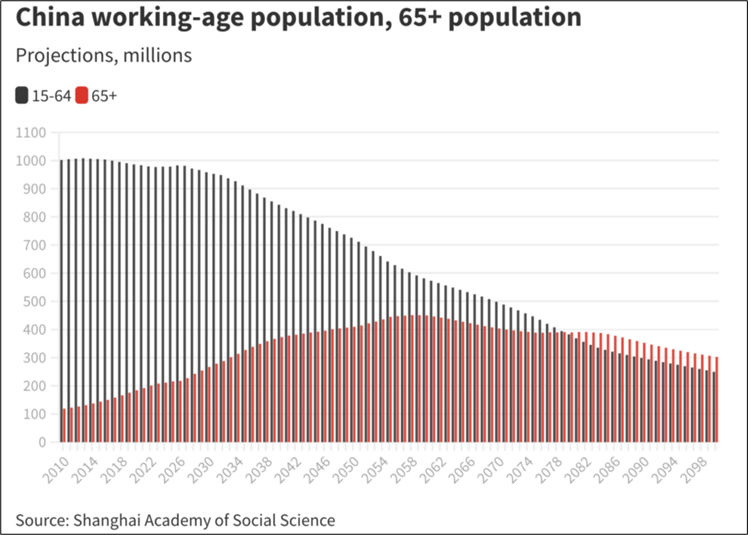
Final, insane fact: Current estimates suggest China’s working age population in 2100 will be <half of where it is now.
Here is a chart:
—
Special Report: Geopolitical View – Focus on China
Jonathan Ward has one of the craziest resumés I have ever seen. As a young man, he bicycled and hitchhiked through China because he wanted to learn more about the people than he could learn just by visiting the cities. He speaks Russian, Chinese, Spanish, Arabic, and English fluently. He has advised the State Department on China foreign policy. He gained access to the Communist Party diplomatic archives in Beijing to view and translate original Communist Party documents. These archives are now closed to foreigners and the Chinese public.
He completed his PhD at Oxford, specializing in China-India relations. Initially admitted to Oxford to study Russian and Chinese nationalism, he spent five years studying with the University’s master historians. He studied Philosophy, Russian, and Chinese language at Columbia University as an undergraduate, and then spent five years living and traveling extensively throughout Russia, China, India, Latin America, and the Middle East. His travels include hitchhiking with truck drivers throughout Tibet and Xinjiang, traveling by cargo ship across the South China Sea, traveling in remote regions of the Russia-China border, and living in Damascus, Syria at the start of the Arab Spring.
He has written two books: China’s Vision of Victory (2019) and tomorrow his latest book comes out. It’s called: The Decisive Decade: American Grand Strategy for Triumph Over China.
When I first met Jonathan in 2019, his views on China sounded kind of out there and radical to me but the mainstream has steadily moved towards his thesis over the past few years. To be honest, his views are too detailed for me to adequately cover in a page or two, so if you want the real story, you need to read his books.
The basic premise is that China has been moving towards a return to global power for decades and the US has stood idly by, without a strategy. The US is slowly waking up to the idea that China is an adversary, not an ally, and America has the rest of this decade to adopt a feasible strategy… or lose.
He proposes strategies that focus on four main arenas:
He is a strong believer in the primacy of old school American values such as democracy, capitalism and free speech and believes that the US needs a strategy to promote those ideals globally and protect them from Chinese and Russian encroachment. Recent events, including Lula’s comments, Macron’s visit, and Yellen’s language on cooperation make Ward concerned there is still no coherent US strategy to counter China’s much clearer vision. He believes that US business interests and national security cannot both be prioritized at the same time. By offshoring our manufacturing to its greatest adversary, the US has created a tangled mess.
*
This is my best attempt to summarize Dr. Ward’s comments in a very short space. I am sure many disagree with him, and this is not an endorsement of everything he says, it’s a summary. If you would like to read more, check out his books. If you have a strong disagreement to any of the above points, please email me as I am always interested in hearing all sides of every story.
The final two sessions were Nayantara Hensel on Critical Minerals (China, Russia, and Ukraine) and Kevin Rudd, Former PM of Australia on Asia, Global Risk, and Policy but sadly I had to catch my flight and missed them. When the video is available I will put a link in am/FX.
Overnight options for the BOJ meeting are trading around 25 vols. Not as crazy as last meeting, when they were trading closer to 44%.
Back to regular FX and macro talk tomorrow.
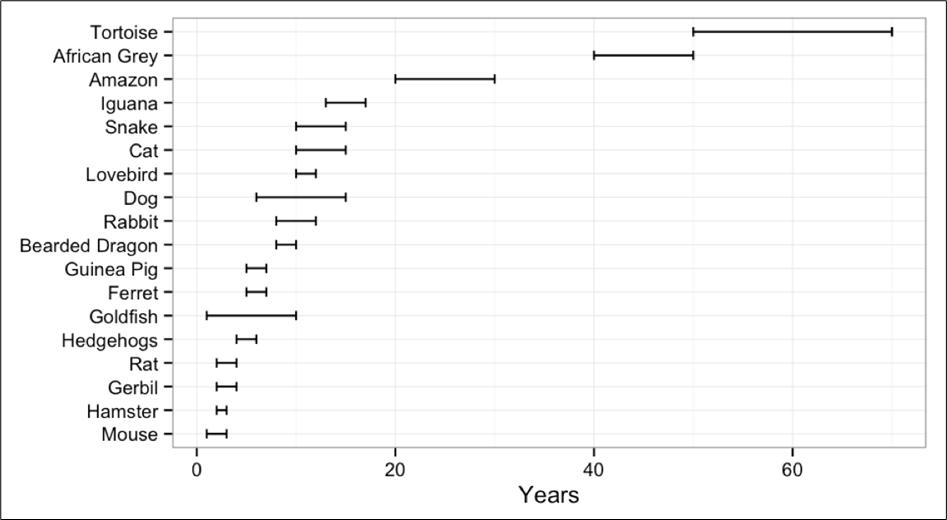
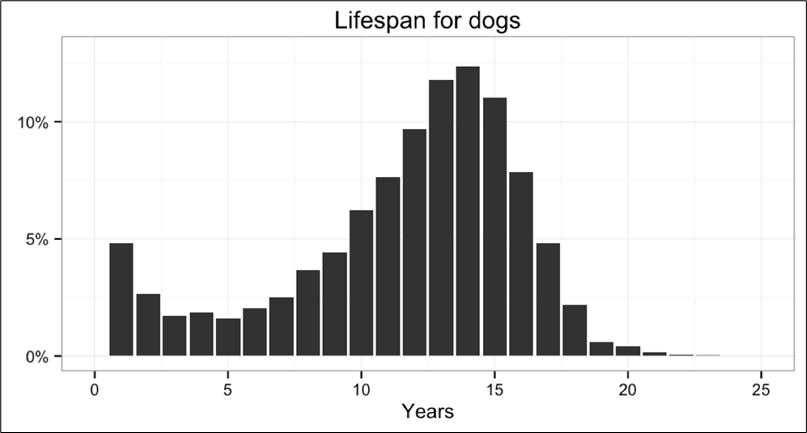
May you outlive even the elderly tortoises.
A sort of almost unbelievably large move in Brazil. Plus: Short CADJPY.

NZD has a bunch of bullish kickers: Election, seasonality, and inflation
