I see risks to the hot side for today’s CPI.
Best plays for hot CPI: Short AUDUSD or long USDMXN.
Best play for weak CPI: Long GBPUSD.

I see risks to the hot side for today’s CPI.
Best plays for hot CPI: Short AUDUSD or long USDMXN.
Best play for weak CPI: Long GBPUSD.

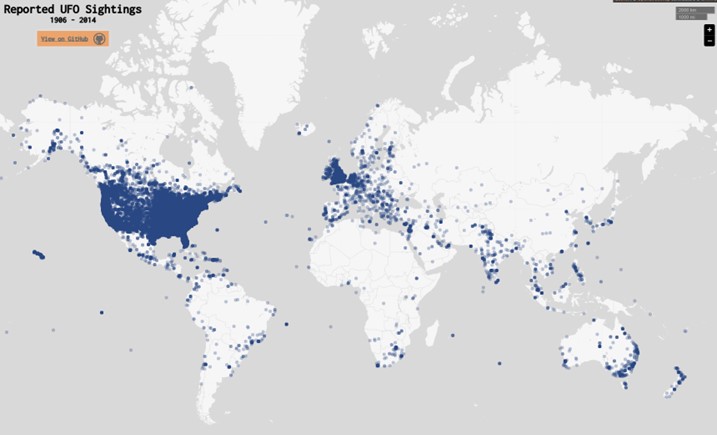
Reported UFO sightings, 1906 to 2014
I guess most aliens come from ~24,690,120,000,000 miles away and then choose to specifically visit the United States. Seems logical!
January 11, 2024
Unlike NFP, I think CPI could impact Fed policy and therefore while the USD whipsawed on NFP, I don’t think it will whipsaw on CPI. Especially if CPI is strong and March starts to reprice. My view is that the risk today is that CPI comes in a bit hot. Here is the evolution of core goods and services inflation over seven years.
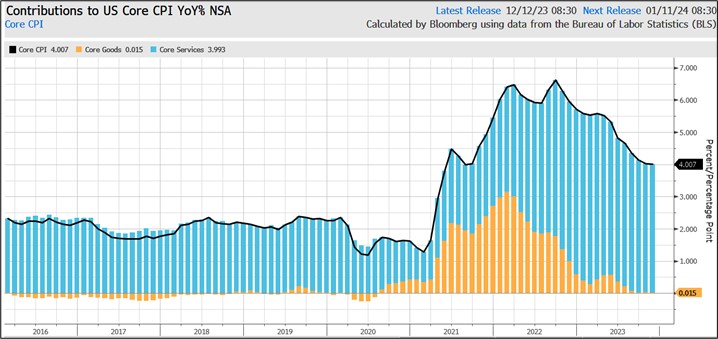
The notable feature, obviously, is persistently low goods inflation (except during the supply shock / fiscal hypercycle) and sticky services inflation. The services inflation has a significant shelter component, and that shelter component is laggy. The BLS really needs to update its methodology so that CPI is timelier and more useful and doesn’t need to be manually adjusted for its blatant wrongness. But they probably know this.
If the story is about sticky services and soft goods prices, it’s interesting that the Adobe online digital price index rose significantly in December. This is the first rise in a while and though the data are not seasonally adjusted, if you do some basic seasonal adjustment, the rise in December 2023 still stands out. Here is the data, not seasonally adjusted, so you can see how hairy it is.
Adobe Digital Price Index MoM, 2014 to now (NSA)
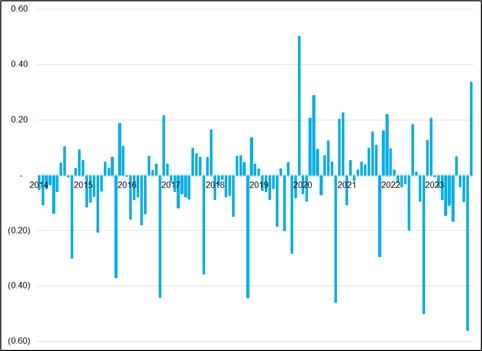
And here it is using some middle school math to seasonally adjust:
Adobe Digital Price Index MoM, 2014 to now (SA)
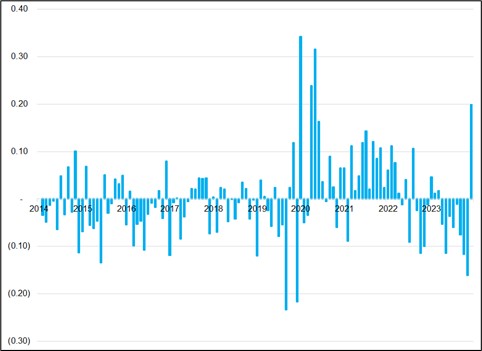
Note: Normally when you seasonally-adjust data, you use a seasonal index and multiply all your data points by the monthly seasonal factor but since I’m working with both positive and negative numbers, I don’t think that methodology works properly here. So, I simply found the average for each month and adjusted the data by that average using addition or subtraction. That is, if the average for January is 0.10 and the actual January figure is 0.40, that would show up as 0.30 on the chart. This is probably not the most academically rigorous way to do this, but it’s a simple and intuitive way to adjust the data when you’re sitting at your desk at 5:50 a.m. trying to get a newsletter finished by 7:30 a.m.
The Adobe Digital Price Index didn’t have much of a profile before 2020, so my assumption is that it’s not factored into economists’ models. To test this assumption, I sorted all the Adobe data and matched it to the beat or miss in CPI. When I say: “Miss in CPI” I am talking about (ACTUAL ECONOMIC RELEASE – BLOOMBERG MEDIAN EXPECTATION) for both core and headline, added together. This month’s Adobe SA number is 0.198 and that is high. It is in the range where there has been a greater chance of CPI strong than weak. You can see the data glides logically… The lower the Adobe SA number, the less chance there is that CPI will exceed expectations. Sample size, regimes change, etc. yes yes.
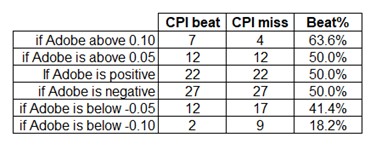
The Adobe Digital Price Index data is noisy, but I think there is enough signal to suggest that a stronger number is more likely than a weak number today. Also, if you stare at the first chart on page 1, you can see that the rate of decline in services inflation is slowing. So if services CPI is getting a bit sticky and goods inflation was unusually high in December, maybe you get a surprise today.
The best trade for strong US CPI is short AUDUSD as the pair trades terribly and I think the market is still long. I would rather have an offer ready than go in short AUDUSD because the risk management if CPI comes in weak is too uncertain. If you want a play for a weak number, long GBPUSD makes the most sense to me because a) it trades well in the face of not particularly good news b) the chart has tons of open air to the topside.
Excellent traders:
Losing traders:
Come in to trade each day with a positive attitude. Do the work. Focus. Behave rationally. Go home. Do it again tomorrow.
Have an intergalactic day.
https://github.com/wlouie1/UFO-Sightings?tab=readme-ov-file
Global UFO sightings 1906 to 2014
Americans want to believe


A sort of almost unbelievably large move in Brazil. Plus: Short CADJPY.

NZD has a bunch of bullish kickers: Election, seasonality, and inflation