I use CAD crosses as an example of an important RV trading concept
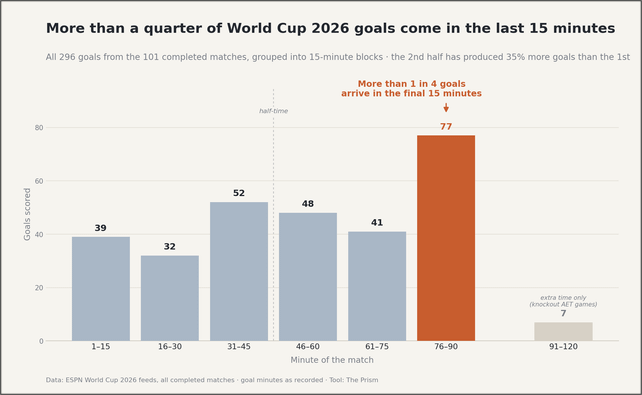
More than a quarter of World Cup 2026 goals came in the last 15 minutes

I use CAD crosses as an example of an important RV trading concept

More than a quarter of World Cup 2026 goals came in the last 15 minutes
31JUL 1.3500 GBPUSD call
23bps off 1.3415
10SEP CHFJPY put spread
199/196 for ~37bps off 200.50 spot
30JUL USDMXN put fly
17.40/17.15/16.90
1X2X1 for 30bps off 17.52 spot
Yesterday I included a graphic that showed the correlation of various crosses to the USD and while I have written about this before in the past, most of it was in 2019 for my book “The Art of Currency Trading”. I think it’s worth revisiting because yesterday a client asked me:
“What is a CAD cross that I can be long and still make money if the USD sells off?”
And I didn’t know the answer! I couldn’t even guess, really. USDCAD is obviously one answer (!), but that is not what he meant lol. His point was that when you look at most CAD crosses, they have enormous beta / correlation to U.S. dollar direction. For example, here is CADSEK vs. DXY.
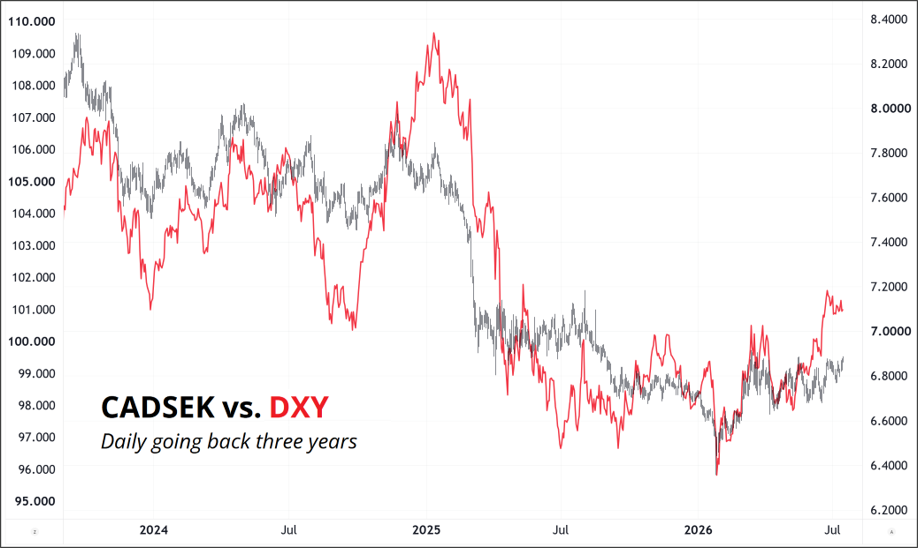
Non-FX peeps often find themselves trading two currencies thinking it’s an RV trade, when really it’s simply a directional play on the most volatile of the two. 1-month USDSEK vol is 8% and USDCAD vol is 4%, so if the USD rallies, USDSEK moves much more than USDCAD and the mechanical result of this process is that CADSEK goes higher. There is very little idiosyncratic CAD there. The only time CADSEK will move idiosyncratically with CAD is on days when there is Canadian data or a BoC meeting. Otherwise, CADSEK is a USD play.
So the question then becomes: Which CAD crosses are NOT a USD play and how does the spectrum run from pure USD play to possible CAD trade? Justin made a spreadsheet!
In order to make things less confusing, he put CAD as the numerator in all cases, so you don’t have to do the mental gymnastics of what is going up and down when comparing, say, EURCAD to CADJPY. Everything is CAD/XXX. Because the client question was specifically about how to be long CAD when the USD sells off, I put that result on top.
Using monthly data, here is the percentage of the time each CAD cross is up or down, based on increasingly large USD down and up moves in the same month.
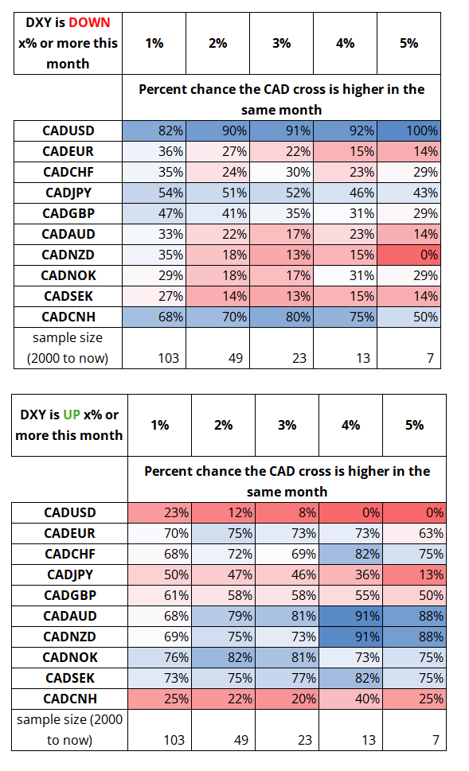
You can see that it’s very hard to find a CAD bull trade that works in a USD down environment. USDCAD, CADCNH, or nothing, basically.
I did not include EM in here because the movement in EM currencies is super nonlinear and so the results of a table like this would be confusing and would tell a misleading story.
This discussion has significant relevance outside of FX and is an important concept even if you have chosen never to trade a CAD cross ever in your life. Whenever you put on a trade, it’s useful to know the underlying beta and/or drivers of the trade. In other words, you need to know what you are cheering for. If you are long an index, you are massively overweight technology, for example. That’s good to know. If you use dollar notionals to size your RV equity bets, you are doing it wrong. If you are long HYG and short TLT in an attempt to isolate credit risk, you better understand the duration mismatch. And of course: whenever you trade a non-USD cross, make sure you can list its main drivers and USD beta.
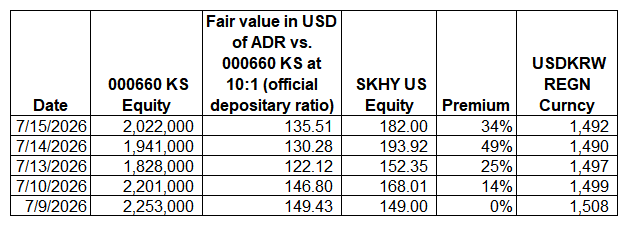
The law of one price (LOOP) violation in VCX was a great trade as it continues to bleed towards NAV. Now, SK Hynix ADRs are violating the LOOP as the domestic price of SK Hynix suggests fair value of $135 for SKHY and the ADR trades at $181. Perhaps this is because SKUU SKDD SKHKL SKHU SKHX and SKHZ are all leveraged ETFs trying to manage their SKHY risk as retail piles in at any price, regardless of fair value? Could be. Don’t worry if you don’t like any of those levered SKHY ETFs; ten more on currently filed and should appear shortly. What are we doing here?
Obviously the two stocks trade in different time zones, so a premium or discount in N.Y. could simply reflect movements in the stock after the Korea close. But this is a persistent premium across multiple days. It’s not a good thing for retail investors. It is the opposite of a margin of safety. It’s like buying MSTR, GBTC, BMNR, or VCX at a huge premium. Buying dollar bills for $1.40 is negative EV.
I believe that ultimately we will see GBPUSD release up and through 1.35 before the end of the month.
Have an inspired day.
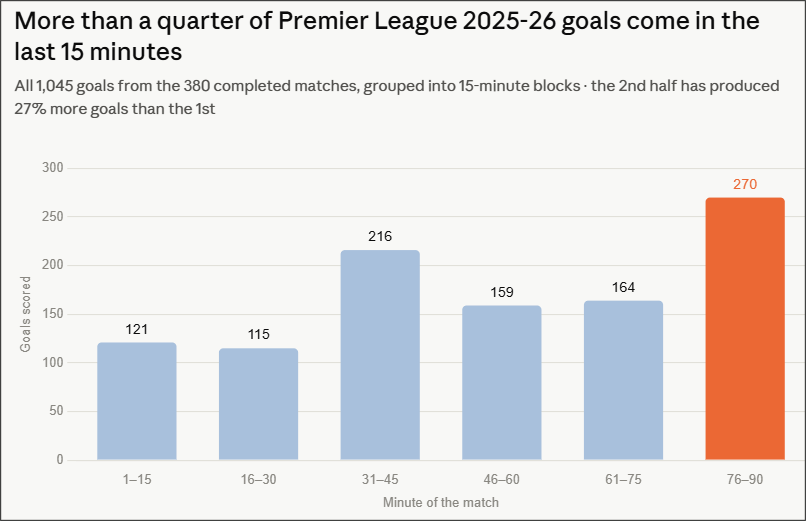
Same deal with Premier League…


This piece is mostly for people who are interested in backtesting