Wrong
My CPI call was wrong and given that, and what I’m writing about today, I don’t want to be long cyclical currencies or short USD anymore. I am also cutting the EURGBP long trade around flat. The trade is stale, and ECB is tomorrow so there is no point continuing to hold onto it. The pair has gone nowhere in weeks. Overall, the AUD and USDNOK still made money, which is a miracle because my calls over the past 10 days have been more wrong than right.
Stonks
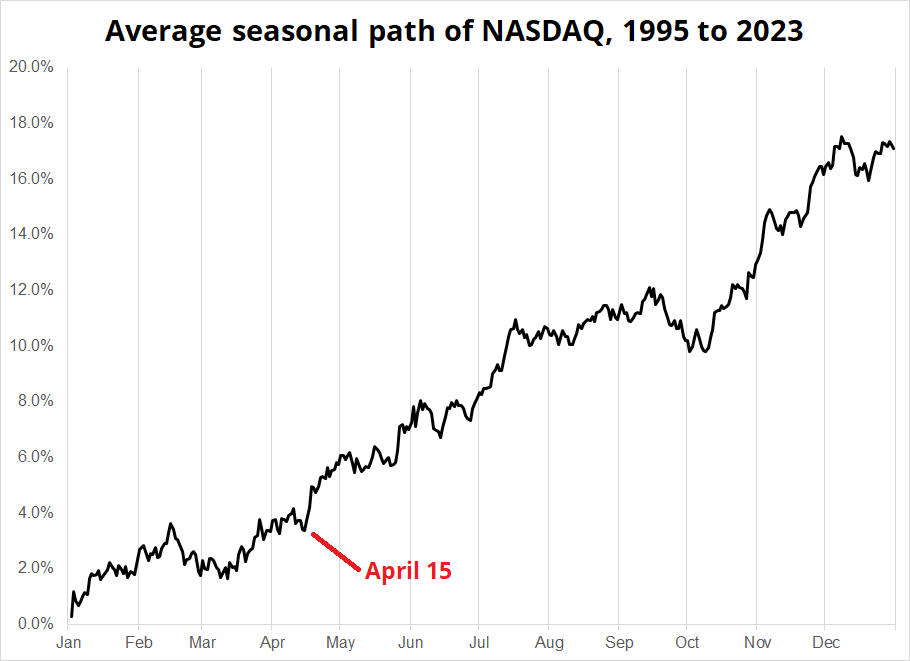
The main reason there is persistent seasonality in the price of equities is that there is persistent seasonality in the flows. People get bonuses around the turn of the year and those flow into 401ks, for example. Another more micro example is that people get tax refunds in March (bullish stocks), but then others need cash to pay their taxes into April 15. Therefore, stocks tend to rally from mid-March to early April, then sell off into Tax Day.
This effect is particularly strong in years when speculation is running rampant, like 2000 and 2022 as traders that made huge gains in 1999 and 2021 did their taxes and had the same “oh sht” moment I had myself in the year 2000 as my account had increased significantly throughout 1999 but I had spent exactly zero seconds ever thinking about the fact I was going to owe taxes on the gains.
Here’s an excerpt from a piece I wrote on this topic in February 2021.
Glory Days
I was pretty dumb in the late 1990s. At 27 years old, I was living proof that smart people still do dumb stuff. All I cared about was having fun and nothing much mattered to me besides the bull market in NASDAQ stocks and the bull market in all things Brent Donnelly. I was making good money, having all sorts of fun and I had no responsibilities or cares.
Anyway, in Q1 2000, I was trading my own money and feeling invincible. The approximate peak of my invincibility coincided with a phone call from a reporter at the Globe and Mail (Canada’s National Newspaper), which led to a feature article / trader profile that appeared on the front page of the April 8, 2000 Globe and Mail Business Section along with a full-color picture of my 27 year-old self. Here’s the article (paywalled):
https://www.theglobeandmail.com/report-on-business/big-risks-are-all-in-a-days-trades/article25459933/
Note this is the exact type of hubris-filled trader profile that comes out when stocks are on the highs and the profiled trader’s equity is about to crash. Little did I know at the time, the NASDAQ had already peaked a few weeks before the article came out. My equity peaked a few months later.
I was excited about the article when it came out (my ego was particularly excited). The feature came out in the Saturday paper, and while things didn’t really go viral in those days, it went semi-viral amongst my friends and acquaintances and I got a few high-five style phone calls including one from a girl I had an unrequited like for in university. Winning! But Monday, when I returned to the trading office, it was all cold water from the adults.
“Brent, you should not be doing interviews like that,” warned one of the managers of the trading shop, “It just puts a target on your back. You don’t want this kind of attention. You’re going to get audited for sure now, so be ready.” Another elder statesman (who was probably 33 or so) just shook his head as he stared at me and said: “So dumb… The tax, man. The tax…” Now, a normal, mature adult would probably react to those comments with some sort of concern about getting audited. Like: “Oh, shoot, I didn’t think of the audit angle here.” But… I was not a mature adult.
My thought process instead was: “Oh, crap. Taxes! I forgot about those.” I am not kidding. I had turned my $25,000 opening account balance into around $275,000 or so by that point , and I had not budgeted for, or even considered that I would need to pay taxes. My only focus had been on making as much money as possible. Crazy thing was, I was not alone. Few of us had considered the tax side.
The rest of that afternoon, the money-making 19-28 year-olds huddled and tried to figure out what to do. Should I just keep trading and worry about taxes later? Maybe I can just pay them all in 2003, or something? Could I maybe “forget” to file my taxes? Would that be bad??
Obviously, the only eventual answer was: Liquidate a bunch of your trading account and pay the tax. My account withdrawals had no market impact because my strategy mostly involved day trading headlines and trading lead/lag single name vs. spooz momentum, but there were plenty of “Swing Traders” that traded exclusively from the long side, cycling between, for example, the hot B2B names like Backweb and Marimba (BWEB and MRBA), the fiber optic darlings (JDSU), and the incubators (CMGI).
Long story short, a lot of stock got sold around tax time in 1999 and 2000, and we saw the same phenomenon in 2022 as the newly-minted crypto and ARKK millionaires sold assets to pay taxes. The selling is persistent and large enough that you can see it on this chart.
The fun thing is that we even had a special controlled experiment in 2021 when Tax Day was moved to May 17 (instead of April 15). Here’s how stocks did around that period in 2021 (after a 43% rally in the NASDAQ in 2020).
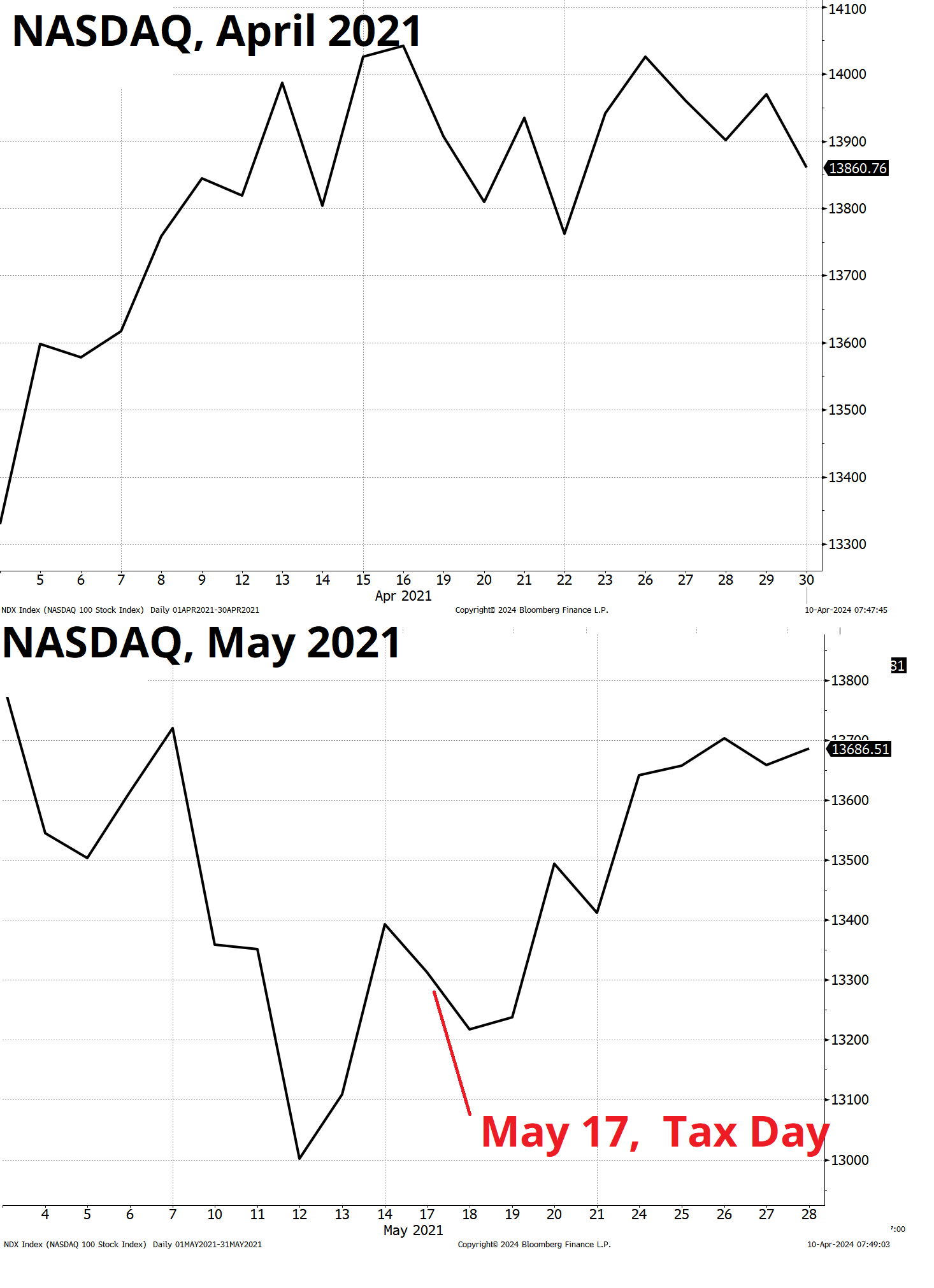
Pretty cool how the selloff that normally centers around April 15 happened a month later. Probably not a coincidence! And here is a more zoomed in view of the average performance of the NASDAQ from 10APR to 30APR.
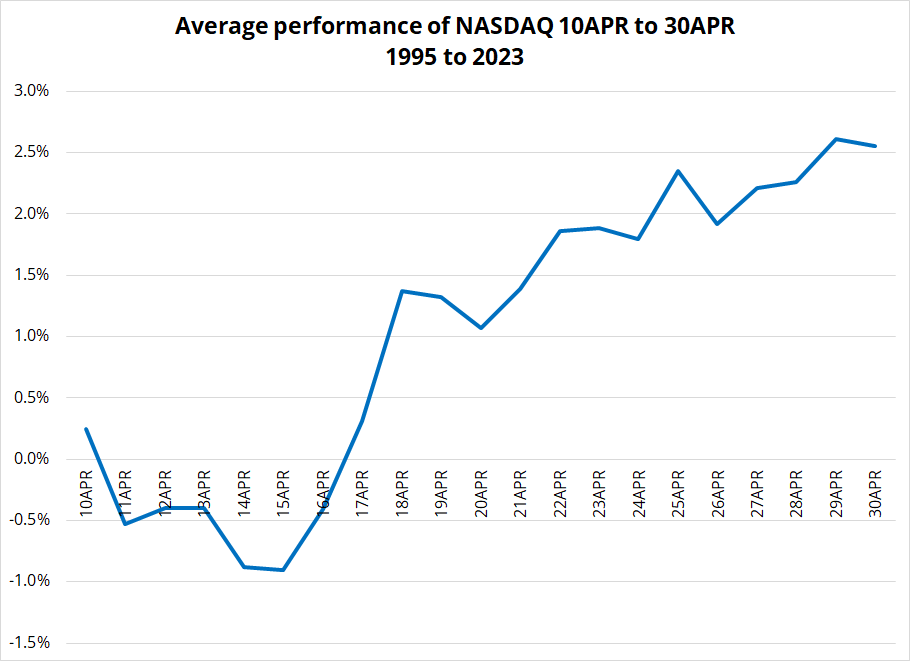
There are three takeaways here:
- If you’re long, be careful over the next few days.
- If you’re bearish, this is a good time of year to be short.
- If you’re bullish and you want to add, buy at the close on Monday.
Everything I have written here today also applies to crypto as the degens there will also need to sell to fund tax payments, just like the NASDAQ and 0DTE degens. Crypto dumped hard into Tax Day in both 2021 and 2022 (both were years where taxes would be high after large gains the previous year) but did nothing in mid-April 2023 after big losses on crypto in 2022.
Have a lotto ticket kinda day.