Supply shocks leave central banks without a roadmap
03NOV 157 USDJPY put
~30bps off 80 spot
Short CADJPY @ 112.01
stop at 113.61. Target 110.41
18DEC 1.22 AUDNZD PUT
Cost ~0.56% AUD off 40 spot

Supply shocks leave central banks without a roadmap

03NOV 157 USDJPY put
~30bps off 80 spot
Short CADJPY @ 112.01
stop at 113.61. Target 110.41
18DEC 1.22 AUDNZD PUT
Cost ~0.56% AUD off 40 spot
My 2-month AUDNZD puts are just about worthless just one week in as the RBNZ went a bit rogue overnight. We live in an interesting and confusing time for central bank policy because it’s quite easy to argue hawkish or dovish, depending on your opinion on second-round effects from an oil shock. The RBNZ statement and the disagreement in a 4-3 vote show how there is no clear roadmap for setting interest rates in the current environment—it’s more of a Choose Your Own Adventure type situation.
When a central bank faces high inflation and a weakening economy simultaneously, what to do? The RBNZ voted 4–3 to hold rates at 2.75%, despite inflation running at 3.7% and projected to rise to 4.4% in December. War-related disruptions to oil production, refining and shipping are pushing up energy and transportation costs, while a weak kiwi compounds imported inflation. And inflation is broadening as core inflation is near the top of the target range, and 56% of the CPI basket is rising by more than 3%.
The problem, say the doves, is that higher interest rates cannot produce more oil, repair refineries or reopen Hormuz. But! Say the hawks: higher interest rates can suppress demand and prevent the initial price shock from becoming embedded in wages, inflation expectations and broader price-setting behaviour! Tightening into a supply shock risks crushing a fragile domestic economy, where household consumption is weak, employment growth is subdued and housing prices are falling.
Do you hike to prevent temporary war inflation from becoming permanent? Or wait and hope for the best? The end of the war is unknowable. A guy told me once that it was going to be over in two or three weeks. As a central banker in a supply shock, it always sounds reasonable to do nothing and wait for more information. But if this war drags on for another two years, central banks have an increasingly sticky situation. If the war ends (or triggers a global growth downturn) they tightened into a recession and repeated the mistakes of 2008. Tough spot.
In a normal cycle, central banks try to slow demand to restore price stability. In wartime, they must decide how much economic damage to inflict to contain inflation they did not cause and cannot directly control. It’s a mess.
There is an obvious read through from the RBNZ to the ECB and Bank of Canada. They face similar stories. Will they follow the RBNZ and stay dovish, or act more forcefully in an effort to ward off second-round effects? We don’t have to wait long for the BoC—they deliver a decision today at 9:45 a.m.
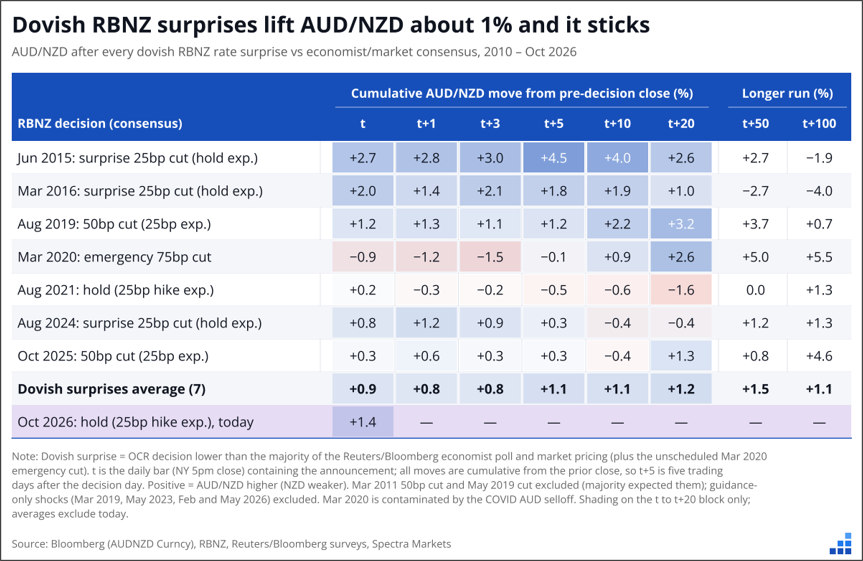
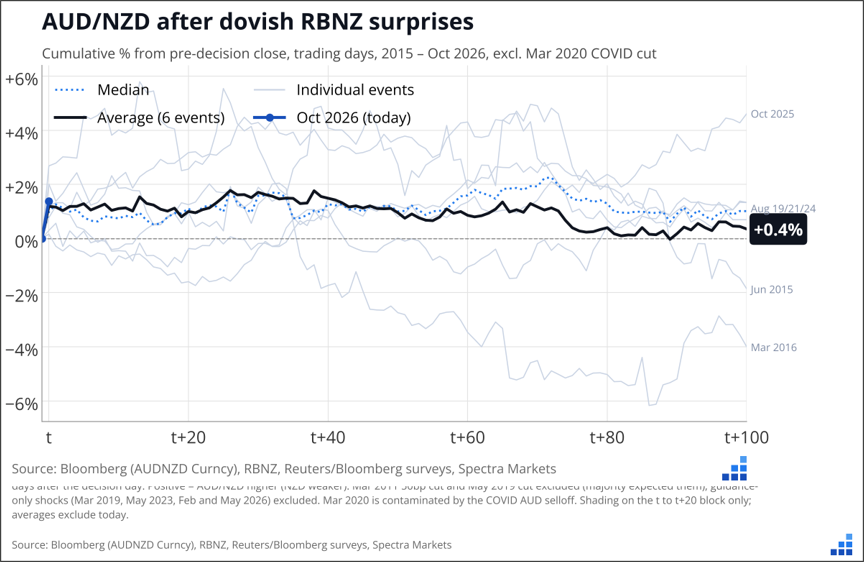
In case you are wondering, when there is a dovish surprise from the RBNZ, the whole thing is pretty much priced in on the day of. Here’s a table and a chart. You can see that the announcement day impact pretty much covers the whole move and the subsequent path looks random. The emergency cut in 2020 is a different animal, so I did not include it when building the forward performance graph (second graphic).
The 29000/30000 range is still holding in NQ and has been in force for a while now. I suppose the FOMC, or U.S. midterms, should be clearing events that help resolve things one way or the other.
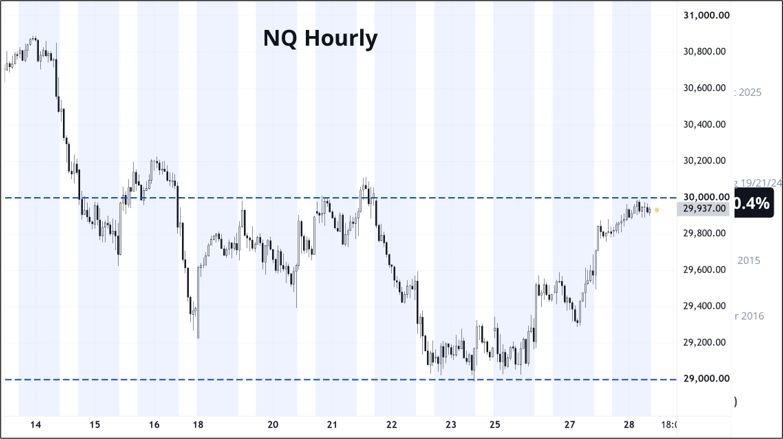
I am keeping am/FX short again today because markets are in a holding pattern ahead of BoC, FOMC, and earnings from MSFT, GOOG, and AMZN.
Polymarket has the December Fed hike at 77% right now and that is a good metric to keep an eye on today during the Warsh presser. Have a pink day.

A sort of almost unbelievably large move in Brazil. Plus: Short CADJPY.

NZD has a bunch of bullish kickers: Election, seasonality, and inflation