Talking about the cement boots that loose RBA policy has put on AUD.
A word from the Tlingit
indigenous tribe:
Kawdigoo
Meaning: The water has
settled clear. When life gets
tangled, you follow the river
until the chaos falls away.

Talking about the cement boots that loose RBA policy has put on AUD.

A word from the Tlingit
indigenous tribe:
Kawdigoo
Meaning: The water has
settled clear. When life gets
tangled, you follow the river
until the chaos falls away.
26APR 11.10/10.90 EURNOK
put spread ~34bps
11.30 spot
Short EURNOK @ 11.30
Stop 11.5610 / Take profit 10.9150
21JUN USDJPY
123 digital put @ 20%
spot 131.30
20JUN USDCHF
0.8850 digital put @ 20%
spot 0.9275
March 31, 2023
About once every six months, I feel like I need to write a piece going through my thoughts on why AUD is so weak. It has so persistently underperformed terms of trade for the past few years and there are numerous explanations including:
While I am always posting AUD vs. copper and charts of that ilk, every now and then I have to zoom out and remember this chart.
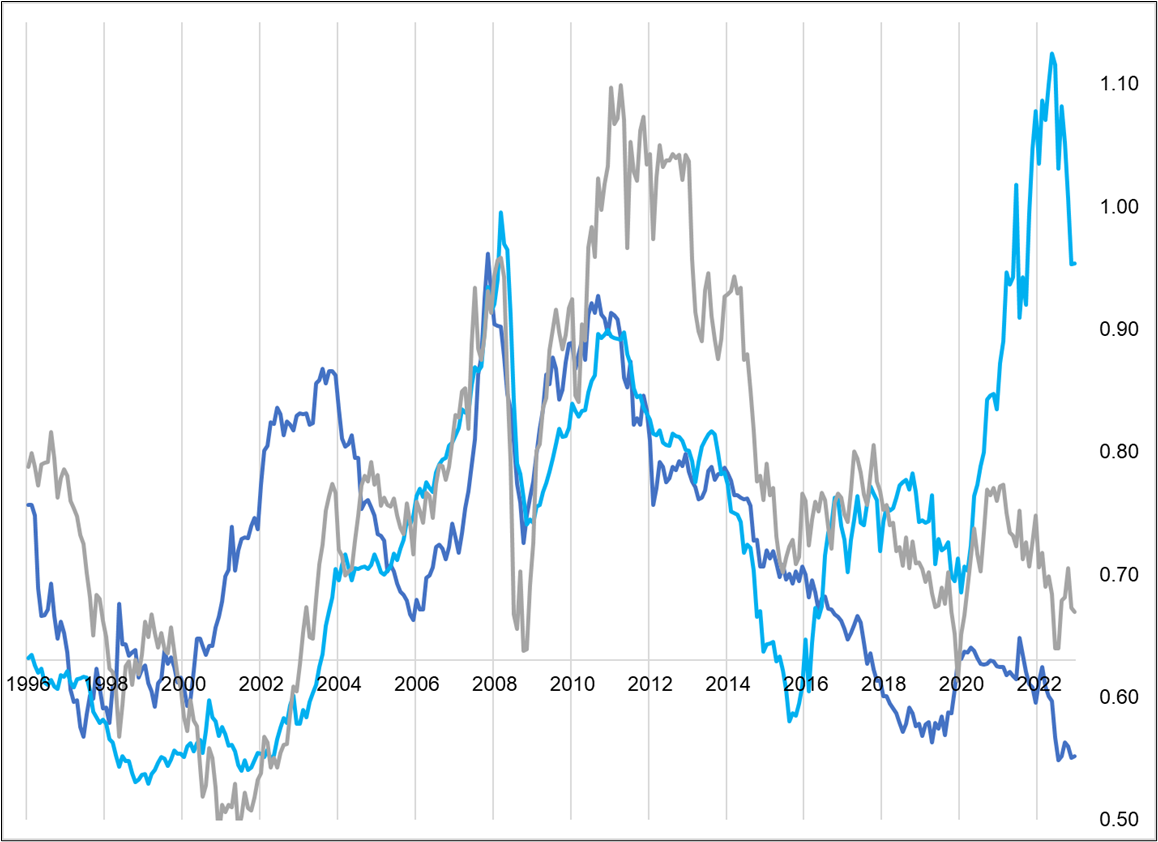
Basically, the terms of trade explosion doesn’t mean much if there is no transmission to monetary policy. I have to keep reminding myself of this. The point is particularly relevant with the RBA set to meet next week.
The RBA has not had a good few years. While every global CB made a variety of mistakes, the RBA made almost all the mistakes. Their adherence to ludicrously dovish forward guidance was particularly extreme, and they managed to find not just their policy, but their process, culture, and structure under the microscope. Bureaucrats, the commentariat, and even ex-RBA governors all launched scathing criticism of the RBA over the past few years. It’s easy to criticize CB’s these days, but Lowe is the most disrespected member of the current class.
The upshot is this 51-recommendation review that just came out. Imagine you go into your manager’s office for your annual review. You sit down. He says: “OK, your performance was not amazing. I have 51 recommendations for how you can improve.” Not good! Anyway, the whole RBA story has become incredibly politicized, and it doesn’t help that home prices are a political football in Australia and that makes ripping rates higher in a country loaded with variable mortgages rather risky.
A good starting point for thinking about how dovish the RBA has been is to compare it to peers. There are many ways to calculate real interest rates and most market practitioners use market-based estimates of future inflation to do so. There are two main issues with that when examining policy:
A simplistic, back of the envelope way of looking at real yields is to compare the current policy rate to current inflation. This has many drawbacks but it has the advantage of taking two real, observable variables in the real world, in real time and comparing them. Here is that number for various G10 countries over time.
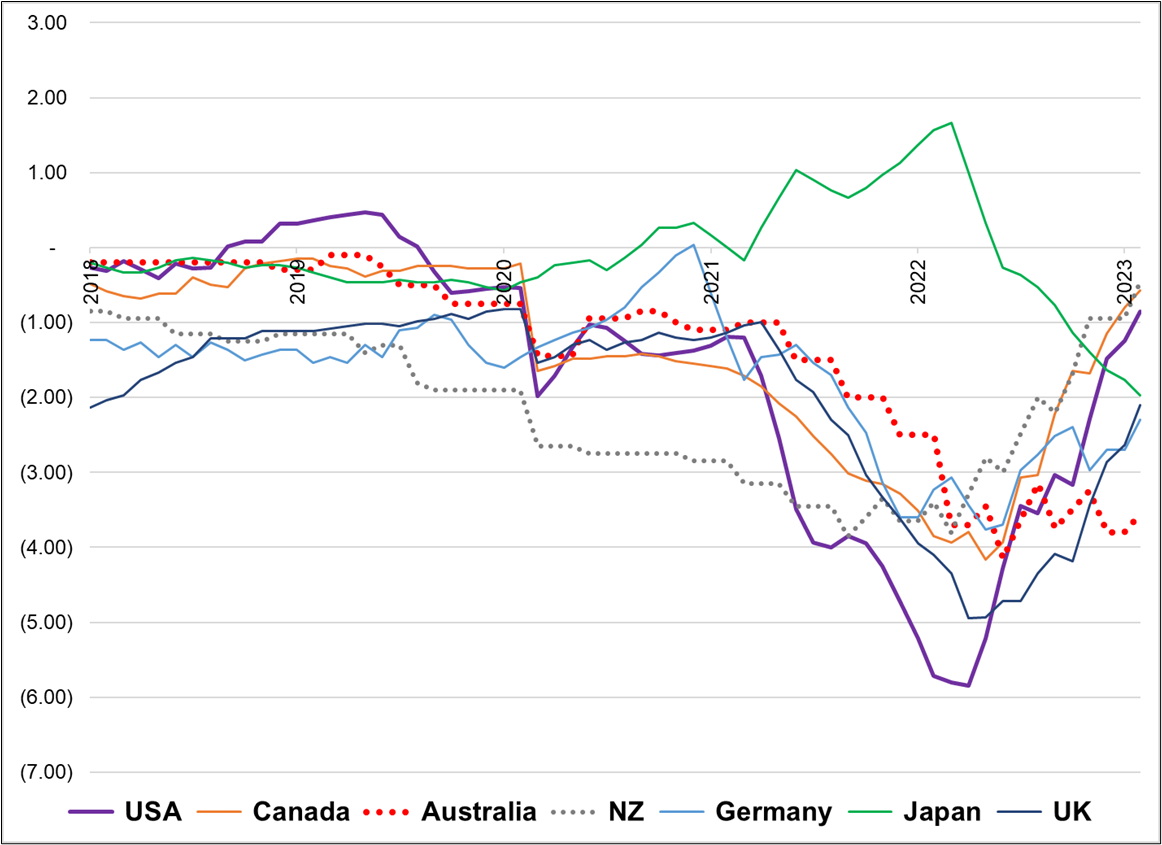
You can see that some combination of higher policy rates and lower inflation is pushing real yields up towards zero in most countries. The US, NZ and Canada are within 100 bps of zero while Germany, Japan, and the UK are closer to minus 2% and Australia is way down there at -3.55%. Nominal yields offer a similar message as you saw in the chart on page 1. The Australia vs. USA yield differential is bobbing along the all-time wides. The RBA is incredibly loose relative to the USA and relative to history.
Another comp is to look at the RBA vs. BoC. Unemployment is at all-time lows in both countries.
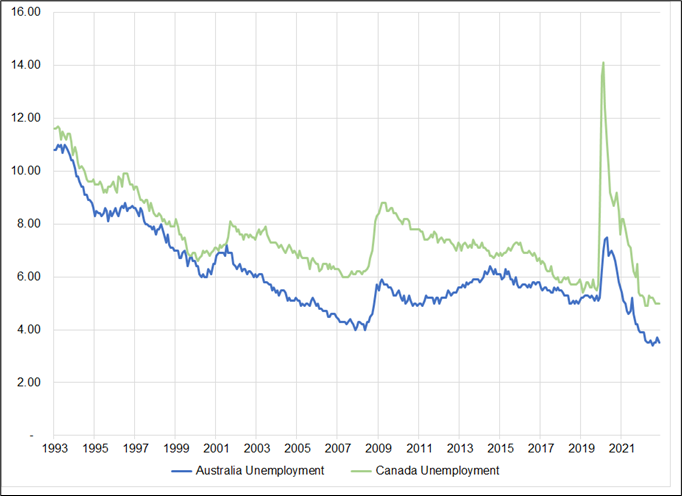
The spread between Aussie and Canadian employment is near the historical average. Meanwhile, Canadian core inflation is 5.2% and Australia’s equivalent reading is 6.3%. Both the RBA and Bank of Canada estimate their neutral rate is around 2.5%. And historically, the RBA and RBNZ have held policy rates well above the Bank of Canada’s overnight target.
But take a look at where rates are now:
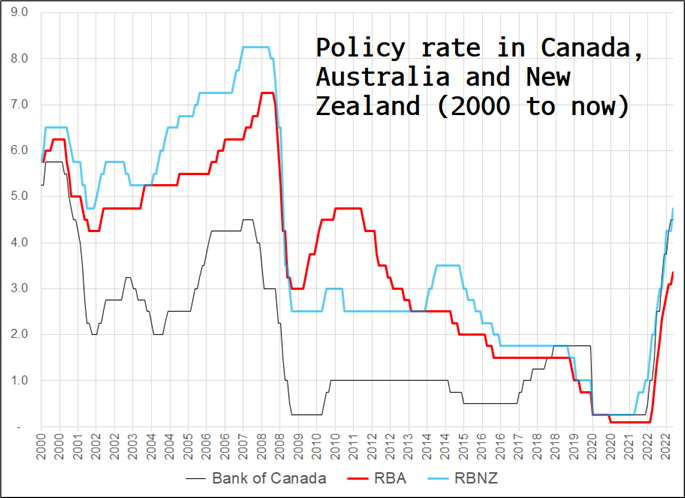
There are plenty of differences between Australia and Canada in this cycle, obviously, but any way you slice and dice it, the RBA is running incredibly loose policy. This explains why AUDUSD can never get up off the mat, regardless of the terms of trade. I should probably stop showing those AUD vs. gold and copper charts until the RBA gets busy.
I suppose there is an opportunity for something out of next week’s RBA meeting. The problem is, Lowe has been all over the place. Recently, he was 9 out of 10 hawkish in February, then 4 out of 10 in March. There are political footballs over the place, and Lowe’s term expires in September.
Lowe’s two predecessors had their terms extended by three years, but Lowe is politically toxic at this point and is certainly gone. I don’t have the political knowledge to handicap what Lowe will do on April 4, especially after the FEB/MAR flip flop. I present all this information only to say that the lynchpin assumption if you really like AUD is that you need the RBA to tighten policy in a meaningful way relative to the rest of the world.
Until then, überloose policy puts perennial cement boots on the AUD.
Meanwhile, in Europe.
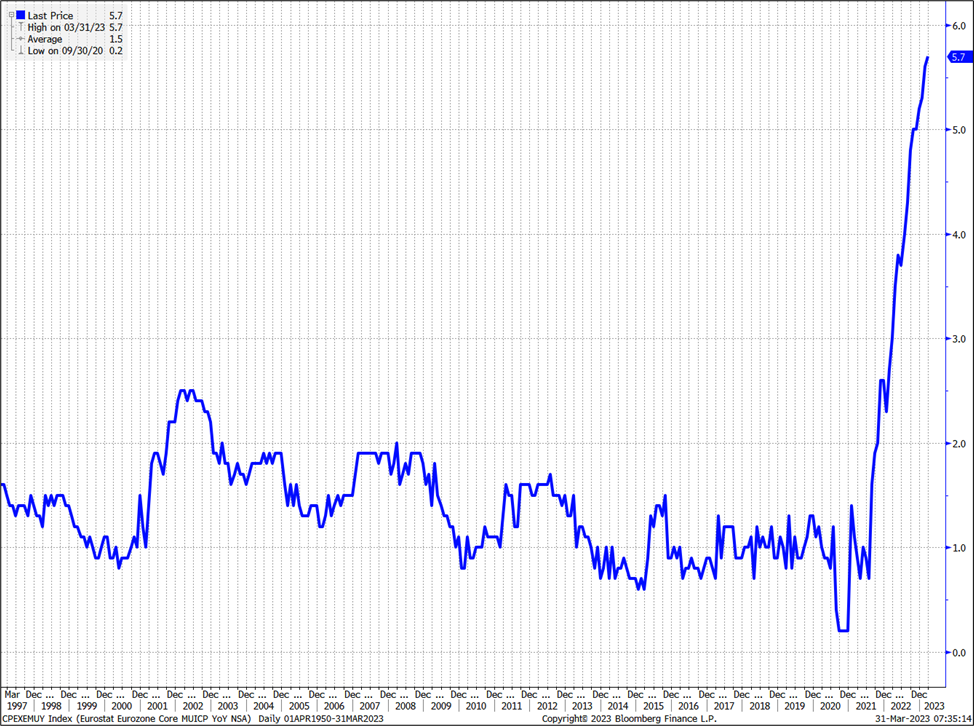
EURNOK is breaking my heart, a little bit. USDJPY bullish seasonality is almost done (ends April 5). Finally, don’t forget to tell your juniors and any students you know about Friday Speedrun. And sign up yourself, obv.
Have an evolutionary weekend.

Charles Darwin trading minis
—
New 50 Trades in 50 Weeks is out:
https://50in50.substack.com/p/week-46-the-evolution-of-edge
—
https://tlingitlanguage.com/wp-content/uploads/2015/01/Tlingit-verb-dictionary.pdf
Page 1 nonsequitur, HT:


A sort of almost unbelievably large move in Brazil. Plus: Short CADJPY.

NZD has a bunch of bullish kickers: Election, seasonality, and inflation