Some scenarios for PCE and thoughts on MOF

Some scenarios for PCE and thoughts on MOF

Long GCQ6 at 4610
Stop loss 4294 Take profit 5320
Keeping it short today because I want to publish before PCE comes out. The figure tends to be on target because the economists have a ton of information from CPI they can input into their models. That said, models are less good at moments of regime change and human economists also anchor on prior data and old regimes. The assumption for now is that goods and shelter disinflation will help offset oil and computer / memory inflation.
So, the first key today is obviously the number vs. expectations, but the second important factor for market reaction will be the composition of the figures. Anything that makes it look like inflation is broader and not driven solely by oil, AI Capex, and financial services will be concerning. Here’s how I see today:
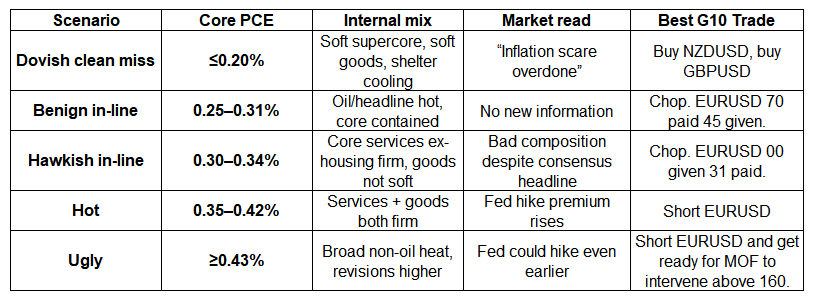
Keep a close eye on AI-related price jumps (memory and processing equipment), as well as tariff-sensitive goods like clothing and footwear. Doves think goods deflation will continue to offset services inflation. If goods prices don’t play ball, or spike due to tariffs, supply concerns, and/or tech sector demand, while Supercore (services ex-housing) remains elevated, the math for a return to 2% is challenging.
The Core PCE Index in March was 129.279, so if you want to calculate Core PCE to three decimals, use: ((today’s index release / 129.279) – 1) * 100. I say this because a 0.37 is quite different from a 0.43 (e.g.).
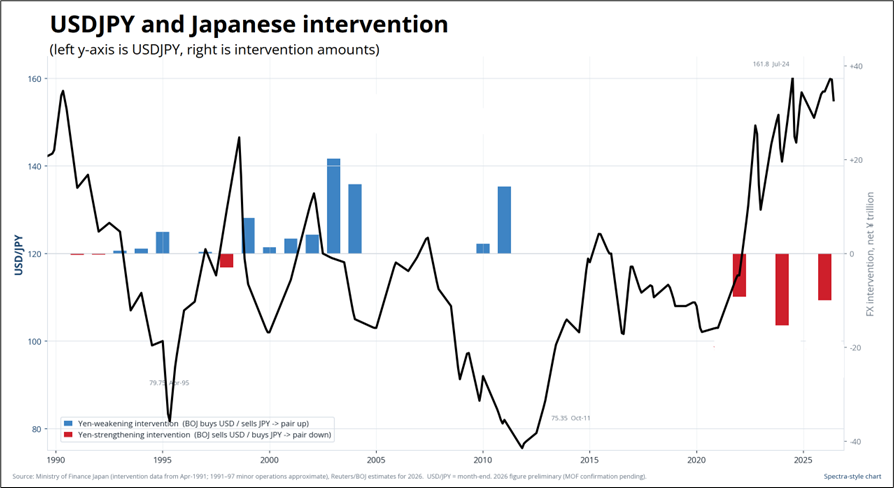
The MOF is in an increasingly weird spot on a strong release and higher U.S. yields because they are then fighting “FX Fundamentals” and that goes against the G7 FX mantra. While we are used to the MOF winning (2022 and 2024 they capped it) it’s worth remembering there were long periods when the MOF did not win. They were buying USDJPY for a few years in the early 2000s and it went lower / chopped around despite their gigantic efforts. All intervention can do is buy time for a flip in fundamentals. It cannot turn the tide on its own. Here’s a chart.
January–August 2003. The MOF held USDJPY, mostly in the 117–120 range against the dollar, until August 2003.
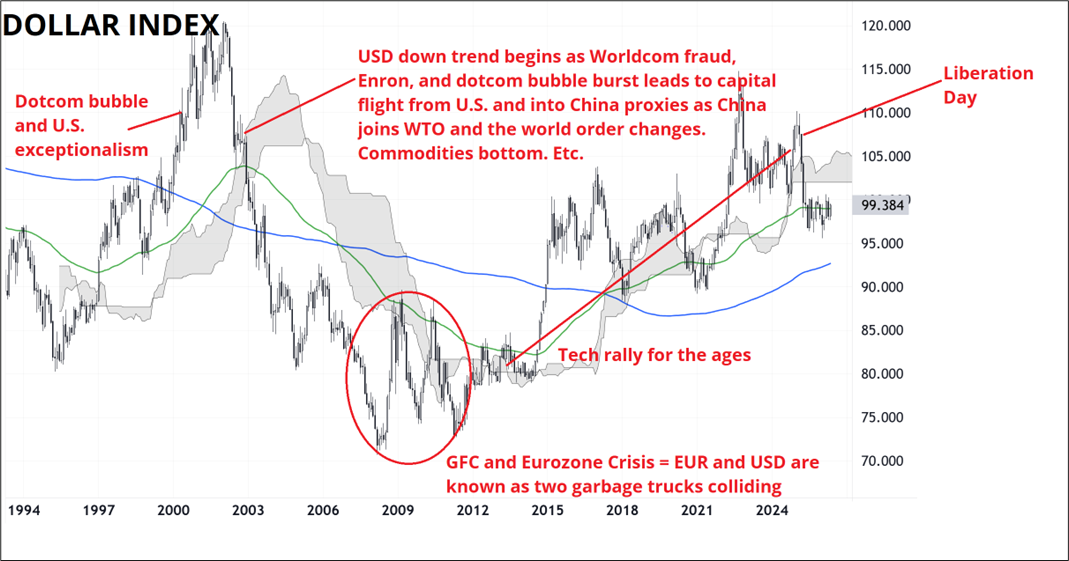
Late 2003 into early 2004. As the dollar weakened broadly after the bursting of the dotcom bubble, USDJPY broke 117, then 110, and the line of defense moved to the 105–110 zone. Much like now, the 1999/2000 period was a strong USD, U.S. exceptionalism, U.S. tech outperformance, all the money rushes into the U.S.A. period and the aftermath was a massive USD down trend that started in 2002 and did not truly end until right around the time S&P downgraded the U.S. credit rating in August 2011.
Q1 2004. The first quarter of 2004 was intense, with the MOF buying close to $150 billion, defending USDJPY around 105 / 107. The last operation was March 16, 2004. Japan did not intervene again until 2010.
The whole 2003–2004 effort totaled about 340 billion USD over fifteen months. 7% of Japanese GDP. Neat.
I was trading EURUSD at the time, but the JPY trader sat next to me and there were some crazy times. BOJQ was the code on EBS, and they would leave bids for yards and also give yards of bids to SMBQ (Sumitomo Tokyo).
Also, around 3 p.m. almost every Friday, they would ramp USDJPY higher by 30-50 pips into the 5 p.m. close. Fun.
All this to say: You cannot completely ignore the possibility that USDJPY is on a long, choppy path to 170.
I got some pushback on my piece yesterday and perhaps I overstated the idea of month-end being dead. It’s not dead, it just ain’t what it used to be. You can still find strategies that still work (AUD 10:30 to 11:00 a.m., for example, which I cited yesterday) and USDJPY on corporate month end. There are still strategies that work, but the overall strategy of buying USD on t-2 and buying or selling currencies based on monthly equity performance has decayed substantially and is nothing like the reliable money faucet it was pre-COVID.
Many corporate and real money actors have changed their behaviors, and the market is hyper-aware of the flows. Still, they’re huge flows and if you don’t know about them, you are at a disadvantage. Even if the Sharpe of running the models is lower, the flows still provide opportunities for better entry points and scalping.
My long gold trade does not look good. My view was that you wanted to buy a dip and then risky assets would rebound and gold would act like a risky asset, and we are off to the races. Instead, central bank selling continues in gold, and we are now getting close to the 200-day moving average. I hate the price action. Similar to BTC; both are going down despite a roaring stock market and raging animal spirits in memory and space stocks. Good news / bad price. I am generally not a fan of cutting trades because of price action, so I am going to stick to my original plan, but I admit that I have already marked this one as a loser in my mind.
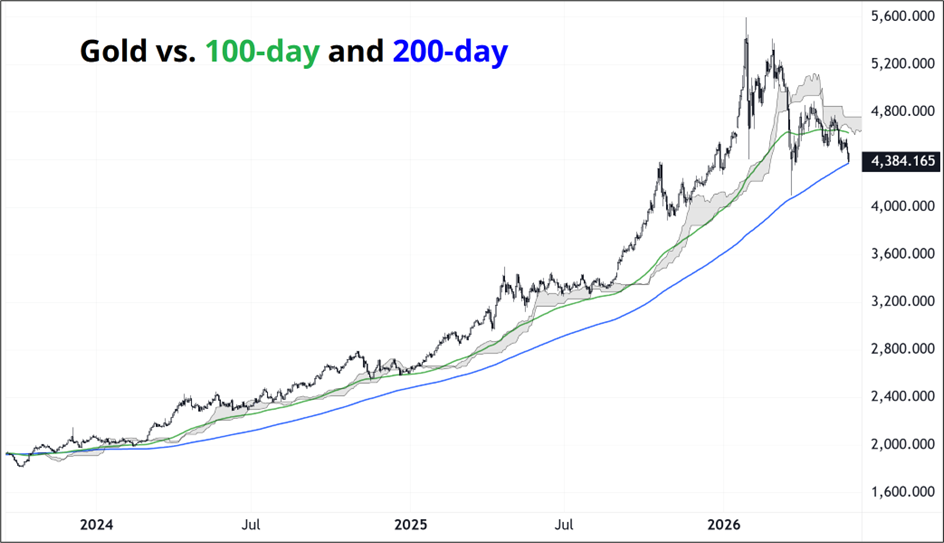
Look at that 200-day. Yikes.
I hope your favorite team wins tonight.

One for the Gitts


This piece is mostly for people who are interested in backtesting