RBA disappoints again, and oil might be relevant again soon.


Subscriber-only
Brazil, Canada, yen
A sort of almost unbelievably large move in Brazil. Plus: Short CADJPY.

RBA disappoints again, and oil might be relevant again soon.
“Please note: Since the data were
provided by the United Nations, which
does not recognize Kosovo as an
independent country, the data for
Kosovo are marked as N/A in the map.”
06APR 0.6800 AUD calls
for around 32bps off 0.6762 spot
26APR 11.10/10.90 EURNOK
put spread ~34bps
11.30 spot
Short EURNOK @ 11.30
Stop 11.5610 / Take profit 10.9150
21JUN USDJPY
123 digital put @ 20%
spot 131.30
20JUN USDCHF
0.8850 digital put @ 20%
spot 0.9275
April 4, 2023
The RBA disappoints (me) again overnight as they leave rates on hold. The rates curve in Oz is super flat now, with less than a 25% chance of a move priced in either direction for any remaining meeting in 2023. Inflation data on April 20th should matter and keep an eye on housing prices, too. For now, a small miracle would be required to get AUD over 0.6800 by Thursday. I believe in miracles, but I don’t expect them.
There is a strong general tendency for Sunday gaps to reverse and fill but so far this Sunday gap in crude oil has held fast. You can see in today’s first chart that about 90% of all price action since last December has been in the 72.40/82.50 range so oil is on my radar more than usual as it rallies up toward the top of that primary equilibrium zone.
The real top of the range is $83.28, the final high in early December 2022. Through there, oil will start to matter again.
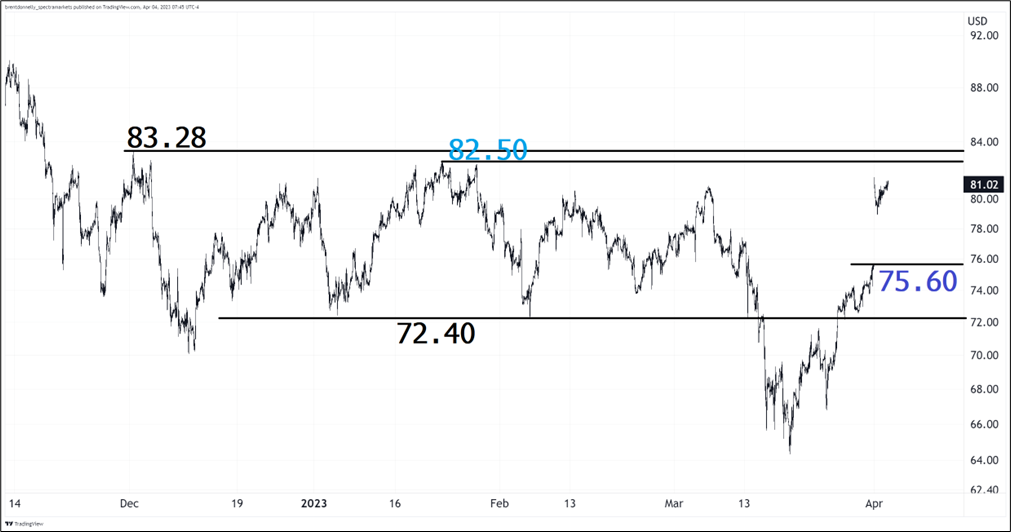
Oil was a huge driver in 2022 as the energy panic triggered by Russia’s invasion of Ukraine was right at the front of the mind of the market. Since then, the long boring range trade has pushed oil lower in the rankings of what matters. Inside this range, oil is not particularly notable or relevant to inflation and FX, but above 83.28, I think people will start to care again.
Using CFND on Bloomberg, here are the four most correlated pairs to CL. So even though much of Norway’s oil revenues are absorbed into the wealth fund, it remains an OK oil proxy at times because Norway still gets ancillary benefits besides the direct cash flows from oil sales.
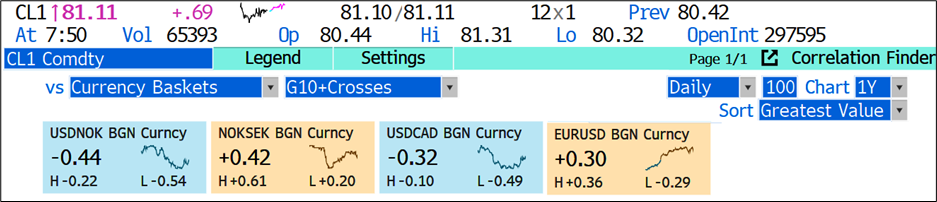
Notably absent from that grid is USDJPY. There was a time when USDJPY, US 10-year yields, and oil were joined at the hip and oil obviously matters for yields and inflation at times. But I would argue that unless we are in feedback loops where oil drives yields higher, the impact on USDJPY is not that meaningful. Japan is an oil importer and the price of oil matters for its current account, but yields just matter so much more. Oil up, yields up is a turbo USDJPY bull cocktail but oil up with yields soggy is not super meaningful for JPY.
Broadening the correlation investigation, here are the top CL 100-day correlations vs. all global macro products.

Today is the last day of bullish USDJPY seasonality. The seasonals have worked well this year and owners of the Spectra Handbook have probably noticed that. Here is the USDJPY seasonal.
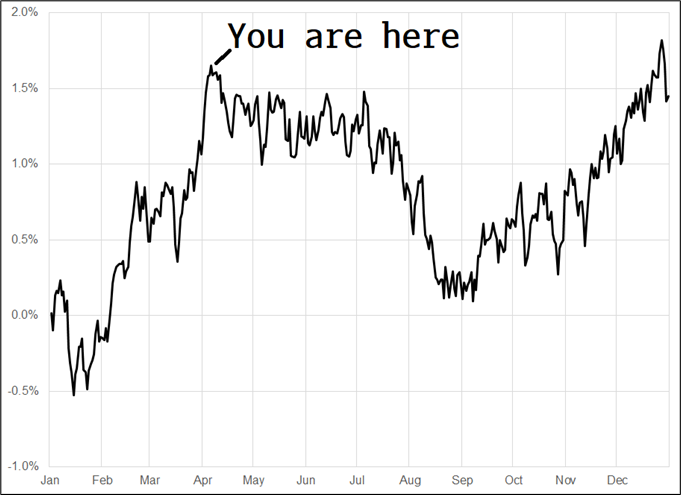
The period from April 4 to April 17 is bearish on that chart and even if you look at seasonality from 2016 to now (to move past Abenomics), the pattern for this part of the year is the same. That is, it looks persistent across multiple time frames. USDJPY also looks kind of high relative to yields (see next chart). Furthermore, tomorrow’s ISM release should be asymmetric to the downside given yesterday’s miss from Manufacturing ISM and the weak guts of the release.

Note: There is no point looking at USDJPY vs. US yields before JAN2023 because the BOJ change in DEC2022 reset the relationship.
Congratulations to Dave Greiner (https://twitter.com/redheadtrader), the winner of this year’s Spectra Markets NCAA March Madness pool. This is evidence that home bias is not always a drag on returns. He is the only person that chose UCONN (where he lives) to win the whole thing. They were 20:1 longshots at the start of the tourney so either Dave has Nostradamus-level forecasting skillz, or betting with your heart isn’t always the worst way to achieve diversification from the crowd.
Dave wins a weirdly heavy 2” tungsten cube and a glorious hoodie. En-Jun Ying wins hardcover copies of “Alpha Trader” and “The Art of Currency Trading” plus a Spectra hoodie, and Salem Fischer wins a hoodie. Life has never been so good for those three. I crouch in the shadow of their glory.


Good article from SB: https://www.persuasion.community/p/why-so-many-elites-feel-like-losers
We get JOLTS today, but tomorrow is a bigger day with ADP and ISM.
Forte is going to win the Triple Crown.
Have a drippy day.
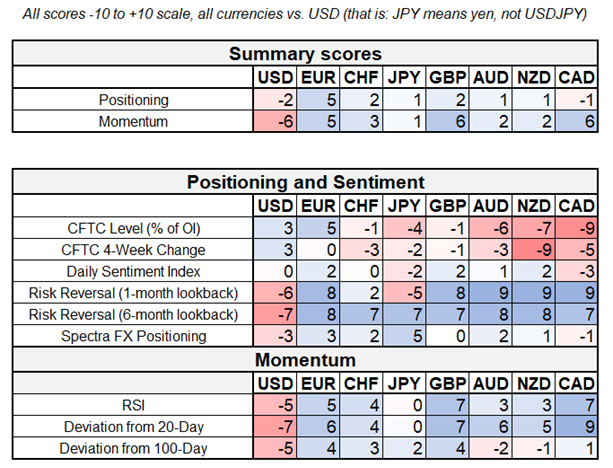
Positioning grid on page two this week. Main points on page one.
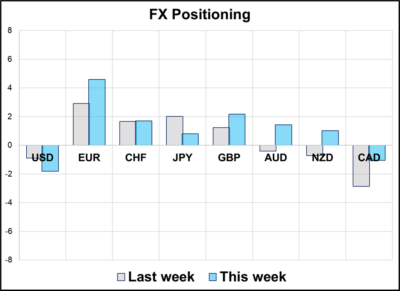
As has been the story of late, it’s as if punters want to bet short USD, but prefer to limp into the pot. No significant USD-Lower wagers have been shoved into the middle still, even as ISM comes in weak with weak components today. The market certainly is not flat, but there is plenty of room for specs to add to existing USD short positions.
RBA tonight, and US ISM Part Deux Wednesday are key.
1. My study backtesting magazine covers found that BusinessWeek and Barron’s are not contrarian, they are coincident. Time and The Economist are contrarian. This makes sense because market-focused weeklies are on top of every single market theme in real time while the bar for a market theme to find the front cover of a geopolitics/economics magazine like The Economist is higher. The bar for a single name equity to hit the cover of GQ must be Mondo Duplantis levels of high.
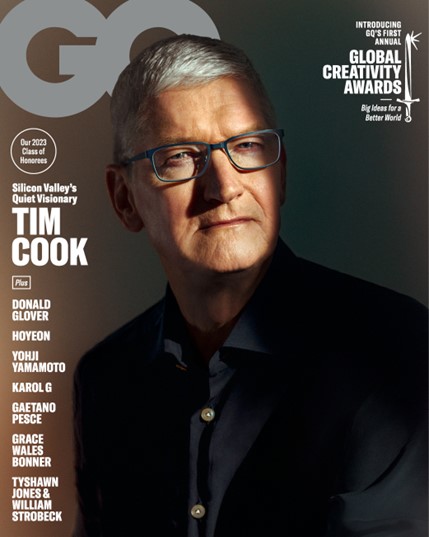
Sure, Apple is a great company. This kind of cover shows it’s fully priced in. Sure, NVDA is a great company and AI is a potentially humanity-destroying world-changing technology. But it trades at 25X sales. This doesn’t mean you need to be short AAPL or NVDA but you have no margin of safety in those investments right now. If you’re long: It’s OK to be flat. With bad timing, great companies can be terrible investments.
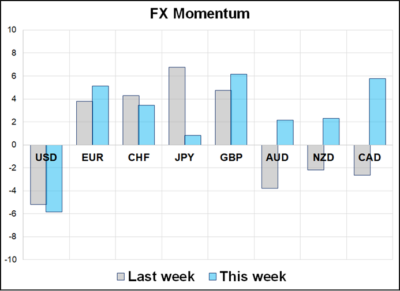
2. Long EURUSD remains the favored USD short. A positioning level of +5 is about as high as we have seen in anything this year as the market pogo hops from narrative to narrative. Not concerning levels of positioning yet.
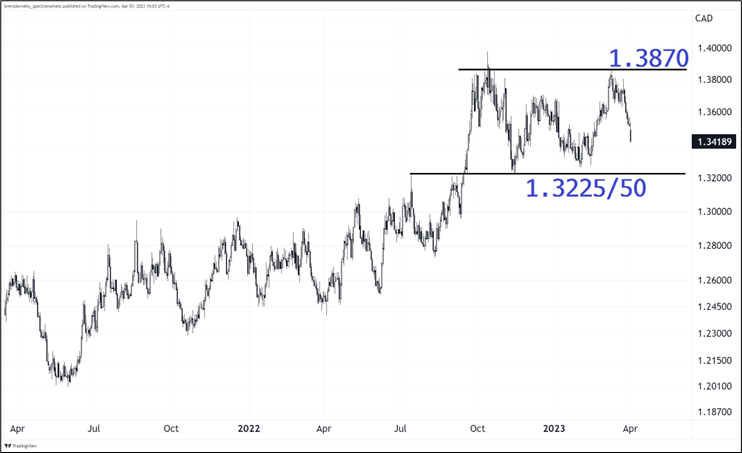
3. CAD looks like a wipeout might be coming. The OPEC cuts, along with a stabilization in the Bank of Canada’s Business Outlook survey today put the short CAD trade at risk. The “inevitable” collapse of the consumer remains elusive, and the Bank of Canada has paused while remaining credibly in control of the narrative. They could still hike, but they probably won’t. USDCAD has been trading a 1.3250 / 1.3900 range since last October and the bottom of the range looks set for a test.
That’s this week’s report. Thank you for reading.
“Perhaps with the exception of Kosovo (for which the data are not available), birth rate and migration have had only a negligible effect on the per capita population of European countries (smaller than the rounding errors involved in the calculations).
You may be thinking now that this is only due to the fact that problems in big cities are offset by hard work of people living in rural regions, but the following map, based on data by Eurostat, proves otherwise (the data are only available for NUTS 2 regions as defined by Eurostat):
“A quick glance at the historical data by Eurostat (from 1990–), reveals that the situation remained unchanged during the last 30 years. Hence, as you can see, there is absolutely no reason to be worried about the demographic situation in Europe. The worries, perpetuated by mainstream media, are based on incorrect methodology…”
https://jakubmarian.com/population-per-capita-by-country-in-europe/
A sort of almost unbelievably large move in Brazil. Plus: Short CADJPY.

NZD has a bunch of bullish kickers: Election, seasonality, and inflation