Today’s piece is mostly a guest post from Corbu economist Sam Rines. Focus: MonPolVol.
America’s decrease in child mortality
(full size image and source at bottom of page)

Today’s piece is mostly a guest post from Corbu economist Sam Rines. Focus: MonPolVol.
America’s decrease in child mortality
(full size image and source at bottom of page)
One trade, four components
Long AUDUSD 0.6435
Stop 0.6344
Long NZDUSD 0.5945
Stop 0.5884
Short USDJPY 145.95
Stop 146.86
Short USDSEK 10.92
Stop 11.0610
August 24, 2023
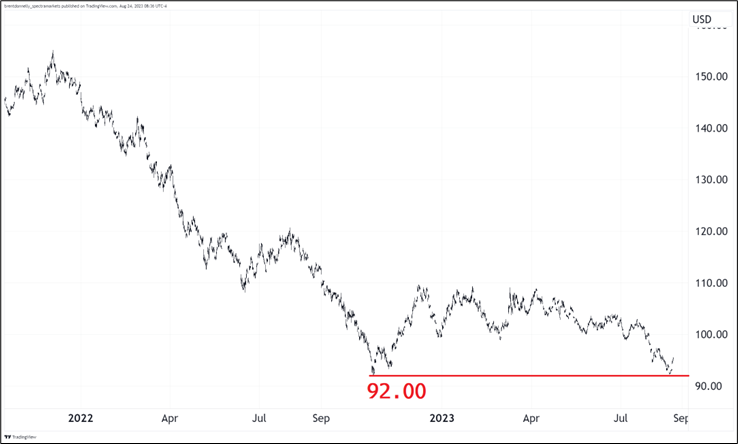
With Jackson Hole heating up tomorrow and starting with Harker on CNBC today at 10am, today has a bit of a random feel. I am surprised at the rebound in the dollar as perhaps US corporates are doing some month end buying early to get ahead of Jackson Hole risk. The levels remain the same with 4.35% in US 10s and 92.00 in TLT (the iShares 20+-year bond ETF) crucial if USD shorts are to survive. The TLT chart is nice.
As a special treat, I’d like to share the latest piece from Sam Rines (with permission). He is a must read for me and one of my favorite people in finance as he’s just an all-around fun and nice person. He got a lot of press for his detailed coverage of how companies were leaning on price over volume (PoV) and has recently been featured in the NYT and on Bloomberg’s Odd Lots. I thought this piece was a good framing of the current state of the Fed puzzle. You can find Sam on Twitter or email.
Bottom Line: Taking a breather from the Jackson Hole previews, it is worth taking a moment to understand the next debate between the “Williams Wiggle” (real rate restrictive) and the “Powell Punt” (nominal rate restrictive). And why the debate matters. In the end, it is probably a compromise of sorts. But it is all MonPolVol.
[Warning: A bit wonky]
To level set, this is not a Jackson Hole preview. This is meant to be a “beyond Jackson Hole” mental model to understand the next debate more clearly.
A few underlying assumptions –
[Not going to critique the r* calculation or argue about its relevance. It is what it is.]
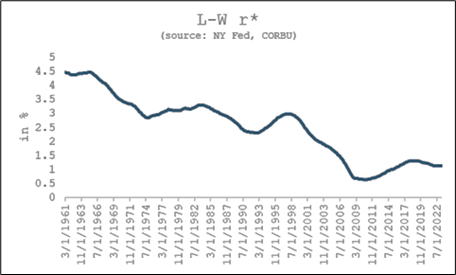
(starting points)
The “real rates” and “nominal rates” debate is only beginning, and it will intensify as the terminal rate is approached. Which leads to the initial conditions for the analysis –
Again, not going to fight the SEP, the L-W model, or the market. And that is where the analysis gets fun. Taking it all together, the FOMC is set to end the year with 3.2% PCE and a 5.625% fed funds rate. Given the 1-1.25% L-W r*, monetary policy is roughly 0.75% into restrictive territory.
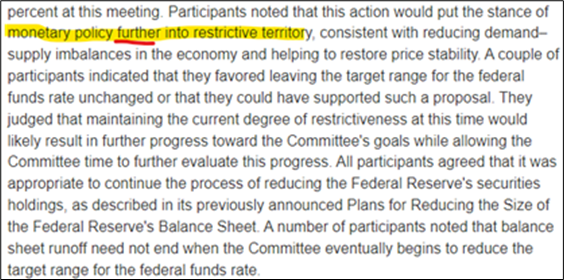
(already restrictive)
Let’s assume the FOMC is comfortable with the current 0.75% level of real restrictiveness for now. The acknowledgement / judgement of monetary policy already being restrictive is notable, and a nod toward the FOMC’s reliance on r* as a guide.
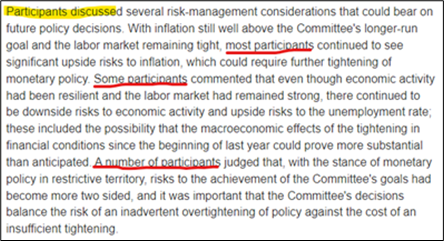
(the debate begins)
What is the difference between the “Powell Punt” and the “Williams Wiggle”? Quite a bit over the next year.
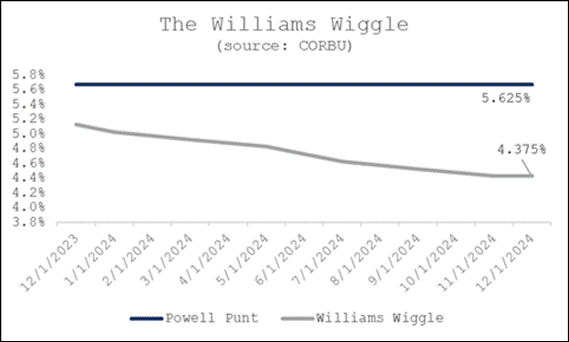
(5 cuts different, assumes PCE steadily declines in ‘24)
It looks like a significant difference. But it is not all that much of a difference for markets.
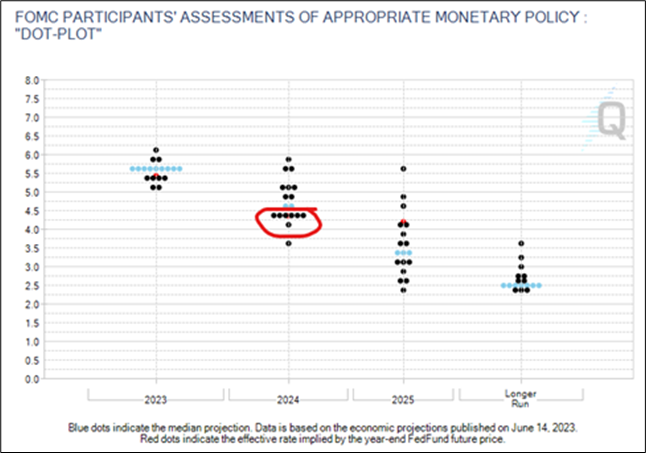
(it was always a Williams World)
With the assumption that inflation at YE 2024 is in line with the SEP and the L-W model remains sacrosanct is followed (don’t @ me), the market and the largest group of FOMC dots are pricing in 0.75% of restrictiveness with fed funds at 4.375%. That seems reasonable.
But there is the issue of communicating the “cut to remain tight” not-pivot, pivot. That is going to be a problem for the FOMC and Powell. Communication / forward guidance is much simpler in a fixed nominally restrictive regime than a fixed real restrictive regime.
A few things –
Critically, the debate about “higher for longer” is evolving rapidly. The is not a debate about whether “H4L” is going to happen. It is a debate of “real or nominally restrictive rates for longer”.
Much of this was “back of the envelope” and there are numerous assumptions embedded. But it illustrates the approaching MonPolVol. The actual outcome is likely a compromise of sorts between the two camps. The compromise will, however, be loudly argued over. Who wins? MonPolVol.
As always, comments are appreciated, feedback taken to heart, and critiques welcomed. Any questions regarding the CORBU x WT PolyMacro Model Portfolio, happy to answer 1-1.
Samuel Rines | Managing Director
CORBŪ
4201 Main Street
Houston, Texas 77002
+1.713.677.3493 [m]
+1.832.844.5111 [o]
NEW YORK | HOUSTON | ST LOUIS
I hope you found that useful!
Another good read:
https://collabfund.com/blog/intelligent-vs-smart/
Have a wildly optimistic day.


A sort of almost unbelievably large move in Brazil. Plus: Short CADJPY.