

Top of the range in yields, middle of the USD smile. Path of least resistance remains lower USD despite this 2-day correction.
subscriber-only
Yields, USD and Gold


Current Views
20JUN USDCHF
0.8850 digital put @ 20%
spot ref. 0.9275
21JUN USDJPY
123 digital put @ 20%
spot ref. 131.30
April 18, 2023
Yields, USD and Gold
Stocks continue to deliver the pain as the benign consensus on the US banking story and US disinflation puts extreme bearish positioning at increased risk. We are right in the sweet spot of the USD smile here as the Chinese consumer awakens from slumber, Aussie rates stabilize, commodities are fine but not scary hot, and so on. I continue to believe that the path of least resistance for the dollar is down and that the Friday/Monday rally in the dollar will fade.
The US yields setup also supports short dollars now with 88% chance of May priced into the Fed and both 2-year and 10-year yields approaching the top of the range.
Until bearish positioning is unwound, or VIX gets down to the 2021 range lows of 15ish, it’s going to continue to be hard work trading stocks from the short side. The benign consensus is out of line with extremely bearish positioning in stocks.
US 2-year and 10-year yield
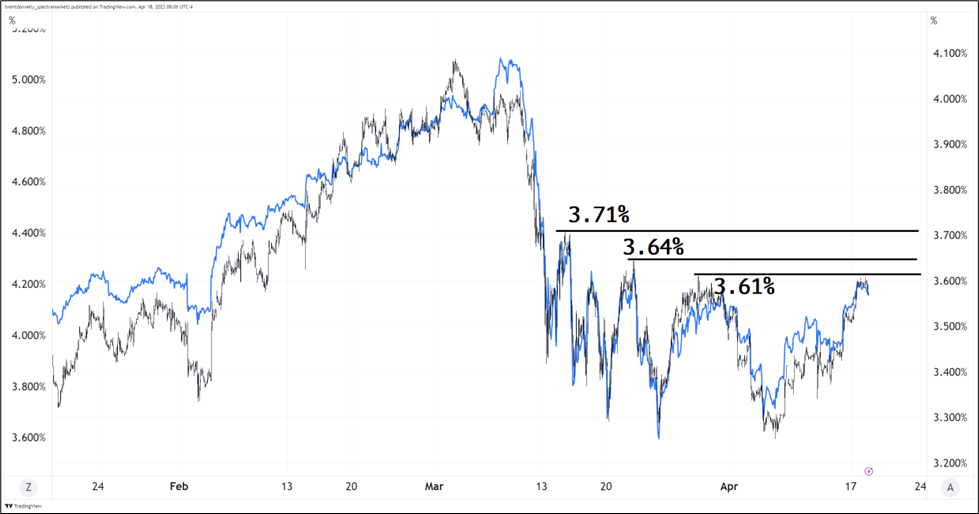
The chart shows the last three lower highs in 10’s and I don’t think we get through those. That is, I think the worst case for higher yields would be 3.71% in 10’s, but we may have just touched the highs as the front end is going to have a tough time pricing anything more and the reality of tighter US lending standards is still humming in the background even if there is no systematic crisis in the US banking system.
As mentioned yesterday, I think USDCAD is ripe for a correction as the consumer debt story there refuses to unfold as the Canadian jobs market remains robust. Below, I show the current state of CAD positioning on the CFTC.
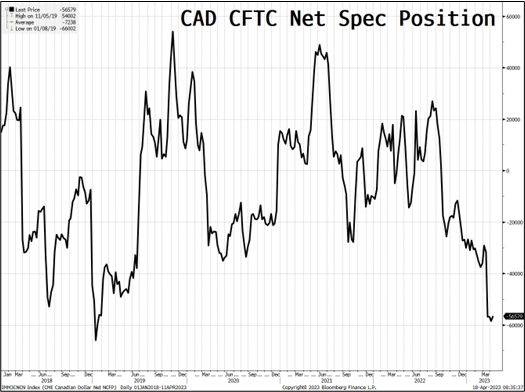
It’s worth mentioning here that CAD, AUD, and NOK have been trading very poorly relative to what one might expect with VIX down here and SPX up here. On the other hand, CFTC positioning in AUD is nowhere near extreme so perhaps CAD has a better chance of catching a bid.
My base case from here is that the USD continues to grind lower and FX volatility contracts until we get something new to chew on.
Gold
I understand that gold is a good hedge against increasingly unorthodox fiscal and monetary policy in the big picture and it has traded incredibly well despite the collapse in M2. The rise in M2 was the reason many got long gold in 2020 and yet now M2 is collapsing and gold trades fine. And I understand that central banks are buying gold. That’s all fine for investors who are HODLing for the big picture. But short term, I would be nervous.
Two observations:
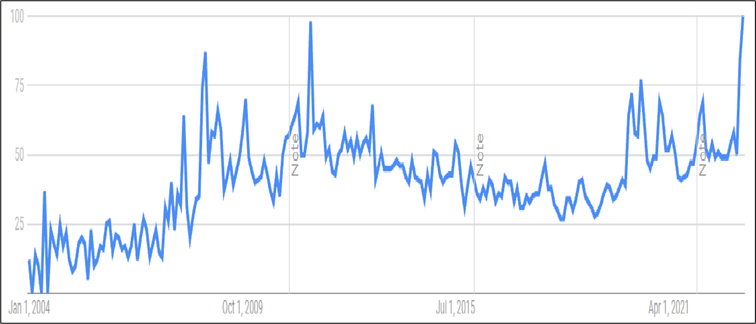
1. Google searches for “how to buy gold” are as high now as they were when gold peaked in 2011:
Searches for “how to buy gold” indexed/normalized by Google, 1 to 100
2. Potential triple top at 2075. This year, the high has been $2047.
Spot gold, 2018 to now
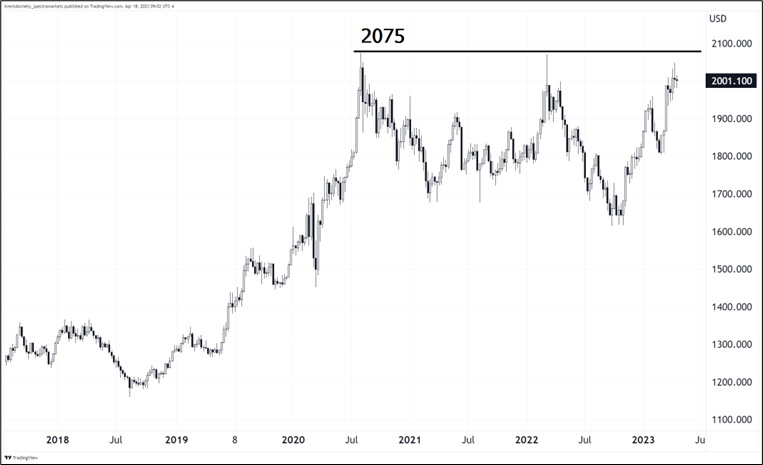
Even though it is a bit counterintuitive, I would feel more comfortable long gold above $2100 than I would feel long here. There is a bit of a retail frenzy happening in gold and that would make me nervous about trading from the long side 70 bucks ahead of the all-time high which capped and firmly rejected in both 2020 and 2022.
Lagarde summarizes the current state of play in ecogeopolitics
Christine Lagarde presented her thoughts on the world after the Russian invasion of Ukraine. Most of the points are somewhat obvious, but it’s an excellent summary of everything that has been going on since March 2022. Full speech here. GPT-3 summary:
In a speech at the Council on Foreign Relations C. Peter McColough Series on International Economics, Christine Lagarde, President of the European Central Bank (ECB), discusses the impact of a fragmenting global economy on central banks. Lagarde highlights the shift of the geopolitical tectonic plates and the potential coalescing of two blocs led by the two largest economies in the world. She suggests this could lead to more instability due to the weakening of global supply elasticity and more multipolarity as geopolitical tensions increase.
Lagarde notes that the fragmentation of the global economy could have far-reaching implications for central banks, particularly leading to lasting instability resulting in lower growth, higher costs, and more uncertain trade partnerships. Governments are now legislating to increase supply security, but this could accelerate fragmentation as firms adjust in anticipation. The changes suggest that a second shift in the central bank landscape is taking place, making the world more multipolar.
Lagarde further explains that new trade patterns could lead to new alliances and create opportunities for certain countries seeking to reduce their dependency on Western payment systems and currency frameworks. She concludes that central banks will have to adjust to these changes to maintain stability in the face of a fragmenting global economy.
Have a green day.
good luck ⇅ be nimble
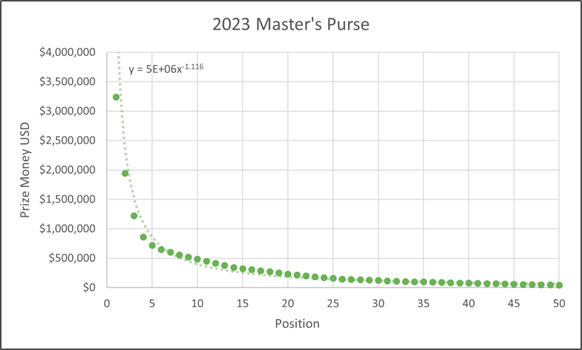
If you’re in fifth place, you should take way more risks than if you are in second place.