
160 is calling


Subscriber-only
Brazil, Canada, yen
A sort of almost unbelievably large move in Brazil. Plus: Short CADJPY.

160 is calling

02JAN26 EURSEK 10.87 put
25bps off 10.92 spot
Medium-term
03FEB26 USDCNH
Put Fly 6.98/6.88/6.78
1X2X1 for 15bps (7.0565 s/r)
The Bank of Japan continued its campaign of ultraloose monetary policy and the market responded in kind by immediately depreciating the yen and selling JGBs. The Japanese authorities have failed to offer a credible response to inflation and the market has taken this as a green light to push the trends.
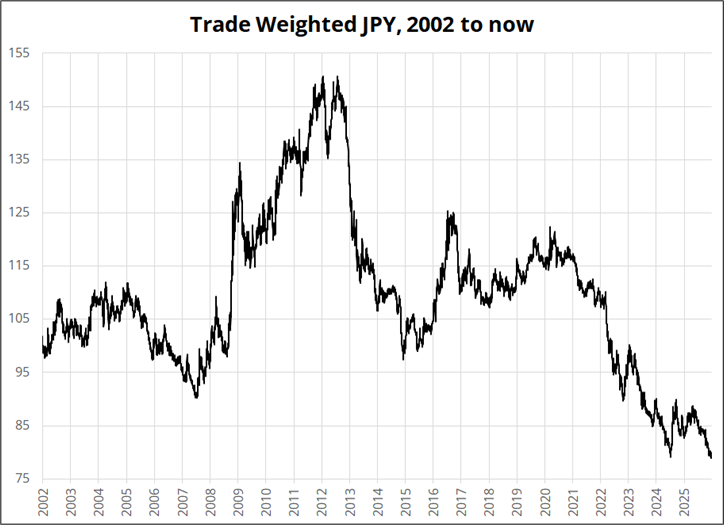
Based on the usual metrics (Kanda rule, 4-week change, 6-week change) we are nowhere near intervention levels. Those rules come in around 161/164 right now, though it’s worth mentioning that the July 2024 intervention was more about levels than speed as USDJPY hadn’t gone up all that far, that fast when the MOF intervened that time. I suppose we have open air to 160/161 then we go on high alert if we believe that this administration will follow the same rules as past admins.
Then again, if the Takaichi government is attempting to violate the trilemma, they could intervene sooner. USDJPY strength is bleeding through to the other pairs and AUDUSD is breaking hearts again. We are slowly creeping towards the 1.1620/50 support zone in EURUSD, there is no rush.
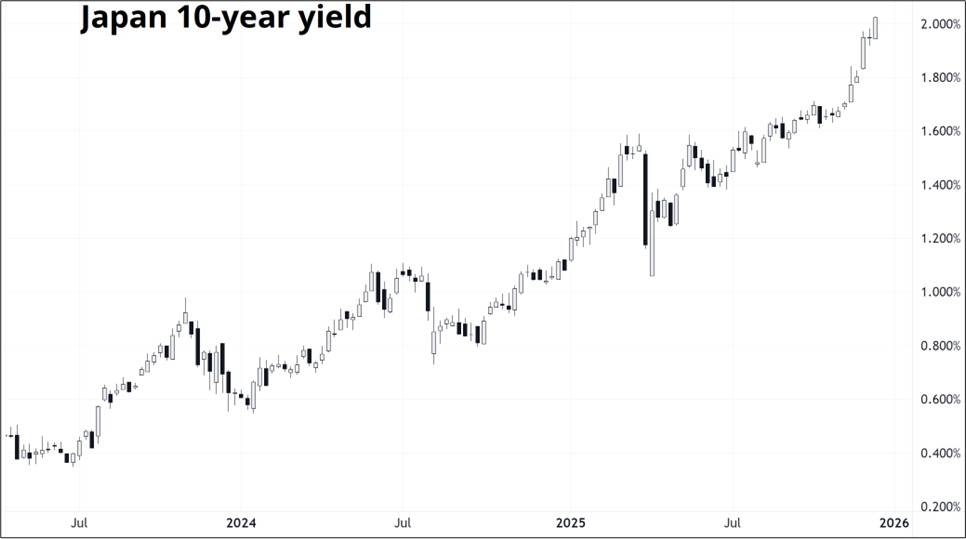
Japanese yields are on the move again, and while it feels a bit scary or unstable at times, it’s kind of amazing how methodical it’s been.
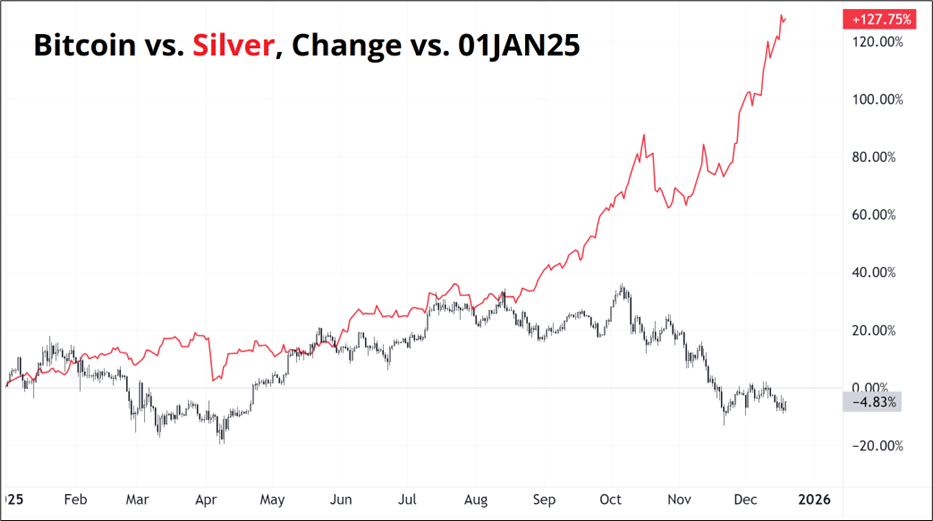
As we near the end of 2025, it’s amazing to think of all the bullish catalysts the consensus saw for crypto at the start of the year and yet bitcoin is on track to close negative for the year while silver is up 127%. Forecasting is hard.
I believe in seasonality for a variety of reasons, all discussed here. To me, it’s not a matter of belief, really. Just a matter of empirical evidence stacked up over years and years and direct experience trading flows that are timed around particular days of the month, etc. It is by nature probabilistic. Flows create a directional bias in the market but that bias can be blown to smithereens by news, larger flows, or any variety of shocks. 2025 has been a bad year for seasonality, partly because of the ongoing series of shocks, and partly because of variance. I find it mildly interesting that the seasonality trades we track have turned the corner and the YTD is almost back to flat.
We started the Trader Almanac in 2023 and the trades in there did very well, as did the trades in the 2024 Almanac. These are obviously real-time out of sample trades predicted in advance as the handbook is published in October of the prior year. Here are the results of the trades for the past three years.
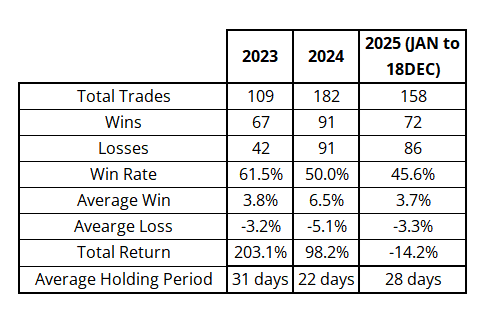
These are not vol-adjusted and there is no stop loss on the trades so these are raw figures and trading them in real life requires a risk management process. I do believe the raw data tells you pretty clearly whether or not the signals are working. If you’re wondering why so many more signals in 2024 and 2025: We just added more products to make the sample size bigger and the Almanac more useful.
In case you’re curious, here is the raw P&L for 2025, as of today.
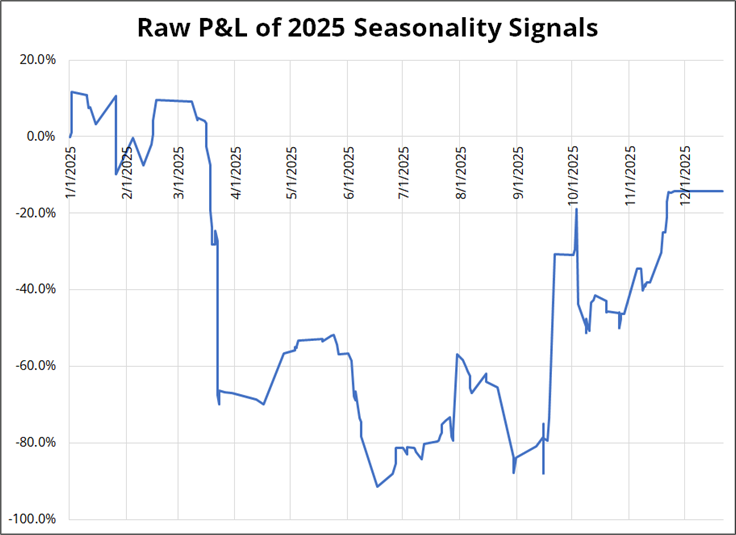
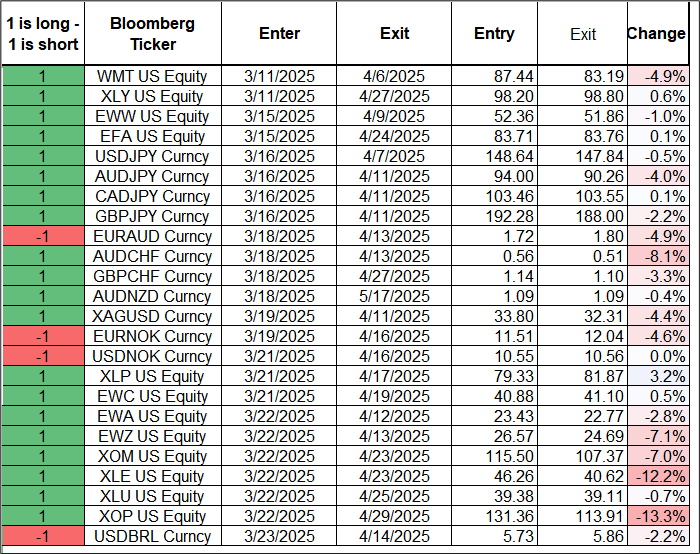
This is a prime example of how a macro shock can destroy a systematic strategy, especially one that is run with no stop losses. I don’t trade the seasonals systematically—I use them as one of many inputs into my discretionary process. In this case, I’m simply showing the chart of the P&L because I think it’s an excellent example of how seasonality can be disrupted. A massive macro shock is a tsunami compared to the gentle probabilistic seasonal flows. If you’re curious, here are the trades that got rekt in the March/April period. Long energy and long risky currencies. Yuck. Normally that rightmost column would be a mix of medium sized green numbers and smaller red numbers.

Have an artistic weekend.

I found this documentary inspiring, entertaining, and uplifting.
A rare win for art over the soul-sucking agents of capitalism and bad urban planning.
Art for art’s sake. Yay!
A sort of almost unbelievably large move in Brazil. Plus: Short CADJPY.

NZD has a bunch of bullish kickers: Election, seasonality, and inflation
