Waller is on his own, the Japanese election is underhyped and two trading tips
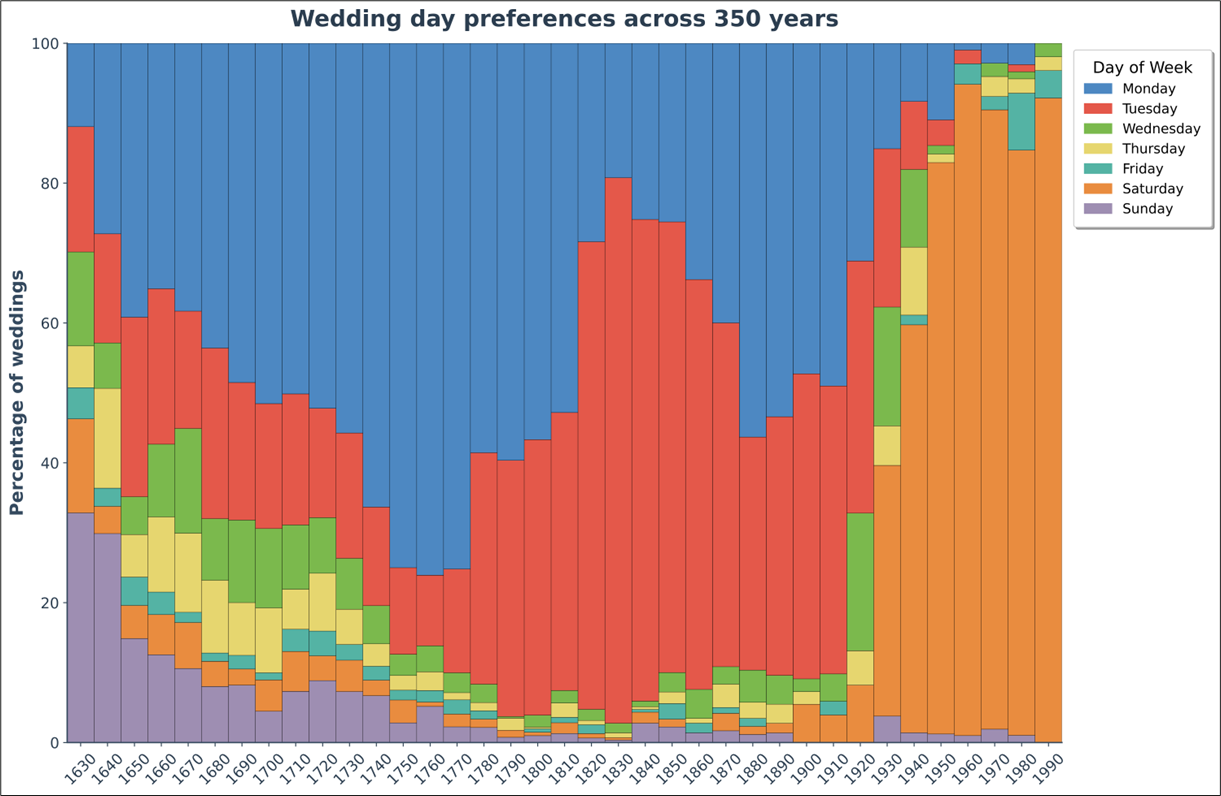
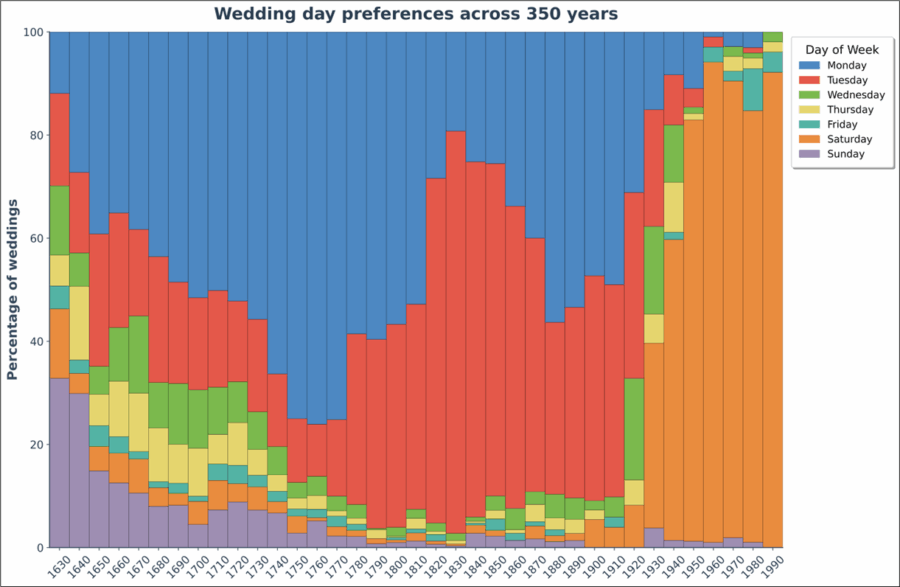
The most common wedding days used to be Monday and Tuesday.
Larger version at bottom of page.

Waller is on his own, the Japanese election is underhyped and two trading tips

The most common wedding days used to be Monday and Tuesday.
Larger version at bottom of page.
Flat
Waller cannot get any new joiners on Team Rate Cuts Now as hard data doesn’t support a cut, the inflation trajectory is unknown, fiscal deficits are expanding like there’s no tomorrow, financial conditions are loose, r-star is procyclical, and NASDAQ, SPX, and crypto are at or near all-time highs. One by one the Fed speakers are saying “no” even as he continues to say “yes”. Even Waller now all but admits there is no reason to cut rates urgently and has turned to framing it as insurance. All these quotes from yesterday show the one vs. all battle going on.
*WALLER SAYS FED SHOULD CUT RATES BY QUARTER POINT THIS MONTH
*FED’S WALLER: NOTHING WRONG WITH TAKING OUT AN INSURANCE CUT
*FED’S KUGLER: APPROPRIATE TO HOLD RATES STEADY FOR SOME TIME
*KUGLER: MANY REASONS TO EXPECT LARGER TARIFF IMPACT COMING
*FED’S DALY: IMPORTANT TO NOT LOWER RATES PREEMPTIVELY
*WILLIAMS: RESTRICTIVE FED POLICY STANCE IS ENTIRELY APPROPRIATE
*FED’S WILLIAMS: RESTRICTIVE STANCE ALLOWS TIME TO ANALYZE DATA
*BOSTIC SAYS RATE CUTS MIGHT BE DIFFICULT IN THE SHORT RUN
That’s the current state of play. Waller, Warsh, and Trump (and Bowman) want lower rates. Everybody else wants more data. It’s going to take a long time to get the data.
Usually going into an event like this weekend’s election in Japan, people would be freaking out and buying vol and everyone would generally see the same tail risk and so lotto tickets would be sold out at all the FX option kiosks. This time, 1-week JPY vol is high but not crazy and while there is a medium strength consensus that the LDP will get smoked, it does not seem to be priced in. I think buying Wednesday 150s will be a good trade, but I can’t quite get myself to put it in the sidebar because the seasonality of USDJPY is so bearish for the second half of July. Still, I like the trade but view it as 3 out of 5 stars.
While the election results drop on Sunday, and you could therefore buy Monday USDJPY options instead of Wednesday, Matt Gittins gave me a good tip once a few years ago: If you’re buying short-dated options, always buy at least one more day than you were thinking you should buy. The price of the extra days is tiny compared to the cost of the first one or two.
Here, e.g., is the cost, in bps, of a 150 USDJPY option of various short durations:
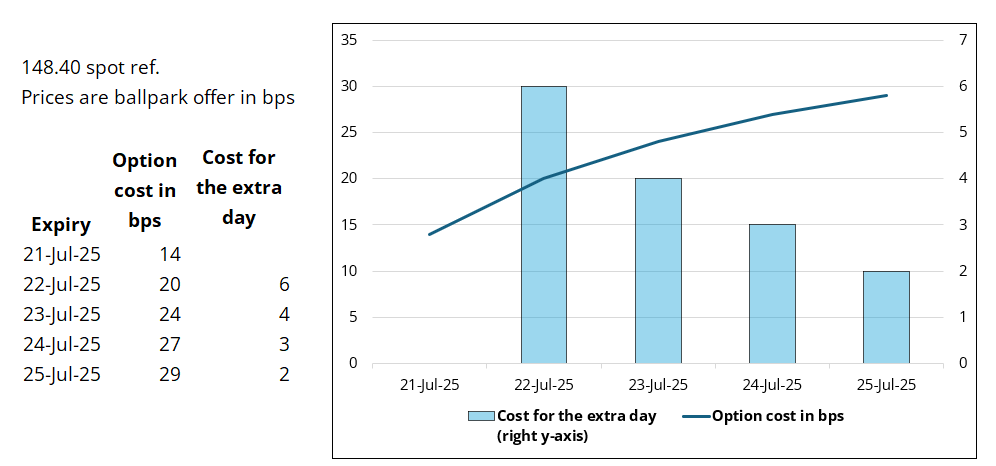
Options professionals understand the non-linear increase in short-dated options prices, especially over events, but I did not always have a good handle on this! The second day relative to the first day is particularly attractive as overnight options are not even good for 24 hours and this particular “overnight” contains a weekend.
The sweet spot here is Wednesday 150s at 24bps. Note these prices are ballpark and could change, but you get the idea. Quite a lot of punters want to fade USDJPY 150/151, though I can’t really understand the logic. I feel like people have been stuck in a sell USDJPY mindset for ages, long after it was clear that there is no rotation to JGBs and the cyclical story in the United States is not rolling over.
Sometimes people will say: “I like Australia’s fundamentals because of XYZ and I think Canada is in trouble, so I am going long AUDCAD.” This fails to account for the fact that AUD is much more volatile than CAD and therefore AUDCAD is simply an AUDUSD trade most of the time. If the USD rallies, you’re probably going to lose money on your AUDCAD, regardless of relative economic performance AU vs. CA. Much like you wouldn’t go short 200 shares of MSTR and long 200 shares of AMZN as an RV trade (because they have different volatility profiles), you can’t just go short AUDCAD or long CADMXN to play a cross-country RV game.
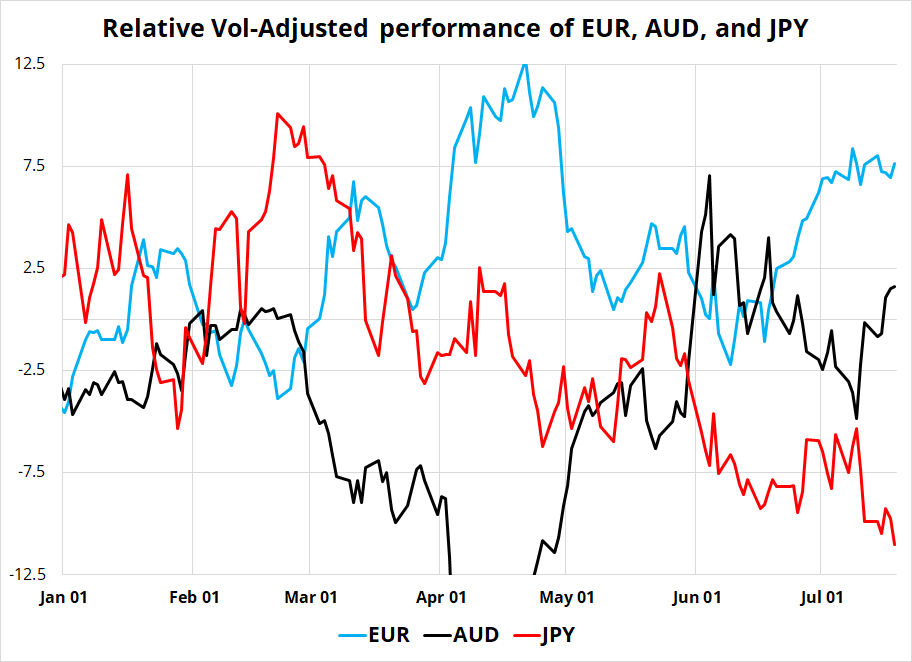
Similarly, when trying to assess how a currency is doing relative to peers, you can’t just flip through the cross charts and get the answer. If I want to know if AUD “trades well” or “trades poorly” vs. peers, I need to vol-adjust AUD and its peers and then compare them. I created a spreadsheet that tracks the daily moves in the currencies, normalizes them, and then compares them to peers over the past 40 days. This is a good way to track whether, for example, AUD is trading well relative to EUR, CAD, JPY, etc. For the list of peers, I used all the majors including SEK and NOK.
If you plot all the currencies on the same chart, it looks like Kellogg’s came out with a Froot Loops brand of spaghetti, so below I show just three currencies. I think it’s interesting.
HT Habibi
AUD traded poorly against its peers through Liberation Day (which I guess makes sense) and then traded horribly in June again for reasons nobody could understand. The takeaway for me here would be that AUD trades pretty well against its peers of late, which could be a signal that Aussie supers are finally starting to get busy. Or not.
A turn in the JPY relative performance (red line) would be a useful signal that maybe Japanese Lifers or GPIF are finally FINALLY switching into JGBs. We did get a glimmer of this possibility today:
*FUKOKU LIFE TO BOOST SUPER-LONG JGBS, MAY SHIFT FROM ABROAD
Team Japan rotating from foreign bonds to JGBs is the dream scenario for JPY bulls, but I will believe it when I see it in the price. I will track this relative performance indicator, plus JPY in Japan time zone price action, and headlines to see if we ever end up in a world where this is a tradable theme.
Have an infinitely loving weekend.
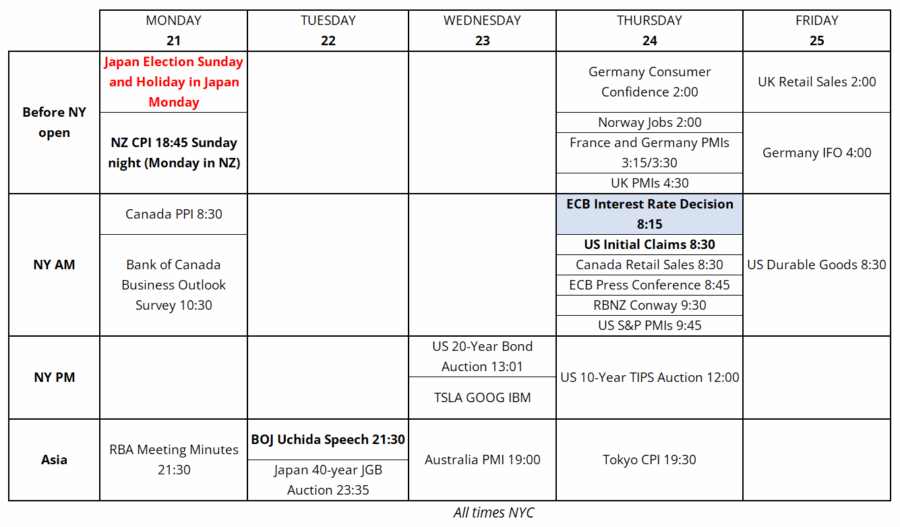
Trading Calendar for the Week of July 21, 2025
The most common wedding days used to be Monday and Tuesday.
In ye olden days, Saturday was market day and Sunday was church day, and everyone from all the rural zones was in town, so it made sense to hold weddings Monday or Tuesday when people were already going to be in town.