Nothing to see here on NFP, folks. Move along.
Hello. It’s Friday. Thanks for signing up. I’m Brent Donnelly.
The About Page for Friday Speedrun is here.

Nothing to see here on NFP, folks. Move along.
Hello. It’s Friday. Thanks for signing up. I’m Brent Donnelly.
The About Page for Friday Speedrun is here.
Here’s what you need to know about markets and macro this week
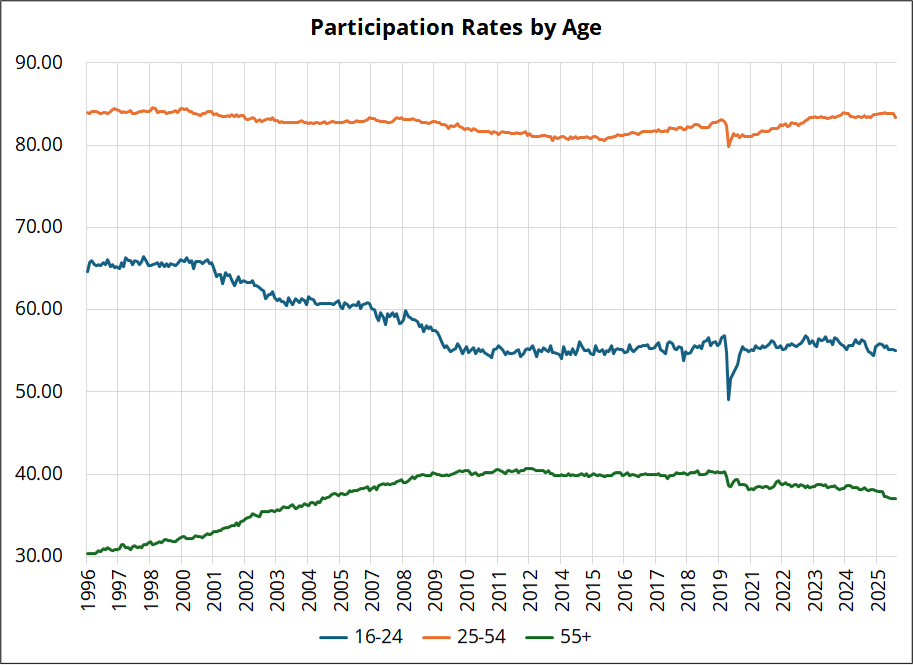
The week ended with one of the more convoluted nonfarm payrolls releases in quite some time as we saw negative job growth, negative revisions, lower hourly earnings, but also lower unemployment. This is what happens when there is falling labor supply and falling labor demand at the same time. The no hire / no fire jobs market that has been in force for ages continues to be the labor market regime today.
I am skeptical of any meaningful takeaway from this collection of digits. I suppose it shows that old people continue to retire and there is a mild shrinking of both supply and demand for labor at the same time.
You don’t have to think very far back to find a similar NFP release to today’s. The February numbers were similar. NFP missed and went negative (-92k vs. +55k) while the UR missed on the strong side (4.3% vs. 4.4%). Yields did nothing that day (similar to today) then went straight up due to war and other factors.
There is no useful information in today’s NFP report. It’s a noisy mess, just like the February 2026 report. To be clear: I do not mean to say this report is going to send yields higher like last time. I am just saying it’s irrelevant and will be completely forgotten by Monday.
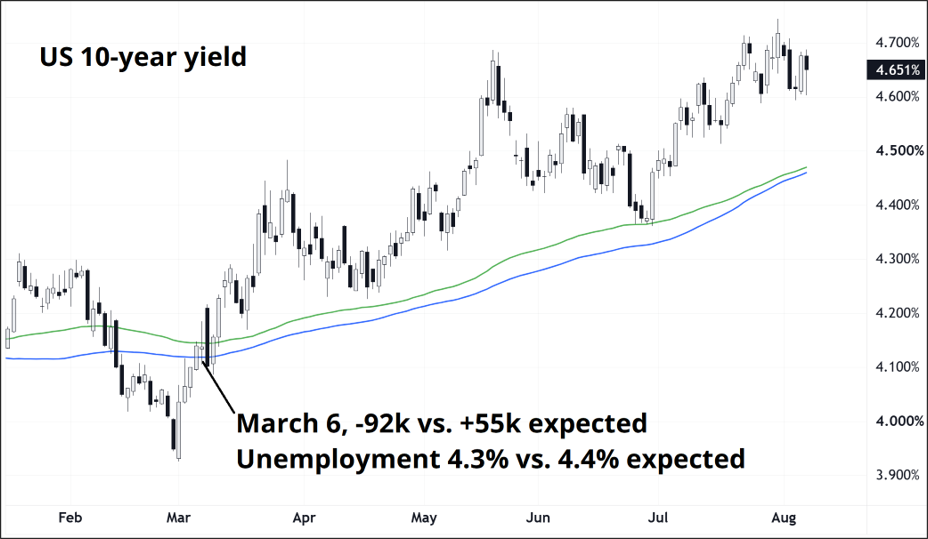
Yes, I know there was a war after that payrolls release. My point is simply that there are larger, more important factors that will immediately dwarf this NFP report. CPI next week, for example.
Warsh’s stated preference is that he wants us to believe he is an inflation tiger, while his revealed preference is similar to that of Yellen and Powell, i.e., lamblike. Talk tough / do nothing. 3% is the new 2%. Et cetera.
We super totally promise to get inflation to target in the next two years.
Outside of the U.S., the macro world was fairly quiet as Canada continues to rebound from the depths of a pretty ugly real-estate-induced slowdown, New Zealand jobs data was mixed like the U.S., and Japan really really wants the JPY to stop depreciating.
There was some potentially important news this week in the world of AI, but because the media always overplays negative news and buries bullish news, it didn’t get much airtime. The news was:
DeepSeek is raising prices significantly
This should take the edge off the “LLMs are a commodity and prices are going to zero” hypothesis at the margin. The commoditization and race to zero view is my base case, but it’s reasonable to say that if DeepSeek is raising prices considerably, the Bayesian in me should lower my odds of OpenAI going bankrupt. That’s probably good for ORCL, NVDA, and others just like the emergence of DeepSeek was bearish for those things. Because this DeepSeek news is bullish, it is underreported relative to the DeepSeek or Kimi K3 freakouts. Bad news gets clicks and good news doesn’t. Always hunt for bullish news items in the constant flood of bad news and rising stock prices.
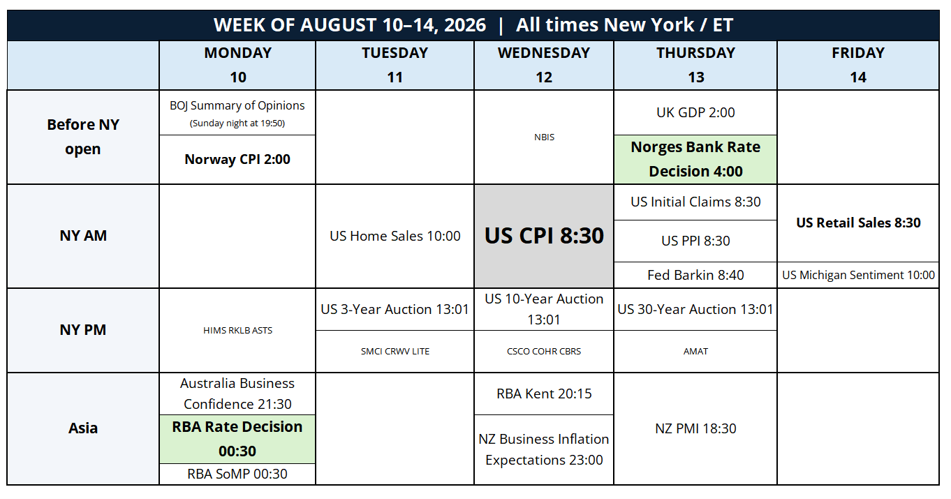
Next week’s calendar:
The Situational Awareness stop out was the low and while it looked for a few hours like the market was freaking out about dovish Warsh and the bond selloff on FOMC day, it was really just a flow story. When the flow stopped, stocks bottomed, and then exploded higher.
When we were in the depths of despair a few weeks ago on the back of more bad news on bond vigilante concerns, tariffs, and Iran, I wrote a Friday Speedrun called : It all sounds familiar. The premise was that familiar threats are not as scary as new threats and so the second or third run of the same old news flow is never going to create a lasting bear trade like the first run might. As this banner said:

Stocks went another bit lower after that on the Situational Awareness selling but then made a V-shaped bottom. This is an important concept in markets and also explains why many attempts to sell the Great British pound on fiscal fears after the Truss debacle in 2022 have not worked out. The first time something happens, it’s scary. The third time it happens, it’s not. That’s just how humans work and how markets work.
There are two important exceptions to this rule: One, when Jason comes up out of the lake at the end of Friday the 13th. That’s scary every time. And two, the entire Children of the Corn movie. Terrifying every time.

I make plenty of bad calls and I often write about them, but I did make a nice call on SPCX this week. It could not have traded more textbook than it did around the lockup release. The low print was literally 9:30:00 on the open on end of lockup day. That is textbook inefficient markets for you right there.
Here’s what I wrote in am/FX on Wednesday:
—
excerpt
SpaceX priced its IPO on June 11 at $135 a share. The IPO sold 556 million shares against roughly 13 billion shares outstanding, so only 4.2% of the company was available to trade. August 6 is the first major release. Up to 912 million shares held by employees and early investors are unlocked tomorrow, roughly 1.6X the existing public float. Further tranches free up regularly from now until December and then Elon Musk’s 6.4 billion shares unlock June 2027. The tension is between these bearish facts and the fact that everybody knows these facts, and everybody knows that everybody knows these facts.
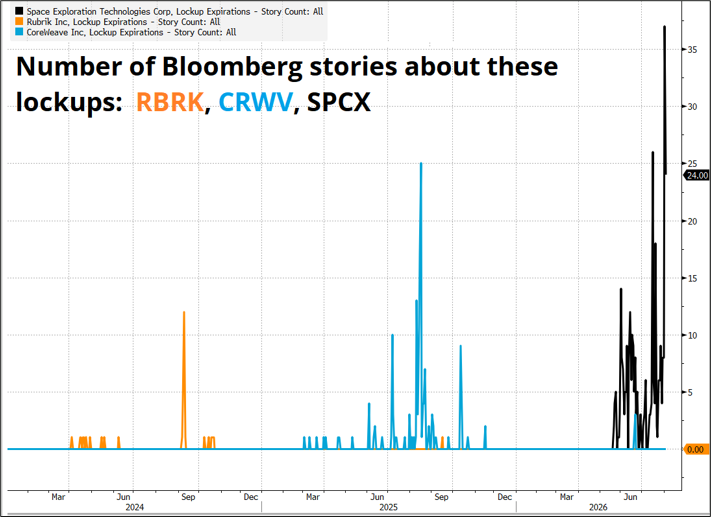
As a non-expert spectator, the three lockups I remember most vividly are CBRS, RBRK and CRWV. There was a fair bit of media attention around those, and you can see that SPCX dwarfs CRWV which dwarfed RBRK (CBRS didn’t register on this measure). Taking a look at those stocks, you can see that the lockup day was a tradable bottom, but the turn was not V-shaped.
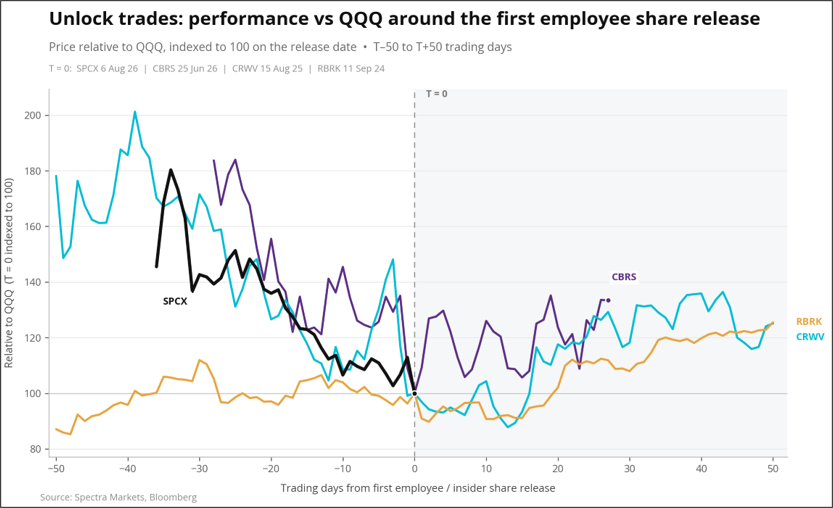
That chart shows the stocks indexed to t0 = 100 where t0 is the lockup expiry. t0 for SPCX is tomorrow. Obviously, n=3 isn’t going to take anyone to the promised land, but the analogs are decent here. And I suppose my starting point is that this information is surely priced in at this point and the imminent supply shock is more likely to be a red herring than a useful bearish indicator at this stage. I suppose if you use the other three stocks as a rough guide, you could hope for a 20% rally in SPCX in the next 20-40 trading days. We are $111 right now, so that would mean you target something up around $133, assuming we are still here tomorrow. You can stop out below the round number of $100 (stop loss at $96.44 to give it a bit of room, let’s say).
I have no view on the underlying business. I believe the best lens for TSLA and SPCX stock is to think of them as memecoins—there is no rational valuation anchor. They are bets on hopes and dreams. This is not a sarcastic comment. Sometimes hopes and dreams come true! Using DCF or anything of that sort to study these stocks is a waste of time. My view here is simply that a supply shock is priced in and the market is ready for it. A relief rally is due. Not investment advice.
end of excerpt
—
When I say SPCX is a memecoin, I don’t mean it’s going to zero. I just mean that the underlying business is almost completely irrelevant to the price of the stock. There is no DCF or valuation to consider when trading it on any time frame under ten years. It’s a sentiment barometer reflecting investor excitement about AI and space. The performance of the underlying business is a rounding error.
Here is how it played out:
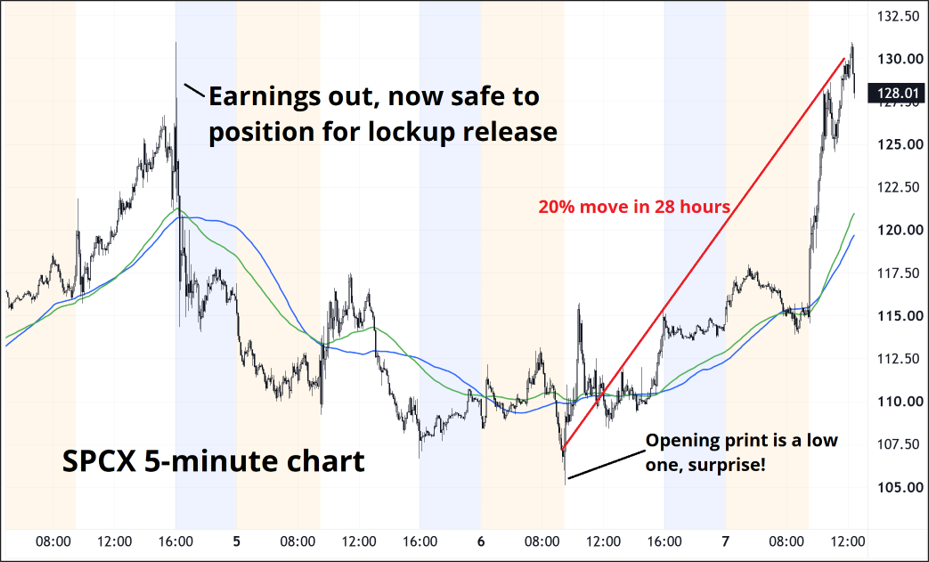
Why does this potentially violate strong-form EMH? The turn could be called in advance (by me, and others) and happened on a publicly pre-announced date. An efficient market wouldn’t leave a scheduled, universally known supply event to be arbitraged at the opening bell — it would discount it beforehand and leave no clean entry. A repeatable edge at a known timestamp is the definition of inefficiency. Lockup-expiry drift and index rebalancing are documented anomalies. This trade was so textbook, it was almost easy, but normally these trades chop around much more before shooting higher and that’s what makes them harder to monetize and risk manage. Very few trades are easy, otherwise cavemen would do them.
Sorry, Maurice.

While most of my ideas are more macro than this, and very few work out this well so quickly, you can subscribe to am/FX and get this stuff in real time instead of hearing about it after, when it’s no longer actionable.
Speaking of marketing and how I feel very uncomfortable doing marketing but still have to do marketing if I want to get the word out and have people consume and enjoy my work…
Sign up for am/FX right here:
https://www.spectramarkets.com/subscribe/

I grew up reading Adbusters and Naomi Klein. It’s very hard for me to do marketing.
Here is this week’s 14-word stock market summary:
Dovish Fed, fine growth, forever war, corporate earnings yay, don’t short a dull market.
The Fed’s reaction function is a bit unclear right now and so the market has decided to leave September close to 50/50 and let the data decide. Today’s NFP moved the needle a bit, and CPI is probably the most important release. Then again, we get a whole ‘nother slug of data in September before the FOMC finally meets on September 16th and there could be more or fewer wars going on in the world by then and U.S. GDP could be 6% or 3%. Atlanta Fed’s opening bid for Q3 is 5.9%. Not a weak economy!
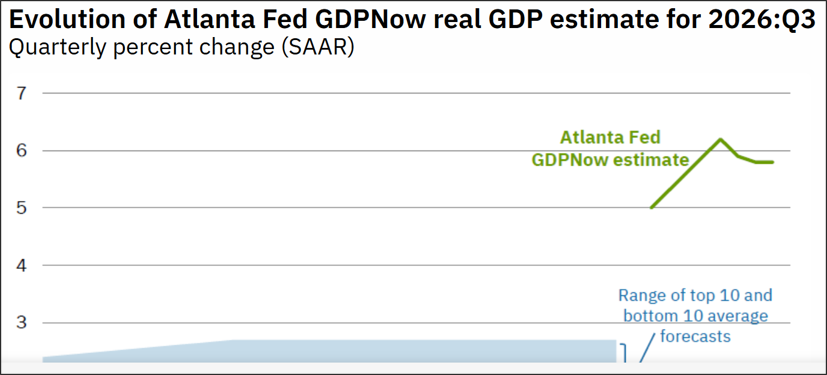
Early on in the sampling period, Atlanta Fed GDPNow will be far off and then it slowly gets more and more accurate as the GDP release date nears. Still, for it to open at 5.9% is rather spicy.
US 10-year yields peaked at month end, while 30-year JGB yields and 10-year yields in the UK both peaked in May. The worst fiscal sinners (according to common knowledge, at least) are under a bit less pressure as yields either top out or consolidate before the next move up. It’s not uncommon for me to have no view on yields, and right now that is the case.
Fed pricing at 50/50 is hard to argue with and while growth is strong right now, fiscal and AI Capex stimulus probably both peaked in Q2 of this year and so it’s reasonable to start wondering if 2027 brings slower growth. I haven’t heard anyone utter the word recession in a long time, so maybe 2027 will wake the economic permabears from hibernation.
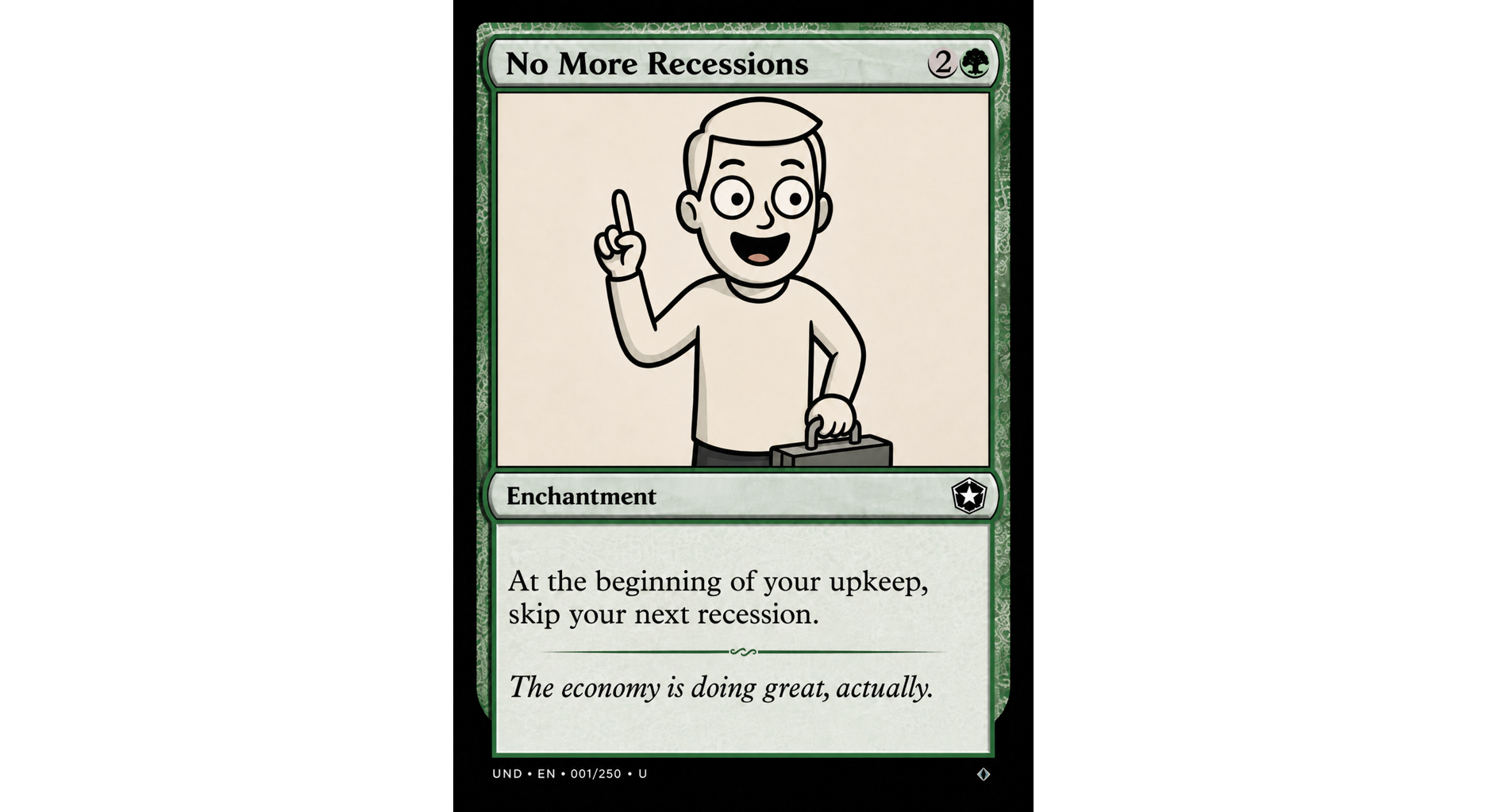
For now, we are at an all-time low for number of stories containing the word “recession” on Bloomberg. Data goes back to 2016 only. It’s amazing to think that if you don’t really start in markets until you are age 20 and the last real economic recession in the United States was 2008… You gotta be pretty old to have traded through a recession.
Mr. Donnelly, please select your age range: ☐ 21-30 ☐ 31-40 ☐ 41-50 ☒ Old AF
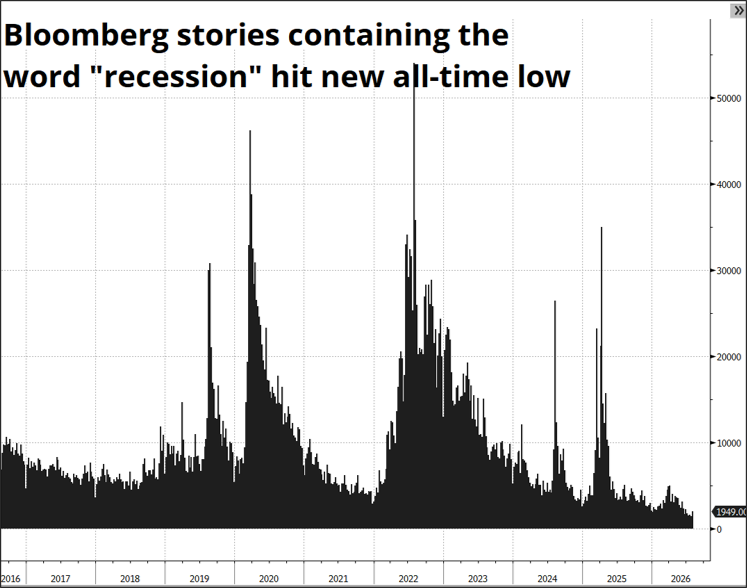
2022 is a great example of how just about everyone got everything wrong. The starting conditions in the U.S. (rate-locked mortgages, huge excess savings, healthy corporate balance sheets) meant rate hikes were either neutral or modestly stimulative. This is why economics is hard. If you could just look at the yield curve and wait for it to invert and then step aside for the recession and reinvest when things are at their worst—it would be so much easier. But every cycle is different.
So, while it’s tempting to think that the AI capex bubble will lead to a tech meltdown like 2000 or a financial crisis like 2008, it will probably lead to some other nasty endgame. That said, whatever nasty endgame emerges, we know exactly how that endgame ends: More fiscal and more monetary stimulus. That part is inevitable, but how we get there is hard to predict.
USDJPY moved last week but didn’t do much this week as the market reassesses its confidence in the intervention narrative.
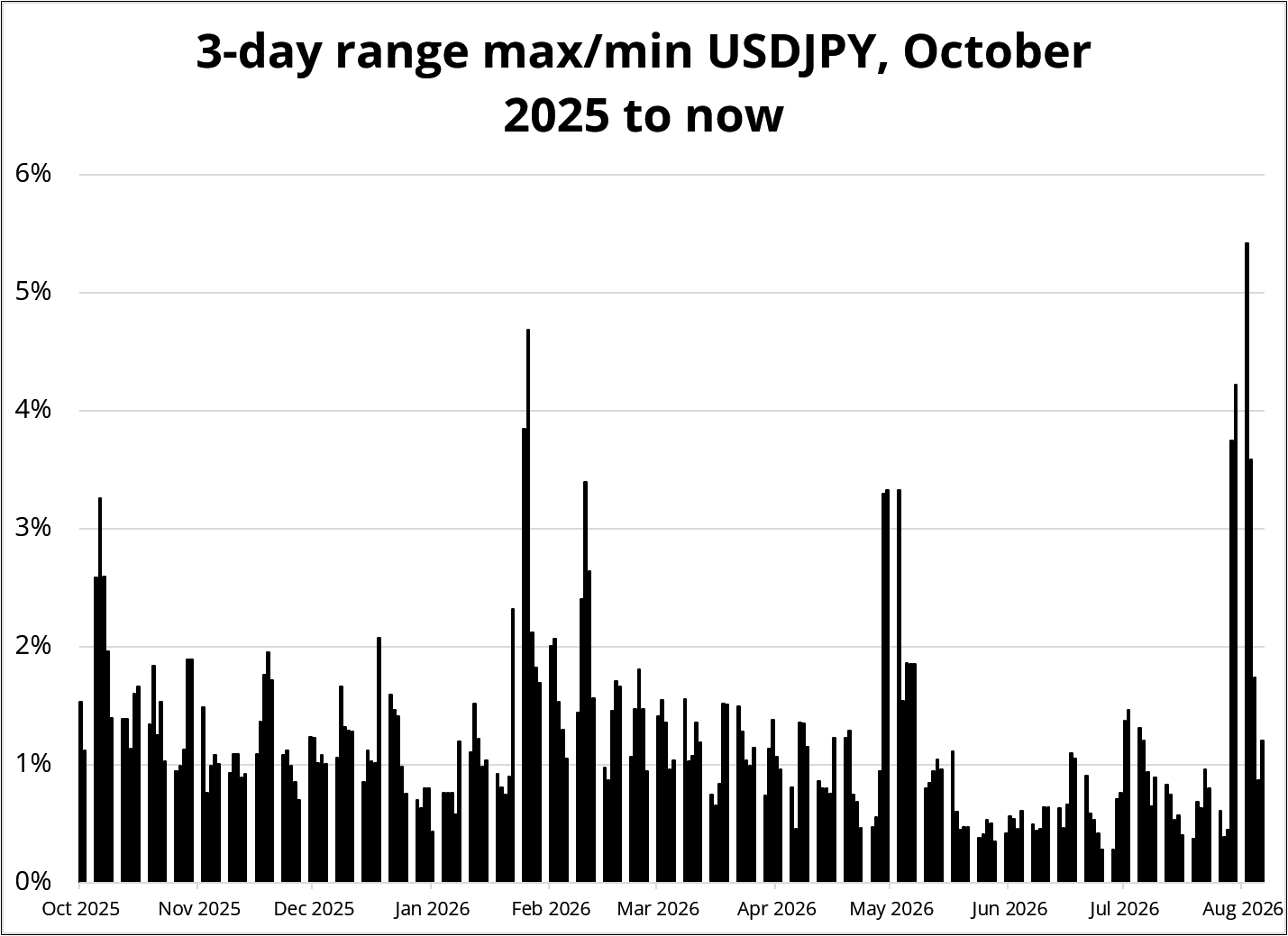
You can see that after the huge flurry of volatility post-intervention, the market settled down quite quickly and enforced a 155/159 range. Normally, coordinated intervention is a major deal for currency markets, but it does not always turn the ship right away. In 1998 and in 2011, coordinated intervention worked eventually, but there were months if not years of back and forth before the desired turn in trend finally went the authorities’ way.
Further complicating the situation here is that a good chunk of the market views the U.S. Treasury Secretary as not fully credible. He came in on the wings of a strong hedge fund reputation, but the halo has dimmed over time because:
He repeatedly cites lower back-end yields, lower deficits, lower inflation, and lower crude oil prices as goals or hopes and yields, deficits, inflation, and crude oil prices all keep going up, not down. Obviously much of this can be blamed on wars and tariffs, but he is a key man in the administration launching wars and tariffs.
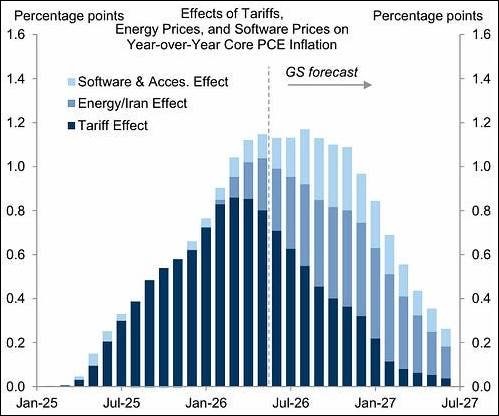
War and tariffs are inflationary, who knew? Chart from GS via Talmon Smith, NYT
He wrote “Buy Japanese Yen (JPY) $5 – 10 bil” on a notepad to spoonfeed reporters.
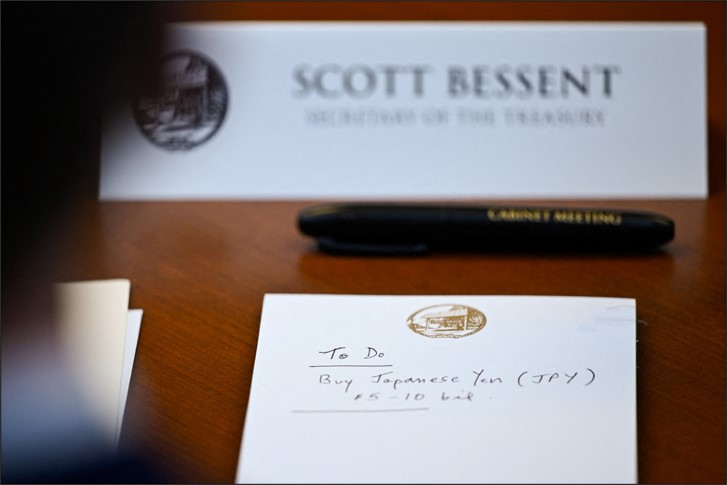
No knowledgeable currency trader would ever write this. He is spoon-feeding reporters in what seems like an attempt to be clever but ends up looking unserious. The only way this could have been worse is if he wrote “intervene in the forex market!” Furthermore, $5 – $10B is peanuts in FX. Again, Bessent knows this—he’s traded USDJPY many times before as a hedge fund manager—so either the whole thing is a joke/troll, or the U.S. is not committing serious firepower to the intervention effort. Either way, not great for credibility. Then two days later, Bessent went on a tirade against a respected journalist, accusing the journalist of being spoon-fed by U.S. authorities in the past. This is two days after Bessent himself was spoon-feeding journalists. Okie dokie.
The explanation for selling EUR and buying JPY is that they were switching reserve composition. U.S. FX reserves are tiny. If this is what their approach is going to be, the market will not take it seriously. Again, not super credible.
The White House asked the Fed to do a USDJPY rate check in late January at 153 then let it fly to 163. They already wasted some credibility there and credibility is hard to win back.
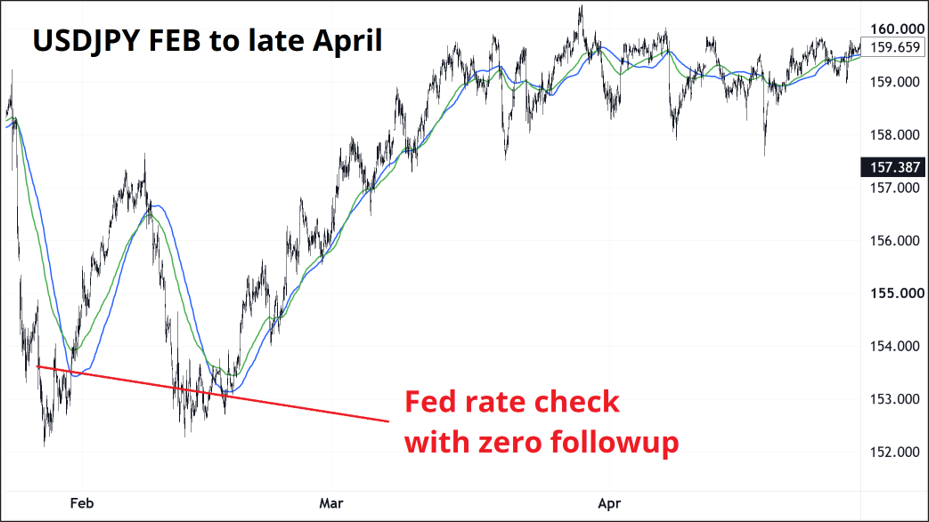
Trump wants lower oil prices and lower front-end interest rates, Bessent wants lower deficits, lower back-end yields, and lower USDJPY. Four of the first four of those things went higher. The fifth is TBD.
Zooming out a bit, I still think the combination of Japanese MOF, GPIF, BOJ, and U.S. Treasury means that the right tail in USDJPY is truncated. But I think you can probably make money trading from both the long and short side in USDJPY going forward. 155/159 for a while then maybe 152.50/160.00 on the wide. And if you are a long-term investor, I sincerely believe that long JGBs, unhedged, will be an incredibly high-Sharpe trade. Not investment advice.
My new book is out:
TRADE OUTSIDE THE BOX: Advanced Thinking for Professional Traders You can buy it on Amazon right here. Here’s the one-pager.

The book is written for experienced traders. If you are new to the game, I would suggest you start with Alpha Trader. If you have been trading or investing for more than five years, this book is for you (and you don’t need to have read Alpha Trader to enjoy it).
I’m waiting for late September to get long crypto. For now, it’s boring.
The following sentence is more or less accurate until further notice.
MSTR is $100, bitcoin is $64,000, ETH is $2,000.
Gold and silver decided they were bored of doing nothing and so they got in the car and drove north this week. The move is easy to explain in hindsight, but the timing was quite random. I have been bullish gold three times since June and gave up all three times (I am a trader, not a buy and holdooooor) as the thing could just never achieve liftoff or react well to good news. This week, there was essentially no news, but the metals just bolted anyway.
It’s been a pretty good setup for a while, with sentiment blown out, options markets bid for puts, a dovish Fed, and the rebound in other risky assets. Now, the price action is cooperating and maybe they are off to the races. One word of caution, though, is that after a bubble bursts, the following rallies tend to be a bit uninspiring, so if you’re long precious, I would not be too ambitious on the TP.
However you draw triangles, this one has broken out:
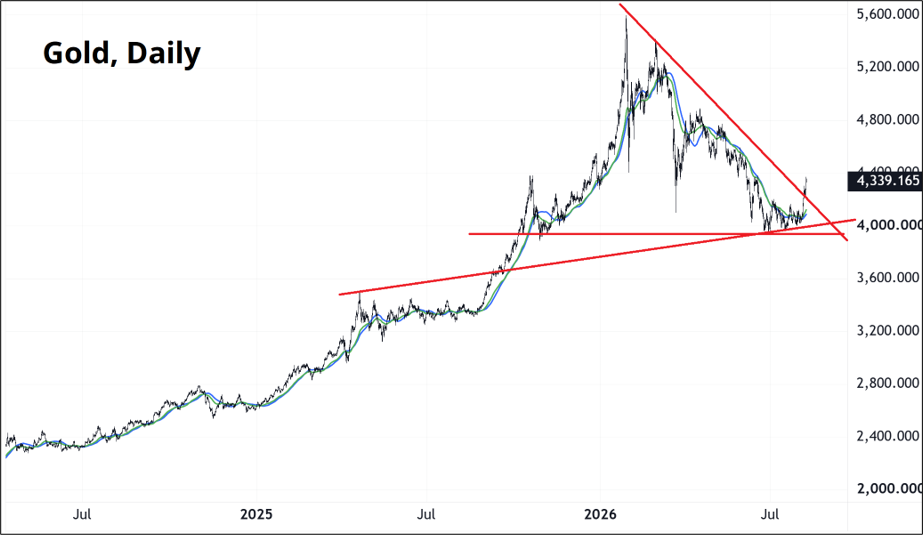
$4,700 looks like the place to take profit and reassess.
That’s it for this week.
Get rich or have fun trying.
TRADE OUTSIDE THE BOX: Advanced Thinking for Professional Traders is out! You can buy it on Amazon right here.
*************

https://rarehistoricalphotos.com/aircraft-detection-radar-1917-1940/
*************
*************
The new Magic: The Gathering Hobbit set comes out tonight.

Card prices continue to skyrocket, and the game is doing so well that it’s driving Hasbro earnings and stock price, too.
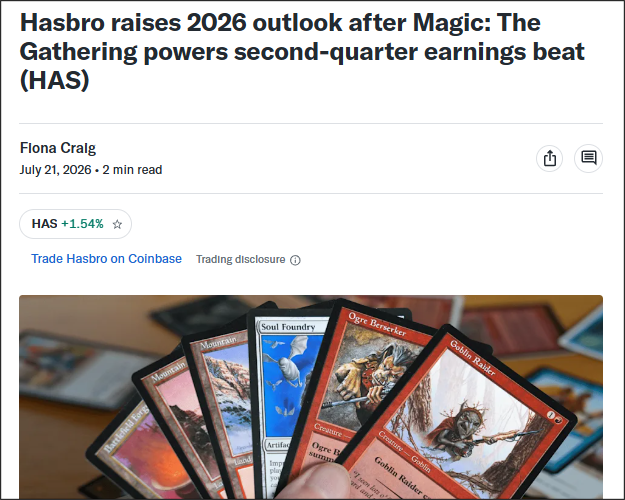
“Trade Hasbro on Coinbase” is the most depressing sentence I read this week.
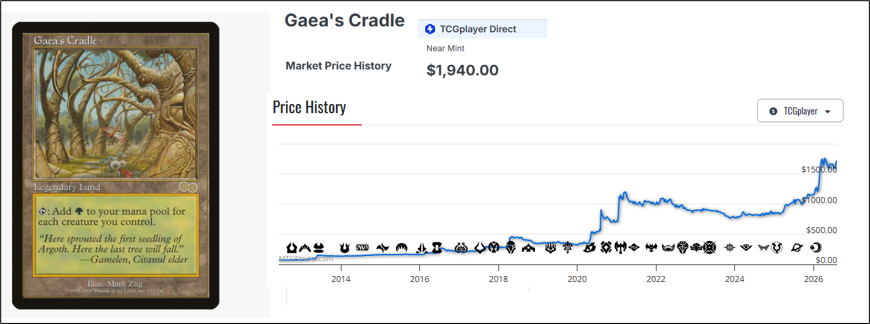
One of the more popular Reserved List cards, Gaea’s Cradle, was below $500 before COVID, rallied to $1k, pulled back into the $700s last year and is now trading $1,700. Most cards are reprinted off and on over the years, but Reserved List cards will never be reprinted.
*************
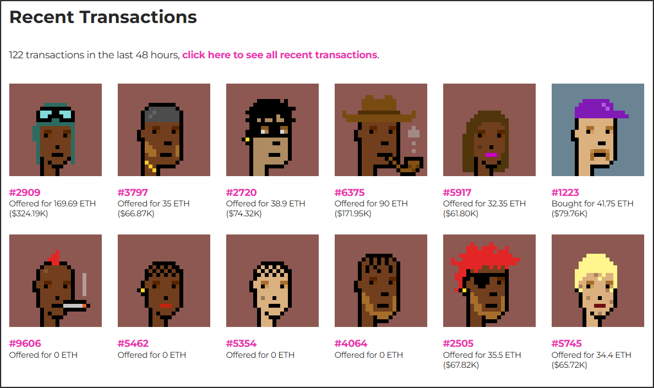
Did you know that CryptoPunks are still a thing? Fun!
*************
It doesn’t seem like it now, but Duran Duran’s The Wild Boys video went pretty hard in 1984.
Simon Le Bon on some sort of torture wheel over water and fire as we shamelessly (but effectively) rip off the Mad Max aesthetic! Let’s go.
*************
Thanks for reading the Friday Speedrun! Sign up for free to receive our global macro wrap-up every week.